LFM Reviews Marco Polo on Netflix

By Joe Bendel. He wrote the equivalent of a bestselling memoir, before the invention of Gutenberg’s printing press. Dozens of hand-written manuscripts of The Travels of Marco Polo have widely circulated, making it rather difficult to determine the canonical truth of the celebrated merchant’s life. That might be frustrating for scholarly biographers and historians, but it rather takes the pressure off filmmakers dramatizing his life. Before securing his fame and fortune, the young Venetian (or “The Latin” as he will often be called) finds an unusual place in the Court of Kublai Khan, becoming enmeshed within a geo-political struggle between two ancient dynastic powers in Marco Polo, an original ten episode historical series premiering on Netflix this Friday.

Polo never knew his father Niccolò Polo, until the Venetian trader made a brief homecoming, before setting off for Asia once again. Desiring a paternal relationship, the younger Polo invited himself along, but it is soon apparent he is quite well-attuned to the rhythms and mysteries of the Eastern world, perhaps even more than his father and uncle. In fact, the great Kublai Khan accepts Marco Polo into his service, when Niccolò Polo offers to barter him in exchange for trading rights along the Silk Road. Of course, the son is quite put out by this, but his father promises to return, which he will, but maybe not in the manner he imagined.

Valuing Polo’s shrewd observations unclouded by courtly biases, Kublai Khan often dispatches the Latin to report on flashpoints within his empire. Not surprisingly, Polo’s favor rather displeases the Khan’s Chinese-educated son, Prince Jingim. Frankly, Polo is not exactly close to anyone in court, least of all the Khan’s trusted ministers. However, he will develop something approaching friendship with Byamba, the Khan’s illegitimate son with one of his many concubines. Polo also becomes ambiguously involved with Kokachin, the Blue Princess, the last surviving noble of a conquered people, and Khutulun, the Khan’s independent-minded warrior niece.

Regardless of historical accuracy, writer-creator John Fusco spends enough time in the Khan’s harem to make the broadcast networks curse the FCC. As Mel Brooks would say, it’s good to be the Khan. Yet, despite the nudity and hedonism, some of MP’s strongest action figures are women. As Khutulun, Korean actress Claudia Soo-hyun Kim credibly wrestles men twice her size and projects a smart, slightly subversive sensibility. Olivia Cheng also displays first class martial arts chops (sometimes naked) as Mei Lin, a Song concubine who infiltrates the Khan harem on the orders of her war-mongering brother, the villainous Imperial Regent Jia Sidao. Zhu Zhu’s Kokachin might be more demur, but she is still quite compelling, balancing her vulnerability with resoluteness. Of course, international superstar Joan Chen frequently upstages everyone as the iron-willed Empress Chabi.

From "Marco Polo."

Italian actor Lorenzo Richelmy holds his own as best he can amid the exotic locales and pitched battles, maintaining the necessary fish-out-of-water earnestness. However, he is no match for the British Benedict Wong (son of naturalized Hong Kong parents), who absolutely dominates the series as Kublai Khan. Although he put on considerable weight for the role, it is his commanding presence that really seems huge. Likewise, Tom Wu is terrific delivering the goods for genre fans as Hundred Eyes, Polo’s blind tutor in the martial arts.

In the initial episodes, MP offers more intrigue and Game of Thrones style decadence than actual fist-and-sword action, but the martial arts melees increase as the series progresses, with the threat (or promise) of an epic war hanging over everyone’s heads. There is a lot of setting-the-scene in episode one, but it quickly sets the addictive hook in the second installment and reels in viewers from there. Kon-Tiki directors Espen Sandberg & Joachim Rønning give the pilot an appropriate sense of mystery and sweep, which carries forth throughout the show. Based on the six episodes provided to the media, MP definitely seems to maintain its passion-fueled energy and richly detailed period production values. Highly recommended (so far), Marco Polo launches for binge-streaming this Friday (12/12) on Netflix.

LFM GRADE: A-

Posted on December 9th, 2014 at 8:23pm.
LFM Reviews Maidan

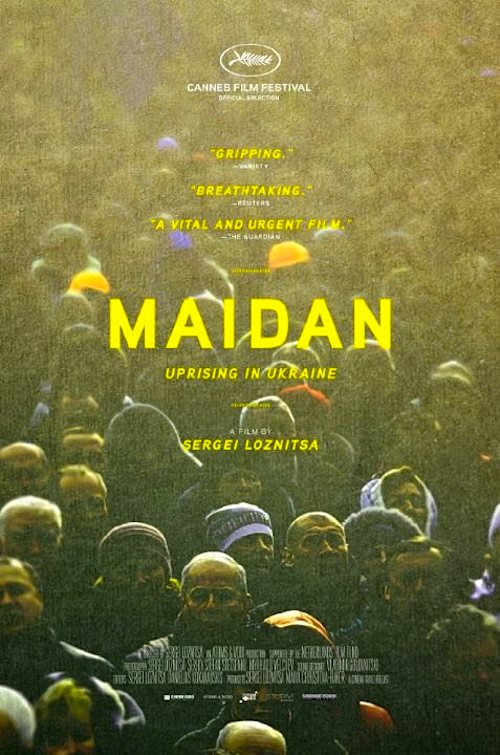
By Joe Bendel. The opening lyrics of the Ukrainian National Anthem make a fitting commencement for any film on the Euromaidan demonstrations and the subsequent Russian aggression: “Ukraine’s glory has not yet perished, nor has her freedom. Upon us fellow patriots, fate shall smile once more.” Let’s be frank, most of the media now considers Ukraine’s freedom a lost cause and the lame duck administration no longer has anything to say on the issue. Yet, when the Ukrainians unite in common purpose, they are a resilient force. Sergei Loznitsa captures his countrymen’s collective spirit in the direct cinema documentary Maidan, which opens this Friday in New York.

Kiev’s central city square is currently known as Maidan Nezalezhnosti, or Independence Square. It was previously known as Soviet Square, Kalinin Square (in honor of Stalin loyalist Mikhail Kalinin), and the Square of the October Revolution—and it might be so renamed again if deposed President Viktor Yanukovych and his Russian masters have their way. In late 2013, outraged Ukrainians took to the square, protesting Yanukovych’s decision to reject an association agreement with the EU, in accordance with Moscow’s wishes. Protests did indeed erupt in Maidan, the scene of many Orange Revolution demonstrations following Yanukovych’s suspect election in 2004, but it was far from the “pogrom” Putin suggested. Loznitsa has the footage to prove it.

In a way, it is too bad the Euromaidan movement advocates freedom and closer ties with the west, because Loznitsa’s documentary could have been the greatest socialist film ever made. Arguably, no other film so powerfully conveys the spirit of collective action and a sense of individuals dedicating themselves to a larger cause. There are many long takes and wide angle crowd shots, but Loznitsa and his fellow cameraman Serhiy Stefan Stetsenko capture the tenor of the time quite viscerally.

Loznitsa never focuses on representative POV figures, maintaining a macro perspective throughout. Nevertheless, we can easily observe the trends and magnitude of the situation from his vantage points. At first, there is very much a sense that things will change, much as it did in 2004. We see the volunteers making sandwiches and distributing tea to regular Sunday night demonstrators. A gullible media largely accepted Putin’s smears at face value, but it is hard to imagine a neo-fascist movement would dispatch four volunteers to make sure nobody slipped on a spot of spilled water in the lobby.

Tragically, Yanukovych would unleash the Interior Ministry’s Berkut forces in January. At this point the audience can clearly see how unscripted Loznitsa’s film truly was, as either the director or his co-cinematographer is caught in a tear gas attack. They maintain the same long fixed approach, but the pleas for medical personnel to come to the stage area to treat the collected wounded speaks volumes about the old regime. Not to be spoilery (unless you work at a major network, you should already know this ends rather badly), but Loznitsa concludes the film with a funeral for two fallen activists, which is absolutely emotionally devastating, even without a personal entry-point character to concentrate on.

Still, the individual stories of Maidan supporters desperately need to be heard, which is why Dmitriy Khavin’s Quiet in Odessa is such a timely and valuable film. Since there is almost no supplemental context in Loznitsa’s Maidan it is best seen in conjunction with a film like Khavin’s. However, it has the virtue of presenting events as they happened and allowing the audience to draw their own conclusions. Highly recommended for anyone seeking an immersive understanding of Ukraine’s Euromaidan movement, Loznitsa’s Maidan opens this Friday (12/12) in New York, at the Elinor Bunin Munroe Film Center.

(The international film community should also note that Ukrainian filmmaker Oleg Sentsov is still being held incommunicado in Russia, on trumped-up terrorism charges, awaiting his day in kangaroo court. Along with Loznitsa’s Maidan and Khavin’s Odessa, film programmers ought to consider scheduling Sentsov’s politically neutral Gaamer to raise awareness for his plight.)

LFM GRADE: A-

Posted on December 9th, 2014 at 8:23pm.
LFM Reviews I’m an Old Communist Hag @ New Romanian Cinema 2014

By Joe Bendel. Emilia was allowed to shake Ceauşescu’s hand because she was a Party member who didn’t have sweaty palms. For a while, that encounter gave her great prestige in her state-run factory, but she tried to avoid discussing it after the revolution. Nonetheless, her nostalgia for the past is rather well known in Stere Gulea’s I’m an Old Communist Hag, which screens during Making Waves: New Romanian Cinema 2014.

She was once an industrial foreman, but now Emilia and her husband Ţucu make do on their pensions and a bit of bartering-up. If you ask her, she will tell you the old dictator did a better job managing the economy. At least, that is how she remembers it. However, her memory is selective and she may have only noticed what she wanted to back in the day. She will slowly and only partially come to realize this when she visits Madame Stroescu to have a dress made for her expat daughter Alice’s sudden visit.

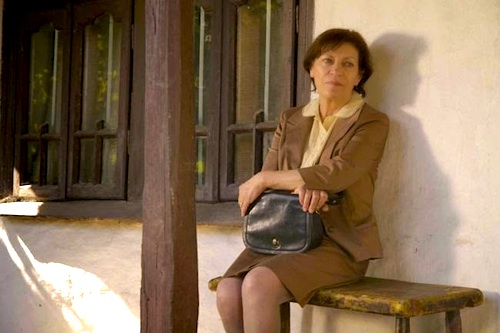
Madame Stroescu was always a favorite of Alice’s, but Emilia never realized how much the gentle woman suffered under Communism. She should have been an accomplished artist, but she was forced to work as a seamstress instead. With her eyesight now failing, even such work is beyond her, but she still hopes to have her late father’s confiscated tailor shop restituted to her. It is an inconvenient episode for Emilia to process, especially with the 2010 financial crisis swirling around her. In fact, that is why Alice and her American husband Alan have suddenly arrived. Both have been let go by their multinational employer and now find themselves at loose ends.

Despite its hot-button title, Hag is a restrained film that eschews all ideologies in favor of human relationships. Emilia is not a bad person. She just happened to do somewhat better than her neighbors during the old regime and is now experiencing a bit of a rough patch due to the new more cyclical system. Nevertheless, Valeria Seciu’s haunted Stroescu unambiguously serves as the film’s conscience and moral corrective. It is a quiet but powerful performance that undercuts Emilia’s romanticized memories.

From "I’m an Old Communist Hag."

While it is a more restrained and forgiving role than her celebrated turn in Child’s Pose, Luminita Gheorghiu still commands the screen as Emilia, embracing her complications. Ana Ularu counterbalances her well as Alice, the daughter who sees the past era in its full historical context, but struggles with her own personal and professional failings. Texan Collin Blair’s Alan resembles a young Michael Rapaport, which works rather well in context. There are probably a dozen additional supporting players playing former colleagues and family members, who are quite colorful, but feeling unfailingly real. Still, it is Gheorghiu and Seciu who really define the film with their contrasting presences.

Gulea was a rather bold critic of the Communist regime in past films, so Hag should not be dismissed as revisionism, but more of a meditation on how folks get by, regardless of the times. It is a nice film, elevated by several thoughtful performances and a lively yet elegiac score composed by Vasilé Sirli. Recommended for those interested in seeing a different side of Romanian cinema, I’m an Old Communist Hag screens this afternoon (12/7) at the Walter Reade Theater and tomorrow (12/8) in Long Island at the Jacob Burns Film Center, as part of Making Wave: New Romanian Cinema.

LFM GRADE: B

Posted on December 9th, 2014 at 8:22pm.

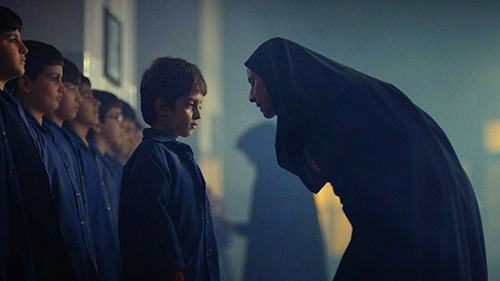
Innocence Martyred: LFM Reviews Keys of Heaven

By Joe Bendel. You could say Majid and Adel have student deferments. They are fifteen and twelve, respectively. Of course, that is hardly too young to die for Revolutionary Iran, especially when it was locked in mortal combat with Iraq. They might live in an Orwellian state prosecuting an apparently endless war, but the brothers lead desperate Dickensian lives in Finnish-Iranian director Hamy Ramezan’s short film, Keys of Heaven, which starts a special three-day engagement today in Los Angeles.

It is in fact 1984. Majid and Adel are homeless in the great Islamist republic, but the elder brother insists they keep attending school. Should they drop out, they would be prime candidates to join the 500,000 other Iranian children who served in the Iran-Iraq War. They work late into the night as street hawkers to earn money for a more permanent relocation, because for some reason, Majid has cut all ties to their widower father. Unfortunately, the dissolute old Kiamarz still has the brothers’ identification papers, which they will need to sit for their final exams.

Keys is a dark film with a bracingly bitter twist that Ramezan skillfully implies rather than bashing the audience’s heads with it. The film very definitely protests the use of child soldiers, but it acknowledges (obliquely) even worse crimes. It also depicts the ruthlessness of the Ayatollah’s thought police in no uncertain terms. Yet, the brothers’ relationship is the engine driving the film.

From "Keys of Heaven."

Salar Ashtiyani gives an extraordinarily honest performance as the gaunt Majid. The young actor maintains a brittle intensity while subtly turning his big revelations. Yazdan Akhoondi’s Adel reliably serves as a wide-eyed picture of innocence and Shaghayeh Djodat brings considerable nuance and sensitivity to bear as the teacher who tries to help the brothers, but lacks a full understanding of their situation.

Filmed in Turkey with Farsi dialogue, Keys feels absolutely genuine. The period details look right and the atmosphere of paranoia is quite tangible. It could be called a powerful coming-of-age tale in a country where vulnerable children, like the brothers, frequently do not live long enough to come of age. Another fine example of diasporic Iranian filmmaking, Keys of Heaven is highly recommended when it screens afternoons, today, tomorrow, and Thursday (12/9-12/11) at the Laemmle Royal in Los Angeles.

LFM GRADE: A-

Posted on December 9th, 2014 at 3:23pm.

LFM Reviews 100 Days

By Joe Bendel. The natural beauty and quaint charm of the Matsu Islands make them a perfect tourist destination. The spotty cell-phone reception and lack of wi-fi could also be attractive to visitors, but it is highly inconvenient for full-time residents. A hot shot telecom exec has returned to his home island to scuttle a fiber optic development plan. While he is there, he will pencil in his mother’s funeral. However, he never bargained on the local tradition requiring his marriage a little more than three months after the ceremony. Romance and ritual threaten to stall his career in Henry Chan’s 100 Days, which opens this Friday in Los Angeles.

Wu Bo Dan felt rejected by his mother when she re-married and packed the teen off to be educated in America. Frankly, he was fine with leaving, because he would only miss his ambiguous girlfriend Xiao Wei. Now a high-flying dealmaker, Wu is not sure how to react when his stepfather comes bearing the bad news. He also brought Wu one of his mother’s favorite chickens, confusing the corporate shark even more.

Once Wu finally arrives on fictional North Island, chicken in tow, he begrudgingly attends her funeral. Of course, he is having none of the get-married-in-100-days mandate. Fortunately, his step-brother Zhen Fong is willing to fulfill Wu’s ceremonial duties in his stead. Unfortunately, he has a five-year arranged engagement with Xiao Wei. That does not sit right with Wu, but she does not want to hear it.

100 Days is pretty much headed exactly where you think it is, but it has the good sense to lose the chicken before the second act starts in earnest. It is also a ridiculously good looking film. The island is spectacularly cinematic, sort of like the Village in The Prisoner, but with shrines dedicated to the ocean deity Mazu. The cast is also obscenely attractive, even including Xiao Wei’s shy, unlucky-in-love bridesmaid Yu Jen, played by the drop-dead gorgeous Julianne Chu. So yes, 100 Days will definitely make viewers want to visit Peikan Island’s Chinpi village, where the film was shot.

From "100 Days."

Model-turned-actress Tracy Chou plays Xiao Wei with demur intelligence, somehow managing to sell her martyr complex. Likewise, Chu’s turn as Yu Jen is touchingly sweet and wholly likable. Aboriginal actor Soda Voyu (seen in Seediq Bale) largely minimizes the shtick as the unflaggingly earnest and only slightly goofy Zhen Fong. On the other hand, poor Johnny Lu’s Wu gets quite a bit of slapstick comeuppance and never really feels like he connects with the other characters, except maybe briefly with Tsai Ming-hsui, who invests his step-father with a quiet dignity that classes up the joint.

100 Days never really tries to transcend the rom-com genre, but it observes the category conventions in moderation. Chan (whose American television credits include episodes of Scrubs and the better-than-its-reputation Kitchen Confidential) keeps things moving along at an easy mid-tempo and cinematographer makes everything sparkle in the warm sunlight. If you are looking for niceness in a film, it has a bounteous spread. Recommended as a safe date film, 100 Days opens this Friday (12/12) in the Los Angeles area, at the Laemmle Playhouse 7.

LFM GRADE: C+

Posted on December 9th, 2014 at 3:22pm.

LFM’s Jason Apuzzo & Govindini Murty at The Huffington Post: For Love of the Game: Talking with Kurt Russell About The Battered Bastards of Baseball

[Editor’s note: the post below appears today at The Huffington Post.]

It’s the kind of thing you probably missed over Thanksgiving dinner, while gnawing on a turkey leg, bickering with your uncle, or falling asleep during a Detroit Lions game: the Miami Marlins just signed an outfielder to a $325 million deal, the largest contract in sports history.

You read that correctly: $325 million. That’s Hunger Games money, Transformers money. It’s the kind of figure you associate with World Bank loans or Rolling Stone comeback tours. Apple needs at least a day to make that kind of cash.

The young outfielder, named Giancarlo Stanton – no, I hadn’t heard of him, either – apparently hit .288 with 37 home runs last season. (Note to Marlins: those were roughly my numbers playing T-ball in 5th grade.) Stanton later celebrated his deal in a Miami nightclub with a $20,000 bottle of champagne coated in 22-carat gold leaf. I don’t know whether he kept the bottle.

It says something about baseball today that a guy you’ve never heard of – again, he plays for the Marlins – can be signed for $25 million per year over 13 years. Frankly, it’s probably a bad deal for the Marlins – especially if the names Albert Pujols, Alex Rodriguez or Josh Hamilton ring a bell. Players paid more than they’re worth – more than some national economies are worth – rarely stay motivated purely by love of the game.

Love of the game. That’s what sports are supposed to be about, isn’t it?

When you think about love of the game, you think of Lou Gehrig – the Iron Horse – playing in 2,130 straight games until his body gave out from ALS. Or Pete Rose, aka Charlie Hustle, barreling over Ray Fosse in the 1970 All Star game to secure a seemingly meaningless win. Or Kirk Gibson, gamely limping around the bases after hitting his clutch home run in the 1988 World Series.

And you should also think of the Portland Mavericks, the subject of a wonderful new documentary called The Battered Bastards of Baseball that premiered this past year at Sundance and is currently showing on Netflix.

My writing partner Govindini Murty and I caught Battered Bastards at Sundance and also at this year’s Los Angeles Film Festival. At the Sundance screening we had the chance to speak to Kurt Russell, who’s interviewed in the film, along with his nephews Chapman Way and Maclain Way, Battered Bastards‘ co-directors.

2014-12-08-JasonApuzzoKurtRussellSundance2014.jpg
LFM's Jason Apuzzo & Kurt Russell at Sundance 2014.

The Mavericks – an independent, Class A minor league baseball team between 1973-77 – were the brainchild of Bing Russell, the actor best known for playing deputy sheriff Clem on TV’s Bonanza. A hugely colorful showman with a fast wit (“I played Clem for 13 years on Bonanza and never solved a case”), Russell appeared in countless film and TV westerns, and made a career of getting killed on camera – most notably in Howard Hawks’ Rio Bravo and John Ford’s The Horse Soldiers.

Of course, Russell is best known today as the father of Kurt Russell, who himself played for the Mavericks in 1973.

As Battered Bastards relates, Bing served as a bat boy for the mighty New York Yankees between 1936-41, when he got to know legends of the game like Joe DiMaggio, Lefty Gomez and Lou Gehrig (who gave young Bing his bat after hitting the final home run of his storied career). Although Bing later tried his hand at pro baseball, an injury cut short his career – leading him to try an acting career in Hollywood.

His love of baseball never left him, however – so when his acting career stalled in the early 1970s, Russell jumped at the opportunity to bring pro baseball to Portland in 1973 after the prior team left town.

“Baseball was a big part of our family,” Maclain Way told us. “Kurt, our uncle, played professional baseball. Bing, himself, played professional baseball. We had cousins who played major league baseball, so baseball was a huge part of our life growing up. I played baseball in high school because of Bing – he taught me how to play.”

The upstart Mavericks would become a team like no one had seen before – totally unaffiliated with any big league franchise, and filled to the brim with misfits and rejects – a scrappy, real life Bad News Bears squad.

“He had a great eye for ball players,” Kurt Russell told us, speaking warmly of his father. “We knew we could put a competitive team together.”

2014-12-08-GovindiniMurtyKurtRussellSundance2014.jpg
Kurt Russell & LFM's Govindini Murty at Sundance 2014.

Managed by restaurant owner Frank “The Flake” Peters, the Mavericks’ roster of wild characters would include: a shaggy, 33 year-old high school English teacher named Larry Colton (who’d later be nominated for a Pulitzer Prize); 38 year-old ex-Yankee Jim “Bulldog” Bouton (who’d been blackballed from baseball after writing a wild tell-all memoir); Joe Garza (aka “JoGarza”), a madman utility player who waved flaming brooms when the Mavericks swept opposing teams; Rob Nelson, who invented Big League Chew bubble gum in the Mavericks’ bullpen; star outfielder Reggie Thomas, who took a limo to games even though he lived only a block from the stadium; and fiery batboy Todd Field, who once got tossed from a game, and later became an Academy Award-nominated writer-director.

And, of course, there was Kurt Russell. “I got injured [playing minor league baseball in Texas], so I had the opportunity to go to Portland and help them get the ball club started,” Russell told us.

“It was just a time in my Dad’s life where I was really happy he was involving himself in something completely new,” says Russell. “It was a big part of our lives.” Continue reading LFM’s Jason Apuzzo & Govindini Murty at The Huffington Post: For Love of the Game: Talking with Kurt Russell About The Battered Bastards of Baseball