LFM Reviews Dying of the Light

By Joe Bendel. Evan Lake is the CIA’s top motivational speaker. He also happens to be played by Nicolas Cage, so hold on tight, this will be a bumpy ride. While a station chief, Lake was captured and tortured by a notorious terrorist, but he lived to tell the tale, with honor. Fatefully, just as the physical and mental symptoms of a rare neurological disease start plaguing Lake, he gets a line on his old tormentor, Muhammad Banir. He might as well get his revenge or die trying in Paul Schrader’s Dying of the Light—although Schrader himself would reportedly prefer not to be so closely identified with the final producer-cut product. Regardless, it opens this Friday in New York.

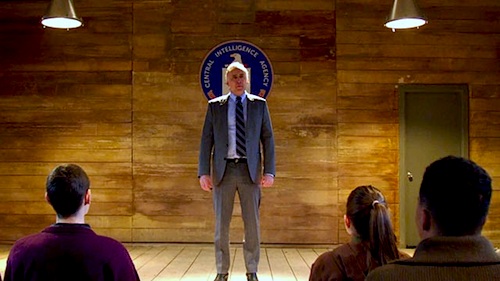
Every year Lake gives a pep talk to the new recruits undergoing basic training and he projects to the back row of the theater—the theater next door. This might be his last hurrah. The agency just got wind his second opinion came back positive (in a bad way). However, his protégé, Milton Schultz has some interesting news. The rare pharmaceutical used to treat Banir’s degenerative disease has strangely surfaced during an incident in Romania. Yes, both men are slowly dying, betrayed by their own bodies.

Since the Agency still insists Banir is dead, Lake goes rogue, burning every possible bridge behind him. Yet, despite his increasingly erratic and anti-social behavior, he can count on the help of the loyal Schultz and Michelle Zuberain, an ambiguously close former Euro colleague. Meanwhile, the dastardly CIA bureaucrats keep trying to send Lake doctors and counselors.

Evidently, Schrader and several cast members are unhappy with the current theatrical cut, but it is hard to see why. It is a reasonably serviceable thriller with a bit of style here and there. Let’s be frank—this is the latest film from the director of The Canyons and the star of Left Behind. It’s just not that bad, especially compared to some of the recent gems in the Cage filmography. Frankly, it probably doesn’t even crack the bottom twenty (hello, The Wicker Man, Stolen, Seeking Justice, Trespass, Season of the Witch?)
From "Dying of the Light."

Be that as it may, Cage sure does his thing as the tightly wound Lake. The man just doesn’t seem to have an inside voice. When he gorges on scenery, it is like watching a bull in a china shop, but at least he is nowhere near as embarrassing as Meryl Streep unconscionably overacting in Osage County. As Schultz, Anton Yelchin looks thoroughly freaked out, probably because he was. At least Irène Jacob does her best to class-up the joint as Zuberain.

Dying wrings plenty of atmosphere out of its Romanian locales and surprisingly, it is almost sympathetic in its treatment of the CIA (perhaps that is why some principals are unhappy). Say what you will, but they are dashed indulgent of Lake. In its current state, the film also portrays the Islamist terrorists as unambiguously vicious extremists. It is far from perfect and nobody would describe it as high art, but Dying of the Light is compulsively watchable, building a fair degree of suspense in its weird way. Recommended for fans of Cage’s flaring nostrils, it opens this Friday (12/5) in New York, at the AMC Empire.

LFM GRADE: C+

Posted on December 2nd, 2014 at 1:01pm.
LFM Reviews The Barefoot Artist

By Joe Bendel. It is the story of one father, two families, and Two Chinas. Learning of the family her late Nationalist general father abandoned to the abuse and oppression of Maoist China, artist Lily Yeh would return in his stead, hoping to make peace with the spirit of his first wife. Her emotional journey is documented in Glenn Holstein & son Daniel Traub’s The Barefoot Artist, which opens this Friday in New York.

Raised in Taiwan, Yeh came to America as an art student, married a man named Traub, and became an American citizen. Eventually, her entire family naturalized, at least those that she knew of. As her father’s health started to fail, he became wracked with remorse over the fate of the wife he divorced to marry her socially connected mother.

Yeh does indeed learn being the ex-wife, daughter, and sons of an absconded KMT officer was agonizingly difficult during the Cultural Revolution. Yet, somehow his first wife bore her fate with dignity. Yeh will experience some heavy personal drama, but it is not clear whether she picks up on the wider lesson regarding the danger of rampant ideology coupled with unchecked state power.

Clearly, the most potent sequences in Barefoot follow Yeh’s humbling trip to China, but the film also spends considerable time watching her work. Essentially, her program is bringing public art to distressed places. Where we might think the downtrodden of the world are most in need of food or constitutional guarantees of the freedoms of expression and worship, Yeh would suggest what they could really use is a little color.

From "The Barefoot Artist."

Based on the film’s footage, her prescription seems to be most effective in place like the Rwandan survivors’ community, where her projects become part of a wider effort to bear witness and memorialize lost ones. Wisely, Holstein & Traub only mention the so-called “Palestinian” so-called “refugee camp” she spruced up in passing, thereby avoiding inconvenient questions like just what would happen if an openly gay or non-Muslim resident tried to participate in the project.

Ultimately, the two sides of Barefoot are so fundamentally unequal, it is impossible to balance them. In China, we see up-close-and-personal how micro choices and macro events in tandem can lead to profound suffering. Yet, in a way, her public art literally white-washes over the resulting legacies of pain. Essentially, Barefoot Artist is half of a good documentary that never really becomes fully self-aware. For Yeh’s admirers and those fascinated by her family’s story, The Barefoot Artist opens this Friday (12/5) in New York, at the IFC Center.

LFM GRADE: B-

Posted on December 2nd, 2014 at 1:00pm.

LFM Reviews Tango Negro @ The 2014 African Diaspora International Film Festival

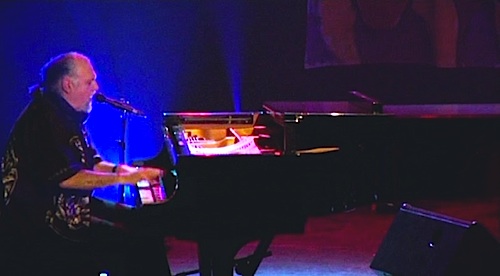
By Joe Bendel. Anyone with a little bit of jazz, blues, and Afro-Cuban music under their belts should be ready to accept the notion that most music with a real rhythmic kick has the “Same Mother,” to quote the title of Jason Moran’s deep blues influenced 2004 release. Yet they seem to have trouble with the idea in Argentina and Uruguay. Parisian expatriate tango-jazz pianist Juan Carlos Cáceres returns to his native Argentina to promote awareness of the music’s African origins in Dom Pedro’s Tango Negro: the African Roots of Tango, which screens during the 2014 African Diaspora International Film Festival in New York.

Blessed with incredible technique, Cáceres has become a leading expert on tango, especially its earliest manifestations. As in Brazil and many other Latin American countries, great numbers of African slaves were brought to Argentina against their will. Retaining elements of their pre-bondage culture, they developed musical forms not so very different from Cuban rumba. However, subsequent waves of overwhelmingly white immigration from Europe would radically change the country’s demographics. Just as the composition of Argentina changes, so too did the character of tango.

Frankly, it is hard to fathom how this could be controversial because it seems so self-evident. By the same token, one could argue the film does not give European immigrants proper credit for making tango what it is today. It is an elegant form of music and dance wholly distinct from traditional Afro-Cuban forms. Arguably, the description of tango quoted in the film as the synthesis of three sadnesses, as experienced by the immigrant, the gaucho, and the disenfranchised African gets at the essence in a fully inclusive way.

From "Tango Negro."

There are some enjoyable performances in TN, including features spots for Cáceres and various neo-traditional ensembles. It makes a logical cinematic pairing with Arístides Falcón Paradí’s Rumba Clave Blen Blen Blen, but it is more self-consciously pursuing a mission, whereas RCBBB is more interested in celebrating musical camaraderie. (If you only see one of the music docs at the festival, chose the rumba, because camaraderie is more fun.)

TN offers some nice music and solid scholarship, but it sees more opposition to its case than the audience does. Regardless, if you want to hear tango performed with uncharacteristic percussion, it is the film for you. Recommended for tango enthusiasts, Tango Negro screens this Friday (12/5) and the following Tuesday (12/9) as part of this year’s ADIFF New York.

LFM GRADE: B-

Posted on November 30th, 2014 at 7:32pm.

LFM Reviews Rumba Clave Blen Blen Blen @ The 2014 African Diaspora International Film Festival

Rumba Clave Blen Blen Blen | Teaser from colorbox on Vimeo.

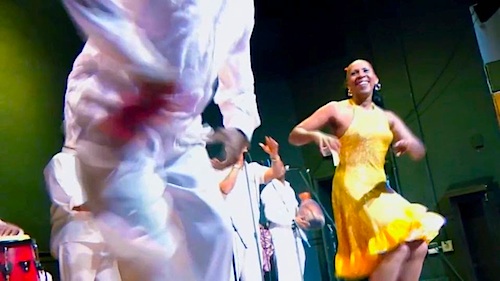
By Joe Bendel. Forget Arthur Murray’s bastardization of the bolero-son. This is the real rumba. Think “The Peanut Vendor,” pre-Stan Kenton. It is a dance and a rhythm and maybe even a philosophy of life. Arístides Falcón Paradí surveys all manifestations of rumba, tracing its journey from Africa to Cuba and on to New York in Rumba Clave Blen Blen Blen, which screens during the 2014 African Diaspora International Film Festival in New York.

You had better believe rhythm and percussion are important to Afro-Cuban music. Those who have not had at least a beginner’s introduction to Afro-Latin jazz (Trueba’s Calle 54 being a nice place to start) might not realize how sophisticated the music really is. It can also be wonderfully earthy, even though it has distant roots in sacred music.

Falcón Paradí explores rumba from both perspectives, celebrating the virtuosity of rumba musicians and its enduring popularity, particularly within the Cuban-American community. In fact, if there is one defining event for RCBBB, it would arguably be Mariel. Without it, Falcón Paradí would not have had nearly as many interview participants.

The doc features some big name musicians, most notably including the revered Candido Camero, considered by many the preeminent jazz conguero, still going strong in his nineties. With at least 2,000 recording credits, Camero (or just plain Candido, as many know him) is clearly the dean of RCBBB, but it is still tough to beat the effortless cool radiated by Jerry González, probably still best known for his work with the Fort Apache Brass Band. However, the late, great Orlando “Puntilla” Ríos largely serves as the film’s Obi-wan, carrying a disproportionate share of the on-screen commentary with authority and charm.

From "Rumba Clave Blen Blen Blen."

From time to time, RCBBB looks backward at rumba history, especially Chano Pozo’s legendary collaborations with Dizzy Gillespie that more or less constitute Latin Jazz’s creation story. Yet, despite his background as a CCNY faculty member, Falcón Paradí is more interested in putting the music in an everyday listener’s context. We get a sense of where the music is played and the lack of a rigid hierarchy demarcating artist from audience. Still, he recognizes interesting material when it arises. Several times he asks about the role played by the Abakua, the secret Cuban fraternal mutual aid society in the development of the music, getting evasive responses like “hmm, maybe for the next documentary.” At least he asked.

In fact, the extent to which Falcón Paradí is welcomed into the Rumba scene really tells you what you need to know about the communal nature of the music. Granted, in a politically focused documentary, a lack of editorial distance is highly problematic, but in this case, it just means he is invited to the party along with everyone else. Striking a good balance between scholarship and a jam session hang, Rumba Clave Blen Blen Blen is recommended for all fans of danceable music when it screens this Monday (12/1) as part of this year’s ADIFF New York.

LFM GRADE: B

Posted on November 28th, 2014 at 12:55pm.

LFM Reviews The Ugandan @ The 2014 African Diaspora International Film Festival

By Joe Bendel. Thirty five years after his ouster and eleven years after his death, military dictator and self-proclaimed “uncrowned King of Scotland” Idi Amin Dada still exerts a cancerous influence on his country. In 1972, Amin forcibly expelled 80,000 Asians (mostly of Indian origin) from Uganda. Several thousand Indo-Ugandans have since returned, filing claims for the property appropriated by the regime. Demagogues invoking Amin’s name are only too willing to capitalize on the resulting tensions. Two families are caught up in the racial and economic tensions escalating throughout Patrick Sekyaya’s ironically titled The Ugandan, which screens as part of the Indian Cinema sidebar at this year’s African Diaspora International Film Festival in New York.

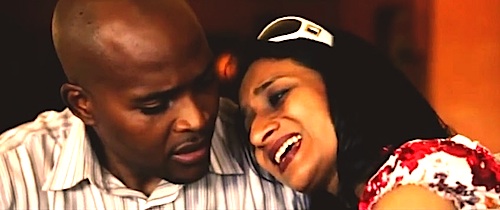
Simon’s little brother was nearly suspended for protecting Sonia’s little sister from a bully. They met during the disciplinary aftermath and eventually fall in love. However, joining their two families will be a tricky proposition. Their home was once the property of Sonia’s father, Raman, who has instituted legal proceedings to retake possession. In fact, he is playing a nasty game of hardball, even though Simon’s sister Becky happens to be his secret mistress. Oh, but it gets even more complicated than that, especially when Becky’s other lover Tony takes advantage of a race riot to waylay her third brother Ralph and his ill-gotten loot. Naturally, the hot-headed Ralph will not take that lying down.

In many respects, The Ugandan is not so far removed from some of the more professional Nollywood films. The execution is a little rough and some of the performances are slightly awkward, but Sekyaya’s ambition is impressive. He tackles some big themes here, openly inviting an honest historical reckoning with the Amin legacy. Even with his budget constraints, Sekyaya also stages a pretty convincing riot, giving the film further ironic resonance in light of current events.

From "The Ugandan."

To be fair, Sekyaya’s cast plugs away rather gamely, including the director himself, who is suitably intense as Ralph. Peter Mayanja and Dora Mwima demonstrate the greatest screen presence, by far, as Simon and Becky, respectively. On the other hand, Arfaan Ahmed has a bit of a rough go of it as Raman, but Sekyaya gets him through it.

Frankly, Ugawood is still developing a talent pool, so Sekyaya makes do in some cases. Nevertheless, the film’s not so thinly veiled social and historical critiques are quite fascinating. His narrative also takes some odd turns, but the seemingly abrupt ending actually makes sense in retrospect. If you were one of his characters, you’d try to end things there as well. Hopefully, it will mark the beginning of a fruitful career, but anyone interested in contemporary Ugandan culture should see it now, because its subject matter will probably be too challenging for most festivals. Recommended for its plucky potential, The Ugandan screens tomorrow (11/28) and Tuesday (12/2) as part of this year’s ADIFF New York.

Posted on November 28th, 2014 at 12:55pm.

LFM Reviews Women Who Flirt

By Joe Bendel. Considering she looks like Zhou Xun, Angie really shouldn’t have to resort to a lot of game-playing. Unfortunately, she has carried a torch so long for Marco, her colleague and former classmate, he now takes her for granted. When a flirty game-player stakes a claim to the oblivious platonic friend, Angie will have to learn how to fight fire with fire. The battle will be joined in Pang Ho-cheung’s Women Who Flirt, which opens this Friday in New York.

Shocked to learn her longtime best friend is suddenly serious about a woman who is not herself, Angie calls on her eye-lash batting chum May to form a kitchen cabinet of proud Shanghai flirters to advise her. However, she finds their recommended baby talk and helpless damsel-in-distress routines absolutely vapid. She is just not equipped for this fight and her rival Hailey knows it. Still, if she can get dumb old Marco alone for a romantic getaway in Taiwan, she just might have a puncher’s chance.

Yes, there are similarities between Flirt and My Best Friend’s Wedding and its tragically romantic Chinese-Korean reconfiguration, A Wedding Invitation, but Zhou’s Angie is a protagonist we can really get behind. Her withering stares and palpable disgust at the Sex in the City antics going on around her are often quite funny and highly sympathetic. Frankly, she is just too cool for everyone else in the film.

From "Women Who Flirt."

Of course, Flirt will eventually settle into a sentimental rom-com, but at least it takes a rainy day trip to the Ju Ming Museum, which looks incredible (so good tourist tip there). In fact, Zhou and Ju are just about enough to carry the film across the finish line. Sonia Sui certainly looks like a deceptively cute femme fatale and shows some convincing claws when the time comes. Still, it is hard to see why they would fight over a blockhead like Marco, played rather woodenly by Huang Xiaoming. In contrast, Xie Yilin constantly kicks up the energy while inhaling scenery as May, the Obi-wan of flirters.

Pang’s films certainly come in a variety of flavors. Instead of a naughty screwball comedy like Vulgaria, a gory satire like Dream Home, or a sensitive family drama like Aberdeen, Flirt is most closely akin to his reasonably mature rom-coms, such as Love in the Buff. It is too bad this one does not depart further from genre conventions, because Zhou and her character deserve something more outside-the-box. Regardless, she still commands the screen. Recommended for fans of Zhou and romantic comedy in general, Women Who Flirt opens this Wednesday (11/26) in New York at the AMC Empire, from China Lion Entertainment.

LFM GRADE: B-

Posted on November 25th, 2014 at 9:36pm.