LFM Reviews Love and Terror on the Howling Plains of Nowhere @ DOC NYC

By Joe Bendel. It is not easy to recruit a theoretical mathematician to a small college nestled in the middle of nowhere. You would think the administration and the police would be somewhat alarmed when said math professor turned up missing. However, many of Dr. Steven Haataja’s friends and colleagues were troubled by a perceived lack of urgency during the early days of his disappearance. The mystery only deepened further when Haataja’s body was discovered. The case became the central strand of Poe Ballantine’s eccentric true crime ode to his adopted home town. Inspired by Ballantine’s pseudo-memoir, Dave Jannette’s investigates Chadron, Nebraska’s most notorious missing person case in Love and Terror on the Howling Plains of Nowhere, which screens as a Midnight selection of this year’s DOC NYC.

Theoretical math is a young, socially awkward man’s game, so the forty-six year old Haataja was already over the hill when he arrived at Chadron State College. They were still lucky to have someone with his qualifications. In his short time in Chadron, Haataja seemed to be making friends, despite a history of depression. Then one day he vanished. Months later, he was discovered, bound to a tree and unrecognizably burnt to death. Naturally, the Chadron police eventually determined it was suicide.

Yes, Haataja’s hands were apparently free, but it still just did not add up correctly for Ballantine. In the film’s centerpiece sequence, the author retraces Haataja’s alleged final steps under similar below-freezing, nocturnal conditions, finding it hard going, even without a recently mended broken hip. Unfortunately, there will be no definitive closure, just more questions. There is also an awful lot of Ballantine and his family, who are all quite pleasant, but often feel like a bit of a distraction from the existential mystery at hand. Still, Ballantine obviously feels a kinship with Haataja as outsiders who found an unlikely home in off-the-beaten-path Chadron.

Jannette constantly plays up Chadron’s idiosyncratic characters, including some who have no apparent connection to the case, but look suitably exotic on camera. There seems to be an effort to play to the Twin Peaks audience, while leaving some issues underdeveloped. Frankly, the material presented in Howling raises a red flag regarding known victims of depression who subsequently die under suspicious circumstances. How diligently are they investigated or are they commonly dismissed as suicides for the sake of convenience?

From "Love and Terror on the Howling Plains of Nowhere."

Although it would be quite a tangent to follow-up on, it is also rather disconcerting when a colleague explains his attempt to interest The Chronicle of Higher Education in the then missing Haataja was rebuffed because they constantly received similar reports of vanishing academics. You have to wonder just how many of them really do “turn up later.” Nonetheless, his use of the local newspaper’s Police Beat is undeniably funny and in its way, quite telling.

There is something about the Haataja case that is hard to shake off. It festers in the subconscious, crying out for a conclusive verdict, but remains maddeningly obscure. There is also a lot of anger in Howling that is not misplaced. Better as a true crime expose than an exploration of local color, Love and Terror on the Howling Plains of Nowhere is recommended on balance when it screens this Saturday night (11/15) as part of DOC NYC 2014.

LFM GRADE: B

Posted on November 12th, 2014 at 3:13pm.
LFM Reviews Desert Lullabies @ MIX NYC 2014

Desert Lullabies Trailer-HD from Monely Soltani on Vimeo.

By Joe Bendel. It is tough to be a kid in Iran. It is also hard to live with dignity as a woman and hard to live at all as an LGBT Iranian. Human rights for everyone remains a serious issue in the country, but the potential wartime death of innocence has become an increasingly pressing and universal concern throughout global battlefields. However, California-based filmmaker Monely Soltani explores it from a distinctly Persian perspective in the narrative short film Desert Lullabies, which screens during MIX NYC: the 27th New York Queer Experimental Film Festival.

Tara’s mother Homa has a hard time explaining why her dissident father has not yet returned as he promised. She has an even harder time explaining why they must flee their home at dawn. She has just received a last-minute warning the government imminently plans to raze their rebellious village along with all its inhabitants, but that is an awful lot to burden a young child with.

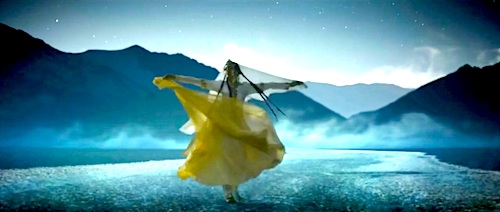
As she slips into a feverish slumber, Tara will be visited by the spirit of her beloved grandmother and the goddess Anahita, but do not expect a happy ending, per se. Despite Desert’s fable-like vibe, reality still is what it is. Nonetheless, simply carrying on constitutes a victory.

Shot on location in Death Valley, but utilizing extensive green screen work, Desert seems to exist eerily out of time, like some sort of near future-Medieval dystopia. Some of the effects might somewhat reflect Soltani’s presumed budget constraints, but the evocative interiors of Homa’s modest home have a Spartan but tangibly lived-in feel.

While Desert is only fifteen minutes long, Shila Ommi’s performance as Homa packs quite a punch. Based on Soltani’s own mother, she vividly conveys all of Homa’s motherly courage and desperation. As Tara, Ariana Molkara’s work is also unusually sensitive and unaffected. Viewers will definitely believe they are family—a tragically incomplete family.

From "Desert Lullabies."

Soltani does not belabor the particulars of the current regime, but there are enough Iranian signifiers, starting with the Persian dialogue, to cue viewers’ pre-existing context. In fact, it could be seen as part the leading edge of an emerging Persian-American cinema, along with Ana Lily Amirpour’s A Girl Walks Home Alone at Night.

Although Soltani’s previous short documentary won an award from USC’s Lambda Association, Desert would not seem to be a natural fit for MIX NYC, but cheers to them for not being stylistically or thematically dogmatic. Highly recommended, Desert Lullabies also looks like one of the more accessible films in the Ancient Futures program, which screens tonight (11/12) at the 27th MIX NYC.

LFM GRADE: B+

Posted on November 12th, 2014 at 1:16pm.

LFM Reviews Miss Tibet: Beauty in Exile @ DOC NYC

By Joe Bendel. For ten years and counting, second and even third generation exiles have competed in a beauty pageant to represent a country they have never lived in. That nation is Tibet, still held captive by their Chinese Communist occupiers. Obviously, this is no ordinary beauty contest. While their numbers are small, their consciousness is high. Documentarian Norah Shapiro follows Tibetan-American Tenzin Khecheo as she competes for the tenth annual Miss Tibet crown in Miss Tibet: Beauty in Exile, which screens during this year’s DOC NYC.

When most people think of Tibet, their mind’s eye pictures monasteries, temples, and snow-capped mountains—but glamor, no so much. Enterprising “impresario” Lobsang Wangyal sets out to change that with the Miss Tibet pageant, envisioning it as a means of empowering young women and providing a focal point for national pride. Despite his obvious slickness, the pageant seems to be taking hold, even though there is often controversy surrounding the swimsuit competition.

Much of Exile explores that tension between tradition and modernizing influences through Khecheo’s eyes. Initially insecure about her rusty Tibetan, she dramatically reconnects with her cultural heritage. One of the cool aspects of the Miss Tibet contest is the extent to which Tibetan music, customs, and history are integrated into the program. However, there are problems with the pageant that will come to light, adding a note of unexpected ambivalence to the third act (but be assured, all of the contestants are clearly a credit to Tibet).

In contrast, there is no equivocating in Exile when it comes to the realities of China’s occupation. Shapiro’s historical context might come from an illustrated children’s book (quite an elegant one, really), but it is still right on the money. In fact, part of the impetus for the pageant in general and Khecheo’s personal participation is to raise international awareness, since conventional protests have produced no results to speak of. Let’s be honest, how much do you think Obama had to say about Tibet during the APEC summit in China?

Khecheo’s personal development arc and the cultural synthesis the pageant represents are all strong stuff that easily sustain the relatively short (a hair under seventy minutes) Exile. Yet, it raises issues of double standards that could have been explored further. At one point, we learn a previous Miss Tibet might have been allowed to compete in an international pageant, but China insisted “Miss Tibet, China” must have been emblazoned on her sash. She refused. You wonder how often that sort of thing happens. For instance, if a fictitious country like “Palestine” is allowed to submit films for best foreign language Oscar consideration, Tibet should have the same right. Yet, if they put Pema Tseden’s latest film into contention, would the Academy accept it or bow to Chinese pressure? How many other such instances might there be?

Regardless, Exile does what it does quite well. It follows a highly engaging and likable POV figure in Khecheo through a surprisingly dramatic journey. Perhaps most valuably, it offers a fuller, more diverse picture of Tibetan identity, while also providing a timely reminder of Tibet’s captive nation status. Highly recommended, Miss Tibet: Beauty in Exile screens this Sunday (11/16) and Monday (11/17) as part of DOC NYC 2014.

LFM GRADE: B+

Posted on November 11th, 2014 at 7:52pm.

Jason Momoa Smells Fresh Blood: LFM Reviews Wolves

By Joe Bendel. Evidently, werewolves can be as snobby as anyone. Sure, some humans are turned through bites, but hereditary lycanthropes look down their snouts at them. You will find a large concentration of pure-bred wolves in Lupine Ridge. It might look like hill country, but it is the Philadelphia Main Line for werewolves. It is there that Cayden Richards will go searching for answers in David Hayter’s Wolves, which opens this Friday in New York.

Richards never knew he was adopted until he heard it on the TV news. Having discovered his parents ripped apart wolf-style after an inconvenient black-out, it is now too late for him to ask them any questions. Resigned to live as a fugitive from justice, Richards simply roams the highways, trying to keep his inner beast in check. However, a chance encounter with Wild Joe, a fellow pure-bred werewolf outcast, points him towards Lupine Ridge.

As soon as he blows into town, he seems to rub Connor, the town’s alpha-male/alpha-wolf, the wrong way. However, a wiry old farmer by the name of John Tollerman offers to take him on as a farmhand, no questions asked. Even the television reports about Richards’ previous misadventures do not seem to throw the good-hearted Tollermans. Nor does it scare off Angelina Timmons, who ought to be too young to tend the bar she inherited if she is roughly as old as Richards, the high school senior-dropout. Of course, the authorities never come to Lupine Ridge, because aside from a few humans like Mrs. Tollerman, they are all werewolves.

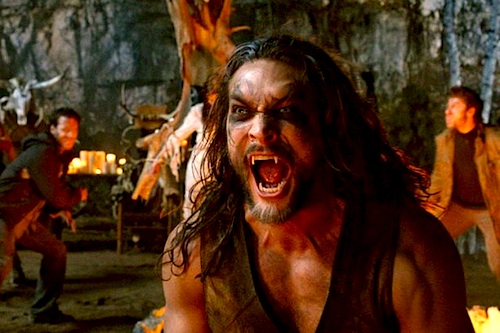
In terms of tone, Wolves aims to be something like the lycanthropic equivalent of The Lost Boys, with hit-or-miss results. On the plus side, Jason Momoa’s Connor makes a terrific hairy heavy and Stephen McHattie has the perfect Lance Henriksen-esque weather-beaten gravitas for Tollerson. Both come into Wolves with genre cred that they only further burnish.

From "Wolves."

The problem is that Lucas Till is horribly dull and awkwardly light weight as Richards. It is hard to see him as a high school quarterback—drama club president, maybe. Hayter had to notice how much verve Momoa and McHattie brought to the table (which they then proceeded to chew) and how slight Till’s presence is in contrast. Granted, dull horror movie heroes are a tradition dating back to mild David Manners in the original Dracula. However, in this case, the film depends on Richards’ fierceness, but it isn’t happening.

Despite the weak vanilla lead, there is a lot of fun stuff in Wolves. The werewolf makeup is not bad and the southern rock soundtrack nicely amplifies Momoa’s super-bad attitude. Unfortunately, too many of Till’s scenes feel like something out of Twilight instead of a werewolf movie with hair on its chest. If only there were less of him and more McHattie, but it is still kind of entertaining in a guilty pleasure sort of way. Recommended for fans of Momoa and McHattie, Wolves opens this Friday (11/14) in New York at the AMC Empire.

LFM GRADE: C-

Posted on November 11th, 2014 at 7:51pm.

LFM Reviews The Midnight After @ The SFFS’s HK Cinema Series

By Joe Bendel. It turns out a web novelist by the name of Pizza has captured Hong Kong’s current uneasy zeitgeist with a tale of the Armageddon. As adapted for the big screen, it also involves the challenges of commuting and David Bowie. Hang on tight, because Fruit Chan’s The Midnight After is one heck of a wild ride that screens during the San Francisco Film Society’s annual Hong Kong Cinema series.

Most of the twenty-two Hong Kongers aboard the fateful mini-bus were not planning to be there. Suet, the driver, is covering for a colleague whose wife went into labor. You Chi-chi was anticipating a date with his girlfriend, but she canceled at the last minute. Junkie Blind Fai got on the wrong bus by mistake, whereas the distraught Yuki left a work social outing early after her lecherous boss summarily fired her. Hong Kong is bustling as ever leaving Kowloon, but when they drive through Lion Rock Tunnel towards the New Territories, the teeming masses and incessant traffic mysteriously vanish.

It seems they are the last people left in Hong Kong and the four students who got off at the first stop probably will not last long judging from their sudden symptoms. Trading cell numbers, the core group agrees to reunite in the morning to take stock of the rather dire situation. Soon they are simultaneously receiving bizarre calls that turn out to be the lyrics of Bowie’s “Space Oddity” in Morse Code. Then things really start to get strange, as the apparent apocalypse takes on both metaphysical and science fictional dimensions.

Frankly, we never figure out what is going on with absolute certainty, but we get a pretty good lesson in Hong Kong geography before the zombies show up. Reportedly, the film is also loaded with vernacular puns and wordplay that would even be lost on Mainland audiences, let alone Yankees, but it hardly matters. As it is, Midnight is absolutely bursting with madness.

It is also fully stocked with big named stars, including Simon Yam, naturally playing Wong Man-fat, a low level gangster who more or less assumes leadership of the ragtag group, with characteristic flair. Johnnie To repertory player Lam Suet is also perfectly cast as Suet the driver. Ironically, he probably gets bloodier in Midnight than in his recent To outings. Janice Man (or JM as she is also known, catchy that) is by turns vulnerable and unnerving as the seemingly innocent Yuki. Kara Hui still looks great and maintains plenty of edginess as Mak Sau-ying, a fortune teller-slash-insurance agent determined to do some post-apocalyptic business one way or the other.

From "The Midnight After."

Throughout Midnight Chan creates an uncomfortably realistic sense of what the end of the world might really feel like, but unlike Abel Ferrara’s cratering 4:44 Last Day on Earth, he uses it as the foundation of a tense and compelling (though admittedly logic challenged) narrative. Chan Fai-hung and Kong Ho-yan’s adaption of Pizza’s descriptively titled Lost on a Red Mini Van to Taipo nicely balances pitch black humor with moments of deep-seated anxiety-ridden existential drama.

Midinight is unremittingly dark, yet somehow it is still wildly entertaining. It represents a triumphantly off-kilter return to form for Chan, a former stalwart of indie HK cinema who found success producing rom-coms. He certainly doesn’t end the world with a whimper. Highly recommended for a broad cross section of cult cinema fans, The Midnight After screens this Saturday (11/15) as part of the SFFS’s 2014 edition of Hong Kong Cinema.

LFM GRADE: A

Posted on November 11th, 2014 at 7:51pm.

From Frogmen to Seal Team Six: LFM Reviews Navy SEALs—Their Untold Story

By Joe Bendel. Although it mostly involved Army Rangers and Air Force support teams, four Navy SEALs also saw action during the Battle of Mogadishu—all four of whom would be awarded Silver Stars for their valor under fire. Perhaps you also heard it was a SEAL Team that dispatched bin Laden to a fiery eternity. With the first-time-ever support of the Naval Special Warfare Command, the history and service of the Navy’s commando force is chronicled in depth throughout Navy SEALs—Their Untold Story, which premieres on PBS this Veterans’ Day.

Conceived in conjunction with the companion volume co-written by former SEAL Dick Couch and co-producer William Doyle, the nearly two hour PBS special features a wealth of on-camera interviews with SEAL veterans who do not ordinarily do this sort of thing. They were there in the jungles of Viet Nam saving “Bat*21” and they have been all over Iraq and Afghanistan. Why would a division of the Navy be in a land-locked country such as the latter? They simply developed the expertise for covert missions.

Director-producer-writer Carol Fleisher takes a comprehensive approach, devoting considerable time to the SEALs’ WWII predecessors, the Naval Combat Demolition Units created by future Rear Admiral Draper Kauffman. For a while, they were generally known as just “Frogmen,” especially with the release of 1951’s The Frogmen, starring Richard Widmark, one of several touchstone films referenced in Untold. However, the SEALs were officially inaugurated during the early days of Viet Nam, to fulfill JFK’s prescient call for a flexible fighting force that would specialize in counter-guerilla insurgencies.

From "Navy SEALs—Their Untold Story."

As viewers would expect, there are some extraordinary stories of courage in Untold. Frankly, it is amazing how often SEALs have successfully completed their missions, despite logistical snafus outside their control. Indeed, it is always respectful of the SEALs themselves. You would expect nothing less, especially since dedicated military supporter Gary Sinise serves as narrator. Strangely though, it seems to uncritically swallow most of the criticisms of the Iraq War, especially the highly debatable claim that Saddam Hussein had no relationship with Al Qaeda whatsoever. Of course, it is on PBS, so apparently certain articles of faith must be respected.

Untold probably features more original interviews with Congressional Medal of Honor recipients than any other television program up until now. That alone makes it worth seeing. It is also a timely corrective to all the controversy surrounding the decision of the fateful former SEAL Team Six member to go public. Regardless of the current media firestorm, Untold reminds viewers of the SEALs peerless decades of resourcefulness and sacrifice. Recommended as appropriate viewing for Veterans’ Day, Navy SEALs—Their Untold Story airs on most PBS outlets this Tuesday (11/11).

LFM GRADE: B

Posted on November 11th, 2014 at 7:05pm.