LFM Reviews My Stolen Revolution @ The 2014 UN Association Film Festival

By Joe Bendel. It is pretty heavy when an atheist Marxist confesses nostalgia for the Shah of Iran. Nahid Persson Sarvestani does not express such a sentiment in those exact terms, but she comes close, readily arguing that the Islamist regime that followed the Shah’s secular authoritarian rule turned out to be far, far worse. Essentially establishing the Islamist-theocratic corollary to the Kirkpatrick Doctrine, Persson Sarvestani collects the harrowing oral history of several former comrades in My Stolen Revolution, which screens as part of the 2014 UN Association Film Festival in the Stanford area.

As a teenager, Persson Sarvestani was an ardent leftist, who had no qualms about joining forces with the Islamic fundamentalists against the Shah. In retrospect, this was a mistake. She ruefully admits the Islamists had superior organization, which launched them into power when Carter pulled the rug out from under our ally the Shah. Soon, the new regime was imprisoning and torturing proven troublemakers like Persson Sarvestani. Although she was able to get out of the country while the getting was good, her younger brother was executed in her place.

Long nurturing an acute case of survivor’s guilt, Persson Sarvestani sought out several revolutionary comrades who were not so fortunate, in the hope they could offer some insight regarding her brother’s final days. However, the reunion with her former cadre leader does not go so well. Persson Sarvestani is appalled to find the good leftist has found solace in the Muslim faith she once rejected. For Persson Sarvestani, that is a deal-breaker.

Fortunately, the subsequent colleagues she tracks down have remained reasonably true to their ideals. Instead of a misogynistic religion, they take comfort in art. Unlike Persson Sarvestani they saw the insides of Iran’s political prisons and lived to tell about it—barely. Indeed, most of the women are dealing with the lingering pain and physical ailments caused by the extreme torture they endured.

From "My Stolen Revolution."

Their stories are so harrowing it is no exaggeration to say Persson Sarvestani’s experiences pale in comparison. She is clearly just as aware of this as viewers will be, yet there is still an awful lot of her throughout the film. When she invites her new friends on a retreat to share their testimony, the film would have been better served if she had just stepped out of the way, rather than making such a point of grappling with her own feelings.

Nevertheless, the women’s individual indictments of the Revolutionary regime are powerful stuff. Of course, the ruling ideology and theocratic state apparatus responsible for the physical and psychological torture of sixteen year old girls remains unchanged. Despite a few video diary indulgences, My Stolen Revolution is a timely and valuable film. Recommended for viewers concerned about international women’s rights, it screens this Saturday (10/25) in Palo Alto, as part of session 25 of this year’s UNAFF.

LFM GRADE: B-

Posted on October 22nd, 2014 at 7:46pm.

LFM Reviews White Bird in a Blizzard

By Joe Bendel. Tired of movies based on YA tearjerkers and dystopian potboilers? Refreshingly, Laura Kasischke writes novels for grown-ups. As for Gregg Araki, he often makes films about teenagers that only adults are old enough to watch. It might seem like an unlikely combination of sensibilities, but it mostly works in Araki’s adaptation of White Bird in a Blizzard, which opens this Friday in New York.

It is the late 1980s, but Eve Connor acts like she just walked out of a Douglas Sirk movie. Rather than dying on the inside, the ostensibly perfect homemaker makes her family miserable, particularly her husband, Brock. Their daughter Kat tries to stay out of the fray, preferring to hang with her hipster outcast friends and hook-up with Phil, her pseudo-boyfriend, who lives across the street. Yet, she still notices her mother’s increasingly erratic behavior in the days leading up to her mysterious disappearance.

Told in retrospect, sort of like a sexually charged, had-I-only-known Mary Roberts Rinehart novel, White Bird examines the ways Kat Connor deals with her mother’s absence—a process that definitely includes resentment and denial. Still, certain opportunities come with mystery, such as her semi-regular trysts with the investigating officer, Det. Scieziesciez. He has his own Nancy Grace-like theories regarding her mother’s fate, but she does not want to hear them. Yet, when she returns from her first semester of college, Connor suddenly starts to crave some closure.

Although White Bird is downright restrained compared to Araki’s wickedly entertaining Kaboom and most of his prior films, he is still working with familiar elements, especially the horny teenagers. He also goes for broke with the third acts twists that should satisfy his cult indie fanbase, but it is really a period domestic mystery and works rather well in that context.

It is hard to think of the late 1980s/early 1990s as a period setting, but Araki and the design team capture the era’s look, texture, music, and zeitgeist quite well. Connor’s frequently self-referential narration might take some viewers out of the film, but fans will understand a Gregg Araki joint is the perfect place for knowing sarcasm.

From "White Bird in a Blizzard."

He also has a perfect mouthpiece in Shailene Woodley. Forget about those love-struck teens with cancer, this should be considered her breakout star-vehicle, because she carries the film through sheer verve and attitude. Of course, Eva Green was born to play a hot mess like Eve Connor and she delivers accordingly. Christopher Meloni sneaks up on viewers quite efficaciously as the compliant but tightly wound Brock Connor, but unfortunately, Shiloh Fernandez’s vacuous presence becomes increasingly problematic for Phil from the block.

Instead of an over-the-top bacchanal, White Bird represents quite a richly realized accomplishment of mise-en-scène. Somehow Araki maintains a vibe that is simultaneously nostalgic and insidious, getting some suitably cagey work from his cast. Recommended for fans of subversive mystery-thrillers, White Bird in a Blizzard opens this Friday (10/24) in New York at the Landmark Sunshine.

LFM GRADE: B+

Posted on October 21st, 2014 at 11:51pm.

The Long Farewell: LFM Reviews Glen Campbell I’ll Be Me

By Joe Bendel. As a one-time member of the first-call studio ensemble, the Wrecking Crew, Glen Campbell could definitely play. His livelihood depended on it. That musical prowess will not abandon Campbell, even when he faces the early and intermediate stages of Alzheimer’s. His “Goodbye Tour” will be a tense high-wire act for his family and sidemen, but there will be moments that justify the stress. James Keach documents the good times and mounting frustrations on-stage and behind-the-scenes in Glen Campbell I’ll Be Me, which opens this Friday in New York.

For those who only know “Rhinestone Cowboy” in a rather condescending way, Keach does a nice job encapsulating Campbell career in the film’s opening minutes. He and his fourth wife Kim (a former Rockette) will soon get the unambiguous confirmation of his Alzheimer’s diagnosis. Even at this early stage, it is clear she understands the implications far better than he. In fact, Kim Campbell is really the protagonist of I’ll Be Me more than her husband, because she is the one who will take the responsibility and do the work, with the help of their grown children Ashley, Cal, and Shannon, who are also regular members of Campbell’s band.

Despite the risks, the Campbells decide to embark on one last tour, as a way to give longtime fans a sense of closure. In the early going, performing also seems to have a therapeutic benefit for Campbell. The shows are generally quite good, but there are always awkward moments that will become more frequent over time.

From "Glen Campbell I’ll Be Me."

In many ways, I’ll Be Me is the equal inverse film of Alan Hicks’ Keep on Keepin’ On, documenting Clark Terry’s continuing dedication to his student while his physical health precipitously declines. Terry’s body might be failing him, but he remains a supportive and insightful music teacher and mentor. On the other hand, Campbell is still strong as a bull, but his brain chemistry is betraying him.

By its very nature, I’ll Be Me asks just what performers owe to their fans and vice versa. Like most real musicians, Campbell during happier days would probably have said he owed them everything and they owed him nothing. Yet, the way the fans pick him up and cover for his rough patches during the later dates is rather touching. So too are bonds shared by Campbell, his wife, and their children. In fact, I’ll Be Me could very well launch Ashley Campbell as a chart-topper in her own right. Yes, she is photogenic, but she can also play like a chip off the block.

In any documentary closely chronicling sickness and tribulation, there is always the risk of confusing exploitation with intimacy. Keach always stays on the right side of the line, showing enough for reality to hit home, but never intruding into the truly ugly moments. Sensitive to all concerned but still honest to the circumstances, he largely redeems himself for helming the misguidedly cloying Waiting for Forever. Recommended for fans of Campbell and fans of his fans (such as Jimmy Webb, Sheryl Crow, and Taylor Swift), Glen Campbell I’ll Be Me opens this Friday (10/24) in New York at the AMC Empire.

LFM GRADE: B

Posted on October 21st, 2014 at 11:50pm.

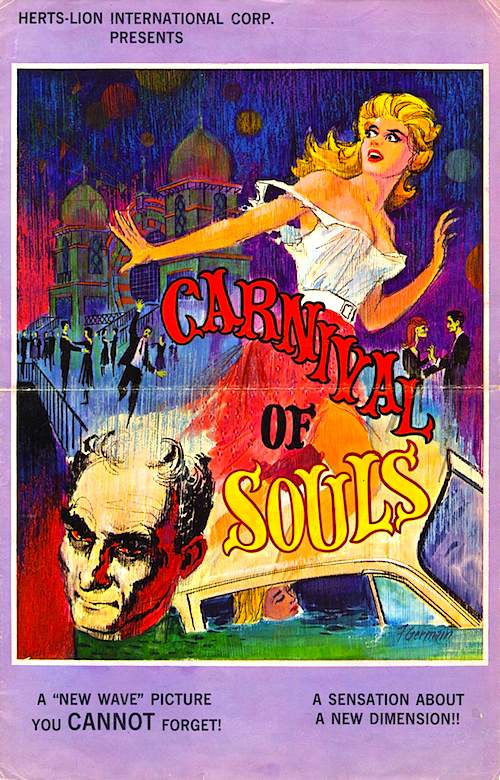
LFM Reviews Carnival of Souls @ The Anthology Film Archive

By Joe Bendel. It must be the only film selected for both the Criterion Collection and the Rifftrax treatment. Rightly or wrongly, it was largely ignored when first released and would be the only feature narrative helmed by its producer-director. Yet, Herk Harvey remained a prolific filmmaker, releasing scores of educational shorts through his Kansas-based Centron Corporation. Like Harvey, many future horror auteurs honed their craft and bided their time making educational and industrial films that often strangely foreshadow their macabre work to come. Fittingly, Harvey’s Carnival of Souls with the Centron short None for the Road screen together during Anthology Film Archive’s before-and-after film series, Industrial Terror.

When reluctant street racing passenger Mary Henry manages to walk away from a fatal accident, it ought to be an occasion for some soul searching. However, she seems determined not to process it. Always temperamentally aloof, she simply proceeds with her prior plans, accepting a church organist position in Utah arranged by the owner of the local pipe organ factory. In her new town, Henry tries her best to cut herself off from social contact, even though she dearly needs an emotional support system.

Beginning during her lonely drive into town, Henry has been haunted by visions of a ghoulish man. Perhaps even more troubling, she experiences episodes of time-stoppage, during which the townspeople around appear oblivious to her freaked-out presence. Spurning offers of help from the kindly priest and concerned Dr. Samuels, Henry becomes increasingly obsessed with the darkly picturesque abandoned carnival outside of town.

That carnival setting is definitely creepy, but most of Harvey’s film is a rather Edward Hopper-esque take on the horror movie genre. There is no gore at all, but the lighting and shadows are all kinds of eerie. Refreshingly, this is the sort of film where priests and factory owners are good people. Unfortunately for Henry, there is also very real supernatural business afoot.

Granted, some of the line readings are a little stilted, but Harvey’s visual style is remarkably accomplished, particularly his smooth jump-cut transitions. He patiently builds an atmosphere of foreboding, rather than resorting to sudden shock scares, perfectly supported and emphasized by Gene Moore’s unnerving organ score.

The performance of method-trained Candace Hilligoss (who bears some resemblance to Judith O’Dea in Romero’s original Night of the Living, another Industrial Terror selection) is almost too inwardly focused for the demands of the genre, but she is certainly convincingly brittle and standoffish. While the supporting ensemble is admittedly all over the place, Stan Levitt provides a solid anchor as Dr. Samuels and Harvey himself is effectively ghastly as the ashen apparition man.

Carnival will have its critical champions and detractors, but you can see its influence in scores of films, such as Adrian Lyne’s Jacob’s Ladder. It is a strong example of the greater efficacy of suggestiveness rather than splatter in horror movies. Thematically, it is also a good fit with None for the Road, in which a research scientist gets lab mice hammered and tries to balance them on metal dowels, while telling kids that if they are going to drink and drive, get so blitzed that the Highway Patrol is guaranteed to pull them over. Science is hardcore. Carnival of Souls is also weirdly potent stuff. Highly recommended, it screens this Friday (10/24) and next Tuesday (10/28) as part of Industrial Terror at Anthology Film Archives.

LFM GRADE: B+

Posted on October 21st, 2014 at 11:49pm.

LFM Reviews Twin Sisters on PBS’ Independent Lens

By Joe Bendel. It is hard to imagine how a parent could ever abandon two good kids like Mia and Alexandra, but China’s draconian One Child policy and the extreme rural poverty force people to do desperate things. At least they were each adopted into loving homes—that is, each of them separately. Evidently, the orphanage thought they stood a better chance of adoption individually, rather than as a package deal. However, through the intercession of fate, the sisters would maintain not just an awareness, but also a love for each other, despite living on opposite sides of the Earth. Mona Friis Bertheussen documents their indomitable bond in Twin Sisters, which airs this Monday as part of the current season of Independent Lens.

In 2003, the Hauglums from Norway and the Hansens from Sacramento came to China to adopt a baby girl. The Norwegian group was supposed to be gone by the time the American adoptees arrived, but events conspired to delay the Hauglums. Suddenly, they were amazed to see the Hansens holding a little girl, who was the spitting image of their Alexandra. Despite the orphanage’s denials, they exchanged contact information and eventually performed a DNA test, but it would hardly be necessary as the girls got older. Seriously, look at them.

Although there are cultural and linguistic barriers, both girls grow up feeling a deep connection to each, even though they had never really met. Eventually, the parents arrange to visit each other and are rather staggered by the girls’ similar mannerisms and personalities.

Obviously, the twins’ situation is imperfect, since they would dearly wish to live together, but their respective parents are good people, who do the best they can. Frankly, that is quite nice to see in a documentary, for a change. For sociologists, there is probably plenty of nature versus nurture grist as well, but most viewers will just be charmed by the sweet tempered girls themselves.

From "Twin Sisters."

Cheers to Bertheussen for making Sisters, because its European festival screenings served as another catalyst to bring together the twins. However, there is a conspicuous lack of follow-up with respects to the orphanage. Many viewers might like to see her try to get some bureaucrat there to admit on-camera they flat-out lied, as the Hansens and Hauglums can prove. Instead, she maintains her focus on the families, preferring a humanist vibe over potential confrontations.

Consequently, Twin Sisters is a sensitive film that borders on outright feel-goodism. Bertheussen’s young subjects are more than engaging enough to sustain the film, convincing viewers China’s loss will be America and Norway’s considerable gains. Recommended for those in search of wholesome family viewing, Twin Sisters airs this Monday (10/20) on most PBS outlets nationwide.

LFM GRADE: B+

Posted on October 20th, 2014 at 9:22pm.

LFM Reviews Young Ones

By Joe Bendel. For centuries of human history, more battles have been fought over water than probably any other natural resource. Apparently, Gwyneth Paltrow’s brother only recently discovered the strategic value of water, but he is duly impressed. Unfortunately, viewers will find an entertainment drought in Jake Paltrow’s Young Ones, which opened Friday in New York.

Ernest Holm was once a farmer, but his parched land is almost as arid as the characters he encounters. Following some sort of vaguely defined environmental disaster, Holm and his socially underdeveloped son Jerome eke out a modest living selling supplies to the knuckle-draggers working for the corrupt water works in the mountains. Flem Lever (a name everyone says with a straight face, to their estimable credit) covets Holm’s trading business and his eternally distant daughter, Mary. Despite Holm’s rugged manliness, the pretty boy Lever still manages to kill him in the desert, framing his new pack mule android for the murder most foul.

Of course, it takes Jerome quite a while to suspect Lever, because intuition hardly runs in the family. Ironically, Lever is much better suited to reversing the family’s fortunes, given his devious nature and ruthless follow-through. Nevertheless, little Jerome will get himself some payback when the time is right.

From "Young Ones."

Ernest Holm is the sort of role Michael Shannon was born to play, but sadly that is the only bit of casting that makes sense in Young Ones. A slow burning brooder like Shannon should be counterbalanced with someone who can project and maybe even chew a bit of scenery. Instead, for Holm’s sort of grown children, Paltrow calls on Kodi Smit-McPhee and Elle Fanning, two of the mousiest screen thesps you will ever come across. Watching them shuffle around the farm makes the films of Bela Tarr look like madcap romps.

Without question, Young Ones’ MVP is cinematographer Giles Nuttgens, who also lensed Perfect Sense, an infinitely superior apocalyptic allegory. He gives the parched vistas the proper John Ford treatment, but unfortunately he does not have much else to shoot in terms of narrative or characters. Unremittingly dull, yet also pretentious, Young Ones is a would-be futuristic western genre-bender that completely melts down. Not recommended for anyone, it opened Friday (10/17) in New York at the Village East.

LFM GRADE: D-

Posted on October 20th, 2014 at 9:21pm.