LFM Reviews Kite

By Joe Bendel. It is supposed to be a near future dystopia, but the post-crash world where roving “numbers gangs” abduct young children for a Middle Eastern human trafficker is not as outlandish as it ought to be. However, a strung-out teenage girl wages war against the cartel with the help of a morally problematic flat foot. It should all sound familiar to anime fans, for good reason. Yasuomi Umetsu’s anime gets the live action remake treatment in Ralph Ziman’s Kite, which opens this Friday in select cities.

It looks like the return of the Dinkins Administration, but on a national scale. Anarchy reigns, as numbers gangs rove the streets and the cops are either too scared or too corrupt to interfere. Karl Aker is the exception. The hard-charging detective has been secretly working to bring down the shadowy white slaver known as the Emir with his secret weapon: Sawa.

After her father, Aker’s partner, was murdered by the Emir’s henchmen, Sawa allowed the cop to pump her full of more juice than major league baseball consumed in 1998. Aker’s narcotic makes her lethal and fast-healing, but it is also addictive and makes her forget. Still, in Sawa’s world there is not much worth remembering. At least, that is how she hazily sees it. Oburi begs to differ. Claiming to be a childhood friend, the would-be Samaritan purports to know important secrets from her past.

From "Kite."

Arguably, the Kite concept simply works better in anime than as an exploitative remake. Frankly, India Eisley is not bad as the haunted Sawa, but she looks lighter than a box of Kleenex and more fragile than a crystal rose, making her butt-kicking scenes rather difficult to buy into, especially considering she does not have any super-powers beyond an anesthetizing buzz.

Of course, Samuel L. Jackson should be money in the bank for a film like this, but he is oddly restrained as Aker, only nibbling on the scenery rather gorging as we would hope and expect. Still, when he does his stone cold thing, it is still cool. Unfortunately, the rest of the ensemble is rather nondescript, including Callan McAuliffe, who certainly does not look like an Oburi.

Ziman’s take on Kite is not nearly as lurid or nihilistic as critics made the source anime out to be. In fact, there is a moral center to the film. Instead, its overriding sin is its general tepidness. Only for franchise fanatics, the under-performing Kite opened this Friday (10/10) in New York.

LFM GRADE: C-

Posted on October 11th, 2014 at 2:44pm.

LFM Reviews Alain Resnais’ Life of Riley @ The New York Film Festival

By Joe Bendel. George Riley is dying, but don’t worry, you will not get too attached to the old playboy. In fact, the title character never appears in Alan Ayckbourn’s play, but we hear plenty about him from his friends. It is exactly the sort of sly theatrical device that would appeal to the late great Alain Resnais. For his final film Resnais went back to the Ayckbourn well a third time, adapting Life of Riley, which screens as a Main Slate selection of the 52nd New York Film Festival.

Colin and Kathryn are rehearsing for their roles in the latest production of their amateur theatrical company (Ayckbourn’s Relatively Speaking, naturally enough), but he is clearly preoccupied. Kathryn quickly extracts the truth from her doctor husband: their beloved friend Riley has less than a year to live. In violation of his professional ethics, the couple discusses his condition with their mutual friends, Jack and Tamara, deciding the play is the thing to keep Riley’s spirits up.

They also resolve to broker some sort of rapprochement with his estranged wife Monica, who has taken up with Simeon, a considerably older gentleman farmer. Despite their history together, Monica is not sure she can handle a reunion with George. Yet, she suddenly agrees to comfort her not quite ex-husband in his final hours, when it becomes clear Kathryn and Tamara might harbor eleventh hour romantic interests in Ayckbourn’s absent character.

Indeed, it all sounds like the stuff of midsummer French farce—and French it is indeed, even though Resnais retains the English trappings and Yorkshire country setting. He emphasizes the theatricality of it all with conspicuous fabric backdrops that look deliberately stagey, but give the film a rich, warm vibe thanks to the bold saturated colors. The cast of Resnais regulars hold up quite well in this slightly surreal environment, embracing their characters’ broad bourgeoisie anxieties. While everyone projects to the back row, so to speak, Sandrine Kiberlain and Hippolyte Girardot still manage to really connect on an emotional level, as Monica and Colin, respectively.

From "Life of Riley."

Of course, verisimilitude was never an obsessive preoccupation for Resnais, who throws it completely out the window in Life of Riley. Instead, he offers us the elegant illustrated transitions sketched by French cartoonist Blutch and X-Files composer Mark Snow’s uncharacteristically nostalgic soundtrack. There is even an apparent tip of the hat to Caddyshack (in did-I-just-see-that moments nearly as random as Wild Grass’s closing scene). In short, Resnais was not long for the world, but he was still having fun.

Indeed, that is the key to understanding Riley. On paper, the masterful You Ain’t Seen Nothing Yet would seem to be the perfect career capstone, given its elegiac tone and its pseudo-resurrection made possible through the power of art. However, like George Riley, Resnais went out on his terms, having one last romp, damning the expectations of others. The result may not be a great film, like the late career masterwork YASNY, but it is a good film, which is always a welcome thing.

Even if Life of Riley is not Resnais’s greatest film, it might be perfectly representative of the auteur’s motifs and strategies. Regardless, it is appealingly wry and sophisticated. Recommended for fans of Resnais and Ayckbourn, Life of Riley screens this Saturday (10/11) at the Beale, as part of this year’s NYFF.

LFM GRADE: B

Posted on October 11th, 2014 at 2:43pm.

LFM Reviews Botso: The Teacher from Tblisi

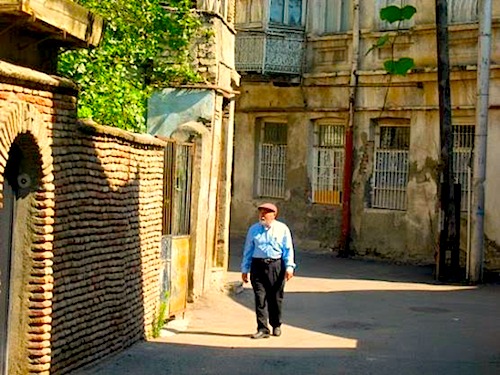
By Joe Bendel. In the final twenty minutes Wachtang “Botso” Korisheli was allowed to see his father, the prominent Georgian actor imparted the life lessons that would later guide a disproportionate number of his Morro Bay students to careers as professional musicians. He also sculpts. With the help of Korisheli’s students and alumni, Tom Walters celebrates Korisheli, the teacher, artist, and father in Botso: The Teacher from Tblisi, which opened this Friday in New York.

At one time, Platon Korisheli and his family were held in high esteem by Stalin, but that tragically changed. Growing up as the child of an enemy of the state was not easy. Having served as a trench digger in the Red Army, a particularly dangerous and menial duty assignment reserved for conscripts of his status, Korisheli tenaciously made his way west after the war.

While fate and the Soviet State would deny Korisheli a reunion with his mother, he forged a teaching career and started a family in Morro Bay, California. Like Korisheli’s grown son before them, his young adopted daughters are amongst his most promising music students. Probably the most celebrated Korisheli graduates are Kent Nagano, the Grammy winning music director of the Orchestre Symphonie de Montréal, as well as his sister, pianist Joan Nagano, and cousin Nancy Nagano, the San Luis Obispo Symphony’s principal cellist. The tradition continues with Nagano’s ten year old daughter, who is among the notable soloists at Botso Fest, the gala reunion concert featuring Korisheli’s former students.

From "Botso: The Teacher from Tblisi."

Over ninety years old himself, Korisheli is clearly doing something right. Walters and writer-co-producer Hillary Roberts Grant caught the big moments, like Botso Fest and his emotional return to Georgia after decades away. However, the best scenes capture Korisheli working with students. We can readily see he is a dynamic but supportive instructor, who helps his young charges connect with the soul of the music. Contrasting sessions recorded five years earlier with recent lessons, Walters also demonstrates the sort of commitment Korisheli inspires in his students and documentarians alike.

Botso is a very nice film that offers some timely lessons on the importance of musical education and the grim legacy of Communism. Strangely though, Walters never really gives us a big musical crescendo, cutting away and truncating the Botso Fest command performance, featuring young Miss Nagano (who clearly did her delighted teacher proud). Nor does he ever ask Korisheli about the state of contemporary Georgia, particularly with respect to Russian military belligerence (arguably a bit of an oversight, given the way recent history has repeated in Ukraine). Nonetheless, it is well worth viewers’ time to meet Mr. Korisheli and listen to his story of hope and music. Warmly recommended for students of music and history, Botso opened this Friday (10/10) in New York at the Quad Cinema.

LFM GRADE: B+

Posted on October 11th, 2014 at 2:42pm.

LFM Reviews Inherent Vice @ The New York Film Festival

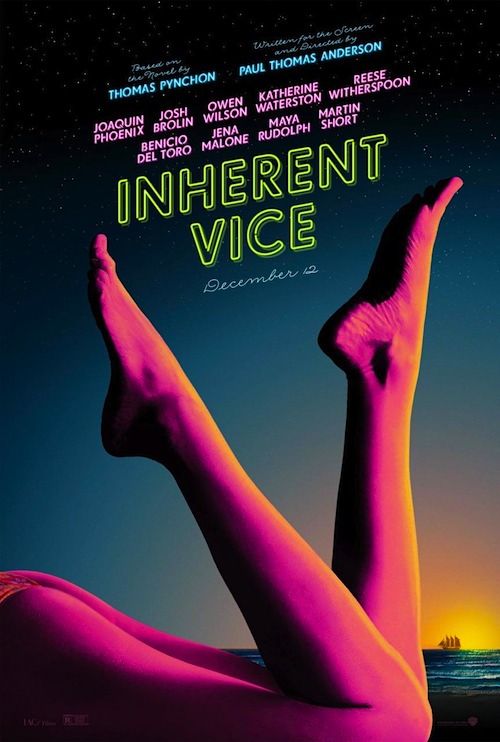
By Joe Bendel. Without question, the Thomas Pynchon character that most persistently arouses reader fascination is Pynchon himself. Already, we are seeing reports Pynchon makes a brief cameo appearance in Paul Thomas Anderson’s adaptation of his 2009 mystery novel (for lack of a more precise term) and attended the New York Film Festival’s press screening. Of course, it is dashed difficult to verify any of that, since nobody knows what he looks like. Regardless, Anderson’s Inherent Vice is guaranteed to be obsessively analyzed and debated after it screened as the Centerpiece of the 52nd New York Film Festival.

A woman furtively walks into stoner-detective Larry “Doc” Sportello’s beachfront crash-pad, but this is no lady. She is Shasta Fay Hepworth, the ex-girlfriend he still carries a torch for. She has need of his professional services, but would rather their meeting look like an assignation. Currently the kept woman of real estate mogul Mickey Wolfmann, Hepworth has been approached by his wife Sloane to co-conspire in a plan to have said sugar daddy committed. Soon thereafter, Sportello is serendipitously hired by Black Panther Tariq Khalil to collect a debt owed by Aryan Brother Glen Harlock, who now works as Wolfmann’s bodyguard.

Unfortunately, things really get complicated when Sportello is waylaid in brothel, waking up next to Harlock’s dead body and surrounded by a circle of cops, most inconveniently including his old nemesis Christian “Bigfoot” Bjornsen. Yes, Inherent is a film that prompts run-on sentences. It also has more name characters than Gone with the Wind and Berlin Alexanderplatz combined, nearly all of whom have back-stories. As Sportello works his vaguely defined case, he crosses paths with a missing musician forced to be a federal informer, his presumptive widow, a maritime attorney, a sex worker, the sexpot daughter of a former client, a lethal loan shark, a shady rehab clinic, multiple G-Men, and the drug-addled Dr. Rudy Blatnoid, DDS, played by the scene-stealing Martin Short.

If you can make heads or tails of the plot, you are doing better than Anderson, but he certainly captures the story’s inherent Pynchon-ness. You have the liberal supply of nicknames, the obsessive telling of tales, and the ever deepening but never illuminated mythology (but Pig Bodine is M.I.A.). Anderson also has a strong sense of the 1970s vibe and attitude, marking something of a return to his Boogie Nights roots. In fact, Vice comes across as so of the era, it ironically feels dated. The frequent but clumsy swipes at Pres. Nixon, Gov. Reagan, COINTELPRO, and Dirty Harry-style policing seem rather quaint and nostalgic now that we have the NSA rifling through our email and social networks.

Inherent certainly works to an extent, but it represents a triumph of form over substance. Anderson constantly proves just how much he gets Pynchon, channeling his breakneck anarchy. Although Abderrahmane Sissako’s Timbuktu is a vastly superior work, they are alike in that every scene of each film has its own unique significance. In the case of Inherent, sequence after sequence further deepens the mythology and features their discrete mini-arcs.

Unfortunately, the major principals are hard to fully embrace. Doc Sportello was clearly formulated for maximum likability, but the undeniably gifted Joaquin Phoenix often looks like he is uncomfortably laboring to let his freak flag fly. Instead, he makes a broody Lebowski. Frankly, Josh Brolin is even shtickier as Bjornsen, recycling all the worst elements of his turns in Men in Black III, W., and Gangster Squad. Fortunately, there is a rich feast of colorful supporting performances to keep things lively, including memorable contributions from Short, Jena Malone, Owen Wilson, Eric Roberts, Hong Chau, Bernicio Del Toro, and Serena Scott Thomas.

Considering how much works in Inherent, it is frustrating that the parts don’t snap together into a more satisfying whole. The period details crafted by the production design team are spot on and cinematographer Robert Elswit bathes it all in a noir Chinatown glow. At times, Thomas’s approach is inspired, particularly his narration, but key on-screen personnel do not always best serve the film’s interests. Recommended for Pynchon fans and those who appreciate self-consciously intricate noirs, Inherent Vice opens December 12th, following its premiere as the Centerpiece of this year’s NYFF.

LFM GRADE: B-

October 7th, 2014 at 9:47pm.

LFM Reviews Red Army @ The New York Film Festival

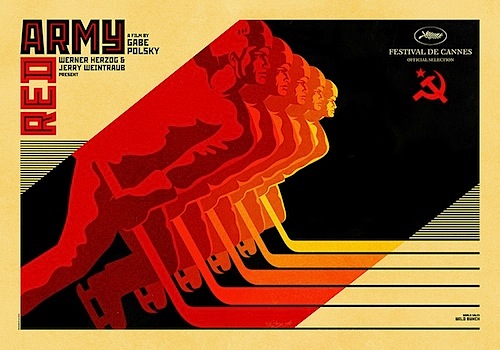
By Joe Bendel. Viacheslav “Slava” Fetisov remains one of the most celebrated players in the history of Russian hockey, but he was also the closest thing to a Curt Flood among Soviet hockey players. With his best friends, he made up a legendary five man line, but his place in the thorny legacy of Soviet history is particularly complicated. Logically, Fetisov serves as the focal point when Gabe Polsky chronicles the Soviet hockey machine’s history in Red Army, which screens during the 52nd New York Film Festival.

When Stalin identified sports as key propaganda tool in the coming Cold War with the free world, Anatoli Tarasov was tapped to build the Soviet hockey system. In just a few short years, the Red Army team dominated international competitions. Beloved by his players, most definitely including Fetisov, Tarasov would have been a hard act for any coach to follow, but the Politburo-connected Viktor Tikhonov would command little respect and no affection from his teams.

Frankly, it is rather odd watching a hockey doc in which the “Miracle on Ice” at Lake Placid is treated by most participants as an inconvenient speed bump to get over. It was Fetisov and Tikhonov’s first crack at Olympic glory, but Herb Brooks and a squad of college players had a different plan (if you really don’t know what happened in that semi-final, watch the final minute here). Unfortunately, the embarrassment of their Olympic defeat gave Tikhonov an opportunity to purge the coaching staff and institute a ridiculously stringent training regimen.

With Putin prosecuting his military campaign against Ukraine, it definitely feels like an inopportune time for Soviet nostalgia, especially considering Polsky’s own Ukrainian heritage. However, Polsky presents a somewhat balanced portrait of the era, addressing the systemic scarcity and control over the individual that defined life in the USSR. In many ways, Tikhonov the martinet becomes the personification of the Soviet system, as well as the story’s unambiguous villain.

Clearly, there is no love lost between the former national coach (who declined to participate in the film) and Fetisov. With fair justification, Fetisov blames Tikhonov for blocking his attempts to accept the lucrative offers from American professional teams. Essentially, he waged a battle in the Glasnost-thawed press to allow a sort of free agency among Soviet players, but unlike Flood, he would eventually reap the benefits of his efforts.

Still, Polsky seems to have hipster fascination with Soviet iconography and a pronounced timidity with respects to the human rights violations that were being committed by the Soviets and their proxies during the period in question, most notably the imposition of martial law in Poland. Nevertheless, the film raises a number of issues that merit further exploration, starting with the treatment of the players themselves, who really got a raw deal compared to the life of privilege afforded to East Germany’s Katarina Witt.

Although they were athletes, the hockey team really served as propaganda pawns. As a result, there are clearly still a lot of mixed feelings about their glory years, including pride in their accomplishments and resentment of Tikhonov and the high level Party members who enabled him. It is not a perfect film but it peels back the curtain far enough to give viewers an intriguing peak into the Soviet sports program. It is all briskly watchable thanks to the era-evocative graphics and the whiz-bang editing of Eli Despres and Kurt Engfehr. Recommended for experienced amateur Kremlinologists, Red Army screened as part of this year’s NYFF.

LFM GRADE: B

Posted on October 7th, 2014 at 9:47pm.

LFM Reviews Mr. Turner @ The New York Film Festival

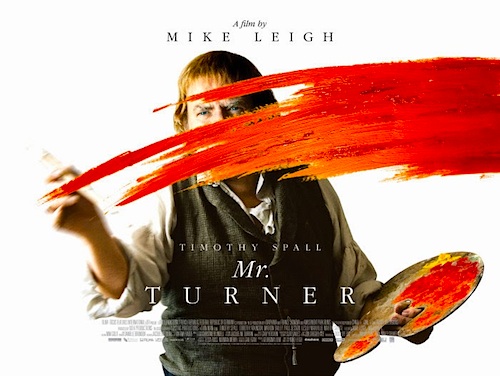
By Joe Bendel. Some of J.M.W. Turner’s most famous subjects include Hannibal traversing the Alps and a study of sea-monsters (or perhaps just fish, as the Tate prosaically insists), but he is best known for the maritime scenes that are now considered an early bridge to Impressionism. He was widely celebrated in his own lifetime, yet popular and critical opinion varied considerably, especially in his twilight years. Mike Leigh and his frequent ensemble player Timothy Spall lovingly paint a portrait of the artist’s irascibility in Mr. Turner, which screened as a Main Slate selection of the 52nd New York Film Festival.

By the late 1820s, Turner was a recognized master, who could get away with considerable eccentricities during the Royal Academy of Arts’ annual exhibitions. Despite a brief affair yielding two illegitimate daughters he had no use for, Turner was not much of a ladies’ man. He lived a bachelor life with his doting father, up until the senior Turner’s death, occasionally exploiting the unrequited affections of their housekeeper, Hannah Danby, the niece of his former mistress.

However, a halting romantic relationship slowly develops between Turner and Mrs. Booth, the twice widowed proprietress of a lodging-house in Margate, the coastal village that inspired many of Turner’s paintings. They find some late-life happiness secretly cohabitating, even while Turner struggles with his declining health and the sleights of the jealous establishment and fickle public.

Structurally, Mr. Turner initially seems rather episodic, skipping somewhat haphazardly down the last two decades of Turner’s life, but a bigger picture slowly slides into place. Granted, there is still a lot of character development coloring in the one hundred forty-nine minute running time, but those are usually the best parts.

J.M.W. Turner might well be the role Spall is forever linked to, like Sir Ben Kingsley and Gandhi. It is a virtuoso performance, but it is also great fun, especially when Turner slyly hams it up at Academy gatherings. Inevitably, someone will edit together a master-cut of all his grunts and guttural noises, which are rather eloquent within the film’s dramatic context.

Marion Bailey also takes an exquisitely sensitive and dignified turn as Mrs. Booth and Dorothy Atkinson piles on the pathos as poor cast-aside Hanna Danby, but after the contributions of Spall and Leigh, it is the work of cinematographer Dick Pope that most defines Mr. Turner. At times, the characters walk through landscapes that shimmer like Turner canvases, bringing to mind Lech Majewski’s The Mill & the Cross.

Obviously, Mr. Turner is more closely akin to Leigh’s Gilbert & Sullivan bio-pic Topsy-Turvy than his stridently class conscious films. There is even a pronounced strain of elitism to be teased out of Turner’s story, yet it is consistently forgiving of human foibles. It rather logically follows Mr. Turner is also one of his most inviting and accessible films. A strong Oscar contender for Spall (and probably for Pope, too), Mr. Turner is recommended for patrons of fine art and British cinema when it screened as part of this year’s NYFF.

LFM GRADE: B+

Posted on October 7th, 2014 at 9:46pm.