LFM Reviews ’71 @ The New York Film Festival

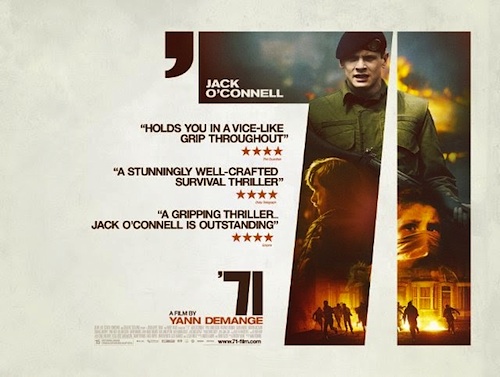
By Joe Bendel. Thanks to Scotland’s independence referendum, Northern Ireland will probably get a taste of Devo Max. The increased autonomy would hardly have satisfied the irrationally violent “Provisional” IRA in the 1970s. One British soldier stranded in the wrong neighborhood will try to elude the faction’s death squad, but there will be other interested parties also hunting him in Yann Demange’s ’71, which screened as a Main Slate selection of the 52nd New York Film Festival.

Private Gary Hook’s unit has been hurriedly dispatched to Belfast, which is just as much a part of the UK as Piccadilly Circus or Leicester Square. Yet, it is most definitely dangerous duty. On his first waking day in Northern Ireland, Hook finds himself facing down a mob. Trying to build trust, the relatively green Lieutenant sent them out in berets rather than flak helmets. In retrospect, this was a mistake. As the chaos spirals out of control, Hook and his mate Thompson are separated from the unit. Thompson takes a bullet to the head from a Provisional assassin, but Hook is able to elude the gunman and his partner.

Hook finds a temporary refuge, but he has no idea how to reach his barracks. He is surrounded by a Catholic population that would either like to kill him or is too frightened of the various IRA contingents to protect him. Nevertheless, he finds a guide in the form of the rabble-rousing seven year old nephew of a high-ranking Protestant paramilitary. Unfortunately, this only leads to more trouble, when Hook narrowly survives an accidental bomb detonation that could deeply embarrass a small detachment of sinister British intelligence officers. Hook’s death would be quite convenient for them.

’71 has an overpowering sense of place, but instead of Belfast, it was shot in Liverpool, Blackburn, Sheffield, and Leeds, which does not say much for those municipalities’ urban ambiance. It looks like the entire city is a housing project (or an estate in British parlance). As night falls, Tat Radcliffe’s cinematography becomes ghostly and disorienting, perfectly mirroring Hook’s increasingly confused state and powerfully reinforcing the edgy vibe.

Rising star Jack O’Connell looks ridiculously young and lost in the grim, battle-scarred world, but that is the whole point. In fact, he is quite effective as an earnest and innocent POV figure for the audience to identify with. Many of the assorted combatants rather blur together, but David Wilmot stands out as Boyle, the local old guard IRA leader. Babou Ceesay (who deserves to become a series regular after his guest spot on last season’s Lewis) is also terrific as the hard but decent Corporal. However, Corey McKinley upstages everyone as Hook’s ferocious young ally (evidently W.C. Fields was right, even in Belfast).
Despite portraying some pretty savage behavior on the part of the IRA factions and their sympathizers, Demange and screenwriter Gregory Burke go out of their way to paint the British Army in a negative light. (I’d still trust the honor and professionalism of Her Majesty’s armed forces over any other military, aside from America’s armed services.) Regardless, Demange crafts a tight, tense white knuckle night of the soul. He certainly proves he can stage a riot. Although they are radically different in many respects, the one film ’71 consistently brings to mind is Carol Reed’s absolutely classic Odd Man Out, which is a heavy statement. Recommended on balance for patrons who appreciate gritty military thrillers, ’71 screened as part of this year’s NYFF.

LFM GRADE: B

Posted on October 1st, 2014 at 12:32pm.

LFM Reviews Last Hijack @ The New York Film Festival

By Joe Bendel. According to the Oceans Beyond Piracy project, over 1,000 international seamen have been held hostage by Somali pirates—roughly a third of whom were tortured and 62 died from a variety of causes. Yet, it sure is more convenient to cast the pirates as victims of colonialism, globalism, capitalism, and generally mean old westernism. However, films trying to advance that narrative have been less than convincing, despite the quality of their execution. Sort of picking up where Greenglass’s Captain Phillips left off, Tommy Pallotta & Femke Wilting offer a personal and figurative defense of high seas plunder in their animated hybrid documentary Last Hijack, which screens today as a Convergence selection of the 52nd New York Film Festival.

Former pirate Muhamed Nura pulled off a few big hijackings and lived to talk about. Unfortunately, he did not save any of his ransom money. Facing middle age with little prospects, Nura decides to assemble a team for one last job. However, times have changed and maritime security is much tighter. Everyone is against his plan, including his stern mother and his vastly younger fiancée. Nonetheless, he has no trouble lining up crew and financial backers.

Pallotta and Wilting clearly invite sympathy for Somali pirates, trying to position them as modern Jean Valjeans, but they bizarrely chose a distinctly unsympathetic POV character. During his screen time, Nura emerges as a rather rash braggart, who seems to have little concern for the consequences of his actions. Although he is supposedly in hard fiscal straights, he has a new wife and a new fixer-upper house, which does not look like such a bad situation.

In contrast, radio talk show host and anti-piracy advocate Abdifatah Omar Gedi cuts a more interesting (and more heroic) figure. During his on-camera sequences, Gedi’s cell phone never stops ringing, constantly receiving calls from strangers trying to determine his location. Frankly, viewers will quickly conclude Pallotta and Wilting chose the wrong person to build their film around.

At least Nura’s hijacking exploits lend themselves to the animated bird of prey interludes that incorporate Hisko Hulsing’s striking paintings. Their symbolically charged look and feel recalls the vibe of Damian Nenow’s short Paths of Hate and select moments of the original Heavy Metal. They are effective, whereas many of the straight forward doc segments are often a bit sluggish—snoozy even.

From "Last Hijack."

Last Hijack makes some legitimate points here and there, but like Captain Phillips, it never pursues the shadowy moneymen underwriting the hijackings. As a result, the attempts to build empathy for Nura fall flat. Drastically uneven, it offers tantalizing hints of a better, deeper film that might have resulted from different decisions at several critical junctures. Perhaps audiences will get more of what might have been at Pallotta & Wilting’s presentation of the film’s online component. Regardless, Last Hijack was largely disappointing when it screened last weekend at this year’s NYFF, in advance of its New York opening this Friday (10/3) at the Quad Cinema.

LFM GRADE: C

Posted on October 1st, 2014 at 12:31pm.

LFM Reviews The Decent One

By Joe Bendel. It is sort of like watching Hell’s production of A.R. Gurney’s Love Letters, because its correspondents have certainly earned damnation. Utilizing a cache of previously unseen letters and documents written by Heinrich Himmler and his family, documentarian Vanessa Lapa paints an uncomfortably intimate portrait of the Holocaust architect. Himmler proves just how banal evil can be in Lapa’s The Decent One, which opens this Wednesday at Film Forum.

The U.S. servicemen dispatched to retrieve whatever documents remained in the Himmler family safe kept them as souvenirs instead. Through some circuitous route, they eventually came into Lapa’s possession. For a historian, they represent a wealth of primary sources, but they should not stoke revisionist fears. Despite Himmler’s conscientious concern for their young daughter Gudrun, Himmler’s letters to wife Margarete never ameliorate his guilt.

There are moments when their domestic business is interrupted by shockingly off-hand anti-Semitic pronouncements (often on Margarete’s part), but the first half of the film largely consists of maddeningly prosaic correspondence and journal entries. Still, when Himmler suggests he and Margarete should number their letters, it arguably foreshadows his sinister efficiency (but it must have been a great help to Lapa and her research team).

Not to be spoilery, but Lapa eventually uses Himmler’s own words to establish his knowledge and culpability with respects to the Holocaust. Of course, all reasonable people of good conscience understand that already. She also exposes the hypocrisy of his outward righteousness through letters to his longtime mistress, but those are the least of his sins.

From "The Decent One."

Frankly the tangential approach of documentaries like Decent One risk losing sight of the big picture’s enormity. Perhaps this generation really needs a documentary that launches a frontal assault, overpowering the viewers with the scale and severity of suffering caused by the National Socialists, especially considering the rise of anti-Semitism in Western Europe and the Middle East.

Lapa’s film is skillfully constructed and undeniably well intentioned, but it is unlikely to inspire many epiphanies. It is good that greater historical background and context is now easily available, but it probably should not be the first or last film students see on National Socialist crimes against humanity. Respectfully recommended for viewers who already have a strong grounding in Holocaust history, The Decent One opens this Wednesday (10/1) at New York’s Film Forum.

LFM GRADE: B-

Posted on October 1st, 2014 at 12:31pm.

LFM Reviews Gone Girl @ The New York Film Festival

By Joe Bendel. Nick Dunne looks the part of a Scott Peterson surrogate, but he is probably not guilty of murdering his wife, Amy. Probably. Nonetheless, nobody would call him innocent. Frankly, that is true of everyone involved in this sordid affair, but that does not stop the wolf-pack media from anointing victims and villains in David Fincher’s Gone Girl, the opening night film of the 52nd New York Film Festival.

It does not take very long to find the cracks and strains in the Dunnes’ marriage. A great deal of it involves money. Since both were laid off, they have had to rely on her much depleted trust fund. There are other issues as well, which will be revealed over time, but with varying degrees of credibility. Regardless, it is perfectly logical for the police to initially suspect Dunne when his wife disappears under mysterious circumstances. When they discover large pools of her blood have been freshly scrubbed from the Dunnes’ kitchen floor, the noose tightens. However, a number of game-changing shoes will drop in the second and third acts.

Adapting her own novel, first-time screenwriter Gillian Flynn is unusually adept at maintaining the unreliable narration and related narrative devices that are often sacrificed in page to screen transfers. Still, some things are crystal clear, such as her withering contempt for the baying media hounds. Missi Pyle plays a character named Ellen Abbott, but she might as well wear a name tag that says: “hello, my name is Nancy Grace.” It is not a flattering portrayal.

However, the depiction of marriage is just as jaundiced. While it might sound like some sort of “the stranger I married” Lifetime movie (a genre unto themselves that drew a snarky comment or two at the NYFF presser), the film really hinges on just how well the Dunnes know each other.

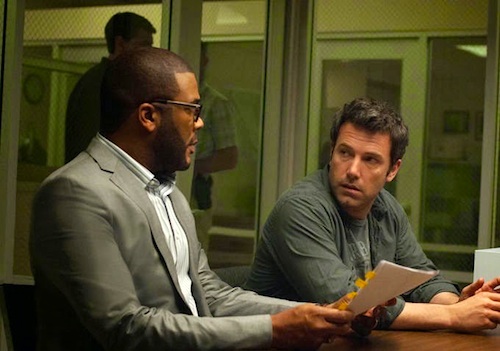
Rosamund Pike was very good in Barney’s Version and unjustly overlooked in Jack Reacher, but she takes her craft to a new level as Amy Dunne. For reasons that would be spoilery to explain, it is a physically and emotionally rigorous performance that brings to mind Bette Davis at her most noir (and that is not suggested lightly). Tyler Perry (yes, that Tyler Perry) is nearly as great a surprise, killing it as Dunne’s lawyer, Tanner Bolt (cool name). He deliberately refrains from channeling well known celebrity attorneys, but he projects the intelligence and charisma you would dearly want in a defense attorney.

Poor Ben Affleck took some Batman ribbing in stride at the press conference, but he is solidly good to very good as the highly flawed Nick Dunne. Neil Patrick Harris also has his moments as Desi Collings, Amy’s well heeled, but decidedly squirrely ex-boyfriend and possibly stalker. Nevertheless, it is hard for those who share the screen with Pike’s Dunne to get out of her dominating shadow.

From "Gone Girl."

Gone Girl is definitely a rebound film for Fincher after the completely unnecessary and largely uninspired Girl with the Dragon Tattoo remake, but it still does not have the distinctive auteurist stamp of films like Fight Club and Se7en. Arguably, this is more of a writer and actor’s vehicle. Even though she does not exactly mirror the structure of her source novel, Flynn’s screenplay is still cleverly constructed, even though she allows the endgame to drag out a bit, rubbing our noses in the story’s implications.

Unfortunately, the film is probably too dark, too thrillerish, and far too morally ambiguous to garner much Oscar love, with the notable exception of Pike, who deserves to be in contention for best actress. For the rest of us civilians, it is quite a good suspenser. Recommended for fans of mainstream film noir, Gone Girl kicked off this year’s NYFF last night at Alice Tully Hall, in advance of its October 3rd opening.

LFM GRADE: A-

Posted on September 30th, 2014 at 10:08pm.

LFM Reviews Beloved Sisters @ The New York Film Festival

By Joe Bendel. It is a love letter to love letters. Without the benefit of e-mail and cell phones, Friedrich Schiller maintained ardent relationships with both von Lengefeld sisters, often communicating through neatly folded missives. Of course it was a secret, but only from society and not the siblings themselves. Naturally, there were complications, developing and intensifying over the course of years in Dominik Graf’s Beloved Sisters, which screens in its one hundred seventy minute entirety as a Main Slate selection of the 52nd New York Film Festival.

The von Lengefeld’s are technically aristocrats, but they hardly have a Mark to their names—hence Caroline’s marriage to the wealthy but boorish von Beulwitz. It is an unhappy union, but it provides the necessary support for Lengefeld’s younger sister Charlotte and their overbearing mother. Reluctantly resigned to her fate, Caroline tries to spend as much time as she can with her sister, who has been entrusted to her socially connected godmother, in hopes she can arrange a suitable match for “Lollo.”

As a commoner known to advocate a radical Enlightenment philosophy, Schiller would hardly qualify. Nonetheless, when the younger von Lengefeld sister spies him from her window, he makes quite the roguish impression. When Caroline subsequently meets him during a holiday, she is also quite taken. It eventually leads to an understanding of sorts to share Schiller as best they can. Of course, this is easier said than done, especially for a married woman like Caroline von Beulwitz. Eventually marital statuses will change, but the two sisters’ respective relationships with Schiller, Lolllo’s future husband, will necessarily remain unequal. This consequently leads to almost three hours worth of drama.

Yes, Beloved essentially revolves around a sort of ménage a trois situation, but Graf emphasizes the literary and philosophical tenor of the times more than the potential luridness of his subject matter. In fact, the film is relatively chaste, all things considered, but there is still plenty of passion and jealousy. Yet, bigger issues loom over their private scandals, especially the French Revolution, which initially thrills and then horrifies Schiller and his intellectual circle.

Like the three-hour historical epics of old, Beloved is a big, chewy melodrama, filled with simmering yearning and cold sweats. Supposedly inspired by Schiller’s only letter to Caroline she did not manage to destroy before her death, Graf’s screenplay relies on considerable speculation, but the earnestness of the central trio gives it all the ring of truth.

From "Beloved Sisters."

While Caroline might have the short end of the ménage, Hannah Herzsprung gets the juiciest scenes as the divorcee turned romance novelist, making the most of them. It is a wonderfully complex and tragic character. However, Lollo is no shrinking violet either, nicely played by Henriette Confurius, who convincingly segues from her youthful coquetry to her more mature resolve. If anyone is underwritten here, it is Schiller, but Florian Stetter portrays him with enough charismatic likability to suspend disbelief and generally hold the proceedings together.

In a sense, Beloved is like a sequel to Philipp Stölzl’s Goethe in Love (whose protagonist Graf references but never shows), but it calls and raises its predecessor in nearly every category (especially running time, but it never feels that long). It is a smart, literate, emotionally involving film that could honestly be considered old fashion, in a good way. Recommended for patrons who enjoy quality period pictures, Beloved Sisters screened today (9/30) at the Walter Reade and screens Wednesday (10/1) at the Gilman as a Main Slate selection of this year’s NYFF.

LFM GRADE: A-

Posted on September 30th, 2014 at 10:08pm.

LFM Reviews The Blue Room @ The New York Film Festival

By Joe Bendel. In a provincial town, there is no such thing as a no-tell motel. Nevertheless, Julien Gahyde thought he was being discrete in his regular meetings with the village pharmacy owner’s wife in the titular chambre bleue. Inconveniently, he learns that their affair was largely common knowledge when he becomes ensnared in a murder inquiry. Just who was killed by whom will be slowly revealed in Mathieu Amalric’s adaptation of the Georges Simenon novel The Blue Room, which screens during the 52nd New York Film Festival.

After a long absence, Gahyde returned to his home town, making good as a John Deere sales rep. It probably was not just lust that drove him into an affair with the sensual Esther Despierre. She also happens to be married to an old classmate, whose wealth and privilege Gahyde always resented. Regardless, her talk about a more permanent arrangement does not sit well with Gahyde, so he uses a near miss with her husband as a pretext for a cooling off period. However, her reckless letters portend bad things. Before long, Gahyde is in prison, fielding questions from the investigating magistrate, but the film’s fractured temporal-hopping narrative structure jealously guards its secrets.

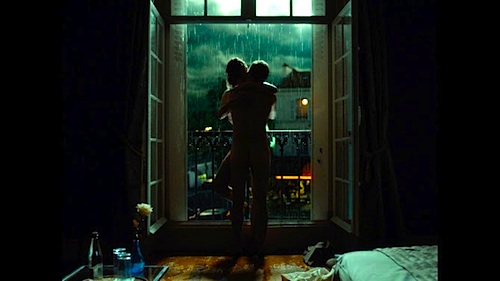
One thing is certain: Gahyde is in a mess of legal trouble. Even if he is technically not guilty, he still bears considerable responsibility for the state of affairs. Amalric and editor François Gédigier keep audiences on their toes with their frequent cuts, often emphasizing oddly elliptical perspectives. There is more than a hint of the old school Nouvelle Vague in their almost Pointillistic approach. (Coincidentally, one of Picasso’s best known Blue Period paintings was also called The Blue Room and it fits the spirit of Amalric’s picture rather well.) Yet, what most distinguishes the film is the degree to which Amalric captures the vibe and essence of Simenon’s non-Maigret hothouse psychological thrillers.

From "The Blue Room."

Director-co-screenwriter Amalric also gives himself an important assist, portraying the thoroughly compromised and increasingly confused Gahyde. There is something Kafka-esque about the weasely philanderer that inspires rapt fascination. Frankly, both Madame Gahyde and Despierre are rendered somewhat simplistically, as the standard-issue wronged wife and Fatal Attraction mistress, respectively. However, in what might appear to be a disposable role, Serge Bozon (another actor turned director), adds a hard to quantify dimension, hinting there is much more churning beneath his magistrate’s poker face façade.

Amalric nicely distinguishes himself as a triple threat with Blue Room. Brainy and rather steamy at times, The Blue Room belongs in the top rank of Simenon adaptations, in the company of films from the likes of Chabrol, Leconte, and Duvivier. Recommended for fans of mature literary thrillers, The Blue Room screened this Monday (9/29) at Alice Tully Hall and Tuesday (9/30) at the Beale, as part of this year’s NYFF, in advance of its opening at the IFC Center this Friday (10/3).

LFM GRADE: A-

Posted on September 30th, 2014 at 10:07pm.