Discovering Georgian Cinema: LFM Reviews Will There Be a Theatre Up There?!

By Joe Bendel. When celebrated actor Kakhi Kavsadze states he came of age in a country that no longer exists, he perhaps should not speak so soon. Putin clearly has designs to reassert the USSR’s old spheres of domination and Kavsadze’s native Georgia was one of the first nations he trained his military crosshairs on. Yet, current events make Kavsadze’s reminiscences of the Stalin era even more poignant in Nana Janelidze’s documentary, Will There Be a Theatre Up There?!, which screens during MoMA’s new film series, Discovering Georgian Cinema, Part 1: A Family Affair.

Kavsadze came from a long line of well respected traditional Georgian singers, as Stalin himself would attest. A letter from the dictator to his revered grandfather has a special place of irony in his family’s history. Kavsadze’s father was also an accomplished vocalist and choir-master, but WWII was not kind to him, or Kavsadze’s family by extension. The senior Kavsadze managed to save scores of Georgian POWs by organizing a camp choir, but such benign survival strategies would earn him the label: “enemy of the people.”

Through his words and occasional songs, Kavsadze revisits his early childhood years, paying tribute to his parents for enduring their endless tribulations. Technically, it all takes place in one location, but the hanger-like industrial building re-purposed as a film studio is remarkably versatile. Janelidze will often stage dramatic tableaux to illustrate Kavsadze’s recollections, which frequently seem to stir legitimate emotions deep within the grand thespian.
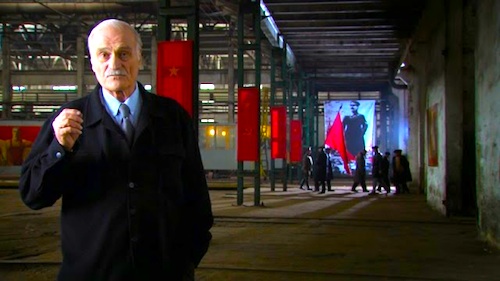
From "Will There Be a Theatre Up There?!"

Kavsadze’s stories are about as personal as they get, yet they offer tremendous insight into the nature of the Communist system. Perhaps most telling is the episode in which a pair of KGB agents came to the Kavsadze home looking for an incriminating document, but tried to carry off their dinner table instead (fun fact: Putin was a veteran KGB agent).

Kavsadze is a forceful presence who truly commands the viewer’s attention. Likewise, Janelidze’s sparse but elegant approach gives rise to some striking images that often bring to mind Eastern European cinematic classics, like Wajda’s Everything for Sale. Despite its relatively short running time (fifty-five minutes), Theatre offers viewers quite a bit to take in. It is especially fitting that it had a special screening during this summer’s Odessa International Film Festival, since Georgia has been informally advising Ukraine how to respond when Russia invades their sovereign territory. Very highly recommended, Will There Be a Theatre Up There?! screens this Thursday (9/25) and Sunday (10/5) as part of MoMA’s upcoming Georgian film series.

LFM GRADE: A

Posted on September 24th, 2014 at 4:05pm.
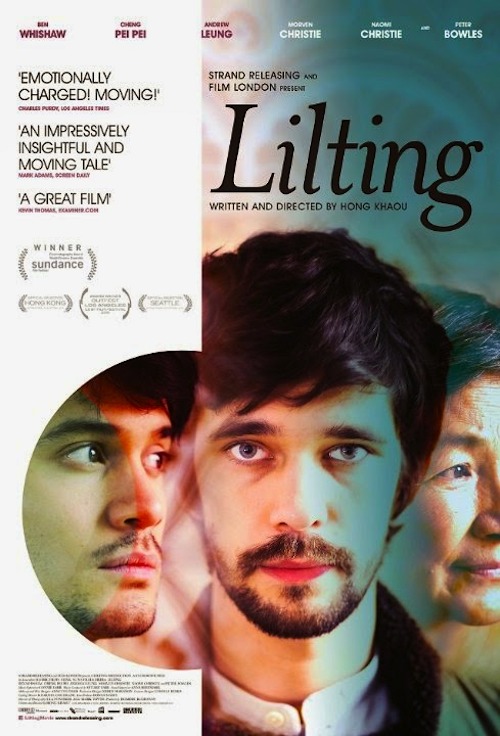
Cheng Pei-pei in the Spotlight: LFM Reviews Lilting

By Joe Bendel. Accurate translations are important in summit conferences and business meetings, but the ethics are a bit trickier on the personal level. A first time translator interpreting for an elderly nursing home couple will grapple with questions of how much and faithfully she should relay their words to each other. However, there are even greater unresolved personal issues lingering between the man who hired her and the Cambodian-Chinese woman utilizing her services in Cambodian-born British filmmaker Hong Khaou’s Lilting, which opens this Friday in New York.

Junn’s time in the nursing home was supposed to be temporary, but her son Kai was tragically killed in a traffic accident before he could arrange a new living situation for her. Unfortunately, she could not have moved in with him, because she never would have accepted his relationship with Richard. After Kai’s death, Richard tries to look after Junn out of a sense of loyalty, but she begrudges his presence, mistakenly blaming him for her current circumstances.

At least the home brought her together with Alan, a British pensioner who cannot speak any Chinese or Cambodian dialects. Nonetheless, they seem to enjoy each others’ company. Wanting to help facilitate their romance, Richard recruits Vann to translate. It works well for a while, perhaps even softening Junn’s attitude towards her late son’s “roommate,” but the mourning mother might be too set in her ways to allow any of her inter-personal relationships to deepen or evolve.

Cheng Pei-pei never flashes her kung-fu moves in Lilting, which is somewhat disappointing, but the Come Drink with Me star’s straight-forward acting chops are impressive enough. It is a restrained but devastating portrayal of grief and resentment. Never sugarcoated, Cheng’s performance shuns sentimentality and theatrics, quietly going to some very deep and dark places.

While many will also focus on James Bond franchise alumnus Ben Whishaw’s co-starring turn, the film’s real discovery is Naomie Christie. Her acutely perceptive work as Vann in many ways functions as the viewer’s entry point. She is even more of an outsider to the proceedings than Richard, yet she too finds herself forming judgments and allowing herself to become emotionally involved.

Lilting represents quite an accomplished feature directorial debut from Hong, who masterfully maintains a mood of exquisite sorrow, nicely abetted by the sensitive, Sundance award-winning cinematography of Ula Pontikos. It is a graceful film with understanding for all and malice towards none. Recommended for Cheng’s fans who wish to see the icon in a whole new light, Lilting opens this Friday (9/26) in New York at the Angelika Film Center.

LFM GRADE: B+

Posted on September 24th, 2014 at 4:04pm.

LFM Reviews: Jacky in The Kingdom of Women @ The 2014 Fantastic Fest

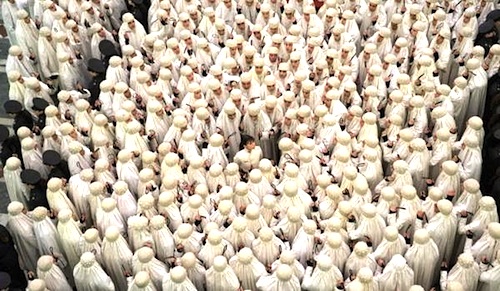
By Joe Bendel. Islamist apologists always assure us that Muslim women feel more comfortable and empowered in restrictive clothes. Here’s their chance to try the burqa on for size. In the backward fictional nation of Bubunne, women have all legal authority and subjugate their uneducated men like chattel. One sad sack man-victim harbors a deep crush on the supreme leader’s heir apparent-daughter, but he has lost his ticket to the grand ball in Riad Sattouf’s satirical Cinderella-riff, Jacky in the Kingdom of Women, which screens during the 2014 Fantastic Fest.

As a male “pleb,” Jacky is about as low as it gets in Bubunne, but women find him attractive (there’s no accounting for taste in this militarist theocracy), so he has always hoped General Bubunne XVI’s daughter, logically known as The Colonel, would choose him to be her “Big Dummy.” Unfortunately, when Jacky’s mother dies, his mean aunt and uncle give his ticket to the cattle-call ball to his ugly cousin. Yet, through a series of misadventures, Jacky will somehow gatecrash the soiree, disguised as a woman, Twelfth Night style.

Although the official religion of Bubunne venerates horses instead of a prophet, it is not hard to see what it is based on. Given the chadors worn by men, the frequent denunciations of blasphemy, public executions, and rampant sexism and homophobia, if you cannot recognize Bubunne as an analog for the Islamist regimes, you are willfully blind enough to work children’s protective services in Rotherham.

It is therefore little exaggeration to describe Sattouf’s screenplay as extraordinarily bold, but twenty-first century viewers might wish his satire came with more jokes. However, the audience that could probably stand to gain the most from seeing the gender tables turned is not exactly known for its collective funny bone. Subtlety can also be an iffy proposition, but Kingdom’s depiction of religiously justified oppression should be in-your-face enough to register some kind of response (like a fatwa).

From "Jacky in The Kingdom of Women."

Charlotte Gainsbourg’s performance as the Colonel is also rather brave, for a host of reasons that would be spoilery to explain. It is safe to say she is a good sport, whose mysterious screen presence perfectly suits the film. However, Vincent Lacoste’s Jacky is so passive and pathetic, viewers will want to bully him along with the rest of the film’s villains. At least Michel Hazanavicius brings some redemptive verve as Julin, an underground propagandist who was close friends with Jacky’s late father. Anémone (co-star of the beloved holiday classic, Santa Stinks) also shows a flair for physical humor as the miserable old General.

Kingdom earns considerable points for satirizing subjects that consider themselves off limits to such treatment, but the characters and narrative never really engage on an emotional level. Still, when it is funny, the jokes also land with a sting. Recommended on balance for free-thinkers, Jacky in the Kingdom of Women screens again this coming Monday (9/22) as part of this year’s Fantastic Fest.

LFM GRADE: B-

Posted on September 20th, 2014 at 10:11pm.

Terry Gilliam Goes Back to the Dystopian Well: LFM Reviews The Zero Theorem

By Joe Bendel. Evidently, there is good money to be made from metaphysical nihilism. How so, you might ask? Well, obviously you are not an evil businessman or you would see it plain as day. For the rest of us mere mortals, it remains a gaping narrative hole in Terry Gilliam’s The Zero Theorem, which opens this Friday in New York.

Qohen Leth is a programming drone who is slaving away, crunching the Zero Theorem, the grand unified theory of life’s meaninglessness, at the behest of his boss, “Management,” the charismatic chairman of Mancom. Evidently, the corporate predator stands to make a lot of money if he can prove the primacy of nothingness. However, Leth lives in the hope that he will soon receive a phone call that will finally give him the inner peace he yearns. (Careful of your shoes, because the irony is laid so thick here, even other characters pick up on it.)

Although practically a shut-in, Leth manages to befriend Bainsley, a professional party-girl and web-stripper and Management’s troubled cyber-repairman son Bob, (most likely through some calculating outside intervention). Nevertheless, Bob’s rebellious streak is genuine, but tragically so are his congenital health issues.

The good thing about Zero T is it looks like a Terry Gilliam film. Leth’s lair is a masterwork of cyber doodads, human detritus, and near future urban decay. Likewise, the Mancom set pieces are suitably large and eccentric. Unfortunately, Pat Rushin’s screenplay was apparently a belated afterthought, recycling wholesale tropes from Gilliam’s vastly superior Brazil. In fact, Zero T even lifts the ending (or rather one of the endings), minimally adapting it to fit the modestly altered circumstances.

From "The Zero Theorem."

Granted, Christoph Waltz truly goes for broke as Leth, over and beyond shaving his eyebrows. He also develops some intriguingly ambiguous chemistry with Mélanie Thierry’s Bainsley. Yet all his heavy-lifting is undermined by an over-abundance of clichés and cringingly broad characters, while internal logic remains dashed scarce.

By far, the greatest embarrassment is the ridiculous looking Matt Damon, trying to come across like a scary adult. He might be going for a J.R. “Bob” Dodds from the Church of the SubGenius kind of thing, but he just cannot carry himself convincingly. Still, in all fairness, it must be admitted that Tilda Swinton gives a considerably subtler performance as Dr. Shrink-Rom the corporate psycho-babbler than her mean-spirited Thatcher caricature in Snowpiercer.

This is one of those films you want to be so much better than it really is, especially considering that Gilliam doesn’t exactly churn films out like Woody Allen. Frankly, the far less heralded The Scribbler is a much better mind-trip. A real disappointment, The Zero Theorem opens this Friday (9/19) in New York at the IFC Center.

LFM GRADE: C-

Posted on September 18th, 2014 at 9:43pm.

He Cometh Anew: LFM Reviews Iceman

By Joe Bendel. He Ying is sort of a Ming era Austin Powers. The disgraced Imperial Guard certainly kicks things off in a similar fashion when he is re-animated amidst modern day Hong Kong. Just why a cabal of shady characters was ferrying about his incubator in the first place is a question that may or may not be answered in Law Wing-cheong’s Iceman, which opens this Friday in New York.

In 1621, He Ying was set up by his comrade Cheung and their sworn brothers Sao and Niehu dutifully believed it. Flashforward to modern Hong Kong, where the truck carrying He Ying, Sao, and Niehu’s cryo-pods meets with a freak accident. He is the first to awaken, but Sao and Niehu soon start tracking him. Initially just as confused by the plot as the audience, He falls in with May, a Mainland immigrant supporting her institutionalized mother as a club hostess. It turns out he happens to have some very valuable knick-knacks on his person that will help pay her overdue bills. He also has some highly motivated enemies on his tail. Further complicating matters, his old nemesis Cheung is apparently serving as the deputy police commissioner.

From "Iceman."

Loosely based on Clarence Fok’s The Iceman Cometh, Law’s Iceman features a couple of awesome action scenes, but they come amid an awful lot of fish-out-of-water dilly-dallying. One thing you won’t find in there is a sense of resolution. Instead, it ends with a tease for the forthcoming part two. Wisely, it promises more action, because the characters and humor of part one may not have a lot of fans clamoring for more.

Of course, Donnie Yen is awesome getting down to business, but he looks about as stiff as a four hundred year old warrior-cycle in his comedic scenes. Fortunately, the always reliable Simon Yam does his villainous thing as Cheung. Since Law is a Johnnie To protégé, you know it is only a matter of time before Lam Suet shows up. In this case, he largely steals the show as Tang, an outrageously crooked politician. Eva Huang Shengyi gives May a bit of an edge, which is nice, but Wang Baoqiang and Yu Kang are largely non-factors as the other icemen.

The big action set pieces will temporarily please genre diehards, but the humor just does not travel well. Still, hope springs eternal for part two. For part one, Yen and Lam fans can safely wait to rent, stream, or demand. Regardless, Iceman opens theatrically tomorrow (9/19) in New York at the AMC Empire.

LFM GRADE: C

Posted on September 18th, 2014 at 9:43pm.

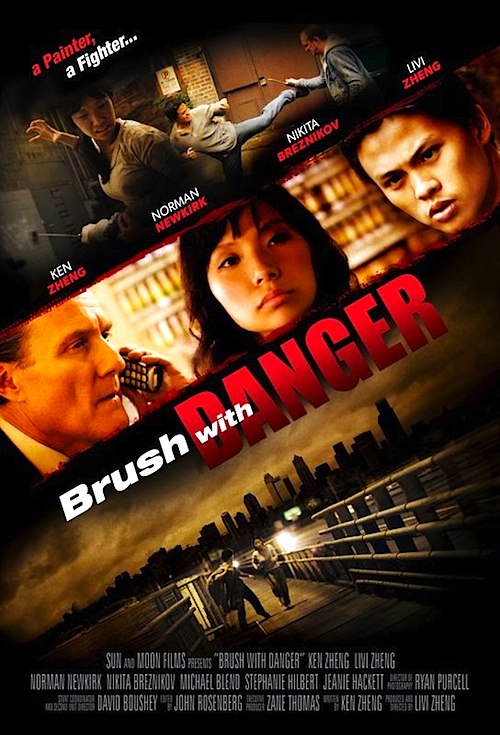
Art and Action in Seattle: LFM Reviews Brush with Danger

By Joe Bendel. These undocumented siblings do the sort of jobs native-born Americans just won’t do, like forging a Van Gogh and boxing in unregulated after hours bouts. To be fair, she is highly conflicted about the former, whereas he faces plenty of home grown talent in the latter. Their legal status is precarious, but their spirit is indomitable in Livi Zheng’s Brush with Danger, which opens this Friday in New York.

Alice and Ken Qiang were two of the lucky ones, who survived their cargo container transit to America. They came in search of a better life, but they also had to get out of Dodge fast. They have practically nothing to their names, except for some of her paintings that they will try to sell on the streets. They also have skills, which is part of the reason why they had to leave in a hurry. Yet, despite Alice’s reluctance, the Qiangs discover they can quickly fill a hat with their street displays of martial arts and acrobatics. Gallerist Justus Sullivan also notices them doing their act, but it is Alice’s work that really catches his eye.

Playing the role of patron, Sullivan moves the Qiangs into his McMansion, so Alice can finally live up to her potential. To keep Ken busy, Sullivan introduces the impetuous kid to his associate running Seattle’s underground fight circuit. Soon Ken is earning his own illegal spending money, fair and square. However, just when Sullivan asks if maybe Alice wouldn’t mind doing an extremely high quality reproduction—for a terminally ill friend, mind you—Det. Nick Thompson starts snooping around.

Brush is the directorial debut Livi Zheng, an Indonesian-born former stuntwoman and NCAA karate competitor. It does indeed have some of the roughness you might associate with first features, but she and her real life kick-boxer brother Ken are totally convincing in the action scenes. In spite of some narrative slack, Zheng keeps it well paced and Norman Newkirk adds some memorable villainous charm as Sullivan.

Frankly, the problem is it is all too nice. The Zhengs are hugely likeably rooting interests and former cop-turned-wrestler Nikita Breznikov is rather likable as Det. Thompson, in a doofus kind of way. Even Sullivan is kind of nice (although some of his angry associates are definitely not). Still, if you had to choose a movie bad guy to have lunch with, he should be at the top of the list.

So if everyone is nice, does that mean the movie is nice too? Unfortunately, that probably constitutes a fallacy of composition. Regardless, it is impossible to root against the Qiangs and the Zhengs, who are already at work on their next action picture. If they maintain their earnestness and add some narrative edge, they could really get somewhere. For now, Brush with Danger opens this Friday (9/19) in New York at the Cinema Village.

Posted on September 18th, 2014 at 9:42pm.