LFM Reviews Hello! Junichi @ Japan Cuts

By Joe Bendel. Junichi Hayashida is a naturally empathetic kid. Unfortunately, that does not impress a lot of third graders. However, he might gain a little bit of confidence through time spent with his five friends and their bombshell student teacher. Being a kid is hard, but it still has its moments in Katsuhito Ishii, Kanoko Kawaguchi & Atsushi Yoshioka’s Hello! Junichi, which screened as part of the 2014 Japan Cuts: the New York Festival of Contemporary Japanese Film.

Anna-Sensei makes quite an impression on everyone, especially Hayashida’s romantically frustrated homeroom teacher. However, he still only has eyes for Maeda. During art class, he found himself borrowing a bunny eraser from her, but he has yet to gird up the courage to return it. This is the sort of thing Anna-Sensei picks up on immediately. Initially, this intimidates Hayashida, just like everything else in life, except more so. Yet, he comes to trust her when she defends him and his mates when they get into a tight spot.

Although Junichi’s parents are well to do, he spends more time with more-with-it-than-he-seems grandfather. Unfortunately, his friend Masato Kuramoto’s home life is much more difficult. Money is tight, so his soon-to-be single mother must work multiple jobs. To help him give her special birthday, Hayashida and his friends agree to stage a special concert for her, with Anna-Sensei’s help, of course.

In terms of tone, Hello is reminiscent of Ishii’s The Taste of Tea, but it substitutes moments of wild but terrestrial zaniness for the magical realism of his Tochigi-set family pastoral. Co-directed with two of his workshop graduates, Hello balances a battalion of characters with ease. They mostly maintain a mood of wistful whimsy, but it still forthrightly addresses the issue of bullying.

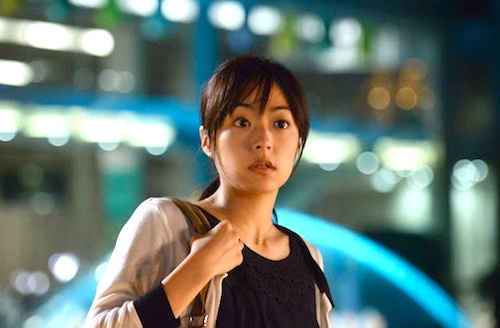
Hikari Mitsushima, who took no prisoners in Sion Sono’s Love Exposure, once again becomes a force of nature as Anna-Sensei, the Miss Jean Brodie we always wanted. She develops some real chemistry with her young co-stars and looks great beating on the various adults who cross her. Still, young Amon Kabe distinguishes himself, carrying the narrator-chief POV duties like a good little soldier.

From "Hello! Junichi."

Likewise, Yohei Hotta and Rio Sasaki are remarkably compelling as the gruff but sensitive Kuramoto and the forceful aspiring pop idol, Kayo Tanaka. Frankly, the all the third grade supporting players are quite assured. It is some of their adult counterparts who get a bit shticky (but not enough to undermine the film’s good vibes).

Anna-Sensei’s magnetism is undeniable and her kids are all quite endearing. As a result, it is hard to imagine anyone would not be won over by Hello’s charm. Gentle but relatively true to life, it is perfect for family viewing. To that end, the Japan Society is offering a special $6 admission deal for children twelve or younger. Recommended with affection, Hello! Junichi screened yesterday, the closing day of this year’s Japan Cuts.

LFM GRADE: B+

Posted on July 21st, 2014 at 10:26am.

LFM Reviews Man from Reno @ Japan Cuts

By Joe Bendel. Mystery novelist Aki Akahori’s Inspector Takabe is like a Japanese Maigret, but her life is about to turn into a Mary Higgins Clark novel, except darker. A chance encounter with a seductive stranger leads to more intrigue than Akahori bargained for in Dave Boyle’s Man from Reno, the best narrative award winner at the 2014 L.A. Film Festival, screens as part of this year’s Japan Cuts: the New York Festival of Contemporary Japanese Film.

Although Takabe rules the Japanese bestseller lists, Akahori is uncomfortable with her success. Tired of her celebrity status, she deserts her publicity tour, taking refuge in San Francisco, where she once went to school. In her hotel, she meets a handsome Japanese tourist from Reno, or so she deduces. She did not have a tryst in mind, but she eventually yields to his charms. However, just when things start heating up, he precipitously vanishes. Even more disconcerting are the total strangers who suddenly want to take a quick look-see in her room.

Just north of town, Paul Del Moral, the sheriff of San Marco, is also searching for a Japanese man. In this case, it is the individual he accidentally hit during severe fog-in, who up and left the hospital in an equally rash manner. Soon a dead body turns up in San Marco who seems to have some connection to the fellow Del Moral dubbed “Running Man.” Inevitably, Del Moral’s investigation will lead him to the increasingly uneasy Akahori.

Reno represents a quantum step up for Boyle, whose previous films, like White on Rice, have been largely classifiable as romantic comedies. His frequent collaborator Hiroshi Watanabe is also back in the fold, but this time around he plays a strictly serious supporting role. Instead, Ayako Fujitani and veteran character actor Pepe Serna take star turns as Akahori and Del Moral, respectively. Expect to see more of them because they both make major statements with their smart, charismatic, yet understated performances.

From "Man from Reno."

As thrillers go, Reno (co-written by Boyle, Joel Clark, and Michael Lerman) has several fresh twists and it nicely captures the between-worlds vibe of the expatriate lifestyle. Technically polished, Richard Wong’s evocatively noir cinematographer also heightens the tension during several key scenes.

Murkier than one might expect, Reno is an effective, somewhat romantic suspenser that never rushes to tip its hand. However, it even more appealing to see a film anchored by people who look like Akahori and Del Moral. Granted, Fujitani is a beautiful woman, but in a mature, cerebral manner. Likewise, Serna is wonderfully grizzled, in a confidence-inspiring way. They are terrific, carrying the film relay-style during their many solo scenes. Highly recommended, Man from Reno screens tomorrow (7/19) at the Japan Society as part of the 2014 Japan Cuts.

LFM GRADE: A-

Posted on July 18th, 2014 at 11:34am.

LFM Reviews Unforgiven @ Japan Cuts

By Joe Bendel. For Jubei Kamata, it is the end of an era—the Tokugawa Era. The former samurai-assassin used to kill with impunity and then he simply killed to stay alive, but he gave up killing at the behest of his beloved late wife. However, killing is a skill you never forget. Reluctantly, Kamata digs up his sword for a final violent errand in Sang-il Lee’s Unforgiven, an inspired cross-cultural remake of Clint Eastwood’s Oscar-winning western, which screened during this year’s Japan Cuts: the New York Festival of Contemporary Japanese Film.

In a remote frontier village on Hokkaido Island, two ranchers brutally disfigure Natsume, a young prostitute. Rather than prosecute them, local police chief Ichizo Oishi merely requires the former samurai pay restitution to the brothel owner. Outraged by his callous disregard for Natsume’s suffering, her fellow prostitutes pool their money to place a bounty on the offending settlers.

Old Kingo Baba intends to collect that bounty, so he tries to recruit his old samurai comrade Kamata, a.k.a. “Jubei the Killer.” Already haunted by his past carnage, Kamata dearly wishes to keep his promise renouncing violence. Unfortunately, a disastrous harvest leaves him no other option to provide for his young son and daughter. Soon, Kamata and Baba are joined by Goro Sawada, an impulsive would-be outlaw, who also happens to be half Ainu (the indigenous people of Hokkaido and Sakhalin). As it happens, Kamata’s late wife was also Ainu, giving the two men a distant kinship and a shared outage at the Meji government’s repression of Ainu customs.

Arguably, the Ainu element further deepens the Unforgiven story beyond the Eastwood’s revisionist critique of a violent, misogynistic American west. Closely paralleling the original, Lee’s adaptation perfectly fits within the rough and tumble early Meiji northern provinces, where many former Shogunate ronin sought refuge.

From "Unforgiven."

Ken Watanabe (who starred in Eastwood’s Letters from Iwo Jima) is impressively hard-nosed and world weary standing in for his former director. Akira Emoto’s nervous energy playing Baba is a bit of a departure from Morgan Freeman’s analog, but it works well in context. Koichi Sato is smoothly fierce in the Hackman mold and Shiori Kutsuna is devastating as the disfigured (but still beautiful) Natsume. Yet, it is evidently still hard to get the balance of exuberance and angst right for Sawada/the Schofield Kid.

Cinematographer Norimichi Kasamatsu gives the Hokkaido vistas the full John Ford treatment, while Lee invests the action sequences with a tragically operatic vibe. It is a gritty period production that represents a triumph return to the tradition of Jidaigeki films and westerns riffing and channeling each other. Frustratingly, it is also a reminder of how rare the contemporary western has become in Hollywood, even though Japanese cinema continues to find creative grist in its national history. Highly recommended for fans of moody westerns and samurai films, Unforgiven screened as part of the 2014 Japan Cuts.

LFM GRADE: A-

Posted on July 17th, 2014 at 9:48am.

LFM Reviews K: Missing Kings

By Joe Bendel. Shizume City appears to be a futuristic metropolis, but beneath the surface, it is like feudal Scotland. Secret clans forge alliances and rivalries, fueled by their unique powers. Kuroh Yatogami and his feline fellow clan member Neko have been looking for Yashiro Isana, the Silver King, who ominously vanished after what fans know as the “Academy Island Incident.” Their fruitless search will be interrupted by more inter-clan conflict in Shingo Suzuki’s K: Missing Kings, the feature length sequel to the hit manga and anime series, which opens this Friday in major markets.

The Silver Clan members are not the only ones struggling with potential losses. The Red Clan, known as HOMRA, has essentially been in hiding, largely out of touch with each other. For some reason, the Green Clan (a.k.a. Jungle) is hunting Anna Kushina, a young HOMRA member with Professor X-like powers. The two Silver Clan members will team up with Kushina’s protector, Rikio Kamamoto as best they can, but they are temporarily overmatched by Yatogami’s old nemesis and his super-charged ninja accomplice. As a result, an unlikely request for help will be made to Scepter 4, the icily efficient Blue Clan.

Unlike many feature incarnations of popular anime franchises, Missing Kings is not an inconsequential side adventure shoehorned into the established timeline. It advances the storyline in significant ways. That means there are real stakes involved. While that makes it a high priority for the existing fan base, newcomers are not given much exposition to get up to speed with. Granted, viewers should be able to pick up on the basic elements of X-Men and various conspiratorial hidden history motifs at play. However, the relationships between the various clans will be richer and far more comprehensible to those who are familiar with their shared histories.

From "K: Missing Kings."

Fortunately, there is a lot of good action in Missing Kings, starting with a highly cinematic raid on the Gold Clan’s corporate headquarters. In quieter moments, it spins out some legitimate character development arcs, particularly for Yatogami and Kushina. Returning writer GoRa also answers some lingering questions from the series, while still leaving plenty unresolved.

A high quality anime production, Missing Kings looks great and sounds surprisingly hip thanks to a jazzy-quiet storm-ish soundtrack. The faithful should be well satisfied, but it is still an awkward entry point for the uninitiated. Recommended for fans or those who just want to see some well executed anime action, K: Missing Kings opens in some markets this Friday (7/18), but screens Saturday and Monday (7/19 & 7/21) in New York at the Village East. Check for local listings at Eleven Arts site here.

Posted on July 17th, 2014 at 9:47am.

LFM Reviews Gaamer @ The Odessa International Film Festival

By Joe Bendel. Really good film festivals are not just an assortment of screenings. They provide a sense of community. Every year, I look forward to fests like Sundance, NYAFF, and the Bosnian-Herzegovinian Festival because of the people I expect to see there. That is why the continuation of the Odessa International Film Festival represents a small but significant victory for Ukraine’s cultural sector. Unfortunately, there is one particular filmmaker who will not be able to attend.

Pro-Ukrainian democracy activist Oleg Sentsov was arrested by the Russian military while attempting to smuggle food to barricaded Ukrainian military personnel in the occupied province of Crimea. He is now being held on trumped up terrorism charges, awaiting a show trial in Moscow. To date, Ukrainian consular personnel have been denied access to Sentsov, in clear violation of diplomatic law and custom. In his place, Sentsov will be represented at this year’s inspiringly defiant OIFF with his 2011 feature directorial debut, Gaamer, which has a special screening this Tuesday.

Ostensibly, there are no political implications to be gleamed from Gaamer. The extra “a” represents a distinctively Slavic pronunciation of “gamer” adopted by video game fanatics in parts of Eastern Europe. Sentsov was once part of the subculture, just like his protagonist. Alex is an unrepentant underachiever. However, under his gamer handle Koss, he is one of the top players of the first-person shooter Quake in his depressed post-industrial town.

Much to his long suffering mother’s frustrations, Alex/Koss has been expelled from his technical school, preferring to idle his time away in a computer gaming parlor, presumably much like the one Sentsov once managed. When he places highly in a local tournament, he is recruited by one of the top national teams. At least he will have free gaming for the near future, but then what?

It is tempting to try to read further political significance into the work of filmmakers like Sentsov or Iranian dissident Jafar Panahi, because you would think it has to be in there somewhere to justify such heavy-handed human rights abuses. However, there is absolutely no commentary on neo-Soviet Imperialism to be found in Gaamer.

Instead, it is a film about lifestyle choices and their consequences. Specifically, it examines the awkward period when gaming loses its thrill. After all, a video game is by its nature fleeting and apparently Quake is one of those games that always ultimately ends with a player’s in-game death. So just what does Alex/Koss have to show for his monitor time?

Frankly, Putin would probably prefer an anesthetized Ukraine, lulled by video games or whatever into a state of extreme myopia. In that limited sense, Gaamer’s get-out-and-get-involved-in-life message is somewhat at odds with his expansionist agenda. However, the truth of the matter is Sentsov was simply rounded up for being a prominent ethnic Ukrainian in the Crimea, with a history of democratic activism.

Clearly, Sentsov also understands the characters of Gaamer and the worlds in which they interact. Vladislav Zhuk is totally convincing as the socially underdeveloped Alex/Koss, but his distant, cipher-like nature is sometimes frustrating. While it is not exactly a showy role, Zhanna Biryuk perfectly calibrates her performance as his mother.

From "Gaamer."

All things considered, Gaamer is a very promising first feature. It has its odd rough edges and pacing issues here and there, but those who see it would be intrigued enough look out for Sentsov’s follow-up film. Unfortunately, production on what was to be called Rhino was postponed due to the Maidan Square protests and the Russian invasion. Any serious filmmaker like Sentsov deserves to have a chance to develop his art over the course of several pictures, but his abduction and incarceration now makes that impossible. Even Putin-approved filmmaker Nikita Mikhalkov has (somewhat boldly) joined the chorus of voices demanding his release.

If you happened to be in Odessa attending the screening of Gaamer on Tuesday (7/15), that was a great way to show solidarity, while seeing a good movie in the process. For the rest of us, light up the social networks and online petitions. Free Oleg Sentsov.

LFM GRADE: B+

Posted on July 16th, 2014 at 10:39am.

LFM Reviews The Snow White Murder Case @ The 2014 Japan Cuts and New York Asian Film Festival

By Joe Bendel. Nobody in their right mind would call Mao Inoue homely and the young actress playing her middle school aged self has to be one of the cutest kids ever. Yet, those caught up in the mob mentality will believe anything. Group think in its many guises, including social networking, scandal mongering journalism, and peer pressure, stands thoroughly indicted in Yoshihiro Nakamura’s The Snow White Murder Case, which screens as a co-presentation of the 2014 Japan Cuts and New York Asian Film Festival.

Noriko Miki was Little Ms. Perfect at her cosmetic company (makers of Snow White soap). Outwardly beautiful and gracious, she was actually manipulative and mean. She also happens to be dead, having been found stabbed repeatedly and then burned to beyond recognition. The media will chose to print the legend, led by TV news part-timer Yuji Akahosi, who sees his relationship with one of the murdered woman’s co-workers as his opportunity to hit the big time. During their interview, Risako Kano not so subtly casts suspicions on Miki Shirono, referred to in his reports as “Miss S.”

In subsequent interviews, their fellow co-workers are eager to follow Kano’s lead, especially since Shirono has conveniently disappeared. Slowly, old high school and college friends emerge to defend Shirono. As they tell their stories in flashbacks, viewers see a pattern of bullying develop in her formative years. Yet, Akahosi doubles down on his narrative, egging on the internet’s baying hounds.

Ostensibly a mystery, Snow White is really the sort of film that rips your heart out and stomps on it. All three actresses playing Shirono are just overwhelmingly endearing and vulnerable. Viewers with any sliver of sympathy will be deeply moved by her/their sensitivity and indomitable faith the future will somehow be better.

From "The Snow White Murder Case."

Snow White was adapted from Kinae Minato’s novel, as was Tetsuya Nakashima’s incendiary Confessions—and it is easy to see a kinship between the two, especially in the way students’ causal cruelty leads to major macro consequences. However, Nakamura’s film does not leave audiences feeling so bereft and numb.

In addition to Inoue and her fellow Sironos, Shihori Kanjiya and her younger alter ego are terrific as Miss S.’s loyal but emotionally stunted childhood friend, Yuko Tanimura. Arguably, Go Ayano is appropriately vacuous and annoying as Akahosi, in a hipster Williamsburg kind of way. Yet, it is TV actress Nanao in her first feature role as Miki, who really gives the film a disconcerting edge.

Considering how intricately plotted Snow White is, the final resolution comes surprisingly quickly and cleanly. Nevertheless, witnessing Shirono’s life is an experience that really gets into your soul. Indeed, its genre trappings are rather deceptive, dressing up an intensely personal drama that steadily expands in scope. Highly recommended, The Snow White Murder Case screens today (7/11) at the Japan Society, as a joint selection of this year’s NYAFF and Japan Cuts: the New York Festival of Contemporary Japanese Film.

LFM GRADE: A-

Posted on July 11th, 2014 at 11:52am.