LFM Reviews Why Don’t You Play in Hell? @ The 2014 Japan Cuts and New York Asian Film Festival

By Joe Bendel. Which is a greater menace to society, the Yakuza or independent filmmakers? It hardly matters, because when they join forces, there will be blood on the floor. We are talking wall-to-wall pooling here. Yes, this is a Sion Sono joint, so get your game face on when Why Don’t You Play in Hell? screens as a joint presentation of the 2014 New York Asian Film Festival and Japan Cuts.

Ten years ago, scruffy would-be teen filmmaker Hirata Don and his two camera-operating chums first met Sasaki, their supposed martial arts star. On that fateful day, they also crossed paths with Jun Ikegami, a profusely bleeding yakuza. He was supposed to assassinate Taizo Muto, a rival clan leader, but they ran into his wife Shizue instead. Only Ikegami survives her wrath, but not before getting a severe dressing-down from her ten year old daughter, Michiko.

Michiko had been well on her way to being Japan’s sweetheart, based on her perversely catchy TV toothpaste commercial, but her mother’s murder convictions derail her career. Feeling understandably indebted to his wife, Muto promises to establish their daughter in the movies before her release. However, the now punky and petulant Michiko walked away from her legit film debut, forcing the studio to recast. With mere days left before Shizue’s parole, Muto needs to find a production for Michiko fast. You see where this is going? Eventually, Don’s dubious crew will hook up with Muto’s clan, but everyone thinks the director is Koji Hashimoto, a poor schmuck on the street Michiko roped into her madness.

From "Why Don’t You Play in Hell?."

With no time to write a proper script, Don opts to film Muto’s war with Ikegama verite-style. Buckle up, because there is going to be a body count. When it comes to over-the-top, outrageously gory comedic violence, Sono’s latest film stands tall, in a field all its own. The sheer level of mayhem Sono unleashes in the third act would even leave Itchy & Scratchy slack-jawed. It is impressive.

Amid all the carnage, there is also something of a valentine to filmmaking and an affectionate eulogy for old school 35mm. It also features one of the greatest and fiercest performances by a child actor, maybe ever, but it will probably be a good eight or ten years before Hara Nanoka’s parents let her see her work as young Michiko. As the older Michiko, NYAFF Rising Star Award winner Fumi Nikaido smoothly picks up the baton and proceeds to bash just about everyone with it. It is a butt-kicking star turn, but nobody can out hard-nose Jun Kunimura (Boss Tanaka in Kill Bill vol. 1, which seems so tame in comparison) as the steely but devoted Muto.

On the Sion Sono spectrum, this is more polished than Bad Film, but more ragged around the edges than Love Exposure. Regardless, whatever you think WDYPIH is, raise it to a power of ten. Highly recommended for cult film connoisseurs who have a general idea what they are getting into, Why Don’t You Play in Hell? screened yesterday at the Japan Society, as a joint selection of this year’s NYAFF and Japan Cuts.

LFM GRADE: A-

Posted on July 11th, 2014 at 11:27am.
Momoa Rides Through the Mojave: LFM Reviews Road to Paloma

By Joe Bendel. It is like Easy Rider, except there is a reason for the angst and defiance. When Robert Wolf’s mother suffered a brutal attack, the Feds, being Feds, declined to prosecute the case. It was just too much work. However, when Wolf took the law into his own hands, they made his capture a top priority. There will not be a lot of sunsets for the biker and his new traveling companion to ride off into during Jason Momoa’s directorial debut, Road to Paloma, which opens this Friday in New York.

Wolf is a lot better at being a drifter than the self-destructive rocker, Cash Guirgis. Nevertheless, they ride together for a while, sharing some colorful encounters on the road. Wolf has secretly picked up his mother’s ashes from his estranged reservation policeman father, to spread in accordance with her wishes. Anticipating he might do something like that, Special Agent Williams grabs a reluctant local white copper and heads into the Mojave after him.

Wolf and Guirgis will see some scenery worthy of John Ford on their journey, stopping along the way for some bare-knuckle brawling and a little bit of loving. For Guirgis that means lap-dances, but Wolf prefers using his mechanical skill to seduce Magdalena and her broken down vintage car. It is nice for a while, but it the law is never far behind.

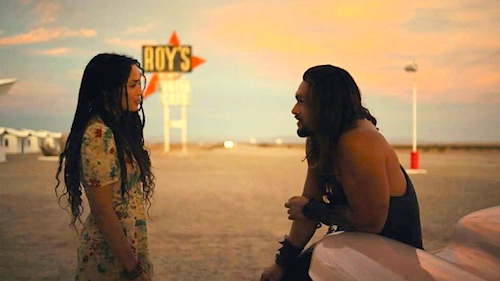
Frankly, Paloma is far more sensitive and moodier than you would expect from Jason Momoa’s WWE-distributed motorcycle-powered directorial debut. Small in scope, it is much more closely akin to his Sundance series The Red Road than Game of Thrones or Conan. They both feature Native themes, as well Momoa’s wife, Lisa Bonet. Regardless, Paloma’s cinematic vistas and alienated vibe are surprisingly effective. On the other hand, Momoa largely wastes the timelessly cool character actors Lance Henriksen and Wes Studi (who has a bit more to do than the former).

From "Road to Paloma."

As his own lead, Momoa is a serviceable renegade-brooder. He also generates some decent heat with Bonet, as well they should. Even in his brief scenes, Studi shows everyone how it is done, but it might co-writer Robert Homer Mollohan who makes the strongest impression as the reckless Guigis. Unfortunately, Timothy V. Murphy’s unapologetically serpentine Williams just does not ring true. Feds are nothing if not politically astute, so the degree he goes about antagonizing local law enforcement feels more like a clichéd contrivance.

Although it has some swagger, Paloma is not a meathead movie. It is a rather dark, character-driven affair that has a real point to make. Essentially, Momoa, Mollohan, and co-writer Jonathan Hirschbein suggest federal jurisdiction over crimes committed by outsiders on reservation land has created an incentive for predators to prey on Native victims. That is the good old Federal government at work. Recommended on balance, Road to Paloma opens this Friday (7/11) in New York at the Quad Cinema.

LFM GRADE: B-

Posted on July 11th, 2014 at 11:27am.

LFM Reviews The Face Reader @ The 2014 New York Asian Film Festival

By Joe Bendel. It is not quite fair to lump physiognomy together with phrenology, because the shrewder readers largely supplement the pseudo-scientific analysis with Sherlockian deduction. Kim Nae-gyeong happens to be one of the better ones, but it is not hard to read the ambition written all over Grand Prince Su-yang’s face. Unfortunately, Kim’s family will be engulfed in the ensuing royal power struggle during the course of Han Jae-rim’s The Face Reader, which screened during the 2014 New York Asian Film Festival.

As the son of a disgraced nobleman, Kim prefers to lay low and eke out a modest living with his bumbling brother-in-law, Paeng-heon. However, his renown as a face reader leads super-connected brothel owner Yeon-hong into tricking him into her employment. Fate shifts quickly in the Joseon era, though. A pro bono gig for the gendarmerie attracts the attention of the venerable deputy prime minister, General Kim Jong-seo, who whisks him off to work with the inspection board evaluating new officials. One of the candidates he approves happens to be his son, Jin-hyeong, who has renounced his name for the sake of a career.

Impressed by his work, the general and the king task the face reader with detecting the traitors within their midst. Obviously, the king’s brother is the leading candidate, but the king dies before Kim gets a good hard look at him. As the grand prince consolidates his hold on the military and the nobility, the face reader scrambles to protect the newly crowned twelve year old king and his guileless son.

Evidently NYAFF’s special guest and Korean Actor in Focus, Lee Jung-jae has quite the fearsome countenance. You would not want to trifle with him in Park Hoon-jung’s wickedly entertaining gangster film New World, either (which also screened this week). While there is plenty of Richard III in his ruthless usurper, Lee puts an intriguing spin on the character.

From "The Face Reader."

Although Face Reader is the first costume role for Snowpiercer’s Song Kang-ho, a sad clown like Kim Nae-gyeong is totally in his wheel-house. Yet, it is Jo Jeong-seok who really lowers the emotional boom, despite Paeng-heon’s deceptively rubber-faced demeanor. On the other hand, Lee Jong-seok’s Jin-hyeong has little presence throughout the film, mostly looking like he has just had his stomach pumped. Such is not the case with Baek Yun-shik, who brings all kinds of grizzled gravitas as General Kim (he has the face of a lion, by the way), while Kim Hye-soo’s courtesan functions as the smart and sophisticated witness to the tale of woe.

Face Reader acts as a corrective to many period action epics, in which a handful of motivated swordsmen can easily scythe through an imperial army. It is also unrepentantly tragic, which meant boffo box-office in South Korea, out-grossing Iron Man 3. Yet, for international audiences, the way karma ironically asserts itself during this chaotic era will be the thing that really sticks. Not surprisingly, it clocks in north of two hours, but Han helms a tight ship, with hardly any slack allowed on-screen. Highly recommended for fans of historical intrigue, The Face Reader screened this week as part of this year’s NYAFF.

LFM GRADE: B+

Posted on July 9th, 2014 at 12:01am.

LFM Reviews Cold Eyes @ The 2014 New York Asian Film Festival

By Joe Bendel. It is not the most social division of the police force, so chief detective Hwang’s ticky, standoffish new recruit should feel right at home. However, the passivity of surveillance will be an issue for her. Nevertheless, her eyes and memory will be needed to take down a master criminal and his crew in Cho Ui-seok & Kim Byung-seo’s Cold Eyes, an inspired Korean remake of Johnnie To’s Eye in the Sky, which screens during the 2014 New York Asian Film Festival.

Ironically, during her rehearsal shadowing assignment, Detective Ha Yoon-joo and Hwang were rubbing shoulders with James, the mysterious mastermind of a gang of armed robbers. He is never personally on-the-scene, preferring to observe from a carefully selected rooftop. Their last bank heist has the force particularly rattled, so Hwang and his boss, director Lee, are under pressure to produce. Scanning surveillance footage, they practice a form of police work resembling a game of Concentration. When they turn up a suspect, Ha will have her initiation by fire, trailing him through the city. Of course, the closer they get to James, the more the stakes rise.

Despite all the time Hwang spends sitting in surveillance vans, Eyes is decidedly action-driven. Co-directors Cho and Kim truly master the near-misses and sudden disappearances involved in tailing suspects. They also have a knack for spectacular shootouts and public safety-defying car chases. Yet, it is the film’s neurotic vibe that really sets it apart from the cops-and-robbers field.

From "Cold Eyes."

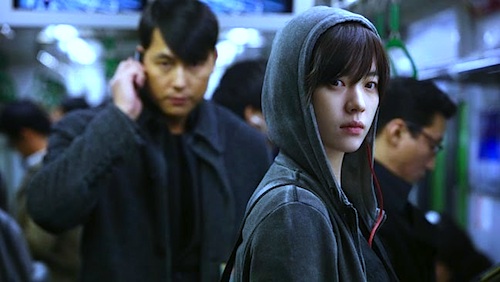
Sol Kyung-gu, this year’s NYAFF Star Asia Award recipient, powers the film with slow-burning intensity. His off-kilter wiliness and rumpled soul distinguishes Hwang from just about every other movie copper, except maybe Han Hyo-joo’s socially awkward Ha. They are quite a pair, developing some appealingly eccentric mentor-protégé chemistry. Counter-balancing her oddball colleagues, Jin Kyung adds some class and authority as Director Lee. Although largely impassive throughout, Jung Woo-sung’s shark-like vibe works in context for the ruthless James.

Cold Eyes is one of the few cop thrillers that genuinely values brains, but hand-to-hand combat skills still come in handy. The execution is slickly stylish, while Cho’s adapted screenplay fits all its moving pieces together quite cleverly. It should even satisfy To fanatics, especially considering an amusing cameo linking it to the original source film. Tight, lean, and unusually cerebral, Cold Eyes is highly recommended for action fans when it screens Thursday (7/10) at the Walter Reade Theater, as part of the tribute to Sol Kyung-gu at this year’s NYAFF.

LFM GRADE: A

Posted on July 9th, 2014 at 12:01am.

LFM Reviews Beautiful New Bay Area Project, Seventh Code @ The 2014 New York Asian Film Festival

By Joe Bendel. Romantic clichés require two to tango, but that is usually not a problem in the movies. Instead, rom-com tropes are dashed upon the rocks of genre cinema in a new long short and a short feature by Japanese J-horror auteur turned art-house favorite, Kiyoshi Kurosawa. Sure to have a long shelf life on the international festival circuit, Kurosawa’s Beautiful New Bay Area Project and Seventh Code played as a double bill during the 2014 New York Asian Film Festival.

Prepare yourself for a look at the seedy side of urban redevelopment in Bay Area (originally conceived as part of a themed anthology). Amano’s family has always ruled the Yokohama port and continues to do so, even though he is a mere wastrel, figurehead president of the family development business. They have ambitious plans to transform the waterfront, but he is more interested Takako, a beautiful laborer. Evidently, he has dreamed of her, but this means nothing to her.

Frankly, it is not exactly clear who or what she is, but she takes her work as a longshoreman and her father’s name very seriously. Enraged by her rejection, Amano steals her ID tile and instructs security to forcibly remove her should she come to reclaim it. That she does—far stronger than anyone expects.

In all honesty, the story of Bay Area does not make much sense and it looks like it was filmed with the cheapest digital camera available at Wal-Mart (not to mention grossly violating the principle of Chekhov’s gun, or rather Chekhov’s norovirus), but it is an awful lot of fun when Takako starts taking care of business. Kurosawa considers this his twenty-nine minute foray into action filmmaking and he duly delivers a series of fan pleasing fight sequences. Tasuku Emoto might not be much as Amano, but Mao Mita is likely to become a lot of NYAFF patrons’ new movie crush as the lovely and steely Takako.

At first blush, Akiko seems to have little in common with Takako. She is the ostensibly innocent protagonist of the hour-long Seventh Code, who has followed the mysterious Matsunaga to Vladivostok, because she was deeply taken with him during a chance meeting in Japan. Hardly knowing her, Matsunaga encourages her to return home, but when she persists, his dodgy Russian associates steal her luggage and passport, leaving her in the middle of nowhere.

However, it will take more than that to get Akiko to give up. Eventually, she will find limited work and friendship with an expatriate Japanese restauranteur and his Chinese girlfriend, Hsiao-yen, while continuing her search for Matsunaga. Yet, now and then, Kurosawa drops hints there might be more to this story than meets the eye.

From "Seventh Code."

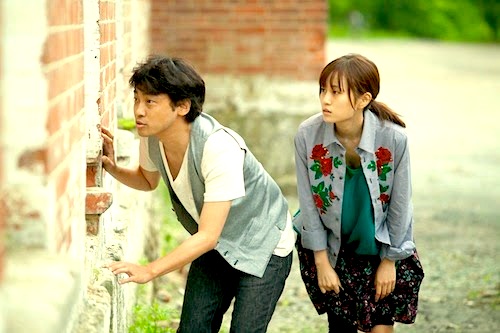
In contrast to Bay Area, Code looks fantastic. Kurosawa effectively takes viewers on a walking tour of Vladivostok’s back alleys, giving the audience a vivid rough-and-tumble sense of place. He also stages another first-rate fight scene and maintains a general vibe of weirdness. While the big surprise might be easy to anticipate, Japanese pop star Atsuko Maeda turns it quite agilely as Akiko. It is a nice acting debut vehicle for her, even though Chinese television host Aissy steals a number of scenes outright as the ambiguously ambitious Hsiao-yen. Unfortunately, Kurosawa has a hard time wrapping-up Code, tacking on a number of false endings and a completely random performance from Maeda, perhaps intended to satisfy her fans.

While both films are a bit of a mixed bag, they are brimming with energy and spectacularly showcase the talents of Mita, Maeda, and Aissy. They fit well together, but represent another curve ball for cineastes familiar either with his previous genre work, like Pulse, or his more sensitive recent releases, such as REAL or Tokyo Sonata. Recommended for fans of action and espionage films with resourceful leading ladies, Beautiful New Bay Area Project and Seventh Code screened this week at NYAFF, so expect them to pop up at more fests shortly.

SEVENTH CODE : LFM GRADE: B+
BEAUTIFUL NEW BAY AREA PROJECT: LFM GRADE: B-

Posted on July 9th, 2014 at 12:00am.

LFM Reviews Dangerous Acts Starring the Unstable Elements of Belarus on HBO

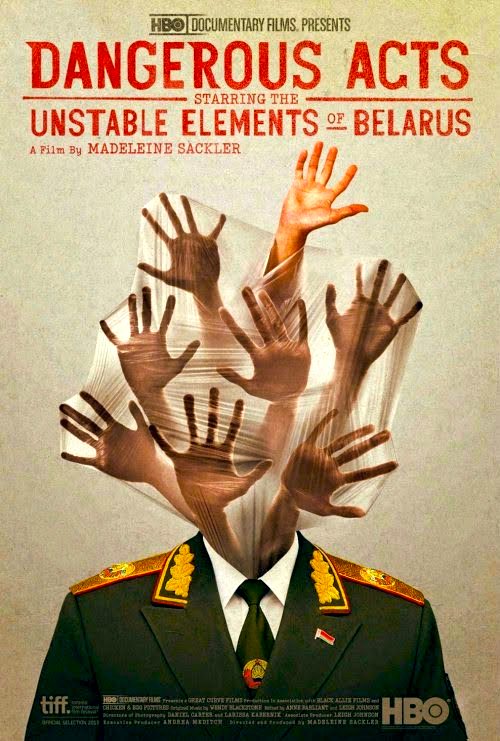
By Joe Bendel. You can judge the legitimacy of Belarus President-for-life Alexander Lukashenko’s latest “re-election” by the countries that sent their congratulations: Venezuela, Syria, Russia, China, and deposed Ukrainian president Viktor Yanukovych. For many, it was just business as usual in what has been dubbed “Europe’s Last Dictatorship.” However, it was an outrageous affront to independent thinking Belarusians, like the underground Belarus Free Theatre (BFT). Filmmaker Madeleine Sackler provides an uncensored chronicle of the activist artists’ Annus horribilis in Dangerous Acts Starring the Unstable Elements of Belarus, which premieres this coming Monday on HBO.

In a state as pervasively regulated as Belarus, any theater group that forthrightly holds a mirror up to society will have to operate outside the official arts bureaucracy, in direct defiance of the law. The small rag-tag troupe was accustomed to a routine level of surveillance and harassment, but the presidential election on December 19, 2010 precipitated a nationwide reign of terror. Co-founders Natalia Kaliada and Nicolai Khalezin were close family friends of Andrei Sannikov, the leading opposition candidate everyone expected to win the presidency if the elections were even remotely fair. That did not happen. Although tens of thousands of protestors demonstrated on Liberty Square, the regime responded with violence, imprisoning Sannikov and six other opposition candidates.

Fortunately, most of the BFT were able to evade the KGB (yes, they retained those charming initials), ironically fleeing through Russia. However, the time away from their homeland and families takes a toll on them. The only way they know how to process it is through their art.

Classifying the BFT is a tricky proposition. Many of the productions Sackler documents are distinctly avant-garde, rather closely akin to the style of Poland’s formerly dissident Theatre of the Eighth Day. Yet, sometimes their performances are painfully intimate and achingly accessible. Frankly, the film’s most intense and devastating sequence does not feature the brutal violence unleashed by the KGB (though there is a good deal of that and it is truly appalling). Instead, a monologue written by featured actor “Oleg” relating the non-political circumstances surrounding a personal tragedy truly leaves audiences emotionally staggered.

Nevertheless, when performing under a regime that prohibits open discussion of mental health, suicide, drug use, and sexuality, the personal becomes perversely political. Sackler and her editors Anne Barliant and Leigh Johnson show Solomon-like judgment, perfectly balancing the political and the artistic, the national and the individual, the macro and the micro.  A heck of a lot of courage went into the making of Dangerous Acts, starting with the BFT, but also including the Belarusian cinematographer Sackler directed via Skype and the small army of eye witnesses and netizen-journalists who contributed protest-crackdown footage.

To her credit, Sackler has tackled some bold subjects, following up her first-rate charter school documentary, The Lottery, with the censorship-defying Dangerous Acts. As a result, she might be one of the few people who can say which is more ruthless protecting their power, Lukashenko or the New York teachers union. Both tell critically important stories, but Dangerous Acts has even more urgency. Highly recommended for all lovers of liberty and advocates for human rights, particularly on the weekend we celebrate our independence, Dangerous Acts Starring the Unstable Elements of Belarus premieres Monday night (7/7) on HBO, with further air dates scheduled for 7/9, 7/10, 7/13, 7/16, 7/19, and 7/25.

LFM GRADE: A

Posted on July 5th, 2014 at 2:43pm.