LFM Reviews Hornet’s Nest

By Joe Bendel. He was known as QZR—was known. Now the Taliban militant is simply the late Qari Ziaur Rahman. The civilized world can thank the troops of the No Slack Battalion 2/327 and their 2nd Battalion 8th Regiment Marine Regiment and 3BCT “Rakkasan” Airborne colleagues. Embedded journalists Mike Boettcher and his son Carlos followed the No Slack Task Force on a series of dangerous missions, culminating with a strike against Rahman on his home turf. Shot by the Boettchers, the action is as real as it gets in David Salzberg & Christian Tureaud’s The Hornet’s Nest, which opens tomorrow in New York.

Credited as producers and cinematographers, the Boettchers were deeply embedded with the No Slack troops, very much in the line of Taliban fire. A veteran war correspondent, Mike Boettcher had done this sort of thing before, serving as a fulltime embed for Nightline. This was Carlos Boettcher’s first time covering a war zone, but his father reluctantly agreed to let him share his assignment. Despite his concern, he hoped the same forces that bound the troops together would help repair their somewhat estranged relationship.

It probably is not much of a spoiler to report that much proceeded as planned. The real point to Nest is the footage they jointly recorded, which is absolutely incredible. Remarkable for their clarity of sound and visuals, Nest’s warfighting incidents are even more intense and far easier to follow than anything seen in Junger’s Korengal films or Brothers at War and Severe Clear, documenting the Iraq War experience. At times, Salzberg & Tureaud are able to shift between each embed’s footage for multiple vantage points on the chaotic battles.

Frankly, Nest probably realizes the worst fears of several Columbia School of Journalism faculty members regarding embedded reporters. While the senior Emmy winning Boettcher scrupulously avoids political judgments, he makes no secret of his deep emotional involvement in the events he covers. It is easy to understand why, because the audience sees what he sees. It is tough to stay neutral watching Afghan children fall victim to IEDs or medivac helicopters take fire from Taliban forces, but the Boettchers witness it all in the heat and smoke of real-time war.

For obvious reasons, Nest has followed an unconventional distribution strategy, releasing in markets with large military populations before its New York run. As it happens, it opens here the same day as Junger’s Korengal. Both films are well worth seeing, but Nest is in fact the more powerful of the two. No other contemporary war doc so eerily captures the whistling sound of bullets whizzing overhead and when No Slack soldiers mourn their fallen brothers, Nest packs a greater punch to the emotional solar plexus. Very highly recommended, The Hornet’s Nest opens tomorrow (5/30) in New York at the AMC Empire and Village 7 theaters.

LFM GRADE: A

Posted on May 29th, 2014 at 9:32pm.
LFM Reviews Karaganda @ The 2014 Dances With Films

Karaganda from Max Weissberg on Vimeo.

By Joe Bendel. If you want to know why Russia held the Winter Olympics in a town without snow and spent so much money on sub-standard construction, you might ask the Ganavim ba Hok or Thieves By Law, but that probably would not be a good idea. They survived the Czars and would survive the Communists, often plying their criminal trades behind bars. Given their power, one Jewish gulag prisoner is convinced joining the “Vors” represents his best chance to save his wife in Max Weissberg’s short film Karaganda, which screens during the seventeenth edition of Dances With Films.

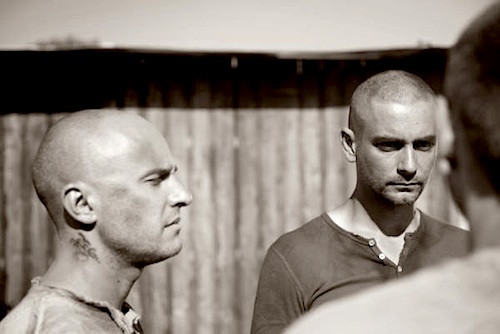
During Stalin’s reign of terror, approximately 18 million Soviet citizens were condemned to the gulag system of prison work camps. Like Siberia, Kazakhstan was a prime location, because of its harsh climate and forbidding landscape. Smuggler Vladimir Bershstein has been sentenced to such a gulag somewhere in the vicinity of Karaganda, but it might as well be the dark side of the moon. At least he is not a political prisoner, like work detail partner Aleksei, but his Jewish heritage is nearly as reviled. Yet, knowing his wife Elena was also condemned to a women’s camp not far from his own torments Bershstein even more than his Soviet jailers.

In spite of Aleksei’s warnings, Bershstein is convinced he can only save Elena by earning an invitation to join the so-called Vors. Of course, it is easier said than done. After all, the guards themselves are afraid to cross the heavily tattooed gang, for good reason. To be considered for membership, Bershstein will need a killing to his name, but that will be the easy part.

From "Karaganda."

The Thieves By Law are definitely a scary bunch, but Weissberg does not let the Soviets off the hook either. What comes to pass in Karaganda is truly Russian style tragedy, portending future repercussions that could be explored in a future feature length version. Still, in just under half an hour, Weissberg covers more plot than a lot of slow cinema indulgences, without skimping on characterization or atmosphere.

He also has the benefit of a strong cast and crew. As the intense Bershstein, Konstantin Lavysh is clearly a gold medal contender for brooding. While his character is more outgoing, Nikita Bogolyubov really centers the film as the decent but somewhat unpredictable Aleksei. Both have strong presences that never wilt under the existential weight of Terrence Laron Burke’s striking black-and-white cinematography and the bleak, forbidding backdrops.

There is more ambitious filmmaking in Karaganda than a festival full of precious navel-gazing indies. Recommended both as a self-contained film and as the start of a potential saga, Karaganda screens this Saturday (5/31) as part of Competition Shorts Group 2 at this year’s Dances With Films.

LFM GRADE: A-

Posted on May 29th, 2014 at 9:27pm.

LFM Reviews Skum Rocks @ The 2014 Dances With Films

By Joe Bendel. If anyone is entitled to laugh at the garage metal band Skum, it is Alice Cooper. He participated in even crazier shenanigans during the early stages of his career, yet he made it to the top and stayed on top. Fittingly, he serves as the subtly acerbic narrator for their shoulda-coulda story. A group of William & Mary soccer players very well might have formed an appallingly untalented hard rock band, but when Clay Westervelt brought them together for a reunion, they kept their tongues firmly planted in their cheeks. The emphasis is on mock and rock when Westervelt’s Skum Rocks screens as a legit doc at the 17th annual Dances With Films in Hollywood, USA.

Skum were almost profiled on Behind the Music style program for “Disaster Bands,” but they turned out to be too disastrous. Nonetheless, Westervelt and a pick-up crew kept following the story. Founding members Hart Baur, Todd Mittlebrook, and Scott Bell had no musical aptitude, but they did not let that dissuade them. Eventually, they recruited some band-members with genuine chops, but quickly fired them when they provided too much competition for their admiring lady fans. Somehow they built up a cult reputation in Miami after graduation, partly because of their success in battle-of-the-bands. Again, this was not due to talent, but the extra credit Baur (now a high school teacher) offered his classes.

Even though they never really made it, Skum lived the rock & roll lifestyle to the fullest, leaving everyone who ever tried to do business with them reeling in bankruptcy. Like an inadvertent Max Bialystock, they oversold shares of their long promised debut album, but fortunately their sole masters were stolen under appropriately bizarre circumstances. That temporarily spelled the end of Skum—and the music industry was grateful. Oh, but there has to be a comeback.

From "Skum Rocks."

While not Spinal Tap or the real life Super Duper Alice Cooper, Skum Rocks is still pretty funny stuff. It hits all the rockumentary bases, including the band’s revolving door for drummers and one member’s pornstar obsession. Sure, they are “playing themselves,” but the dudes from Skum nail the aging un-self-aware hedonist rocker vibe, particularly Baur and John Eaton. Of course, Cooper sells it perfectly with his stranger-than-fiction voiceovers. Following Super Duper, Supermensch, and An Honest Liar, Skum Rocks represents the fourth “documentary” he appears in this year. It is quite a body of work that makes for entertaining binge viewing.

Whether hand-on-the-Bible true or somewhat enhanced, Skum Rocks is a lot of mischievous fun, which nobody should take too seriously regardless. At least the rock & roll attitude is certainly genuine. Recommended for Skum fans and those who appreciate their milieu, Skum Rocks screens this Friday (5/30) during the 2014 Dances With Films.

LFM GRADE: B

Posted on May 29th, 2014 at 9:21pm.

Revisiting Camp Restrepo: LFM Reviews Korengal

By Joe Bendel. Stationed in a remote outpost in the Korengal Valley dubbed Camp Restrepo (in honor of a late, beloved medic), the men of the Airborne Brigade’s Battle Company, 2/503 were supposed to be the tip of the spear for the American military in Afghanistan. However, in 2010, the administration decided the spear no longer needed a tip and closed all the American outposts in the deadly Korengal. Through new interviews and previously unseen footage, Sebastian Junger revisits the men featured in his Academy Award nominated documentary Restrepo, analyzing the impact of war on those who fight it in Korengal, which opens this Friday in New York.

Tragically, Junger completed Korengal without his late partner Tim Hetherington, who shot his share of the footage and served as co-director of Restrepo and the subject of Junger’s elegiac tribute documentary, Which Way is the Front Line from Here? In fact, they had always planned a more reflective companion film to Restrepo that would allow audiences to become better acquainted with the men of Battle Company.

So now that Restrepo has been decommissioned, do they miss it? More than you might think. War can be shocking and profoundly unfair, as Junger’s first film with Hetherington documents, but it can also be bracing. Nothing clears the head like a morning fire fight, especially for the athletically inclined. (In a rueful aside, one Airborne infantryman casually observes the Korengal mountain ridge would be “sports paradise” were it not for all the warfare going on.)

However, Junger will not allow ideological viewers to conveniently dismiss the men as adrenaline junkies. That might play a part in their adaptation to the harsh duty conditions, but the men form a strong camaraderie with one another and consciously shield their loved ones from the realities of their service as best they can. They also develop unromanticized opinions of the assorted clan leaders operating within the Korengal. Frankly, they probably have a much better understanding of the country than their current civilian leadership (not that that is a particularly high standard to surpass). Indeed, they sound remarkably grounded, all things considered, despite all they have witnessed.

It is very clear why Junger made his Afghanistan films, including Front Line. They vividly capture the soldiering experience, very definitely including the sudden loss of a brother-in-arms. However, it is fair to wonder what was the purpose of the events they documented, if the strategy can be reversed at the drop of a hat? To Junger’s credit (and Hetherington’s too), the films scrupulously avoid politics, but once the house lights come back up, we exit into a political world.

Always fair to the men who appear in it, Korengal covers the full gamut of human emotions, while opening a window into one of the least forgiving corners of the world. Recommended for general audiences, perhaps even more highly than Restrepo, Korengal opens this Friday (5/30) in New York at the Landmark Sunshine.

LFM GRADE: A-

Posted on May 27th, 2014 at 2:03pm.

The Latest from Manoel de Oliveira: LFM Reviews Gebo and the Shadow

By Joe Bendel. Reportedly, Raul Brandão’s 1923 play was a strong influence on Samuel Beckett’s Waiting for Godot, but it will strike most contemporary viewers as being downright Dickensian. Regardless, probably no filmmaker is better suited to adapt it for the screen than 104 year old Manoel de Oliveira. He was around when it premiered and has seen its critical reputation evolve over time. The dean of world cinema continues to polish his craft with Gebo and the Shadow, which opens tomorrow at the Anthology Film Archives.

This is the part of the review where we all marvel at Oliveira’s productivity and longevity. Pushing 105, Oliveira has multiple projects in development and at this point there is no reason to doubt he will see them through. Given the exquisite elegance of The Strange Case of Angélica (which hit theaters when Oliveira was the tender age of 102), we can also expect them to be quite good. While Shadow is a relatively minor work, it clearly shows the hallmarks of a master at work.

Old Gebo should be retired by now, but he labors on as a debt-collecting clerk for his callous employers. He has no choice. Gebo is the sole support of his beloved wife Doroteia and daughter-in-law Sofia, since his son João absconded eight years ago, under ominous circumstances. Gebo struggles to preserve the illusion João might someday return to protect Doroteia’s fragile psyche. Yet, he fears their son’s homecoming might lead to more harm than good, should it actually come to pass. Unlike Godot, the prodigal (the metaphoric shadow of the title) will indeed suddenly darken Gebo’s door at the end of the first act.

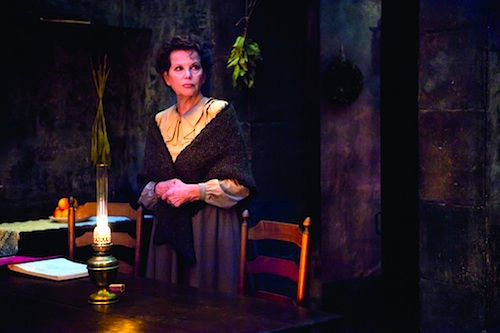
Claudia Cardinale in "Gebo and the Shadow."

Shadow’s theatrical roots are highly conspicuous, but Oliveira tries to make a virtue of its staginess—for understandable reasons. He might be 104, but Micheal Lonsdale looks at least that old as the much abused Gebo. It is a striking performance, marked by palpable physical exhaustion and acute world weariness. Yet, it is his tender moments with Leonor Silveira as the sensitive Sofia that really give the film its soul. Claudia Cardinale is perfectly fine as the high strung Doroteia, but it is not a great showcase role. For further art house appeal, Jeanne Moreau makes her presence deeply felt when appearing briefly as the mystical neighbor, Candidinha, like the veteran screen diva she is. In contrast, Ricardo Trêpa is rather stiff and shrill as Dostoyevskian João.

Oliveira and cinematographer Renato Berta absolutely love the soft, smoky light given off by the era’s oil lamps. The entire film glows like the chiaroscuro of the Old Masters. At times, Oliveira tries to enhance the mystery surrounding João, the shadow, but he still maintains an overriding mood of melancholy. Despite the big name international cast, Shadow is a small film in the grand scheme of cinema history, but it certainly demonstrates Oliveira can still do his thing. Respectfully recommended for those who appreciate chamber dramas, Gebo and the Shadow opens tomorrow (5/28) in New York at the Anthology Film Archives.

LFM GRADE: B-

Posted on May 27th, 2014 at 2:02pm.

America’s Most Famous Jewel Thief: LFM Reviews The Life and Crimes of Doris Payne

By Joe Bendel. To be a jewel thief, you have to talk the talk and walk the walk. Even though Doris Payne was born into a life of poverty and segregation, she never had trouble passing for an elegant society lady. Criminals also have a saying about not doing the crime if you can’t do the time. She takes issue with that one. Nonetheless, she finds herself on trial facing a de facto life sentence in Matthew Pond & Kirk Marcolina’s The Life and Crimes of Doris Payne, which opens this Wednesday at Film Forum.

Doris Payne has been doing this for sixty years. It is easy to forgive, or even applaud her first score, perpetrated solely to finance her mother’s escape from her abusive father. Initially, she capitalized on the “invisibility” of an African American woman from clerks eager to wait on presumably more affluent customers. However, she soon adopted the role a woman of means and position, literally taking her act global.

Some of Payne’s exploits would sound fanciful if she did not have the arrest records to prove them. She has seen the insides of many a prison cell in several countries, but somehow providence always intervened. Unfortunately, providence seems to be running late at her current trial.

Frankly, there is a bit of a disconnect between the heists Payne gleefully describes and her protestations of innocence this time around. Essentially, she falls back on snobbery as a defense, claiming she would never steal from such a gauche store as Macy’s. Yet, from time to time, Pond & Marcolina catch her playing them. As charming and innocent looking as Payne might be, viewers will eventually understand that truth is a movable goalpost for her.

Arguably, Pond & Marcolina could have and should have challenged her more in their interview segments, but it is clear they preferred to print the legend, for good reason. There is something very appealing about Payne, the international woman of mystery, romancing Damon Runyonesque accomplices and evading the Swiss police (all of which is true). We want to enjoy her adventures, investing them with the spirit of a racially conscious Raffles, so it is hard to fault the filmmakers for not following up with the various sales associates who might have been fired or the smaller stores that might have been shuttered due to increased premiums and loss of valuable inventory. Nonetheless, the absence of such deeper digging is conspicuous.

Still, by doc standards, Life and Crimes is unusually entertaining, even when Payne’s sociopathic tendencies peak through. Pond & Marcolina keep the pace brisk, getting a nice assist from Mark Rivett’s retro-groovy score. When it’s over, audiences will definitely keep their hands firmly on their wallets as they file out of the theater. Recommended for fans of true crime and too-true-to-believe documentaries, The Life and Crimes of Doris Payne opens this Wednesday (5/28) at Film Forum.

LFM GRADE: B

Posted on May 27th, 2014 at 2:01pm.