LFM Reviews Rezeta @ The 2014 Slamdance Film Festival

By Joe Bendel. Rezeta still calls herself Albanian, but technically that is no longer true. Regardless of her Balkan nationality issues, the fashion model is not fluent in Spanish. Nonetheless, she will have no trouble meeting men in Fernando Frías’s Rezeta, which won the narrative feature Jury Award at the 2014 Slamdance Film Festival.

Things always seem to work out relatively okay for Rezeta, if not spectacularly so. The modeling agency that brought her to Mexico is decidedly on the dodgy side, yet she starts scoring high profile work almost immediately. She gets along reasonably well with most of her roommates in the company’s model crash pad, but frankly she will not be around very much. She is not Blanche DuBois, but Rezeta will knowingly slip into some bad relationships with underwhelming men of means, for obvious reasons. However, things with Alex, the working class punk rock hipster, might be different. He definitely catches her eye when they bond over their tattoos, but he plays bafflingly hard to get.

Highly improvisational, Rezeta the film chronicles the rise and potential fall of a romantic relationship, with some culture clash garnish on the side. Even at its best, Rezeta is never particularly deep and there are long stretches of narrative slack. Still, the Balkan connection lends the Lost in Translation story a fresh angle.

From "Rezeta."

Without question, lead actress Rezeta Veliu is the film’s winning ace-in-the-hole. Not just a pretty face, she is also quite a fine screen performer, blessed with a natural sense of when to dial it up or down. As Alex, Roger Mendoza does not have a fraction of her screen presence, but at least they develop some credible chemistry together during their ambiguous courtship scenes.

The occasional glimpses Rezeta offers of the vagabond lives led by not-quite-supermodels suggests there is more to be mined from this strange world of pseudo-glamour and exploitation. Clearly, Frías is much more interested in the characters transparently based on his co-leads, but their interpersonal dramas are rather hit-or-miss stuff. Regardless, Rezeta obviously made quite an impression on the jury when it screened at this year’s Slamdance Film Festival. The combination of its award attention and Veliu’s striking look (she is not a plastic cookie-cutter type, by any stretch) should secure it plenty of festival play, including at the 2014 Indie Fest in San Francisco, where it screens February 11th, 16th, and 20th.

LFM GRADE: C+

Posted on January 27th, 2014 at 3:49pm.
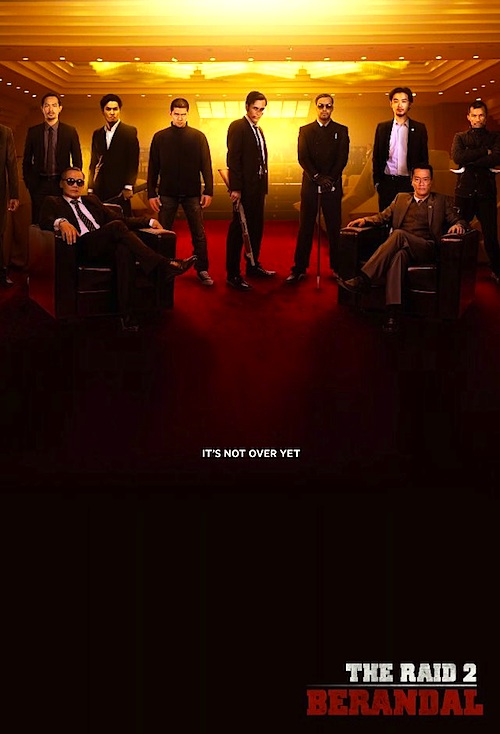
LFM Reviews The Raid 2 @ The 2014 Sundance Film Festival

By Joe Bendel. Rama’s last mission was an off-the-books frontal assault. He was one of the few survivors. This time, he will use stealth and deception. Don’t worry, he will generate the same massive body count in Gareth Huw Evans’ The Raid 2, which screens during this year’s Sundance Film Festival.

Ironically, busting his corrupt commanding officer might not be so hot for Rama’s career. It is likely to attract the wrong sort of attention. Fortunately (or not), the leader of the new anti-corruption squad papers over the whole affair, so he can recruit Rama for a deep cover operation. The honest cop and family man will spend two years in prison, where he will become the protector of Uco, the unstable son of Bangun, Jakarta’s top mob boss. His objective is not to take down Bangun, but to expose the cops in his pocket.

Matters get more complicated (as gangster business often does) when Uco hatches a plan to usurp his father and launch an all out war against their Japanese Yakuza allies. With chaos unleashed, Rama forms a de facto alliance with Eka, Bangun’s more rational lieutenant, played by Mr. Sundance, Oka Antara, co-lead of the Mo Brothers’ Killers.

Raid 2 starts a bit slower than the previous film, actually devoting a minute or two to exposition, but it is soon off to the races. In addition to the mega-melees, there are several feature spots devoted to various supporting beat down artists. Yayan Ruhian, Iko Uwais’s co-action choreographer on both films, reappears in the persona of Prakoso, a loyal Bangun assassin done wrong by Uco. However, the sequel’s new fan favorite is likely to be Julie Estelle, who literally tears it up the joint as the aptly named “Hammer Girl.” Watching her go Sears Craftsman on various Yakuza is what the movies should be all about.

Once again, Uwais and Ruhian’s fight scenes are spectacularly violent and wildly cool. Close quarters combat is unquestionably their forte. While their moves are often dazzling cinematic, there is nothing superhuman in Raid 2, except perhaps its characters’ tolerance for pain.

Uwais is an earnest enough screen presence with truly ferocious action chops. Likewise, Ruhian and Estelle should be future cult stars in their own right. Arifin Putra brings plenty of entitled villainy as the recklessly ambitious Uco, while Antara and Tio Pakusodewo’s Bangun nicely hold up the Johnnie To gangster tradition.

Without question, Raid 2 maintains the franchise’s status as the reigning Cadillac of martial arts cinema. Saturated in adrenaline, it is the sort of film that inspires expressions of appreciative shock and awe from the audience. Highly recommended, it screens again this Saturday (1/25) in Salt Lake as part of this year’s Sundance Film Festival.

LFM GRADE: A

Posted on January 24th, 2014 at 5:36pm.

LFM Reviews The Better Angels @ The 2014 Sundance Film Festival

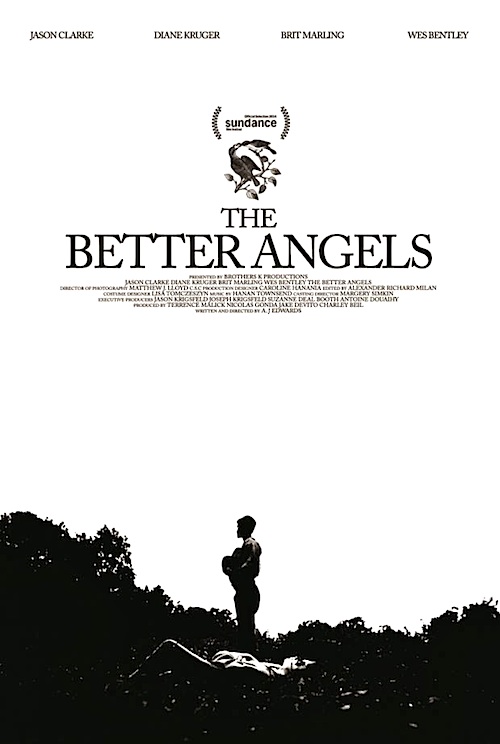
By Joe Bendel. That log cabin business was no joke. Abraham Lincoln’s formative years put the “hard” in hardscrabble. Yet, they also shaped him into the commanding and compassionate leader our nation needed. Young Master Lincoln comes of age in A.J. Edwards’ impressionistic The Better Angels, co-produced by Terrence Malick, which screens as a New Frontier selection of the 2014 Sundance Film Festival.

Narrated by Lincoln’s cousin reminiscing shortly after his assassination, Angels chronicles three years of his life as a gangly youth in the back hills of Indiana. His devout but illiterate mother Nancy Lincoln recognizes her youngest son’s remarkable intellectual gifts, but his gruff father sees no value in a bookish education. Nancy Lincoln would die at a tragically young age, but her religious convictions clearly shaped her sensitive son’s ethical values. A short while later Tom Lincoln remarries. Sarah Lincoln also takes a shine to young Abraham, finally convincing her husband to support his education.

Throughout Angels, Malick protégé Edwards maintains a style consistent with that of his mentor, but scene after scene resonate with far greater emotion than the austere To the Wonder. This is a simple story, but it is deeply moving. Aside from the exquisitely beautiful opening shots of the Lincoln Memorial, Angels never leaves the Indiana Hill country, circa 1817. Yet, Lincoln’s later significance is unambiguously stamped upon the film.

Visually, Angels is a true work of art. Each and every frame of Matthew J. Lloyd’s black-and-white cinematography is suitable for framing. As sort of an illustrative tone poem-tribute to Lincoln, Angels fits comfortably enough in the New Frontiers rubric. Nevertheless, the film boasts several very fine performances. Diane Kruger’s turn as Sarah Lincoln is wonderfully sensitive and finely wrought, but Jason Clarke’s work as the demanding but ultimately loving Tom Lincoln sneaks up on viewers, landing a total knockout punch.

Yes, Angels is deliberately paced, favoring sensory stimulus over narrative drive. It is also an unusually powerful and evocative film. There will be plenty of people who just won’t get it, but they will be wrong. Elegantly crafted, it is one of the high-end high-points of this year’s Sundance. Enthusiastically recommended for patrons with adult attention spans, The Better Angels screens again Saturday (1/25) in Park City.

LFM GRADE: A

Posted on January 24th, 2014 at 3:25pm.

LFM Reviews Sepideh Reaching for the Stars @ The 2014 Sundance Film Festival

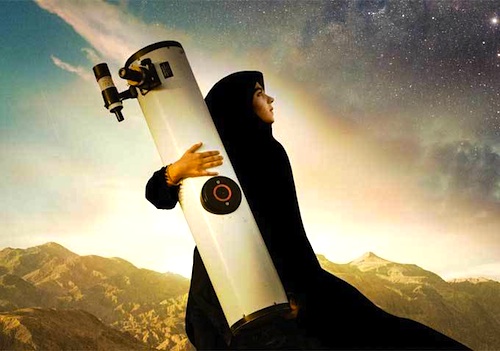
By Joe Bendel. In the provincial Iranian foothills, an astronomy club sets up a portable telescope outside a skeletal observatory, abandoned halfway through the construction process. Meanwhile, it is full speed ahead for Iran’s nuclear reactors. Such are the scientific priorities in today’s Iran. For a teenage girl harboring astronomical dreams, the cultural climate is even trickier. Documentary filmmaker Berit Madsen quietly observes her subject plugging away in Sepideh Reaching for the Stars, which screens during this year’s Sundance Film Festival.

Star-gazing has profound personal significance for Sepideh Hooshyar. It is a form of meditation and a way to commune with the spirit of her beloved late father. As an intelligent student blessed with an independent streak, she has been tapped as a leader of her extracurricular astronomy club. Naturally, her patriarchal deadbeat uncles do not think very much of young women practicing astronomy. For reasons of greed and pettiness, they have jeopardized the financial position of Hooshyar’s mother. Still, the young woman is not inclined to kowtow to anybody.

While Hooshyar never directly addresses any political or ideological controversies, it would still be fair to describe her as a free-thinker. Throughout the film, she addresses her diary entries to her muse, Albert Einstein, and takes inspiration from her idol, Iranian American astronaut Anousheh Ansari (whom she erroneously considers the “first woman in space”).

From "Sepideh Reaching for the Stars."

Intellectually, most viewers understand Iran is far from a progressive society, but there are scenes of unabashed misogyny in Sepideh that will drop their jaws and boil their blood. Clearly, young Hooshyar is nearly always the smartest person in the room, but her government, society, and extended family all seem determined to squander her talents.

Given her fly-on-the-wall style, Madsen never offers any commentary or context, but it is transparently evident where these attitudes come from. The men and assorted female authority figures are all swimming in Islamist rhetoric. Filmed in a rather flat, colorless HD, Sepideh is not particularly cinematic looking, but there are real stakes to the drama that unfolds.

In many ways, Sepideh could be considered a fitting documentary companion to Haifaa Al Monsour’s narrative feature, Wadjda. It is a timely film, but also a deeply personal story. Highly recommended, Sepideh Reaching for the Stars screens again tomorrow (1/21), Thursday (1/23), and Friday (1/24) in Park City, as part of the 2014 Sundance Film Festival.

LFM GRADE: A-

Posted on January 20th, 2014 at 9:22pm.

LFM Reviews Locke @ The 2014 Sundance Film Festival

By Joe Bendel. This film would not have been possible twenty-five years ago. Without the advent of cell phones, a long dark night of the soul spent on England’s motorways would not offer much drama. Fortunately, Ivan Locke is a plugged-in guy, but he will suffer through a series of uncomfortable calls in Steven Knight’s Locke, which screens during this year’s Sundance Film Festival.

Locke is a construction supervisor who takes pride in doing things the right way. However, he has made a mistake that will be hard to put right. Acknowledging his responsibility, Locke is driving to London, where a woman who is not his wife will soon enter into labor. This is a really bad time for it. In addition to fielding tough questions from his wife and their two sons, Locke is expected to oversee the pouring of the concrete foundation for a major new high rise. Having gone AWOL, Locke is pretty much fired, but he is determined to guide his loyal subordinate Donal through the process, for the sake of the project. Of course, complications arise, at the work site, the hospital, and the home front.

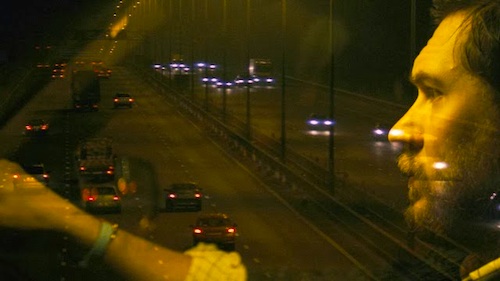
If nothing else, Locke should go down in history as the definitive film on the intricacies of concrete construction techniques. It really is educational. Happily, it also has Tom Hardy, putting on an acting clinic behind the wheel of Locke’s BMW. He goes through a full spectrum of emotions, but he never indulgences in cheap Streepian histrionics. This is a performance that pulls viewers into the man’s psyche, rather than obsessing over ticks and twitches.

From "Locke."

Even though Locke is essentially a one man show, Hardy gets some nice assists from a talented voice cast literally phoning in their supporting turn. Andrew Scott (Moriarty in the BBC-PBS Sherlock) is a particular stand out as Donal, often delivering some welcome and effective comic relief.

Best known as the Oscar nominated screenwriter of Dirty Pretty Things, Knight deserved considerably more attention for his directorial debut, Redemption, starring a misty-eyed Jason Statham. Clearly he has an affinity for noirish tales of nocturnal angst and desperation. Indeed, Knight’s execution is surprisingly stylish, never feeling stagey or contrived. In fact, there is something rather hypnotic about the constant play of head lights and reflections captured by cinematographer Haris Zambarloukos’s three mounted digital cameras. Deceptively simple, Locke is a film of considerable depth and integrity of character. Recommended for general audiences, it screens again tomorrow (1/19), Friday (1/24), and Saturday (1/25) in Park City, as well as Thursday (1/23) in Salt Lake, as part of the 2014 Sundance Film Festival.

LFM GRADE: B+

Posted on January 18th, 2014 at 5:48pm.

LFM Reviews Elliot @ The 2014 Slamdance Film Festival

By Joe Bendel. Did the recent death of Tom Laughlin leave a vacancy for Elliot “White Lightning” Scott to become the next white, working class martial arts star? No, absolutely not. Although he aspires to be the Nova Scotian Chuck Norris, Scott’s barely-there career is only headed in one direction—due south. Viewers will understand why after watching Jaret Belliveau & Matthew Bauckman’s documentary Elliot, which premiered yesterday at the 2014 Slamdance Film Festival.

With two scruffy DIY martial arts flicks under his belt, Scott is trying to complete his most ambitious project to date, a beatdown entitled Blood Fight. Unfortunately, the production has been plagued by problems that initially do seem to be entirely his fault. Nevertheless, Linda Lum, his increasingly impatient girlfriend-slash-producer is clearly starting to have doubts about his action movie dreams and pretty much every other aspect of their relationship.

Frankly, Barney Fife had better moves than Scott, but for a while viewers will try to see him as noble dreamer, like an Ed Wood or Mark Borchardt, whose ambitions exceed their talents. However, this is not American Movie. While in China with his acupuncture class, Scott lets his yellow fever run rampant. Aspects of his not so carefully constructed backstory then start to unravel. In fact, by the time the documentary enters the third act, Belliveau and Bauckman have pretty clearly turned against their subject, which becomes quite a sight to behold.

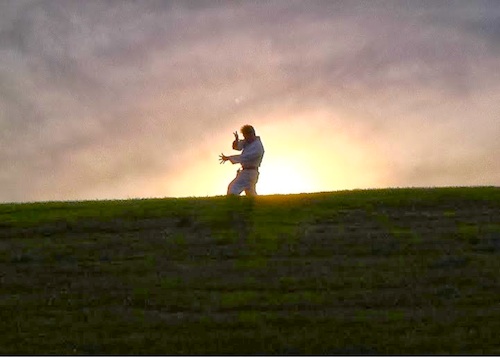
From "Elliot."

Things get so in-your-face uncomfortable, you have to wonder if it is all an extended meta-joke in the tradition of I’m Still Here. Either way, it is dramatic stuff and a not inconsiderable feat of filmmaking, shot on location in both Nova Scotia and China. There is also a lot of humor in the film, mostly derived from Scott’s sheer brazenness and lack of self awareness.

Scott’s martial arts might be laughably amateurish (an underwhelmed Shaolin monk is obviously tempted to beat him like a drum and we sort of wish he would), but Belliveau & Bauckman practice a decidedly nimble form of cinematic jujitsu. Not exactly a film for martial art purists, Elliot is sort of like Kung Fu reality programming. Right now, the late legendary Sir Run Run Shaw is probably looking down on Scott and thinking “kid, you stink.” Yet, it is all undeniably compelling. Although it screens as part of Slamdance’s Doc Features section, it could be comfortably programmed elsewhere as a midnight movie. Recommended for anyone open to a bit of Canadian bizarreness, Elliot screens again this Monday (1/20) as part of this year’s Slamdance in Park City.

LFM GRADE: B+

Posted on January 18th, 2014 at 5:41pm.