Jet Li Supervises: LFM Reviews Badges of Fury, Now on DVD/Blu-ray

By Joe Bendel. Jet Li’s Huang Fei Hong is sort of the Sergeant Murtaugh of the Hong Kong police. He is definitely getting too old for this sort of thing, but unlike his Lethal Weapon counterpart, he always punches out promptly at 5:00 and disappears for long stretches. That leaves most of the slapstick to his younger colleagues. Seniority has its privileges. Still, whenever Huang returns for a throw down, things perk up dramatically in Wong Tsz-ming’s Badges of Fury, which releases today on DVD and Blu-ray from Well Go USA.

Huang is a crafty old salt who is more interested in his retirement portfolio than office politics. Wang Bu-er thinks he’s all that, but has an uncanny talent for self-sabotage. Their young, insecure team leader has paired them together in the hope some of Huang’s mature risk-aversion will rub off on Wang. So far, it is not taking. Wang just keeps blundering ahead, inadvertently aiding the escape of the wanted criminal Huang nearly captures in the spectacular opening action sequence.

However, Badges is not really about the fugitive Chen Hu. Frankly, it keeps changing its mind, but the preponderance of the narrative involves the investigation of the so-called “Smile Murders.” Each of the victims died with a strange smile plastered across their faces. It turns out they were also all once engaged to low budget starlet Liu Jinshui. Quickly, Liu falls under suspicion, but her half-sister Dai Yiyi appears far more dangerous, given her obvious va-va-voom.

From "Badges of Fury."

When Badges goes for laughs, it can be painful. However, action director Corey Yuen embraces the film’s cartooniness, unleashing his inner Itchy and Scratchy for some absolutely off-the-wall fight scenes. In the big opener and closer, Jet Li shows he still has his mojo. It is too bad there isn’t more of him as the steely Huang. Unfortunately, his Ocean Heaven co-star Wen Zhang kind of stinks up the joint with his shtick. Rising star Michelle Chen (so memorable in Ripples of Desire) is also clearly out of her element as their exasperated superior. At least, Ada Liu vamps it up with gusto as the femme fatale sister.

As if Badges were not inconsistent enough, it also shoehorns in more cameos than the director’s cut of It’s a Mad, Mad, Mad, Mad World. Sometimes it works great, as when action star Wu Jing shows up to rumble as an insurance investigator. Other times, it can be a rather head-scratching distraction for viewers not up on their Hong Kong reality television. Still, it is always pleasant to see Lam Suet, Stephy Tang, Josie Ho, and Grace Huang on-screen.

When it clicks, Badges is a martial arts machine. When it doesn’t, it is usually dabbling in romantic comedy. Still, Jet Li and Wu Jing’s chops, Yuen’s gravity-defying fight choreography, and Liu’s sex appeal should be enough to hold HK action junkies’ interest on DVD. Recommended for fans, but not as a Jet Li entry point, Badges of Fury is now available for home viewing from Well Go USA.

LFM GRADE: C+

Posted on January 7th, 2014 at 8:18pm.

LFM Reviews Lonely Planet @ The 2014 New York Jewish Film Festival

By Joe Bendel. It is easy to see why banishment to Siberia was a favorite method of punishment under the old Communist regime. It still seems like a cold, isolated, economically depressed region, at least judging from the footage shot by an Israeli film crew. Ostensibly, they are looking for Mishka Zilberstein, who as young Jewish boy reportedly took refuge from the National Socialists with the wolves in the Belarus forest. Oddly enough, Zilberstein’s urban legend might be the only thing that is true in Edan Zeira’s docu-drama hybrid, Lonely Planet, which screens during the 2014 New York Jewish Film Festival.

Zeira and his Israeli-French crew are determined to find the mythical Mishka, but each lead turns out to be a dead-end. Supposedly, the real life Zilberstein eventually settled in a remote corner of Siberia. Everyone seems to know his story, but the locals are not exactly welcoming. At least all the trouble Zeira and his colleagues got into was presumably fictional, unless Zeira really did agree to a shotgun wedding to a provincial police chief’s pretty daughter, in which case, Mazel tov.

From "Lonely Planet."

This is a very strange film, for obvious reasons. Yet, despite its postmodern gamesmanship, it is worth listening-up when the real Zilberstein finally enters the picture. Indeed, Zilberstein is a fairly well documented historical figure and viewers have no reason to doubt it is really him consenting to tell his story (aside from all the meta-meta business that came before). It is a powerful tale, involving torture at the hands of both the National Socialists and the Soviets. Essentially, Zilberstein was reduced to an animal state, at a time when animals were more humane than humans.

Zeira illustrates Zilberstein’s story with highly stylized black-and-white re-enactments. Clearly, they had a terrific handler for the wolves. While his (presumed) humor is sometimes questionable, it always comes at his own expense. Some might understandably take issue with his mash-up approach in a film that directly addresses the Jewish experience during WWII, but Zeira is unfailingly respectful in his treatment of Zilberstein. Fans of Guy Maddin will probably enjoy his deconstructive and surreal inclinations, whereas general audiences will appreciate Zilberstein’s testimony. Recommended for the somewhat adventurous, Lonely Planet screens twice this coming Thursday (1/9) at the Walter Reade Theater, as part of this year’s NYJFF.

LFM GRADE: B-

Posted on January 6th, 2014 at 11:08pm.

It’s All About Making Lawyers Richer: LFM Reviews Divorce Corp

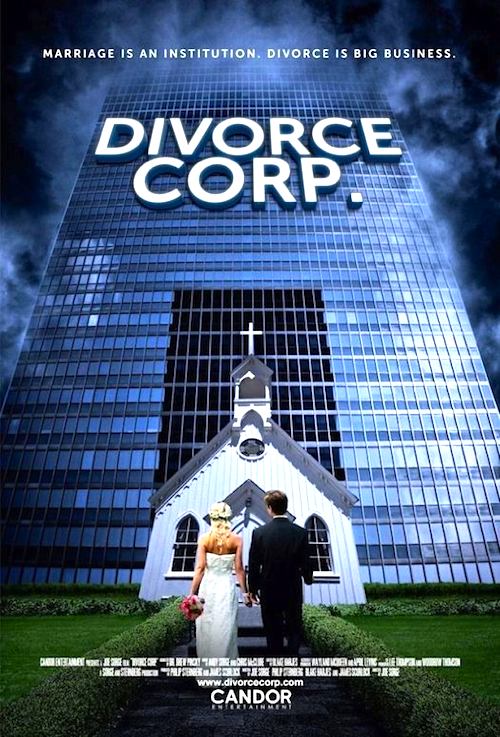
By Joe Bendel. It’s not a gender thing, it’s a lawyer thing. It turns out that predatory divorce lawyers – and judges congenial to the point of collusion – have rigged the system to line their respective pockets. That hardly sounds shocking, but the reality is worse than you imagined, at least according to a new documentary openly advocating a comprehensive overhaul of the American family law system. The lawyers and judges profiting from broken families stand duly indicted in Joseph Sorge’s Divorce Corp, which opens this Friday in New York.

Like a shrewd consensus builder, Sorge includes an equal balance of men and women who have been done wrong by the judge presiding over their divorces. When watching the case he lays out, it seems neither men nor women have a built in advantage. It all depends on whose lawyer is more buddy-buddy with the judge. You might assume a judge would recuse himself from hearing a case presented by a close friend and former law partner, but in family court you would be wrong.

Sorge paints an alarming portrait of the family court as a judicial tyranny, where jury trials and the right to council no longer apply. Perhaps most shockingly, he interviews two victims of judicial persecution (one man and one woman), who were sent to prison on dubious charges (such as “judicial intimidation”) after publicizing in the media their judges’ clear conflicts of interest.

As an alternative, Sorge and his associates point to the Scandinavian model as a better method of divorce. They might be right, but it is hard to imagine restricting alimony until the finalization of the divorce will catch on here anytime soon. For a start, states with referendum votes should pass provisions mandating full C-O-I disclosure and allowing potentially disadvantaged parties to opt for judicial reassignment. The various state bars should also automatically investigate any divorce dragging on longer than twelve months (which Sorge argues is indicative of frivolous motions designed to bleed both parties dry).

If Sorge and co-writers Blake Harjes, James D. Scurlock, and Philip Sternberg have misrepresented the reality of family law in America, then the Bar Association should produce a rebuttal documentary post-haste. Corp is a compelling indictment, given additional authority by the participation of narrator Dr. Drew Pinsky (who has credibility as an advocate for personal responsibility). To a layman viewer, the film comes across as quite even-handed and never engages in hysterical hyperventilating.

Still, Corp is not exactly fun stuff, but it is highly watchable, particularly when colorful private detective John J. Nazarian offers his commentary. When he says he would rather go through “death than divorce,” it is pretty heavy. Recommended for legal reform activists and those looking for a justification to stay single forever, Divorce Corp opens this Friday (1/10) in New York at the Quad Cinema.

Posted on January 6th, 2014 at 11:04pm.

Tammany and Toxicology: LFM Reviews The Poisoner’s Handbook; Premieres on PBS Tuesday, 1/7

By Joe Bendel. There was a time crime was rampant in New York, but City Hall was fine with the carnage. This seems to be a recurring cycle in the City, but in this case, the time in question is 1918. Coroner positions were an important part of Tammany Hall’s patronage mill. No medical training was required, as long as the mortuary kick-backs were shared with the machine. As a result, untold poisoners escaped judgment, either through negligence or graft. The efforts of a reformist medical examiner and his pioneering toxicologist to make science and integrity part of New York law enforcement are chronicled in Rob Rapley’s The Poisoner’s Handbook, which airs this Tuesday as part of the current season of American Experience.

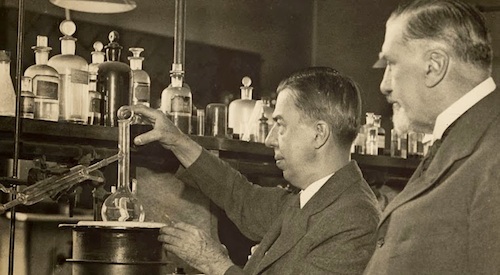
Charles Norris was independently wealthy, relatively politically astute, and a genuine medical doctor. Against the vociferous objections of Tammany Mayor John F. “Red Mike” Hylan, the state of New York forced through his appointment as the City’s medical examiner. His chief lieutenant was Alexander Gettler, a Jewish Hungarian immigrant who worked his way through a PhD in chemistry. No longer in the business of selling specially tailored death certificates, Norris’ office actually started applying the scientific method to criminal investigation. During their early years, Gettler wrote academic papers on scores of toxins that remain relevant to this day.

From "The Poisoner's Handbook."

Based on the nonfiction book by Deborah Blum (who appears as a talking head), Poisoner is more authoritative in its treatment of criminological history than the thematically related How Sherlock Changed the World. Rapley never addresses Gettler’s reading habits, but evidently he was quite the Yankees fan. Shrewdly structured, Poisoner zeroes in on Gettler’s relationship with his nemesis, sort of the Irene Adler of arsenic, for maximum dramatic value. It also morbidly but logically organizes each section according to the relevant toxin under discussion.

However, it clearly favors the toxicologist over his M.E., even though political junkies would probably prefer to hear more about Norris’ wrangling with Tammany Hall. In contrast, a bit too much time is devoted to Prohibition. While it certainly kept Norris and Gettler (both Wets) busy, there was little mystery involved in each toxic “denatured” alcohol death.

There is plenty of good New York history and vintage true crime in American Experience’s The Poisoner’s Handbook. Highly watchable (at least until the last minute cheerleading for the FDA), it should entertain (and inform) fans of Caleb Carr’s The Alienist and BBC America’s Copper. It premieres on most PBS outlets this coming Tuesday (1/7).

LFM GRADE: B-

Posted on January 6th, 2014 at 10:17pm.

LFM Reviews Friends from France @ The 2014 New York Jewish Film Festival

By Joe Bendel. As a matter of policy, the Soviets automatically denied all requests from the so-called “Refuseniks” to immigrate to Israel, often spuriously claiming they were irreplaceable specialists (who were then duly fired from their positions). As it happens, Victor Rybak really is a highly respected authority in the field of physics, much like Sakharov. His uphill battle to join his wife in Israel will profoundly affect two young French cousins in Anne Weil & Philippe Kotlarski’s Friends from France, the opening night selection of the 2014 New York Jewish Film Festival, co-presented by the Jewish Museum and the Film Society of Lincoln Center.

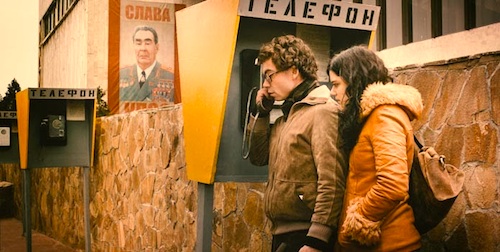
Carole Brikerman is a passionate Zionist, who supports the Refuseniks’ aspirations for Israel. Jérôme Berkowitz is passionate about his cousin Brikerman. Despite his mixed feelings, Berkowitz joins his cousin on a leftist guided tour of Odessa. Pretending to be newlyweds, they will secretly visit Jewish dissidents, bringing smuggled care packages and offering moral support. Berkowitz resents what he considers Brikerman’s Zionist proselytizing, while struggling with his arousal from their intimate proximity. However, when they pay a call on Rybak, Berokwitz meets someone far more cynical than himself.

Rybak has good reason to be jaded. He endured constant torture in a Communist mental hospital, intended to force him to denounce his beloved wife, who had successfully reached Israel ahead of him. While imprisoned, he secretly maintained a diary. Not only did he document the systemized abuse and summary executions, he also included deeply personal passages of erotic longing, meant solely for her eyes.

Even in translated subtitles, the words of Rybak’s diary ring with truth and poetry. They are easily the most compelling element of Weil & Kotlarski’s screenplay. It is easy to understand why Brikerman’s network would want to publish it and why the Soviets would be determined to prevent such an embarrassment. They also open a deep window into the Refusenik physicist’s soul. For all his exterior gruffness, Rybak is a haunted romantic at heart.

Vladimir Fridman is simply extraordinary as Rybak. It is an acutely human and humane portrayal, conveying all his messy complications and understandable bitterness. It is only January, but Fridman’s work should be noted for year-end lists. He instills Friends with power and integrity whenever he is on-screen.

From "Friends From France."

In contrast, Soko and Jérémie Lippmann simply are not in the same league. Still, much like his character, Lippmann slowly sneaks up on viewers, developing a distinct presence and persona down the stretch. Evidently, Soko is France’s current “It Girl,” so it is nice she wants to appear in a film like this. At least she is more engaging than in the grossly over-rated Augustine. She does not undermine any of the proceedings, but it is hard to see her in the way other characters do.

Weil & Kotlarski vividly capture oppressive vibe of Communist era Odessa. At times Friends functions as a surprisingly good Cold War thriller. It probably holds some sort of distinction as a film noticeably critical of both the Soviet Union and the Zionist movement. Yet, its sharpest, most illuminating observations involve the hypocrisy of the leftwing tourists. Ostensibly on a personal mission of solidarity, they are clearly fearful of the Party’s apparatus of control—with very good reason. Smart, literate, and sometimes quite moving, Friends from France is a strong way to open this year’s NYJFF.  Highly recommended, it screens twice this coming Wednesday (1/8) at the Walter Reade Theater.

LFM GRADE: A-

Posted on January 3rd, 2014 at 10:31am.

LFM Reviews Mother, I Love You @ The 2014 Palms Springs International Film Festival

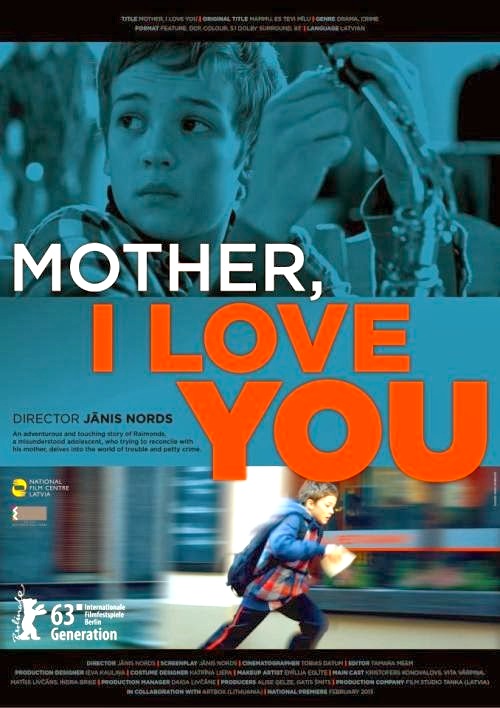
By Joe Bendel. Quality musical instruments are expensive, even for middle class professionals in Riga. That is one reason Raimonds Krasts is reluctant to tell his perennially stressed out OBGYN mother he lost his saxophone, particularly since it happened during a bit of misdemeanor mischief. Each lie and evasion only makes matters worse for Krasts in Jānis Nords’ Mother, I Love You, a Dostoyevskian middle school morality play that screens as part of the 2014 Palm Springs International Film Festival’s focus on official Academy Award submissions for best foreign language film.

There is already tension between Krasts and his single mother, Silvia Krasta. She has been secretly dating a colleague while supposedly working the late shift. Frankly, it is unclear how Krasts feels about this, but there is no question Krasta is displeased with his behavioral issues at school. She is also none too thrilled about his friend from the wrong side of the tracks, Peteris Cepurnieks. The son of a cleaning lady, Cepurnieks has swiped his mother’s key to a dodgy playboy’s often vacant apartment, where they often hang out and steal pocket money.

When things get particularly heated at home, Krasts runs off to the bachelor pad, but cuts short his stay when the owner arrives with a prostitute. Unfortunately, the woman in question filches his saxophone along with several other portable items from the flat. Predictably, his attempts to retrieve it lead to even more serious problems, because Krasts is still just a kid—one with particularly bad judgment.

Even though MILY did not make the Academy’s nine film short list, it was a smart choice for Latvia. As the winner of the Jury Award at this year’s LA Film Festival, it would have had more credibility and perhaps recognition among left coast Academy members than the average submission. Nords’ brand of sensitive naturalism is also perfectly compatible with Academy tastes and preferences. Evidently it was not to be, but it is still an accomplished film. The work of cinematographer Tobias Datum is particularly noteworthy for the way it captures the moody elegance and loneliness of late night Riga.

Front-and-center throughout the film, thirteen year old lead-actor Kristofers Konovalovs holds up to the scrutiny remarkably well. As problematic as Krasts might be, he never comes across as a caricature. Instead, we can understand why he makes each compounding mistake. Never overly showy, he could teach a thing or two to some of this year’s supposed Oscar contenders.

Likewise, the performance of Vita Varpina (one of two established screen actors in MILY) is smartly balanced and acutely believable. Haralds Barzdins, the real life conductor for the Latvian Song and Dance Festival adds some color as Krasts’ band director, but it is debatable whether the film will do much to spur youthful enthusiasm for orchestral music.

There is indeed a lot of messy humanity in MILY. Everyone makes mistakes, but nobody is irredeemable. It should be interesting for festival patrons to watch the film in close dialogue with Kang Yi-kwan’s somewhat thematically related Juvenile Offender. Nords never takes the easy way out, yet his film is still considerably more optimistic. Small but potent, Mother, I Love You is recommended for those who appreciate coming-of-age character studies. It screens this coming Sunday (1/5), Monday (1/6), and the following Saturday (1/11) during the 2014 Palm Springs International Film Festival.

LFM GRADE: B

Posted on January 2nd, 2014 at 11:03pm.