Internet Age Anxiety: LFM Reviews Chen Kaige’s Caught in the Web

By Joe Bendel. It is the age of the internet troll. Abetted by the tabloid press, anonymous malcontents offer a steady stream of bullying invective aimed at impulsively chosen targets. In this case, the locale is central China, but it could happen here, too. One woman is tragically ensnared in a joint new media-old/media feeding frenzy at the start of Chen Kaige’s of-the-moment contemporary drama Caught in the Web, which opened this week in New York.

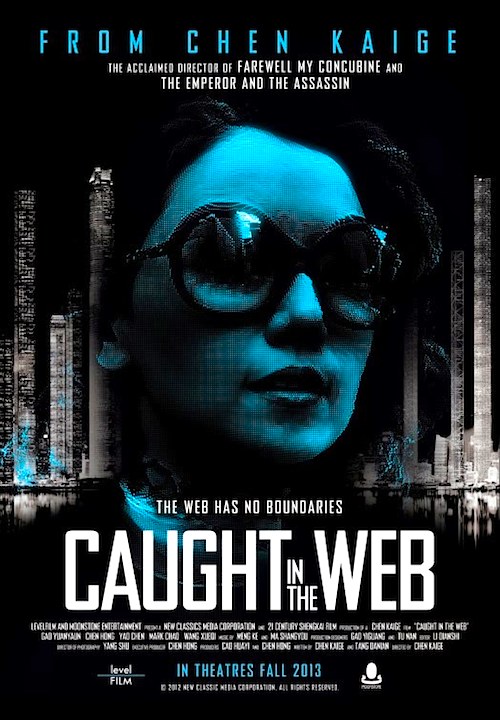
During a routine check-up, Ye Lanqiu receives some devastating news: advanced lymphatic cancer, requiring immediate treatment she cannot afford. Dazed, she returns to work on the bus, not noticing the old man coveting her seat. When he complains, she tells him where to get off. Unfortunately, it was all captured on the smart-phone of Yang Jiaqi, who is interning at a television station with her cousin’s ambitious girlfriend, Chen Ruoxi. By the end of the day, Chen will make Ye notorious as “Sunglasses Girl.”

However, Ye’s problems are only getting starting. Seeking a loan and an emergency leave from her industrialist boss, Shen Liushu, Ye breaks down before she can fully explain her dire circumstances. At the worst possible moment, Shen’s high maintenance wife Mo Xiaoyu walks in on them, naturally misconstruing the intimate scene. As Ye becomes a public pariah, Mo pours gasoline on the fire, antagonizing her husband and jeopardizing his big deal with an American firm. While Shen and Mo wage their cold war and Chen bottom feeds, Ye goes into hiding, hiring her nemesis’s increasingly disillusioned boyfriend Yang Shoucheng as her bodyguard.
Whew, end of set-up. From there things get complicated. Chen and his co-screenwriter Tang Danian have scripted the closest thing to a Chinese Tom Wolfe story you will find, chocked to the brim with intertwined characters and loads of zeitgeisty angst. At times, they flirt dangerously with shameless melodrama, but the quiet dignity of Gao Yuanyuan’s lead performance saves their bacon every time. It is a reserved, but deeply tragic turn, nicely matched by the restraint of the Taiwanese-Canadian Mark Chao as her reluctant protector, Yang Shoucheng.

In contrast, Chen’s frequent collaborator Wang Xuegi and his actress-producer-wife Chen Hong produce some spectacular fireworks as the crafty old Shen and his impulsive wife. Perhaps fittingly, Chen Ruoxi is played by Yao Chen, who holds the distinction of having the most followers on China’s micro-blogging service, Sina Weibo. She has also “Weiboed” on behalf of journalists challenging official state censorship, which makes her massively cool as well as popular. She really digs into the character, portraying both her ruthless ambition and her deep-seated insecurities. It is award caliber work that truly makes the film.

Cinematographer Yang Shu (an alumnus of Chen’s Sacrifice) gives it a slick, austere polish that well suits the in-the-know class conscious morality tale. It is a relatively rare contemporary piece from Chen Kaige, but he adroitly manages the large ensemble and keeps the complex proceedings moving along at a healthy clip. Thanks to Yao and Gao, Caught has real dramatic force, as well as a real message. As long as the media focuses on the next “Sunglasses Girl,” they will ignore more inconvenient stories for the powers that be. (That applies beyond China too—just compare the coverage granted the Kardashians to analysis warning of the millions of individual insurance policies that will be canceled under Obamacare.) Highly recommended both for fans of Chinese films and those who appreciate shrewdly observed social cinema, Caught in the Web opens today (11/27) in New York at the Village East.

LFM GRADE: A-

Posted on November 29th, 2013 at 8:53pm.
Just Passing Through: LFM Reviews Shotokan Man, Now Available on DVD

By Joe Bendel. Redneck bullies never learn. If a trouble-making martial arts hardnose says he’s “just passing through,” you’ll never run him off with the typical strong-arm stuff. Instead, tell him to consider settling down. Needless to say, reverse psychology is not the style of the thuggish proprietor of the local Double Death Dojo. Get ready to rumble Roadhouse style with the DVD release of Bob Clark’s animated feature, Shotokan Man (a.k.a. Dixie Dynamite), now available from FilmWorks Entertainment.

Wandering the Earth in search of his absconded American serviceman father has taken the taciturn Dirk to many small towns, but never anywhere quite like Westabooga, Alabama. Thanks to the influence of the Nipponophile Sheriff Fuquay, Westabooga has largely adopted Japanese cuisine and culture, but their necks are still pretty red. The Japanese raised Amerasian drifter does not feel as comfortable as you might expect, though. He has issues with his Japanese heritage, particularly his experiences with his missing father’s dojo.

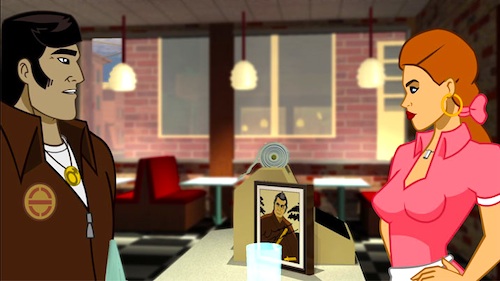
His Zen-like approach to life and martial arts is quite attractive to single mother Rose Stewart, the owner of the Westabooga Sushi Café and on-again-off-again girlfriend of Dewey, Jr., the narcoleptic sheriff’s entitled son and the leader of the Double Death. It logically follows that Dirk is in for a massive beat down at the hands of Dewey’s students, but the backcountry Possum Master will help him recharge his karma, giving the spiritual conventions of kung fu movies a sly, chicken fried twist.

From "Shotokan Man."

Any film that uses the word didgeridoo more than three times earns points for something. It is Dirk’s instrument of choice and also sometimes a handy club. We do not hear much of it played throughout the film, but there is a nifty arrangement of “Free Bird” featuring shamisen and electric bass. The combination of greasy grits-and-gravy southern living married to higher forms of Japanese art and philosophy ought to produce some outrageous gags, but Shotokan never escalates beyond the level of pleasantly amusing. There is a respect for both traditions, but not a lot of transcendent inspiration.

Still, voice actor George Faughnan has a way of delivering Dirk’s limited dialogue that maximizes the comedic effect. The renderings of Stewart and her waitress Tula Mae should also appeal to junior high school boys, bringing to mind the ladies of Twin Peaks’ Double R Diner for older hipsters.

Frankly, Clark (not to be confused with the Bob Clark who directed A Christmas Story and Porky’s) and co-writer-associate producer Mimi Gentry are surprisingly forgiving in their portrayal of 1979 Alabama. They eschew cheap shots and score settling, only resorting to cliché with the loutish but unremarkable villain, Dewey, Jr. Genre fans raised on a steady diet of Billy Jack movies will find it agreeable but not essential viewing. Of course, all the kids are caught up in Shotokan Man fever these days, making it a hot Christmas item. Recommended for mild chuckles as a stocking stuffer, Shotokan Man is now available on DVD from FilmWorks Entertainment.

LFM GRADE: B-

Posted on November 29th, 2013 at 8:50pm.

StoryCorps for Thanksgiving: LFM Reviews Listening is an Act of Love

By Joe Bendel. Think of it as the less noir version of Naked City with its eight million stories. Dave Isay founded StoryCorps in the belief that there were real life stories out there from everyday people that deserved to be recorded for posterity. For ten years, StoryCorps crews have collected oral histories across the country. Sometimes the stories were funny and sometimes poignant, but their inherent drama has become a source of constant inspiration for the Rauch Brothers. Their short animated adaptations of StoryCorps transcripts have become staples of short film festivals and have regularly been peppered throughout seasons of POV. Fittingly for Thanksgiving and the first day of Hanukkah, POV will premiere its first ever animated special, Mike & Tim Rauch’s Listening is an Act of Love on PBS stations nationwide.

As a wrap-around framing device, Isay’s young nephew Benji interviews his uncle to find out just why he does all this anyway. He has a memorable answer that nicely establishes the theme of Listening: family. The POV special includes four new stories, but begins and ends with two old favorites—and it is not hard to understand why those two struck such a chord with audiences. In the gleefully funny Miss Devine, two cousins swap memories of the titular Sunday School teacher who was a stern, unyielding presence during their summer vacations. Both James Ransom and Cherie Johnson are natural storytellers and the way they crack each other up is appealingly infectious.

Things get more serious and more family-focused during Listening’s debuts, starting with Making It, a simple but inspiring story of the American dream. On the eve of becoming the first in his family to go to college, Noe Rueda reflects on the difficult jobs he held to help his single mother make ends meet. It is probably the most touching segment of the POV segment, even if it is somewhat open-ended. The following Marking the Distance tells the story of a brain tumor survivor, who lost her short term memory, but has since become an accomplished marathoner thanks to the support of a boyfriend. It is a nice, feel-good story, but perhaps the least distinctive of the special.

Arguably, The Road Home gives Listening its greatest emotional pop. Eddie Lanier tells his story of how he went from being the privileged son of a prominent North Carolina mayor to a skid row drunk, until a good Christian Samaritan took him into his home. Wider in scope than the rest of the special, Lanier’s unabashedly redemptive story would be perfect for a Hallmark original film. There is also unexpected power in the twist to the tale Jackie Miller tells her adopted son Scott in Me & You, which has something for pro-life viewers and fans of Modern Family, alike.

Listening concludes with an encore appearance of No More Questions! Kay Wang was not one to suffer fools gladly, but her son Cheng and granddaughter Chen had learned to appreciate her forceful personality. Somehow, they managed to get her to sit for a StoryCorps session, laughing their way through her uncooperative responses that so aptly reflected her personality. In fact, they are probably rather glad it turned out that way in retrospect, judging from the bittersweet postscript.

The Rauch Brothers have a real facility for matching the expressions of their animated figures to the recorded interviews. In fact, they have been known to nail the likenesses and mannerisms of the speakers without having anything to model them on, besides their spoken words. Frankly, it is always reassuring to see a StoryCorps film in a festival’s shorts programming block, because of the Rauch Brothers’ commitment to quality. Recommended for post-turkey family viewing, Listening is an Act of Love airs on most PBS outlets this Thursday night (11/28) as part of the current season of POV.

LFM GRADE: B

Posted on November 26th, 2013 at 2:31pm.

Korea Takes a Stab at Time Travel: LFM Reviews 11 AM

By Joe Bendel. Woo-seok’s shady Russian oligarch patron named his prospective time machine “Trotsky” in the belief history would have turned out radically better if he had bested Stalin in their power struggle. They should have called “Ice-Pick,” considering the mayhem it will cause Woo-seok’s research team. They will struggle to cheat fate in Kim Hyun-seok’s 11 A.M., which opens this Thanksgiving Thursday in Los Angeles.

Everyone knows Woo-seok’s obsession with time travel stems from the untimely death of his wife, regardless of what Hawking says about it. Likewise, many suspect his protégé Young-eun hopes to meet her late theoretical physicist father in the future. His chief deputy Ji-wan is more skeptical. Nonetheless, their wheelchair-bound benefactor ponied up the funds for their undersea facility for his own personal reasons. Unfortunately, the financial spigot will be cut-off unless Woo-seok produces results fast. Against Ji-wan’s advice, he and Young-eun embark on a journey to tomorrow, at 11:00 a.m.

The good news is Trotsky works. The bad news is they discover the lab has been (or will be) destroyed by a series of explosions. As they investigate, Woo-seok is attacked by a mysterious assailant. Whisked back to the previous (current) day without Young-eun, Woo-seok and his crew must determine the source of the impending disaster, as the clock ticks down.

As time travel films go, 11 AM’s internal logic holds together fairly well, explaining its big head-scratching twists in due time. It also has a patina of credibility in the way it acknowledges Hawking’s event horizon. Yet, despite the sci-fi MacGuffin, it is human nature rather than science that poses the gravest danger in Park Su-jin’s screenplay.

From "11AM."

Frankly, Korean film fans will be surprised to discover Kim Hyun-seok, previously a specialist in jaunty rom-coms like Cyrano Agency, had this in him. He nicely balances the more macabre Final Departure-Then There Were None elements with the cerebral scientific speculation. Production designer Kim Minio’s team also creates a credible sci-fi environment, before it all gets blown to smithereens.

The cast goes to piece rather effectively, as well. As Woo-seok, Jung Jae-young is wound wickedly tight, while still exhibiting the intellectual facilities of a man of science. Likewise Kim Ok-bin makes the most of Young-eun’s big revelation scenes, the likes of which actors only get in genre films.

Nacho Vigalondo’s Timecrimes is still probably the gold standard of contemporary time travel movies, but 11 A.M. is a smart and grabby addition to the sub-genre canon. Sort of a SF chamber drama, but with first rate production values, 11 A.M. is recommended pretty enthusiastically for time travel fans when it opens this Thanksgiving (11/28) in Los Angeles at the CGV Cinemas.

LFM GRADE: B+

Posted on November 26th, 2013 at 2:27pm.

LFM Reviews Inside the Mind of Leonardo in 3D @ The 2013 DOC NYC

By Joe Bendel. Probably the best established fact of Leonardo da Vinci’s mysterious life is his brilliance. It is hardly surprising that he has inspired quite a few speculative novels, films, and television shows from the likes of Dan Brown, Ron Howard, Roberto Benigni, and David Goyer. His art is instantly recognizable, but there are plenty of holes in the historical record, where stuff can be safely made up. Of course, that just won’t do for DOC NYC or the History Channel. Scrupulously adapted from da Vinci’s notebooks, Julian Jones gives viewers an impressionistic, 3D portrait of the great Renaissance artist in Inside the Mind of Leonardo, which screened on the final night of this year’s DOC NYC.

Raised by his single servant girl mother, Leonardo had little formal education, but maybe that was just as well, sparing him the burden of a lot of false preconceptions. Verrocchio certainly recognized his young apprentice’s talents. However, he was not nearly as prolific a painter as one might assume (or hope). His journals are another matter. The extensive da Vinci notebooks offered Jones and his co-screenwriter Nick Dear a treasure trove of material. With Oxford Professor Martin Kemp vetting for accuracy, they give viewers a good nutshell overview of the original Renaissance man’s life and abiding ambitions.

Forgoing familiar imagery, like Vitruvian Man, Jones and the animation team render da Vinci’s muscular sketches of birds in flight and humans in motion in evocative 3D, while Peter Capaldi performs extracts from the various codexes in the manner of a one-man stage play. Periodically, Jones also indulges in slow panning shots of modern day Florence and Milan, presumably to anchor the film in its specific locales. Unfortunately, these often feel like travelogue interludes that get a little snoozy at times.

From "Inside the Mind of Leonardo."

On the plus side of the ledger, Capaldi is perfectly cast as da Vinci. He has always been a reliably intelligent presence, but here he vividly projects both the polymath’s arrogance and his melancholy world-weariness. When watching him in Inside, it is easy to see why he was selected to be the next Doctor Who. Once he has finished his run as the timelord, he should be able to take a da Vinci show on the road, much like Hal Holbrook’s Mark Twain.

Eschewing jerkins, Capaldi’s modern dress actually heightens the film’s intimacy. (He rather looks like he might be in his Doctor Who wardrobe, complete with a stylish scarf, but not the full Tom Baker, mind you). Inside works quite well when it really does go inside—either into da Vinci’s chambers or into the pages of his notebooks. When it goes outside, soaking up Tuscan landscapes and bustling Florentine street scenes, it waters down its atmosphere and character. Still, it is an interesting docu-hybrid and an unconventional (but sometimes effective) use of 3D. Recommended for art and history buffs, Inside the Mind of Leonardo is destined to have a limited theatrical release and an eventual airdate on the History Channel, following its premiere at DOC NYC 2013.

LFM GRADE: B

Posted on November 25th, 2013 at 9:46pm.

The Philosopher Reports: LFM Reviews Hannah Arendt; Now on Blu-ray/DVD

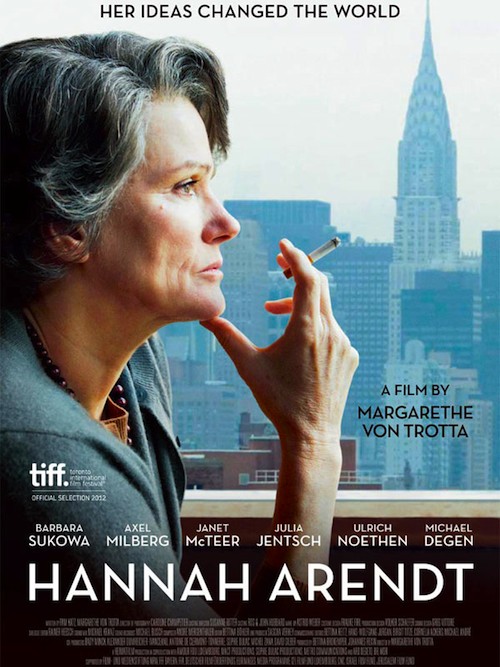
By Joe Bendel. In her landmark book The Origins of Totalitarianism, Hannah Arendt examined the close kinship between Stalinism and National Socialism. Surprisingly, it did not cost her many friendships amongst the intelligentsia. Of course, her think-piece reporting on the Eichmann trial in Jerusalem would be a different matter entirely. The defining controversy of the philosopher’s career is logically the focus of Margarethe von Trotta’s Hannah Arendt, which just released on DVD and Blu-ray from Zeitgeist Films.

As the film opens, Arendt has settled into a relatively comfortable life as a naturalized citizen, teaching at the New School and tolerating her husband Heinrich Blücher’s discrete infidelities. The Mossad has just captured Adolf Eichmann—news that electrifies Arendt’s Jewish colleagues. Intrigued by the implications of the trial, Arendt offers her services to New Yorker editor William Shawn as a correspondent, which he accepts because she is Hannah Arendt.

To the bafflement of old friends, the frustrated Arendt becomes preoccupied with Eichmann’s bureaucratic blandness and his willingness to surrender his status as an individual. It seems rather strange how divisive her resulting theory of the “banality of evil” was at the time, considering how thoroughly it now informs our collective impression of Eichmann and other war criminals of his ilk. Perhaps even more contentious, her critical observations regarding the miscalculations of some National Socialist appointed “Jewish Councils” to engage in some forms of temporary tactical acquiesce are not as widely held, but they are far from uncommon complaints today.

Von Trotta’s Arendt captures the intellectual swagger of Arendt and her circle, as well as the still relatively buttoned down tenor of the very early 1960’s. The New School still looks much the same from the outside, but chain-smoking is most likely frowned upon in lecture halls. It is a quality period production that looks true to the era during the scenes in both New York and Israel.

Frankly, von Trotta and co-writer Pamela Katz are not above playing favorites, portraying Norman Podhoretz as a knee-jerk hyper-ventilator, whereas Mary McCarthy is faultlessly down-to-earth and sympathetic. Still, the depiction of Arendt, as written by von Trotta & Katz and played by Barbara Sukowa, is remarkably complex and even-handed. Viewers fully understand just how thoroughly Arendt’s emotions are subservient to her intellect. What was once a defense mechanism becomes problematic, preventing her from anticipating the furor stemming from her articles. Von Trotta shrewdly resists the lure of an easy ending, ending the film on a decidedly ambiguous note.

Sukowa is admirably restrained as Arendt, to a degree approaching the tragic. Yet, she has some deeply human moments, particularly with Klaus Pohl as her disgraced former mentor-lover, Martin Heidegger. Cerebral and literate, yet rather forgiving of human foibles, Hannah Arendt is a compelling portrait of a difficult figure to do justice on-screen. Respectfully recommended for those who appreciate intellectual history, Hannah Arendt is now available for home viewing from Zeitgeist Films.

LFM GRADE: B

Posted on November 21st, 2013 at 2:18pm.