Strange Things Happen in Utah: LFM Reviews Skinwalker Ranch

By Joe Bendel. It is an area notorious for weird happenings, but this is northern Utah, so they can’t be blamed on drunken misperceptions. In fact, a private paranormal research team could probably use a stiff shot when things start going bump in the night in Devin McGinn’s Skinwalker Ranch, which launches on VOD and screens in select cities this Wednesday.
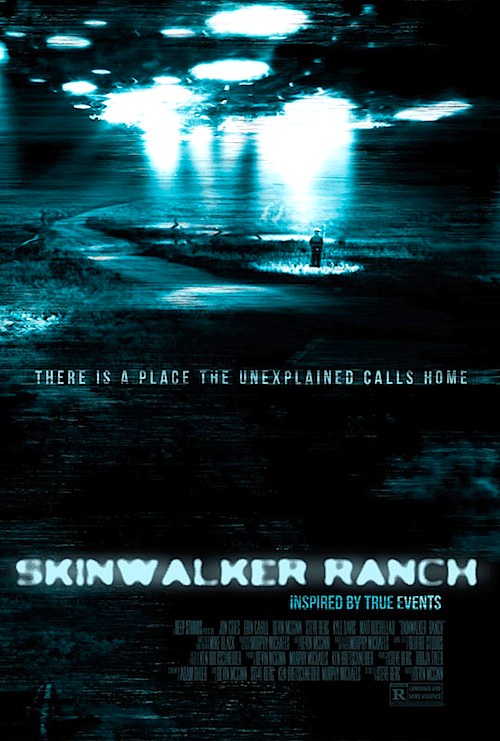
Some locals believe the home video purportedly showing a young boy whisked away by supernatural forces is legitimate, while some suspect it is a hoax concocted by his father. Desperate to find his son, distraught rancher Hoyt Miller welcomes a team of scientists from Modern Defense Enterprises and a journalist recruited to serve as a neutral observer, hoping they can supply some answers. They wire the house and surrounding property with motion sensor cameras and settle in, but they will not have long to wait. An unearthly high pitched tone rudely awakens them their first night in the field, with subsequent uncanny events preventing them from getting much sleep thereafter.

Although not entirely found footage, a great deal of Skinwalker unfolds from the perspective of the surveillance cameras. By genre standards, McGinn shows admirable patience in the early going, nicely setting the scene and establishing the ranch’s atmospheric nooks and crannies. For a while, it is surprisingly creepy, thanks to his skillful use of suggestion and mystery to build the tension. Unfortunately, the conclusion seems rather rushed, but with horror movies, a good set-up often compensates for a weak ending.

Although the helmer directing himself is usually a red flag, McGinn is actually quite respectable as Cameron Murphy, the semi-skeptical journalist. Jon Gries is also better than average as the poor, suffering Miller. Frankly, Skinwalker earns a recommendation just for casting the eternally cool Michael Horse (a cult favorite from Twin Peaks) as Ahote, a vaguely shaman-esque figure who offers the helpful advice to get the good golly out of there.

Skinwalker’s fusion of the horror and alien abduction genres is hardly original, but the execution exceeds expectations. After all, for a low budget programmer, not bad is pretty good. Recommended for a Halloween outing with like-minded viewers, Skinwalker Ranch screens this Wednesday (10/30), Devil’s Night, in theaters throughout Texas, Florida, and Alabama.

LFM GRADE: B-

Posted on October 28th, 2013 at 9:51pm.

Her Father’s Voice: LFM Reviews Blood and Ties

By Joe Bendel. The so-called “Hwaseong Murders” were South Korea’s first recorded serial killings, but the statute of limitations expired before the murderer was uncovered. The case’s impact can still be discerned in Korean cinema’s fascination with serial killers and the ticking prosecutorial clock. Bong Joon-ho’s Memories of Murder was transparently based on the Hwaseong killings and it is easy to see its influence on Jung Byoung-gil’s Confession of Murder. The notorious crimes also directly inspired Kook Dong-seok’s Blood and Ties, which opens this Friday in Los Angeles.

Jung Da-eun’s working class father Soon-man never had much, but he made sure she never lacked for anything. Now a grown adult, she still lives at home with the ever dedicated single parent. All her grad school friends adore dear old dad too, but after watching a lurid new documentary, they cannot help noticing how similar his voice sounds to that of a notorious child abductor. The unknown perpetrator was only recorded during a brief ransom call, but he even uses one the senior Jung’s favorite catch phrases.

Thoroughly confused and suspicious, Jung’s daughter starts poking around. The sudden appearance of Shim Yoon-young further amplifies her anxiety. He is obviously an unsavory character, but seems to share some murky history with her father. As the media trumpets the imminent expiration of the statute of limitations, Jung Da-eun struggles with her doubts and loyalties.

From "Blood and Ties."

B&T is a wicked high concept thriller with ample opportunity for high tragedy, but it does not guard its secret closely enough. The set-up is downright sinister and the top-shelf primary cast maintains the intensity, but viewers will always have a pretty good idea where it is all headed.

Son Ye-jin comes apart at the emotional seams quite convincingly as Da-eun, but it is Kim Kap-soo who commands the film as her father. Somehow he projects steely malevolence and pained sensitivity simultaneously, thereby providing both sides of his character’s Rorschach. Without Kim’s perfectly modulated performance, B&T would not work to any extent. While the supporting cast is mostly adequate, Lim Hyung-joon is also distinctly slimy as the all kinds of bad news Shim.

Based on a story by Kook’s mentor, filmmaker Park Jin-pyo, B&T taps into some deep-seated anxieties, but it is driven by the work of Kim, Son, and Li. Recommended for thriller fans looking for a blend of Mary Higgins Clark and James Patterson, Blood and Ties opens this Friday (11/1) at the CGV Theater in Los Angeles and next Friday (11/8) at AMC Bay Terrace in Flushing, Queens.

LFM GRADE: B-

Posted on October 28th, 2013 at 9:48pm.

Invasion Alert: LFM Reviews War of the Worlds; Premieres on PBS Tues., 10/29

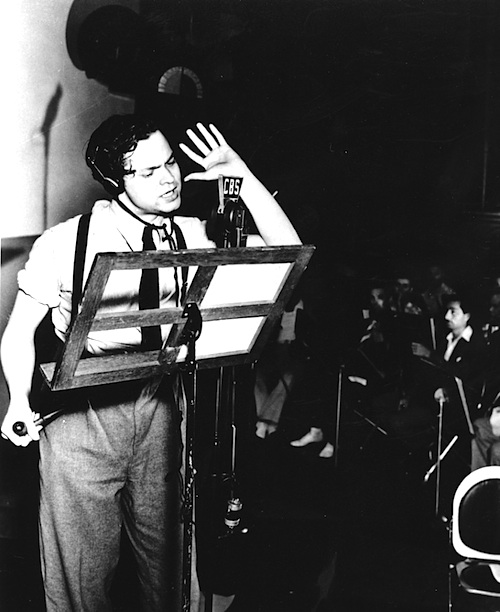
By Joe Bendel. Prior to October 30, 1938, Orson Welles was considered a talent to watch, but his Mercury Theater on the Air did not have a proper sponsor and it regularly got beat by a variety show featuring ventriloquist Edgar Bergen with his dummy Charlie McCarthy (it was a great act for radio, because you truly couldn’t see his lips move). Then Welles staged an innovative adaptation of H.G. Wells’ science fiction classic and suddenly everything changed. American Experience marks the 75th anniversary of Welles’ controversial broadcast with War of the Worlds, which airs this coming Tuesday on most PBS stations.

Orson Welles performing "War of the Worlds."

Welles was already a cottage industry before he transplanted War of the Worlds to Grover’s Mill, New Jersey. Best known as a stage director, he frequently performed on radio, often without credit. The media and the smart set closely followed his career, but he had yet to breakthrough with Middle America. For his weekly radio showcase, Welles had a notion to adapt the Martian invasion novel. Producer-adult supervisor John Houseman thought it was a terrible idea, but Welles had his way as usual. However, the script just didn’t come together until they decided to stage it as a series of breaking news bulletins. This was not a completely original strategy. It was inspired by Archibald MacLeish’s radio play Air Raid, which had just aired with much less fanfare.

According to American Experience’s historical experts, most listeners missed Welles’ introduction, dial-twisting over to the Mercury Theater once Bergen had finished his shtick. As most everyone knows, a mild panic then ensued. All the talking heads try their best to excuse away the mass hysteria, arguing that the stress of the Depression and the constant news flashes trumpeting European war left the general public primed to believe Welles’ Americanized War of the Worlds. Maybe there is a kernel truth to that, but that would have been one heck of an exclusive for CBS to score.

Just about everyone now recognizes Welles as one of the most important film directors of the Twentieth Century, but AE’s WOTW reminds us he was also probably one of the greatest radio directors as well. Director Cathleen O’Connell and tele-writer Michelle Ferrari include some fascinating behind-the-scenes details of the in/famous broadcast, but the black-and-white dramatic recreations of angry listeners’ letters of complaint are rather corny and just generally unnecessary.

Arguably, Welles’ fictionalized news flashes represent an early forerunner to found footage genre films, in which a carefully produced narrative deliberately approximates some form of on-the-fly documentation. O’Connell and her battery of experts, including Welles’ daughter Chris Welles Feder, nicely put the episode in the context of Welles’ career and the development of mass media. Easily recommended for fans of Welles and Wells despite the over-stylized recreation interludes, American Experience’s War of the Worlds premieres on PBS Tuesday the 29th (10/29), seventy-five years after the fateful broadcast, nearly to the day.

LFM GRADE: B

Posted on October 25th, 2013 at 12:54pm.

Days Gone by in North Korea: LFM Reviews The Girl from the South @ The 2013 Korean American Film Festival in New York

By Joe Bendel. It was mostly guys with a whole lot of facial hair. In frat house parlance, the final Soviet-funded World Youth and Students Festival was a real sausage party. For obvious reasons, the South Korean delegate made quite an impression on José Luis García. Since the 1989 Communist youth confab was held in Pyongyang, Lim Sukyung became a minor media sensation. Decades later, García tracked down the so-called “Flower of Re-Unification” for the documentary profile, The Girl from the South, which screens during the 2013 Korean American Film Festival in New York.

García happened to be in Pyongyang by chance, taking his brother’s place in the Argentine delegation at the last minute. To his credit, García was quite curious how the Communist youth congress would address the still fresh massacre in Tiananmen Square. The answer—stony silence, aside from an impromptu punk rock protest from the Scandinavians—was rather unsatisfying. Then Lim blew into town, ready to decry South Korea’s restrictions on contact with the North at every public gathering. Fascinated by her, García recorded as many of her appearances as he could with his consumer video camera. After all, she was one of the few delegates not trying to look like Che.

From "The Girl from the South."

Loaded with irony, García’s home movies of the Pyongyang get-down are easily the best part of the film. Frankly, it isn’t even close. Although García suggests he was more-or-less apolitical in his youth, he captures all the absurdity and pretension of international Communism’s last gasp before crashing into the dustbin of history. One can easily see how this material could be reworked into a wickedly satirical narrative feature.

Unfortunately, the Lim he meets some twenty years later is not particularly interesting to spend time with and decidedly uncooperative. Evidently, Lim served a short prison term after returning to the Republic of Korea and would subsequently suffer a terrible family tragedy, but she never opens up to García about anything. As a result, the film’s second two acts are about as illuminating as a wiki entry.

Granted, GFTS presents a sharp contrast between idealized memories and the disappointments of reality, but that does not exactly make gripping viewing. García never pushes Lim with obvious questions regarding North Korea famines and labor camps, but he never really succeeded in getting her to sit for a proper interview. Thanks to her overt manipulations, his climatic one-on-one quickly descends into an exercise in futility. García practically bangs his head on the table out of frustration and most viewers will be tempted to do the same.

Of course, there is no corresponding “Girl from the North,” because anyone returning to the DPRK after publically criticizing the country’s militarism would be consigned to a death, along with their entire family. García probably gets that, but he was too hung up on getting something—anything—from Lim. Girl from the South has some fascinating moments, but they are largely front-loaded. Mainly recommended for hard-core North Korea watchers, it screens this Saturday (10/26) at the Village East as part of this year’s KAFFNY.

LFM GRADE: C+

Posted on October 24th, 2013 at 3:45pm.

LFM Reviews Pluto @ The 2013 Korean American Film Festival in New York

By Joe Bendel. Forget about secret society rituals. These elite prep school kids are too busy keeping their classmates down. They are the top ten in their class and they will kill to keep it that way throughout Shin Su-won’s Pluto, which screens during the 2013 Korean American Film Festival in New York.

Kim June was the top student in his public high school, but that does not impress anyone in his new school, particularly not his American roommate, Yu-jin Taylor, the top man in their class. Supposedly, this is his big opportunity. He was only admitted because a suicide opened up space for him. That was Yung Su-jin’s roommate. Now the slacker computer major is out to settle the score with the ruling elite. Kim sort of likes her, but the working class transfer student opts to curry favor with the privileged ten instead.

As part of their “rabbit hunting” initiations, Kim does their dirty work in exchange for inside information on approaching exams. Naturally, Taylor and his cronies clearly have no intention of letting him into the club. However, as viewers can readily glean from the film’s complicated flashback structure, it is a very bad idea to play mind games with someone as tightly wound as Kim.

From "Pluto."

While Pluto’s class warfare themes are obvious and inescapable, Shin’s uncompromising screenplay surpasses mere polemics, portraying the sociopathic will-to-power at its rawest. This is not the sort of film that will have anyone saying “so there” when it ends. Kim might be our protagonist, but he is not an exactly a downtrodden POV character audiences would like to identify with. Surprisingly, his nemesis Taylor turns out to be the most nuanced of the lot. Of course, his cronies do not much care for his sudden subtle dimensions of character.

Pluto boasts some considerable star-power, thanks to Kim Kkobbi appearing as Yung, a relatively modest but intriguing supporting role. Lee Da-wit is eerily soulless and desperate as the hollow-looking Kim. Yet, it is June Sung who really keeps viewers off-balance as the not exactly remorseful Taylor.

Many of the sins of prep school dramas past repeat again in Pluto. As if required by an unwritten law, all the adults are ridiculously dense and the cops are problematically passive. Still, Shin raises the stakes for all future prep students behaving badly, making a film like Tanner Hall look tame and pale in comparison. Despite some clumsy excesses, it is mesmerizing, in-your-face filmmaking. Recommended for the reasonably jaded, Pluto screens this Friday (10/25) at the Village East as part of this year’s KAFFNY.

LFM GRADE: B

Posted on October 23rd, 2013 at 1:09pm.

Held Hostage by Al Qaeda: LFM Reviews Held Hostage; Premieres on PBS Tues., 10/22

By Joe Bendel. Algeria’s In Amenas gasoline processing facility would be the perfect setting for a Die Hard movie. It is an isolated spot, surrounded by vast stretches of the Sahara Desert in every direction. That is why many survivors wonder how several truckloads of al-Qaeda affiliated terrorists could launch a ground assault on the facility without the Algerian authorities noticing. Not surprisingly, many in the Algerian government would prefer to forget the embarrassing international incident. Fortunately, director Bruce Goodison and his team have assembled a comprehensive tick-tock history of the In Amenas hostage crisis. Their revealing look at contemporary Islamist terrorism, Held Hostage, airs on most PBS outlets tomorrow.

With al-Qaeda reportedly operating freely to the south and east of In Amenas in Mali and Libya, security was obviously a concern for the expat workers long before January 16th, 2013. Paul Morgan, the British security chief, had actually tendered his resignation out of frustration with lax plant security days before the attack. (Tragically, he would not survive to be vindicated by events.) While military and gendarmerie escorted workers on and off the premises, no facility personnel were allowed to carry arms. That meant once Mokhtar Belmokhtar’s band of terrorist-brigands reached the plant, there would be no means of organizing any resistance.

From "Held Hostage."

Securing the first on-camera interviews of many survivors and victims’ family members, Held Hostage provides a very personal perspective on the terrorist attack. Perhaps the report’s most shocking moment involves the circumstances surrounding the truly cruel and senseless murder of Filipino expat Angelito Manaois, Jr. Three Americans died at In Amenas, which should concern us all, but the losses were greater for Britain, Norway, Japan, and the Philippines. Regardless, the crimes committed in In Amenas warranted far greater attention than they received from the traditional old media.

Goodison’s team broaches a number of inconvenient questions throughout the program, particularly with respect to the conduct of the Algerian military. Granted, refusal to negotiate with terrorists is a defensible position, but it rather looks better if there is some attempt to stall for time while organizing a rescue operation. Whereas, strafing carloads of hostages is just hard to defend from any standpoint.

Held Hostage is technically quite well constructed, instilling a full sense of the factors that contributed to the desert calamity in just under an hour. Viewers will have the sense they could lead their own briefing session after watching it—and perhaps they should. It a real expose and a wake-up call, but its warning is likely to fall on deaf ears. Easily the most important television of the week, Held Hostage airs on most PBS stations tomorrow (10/22).

LFM GRADE: B+

Posted on October 21st, 2013 at 12:02pm.