LFM’s Jason Apuzzo & Govindini Murty at The Huffington Post: Voices Raised in Resistance: Powerful Defiant Requiem Premieres on PBS Sunday, April 7

[Editor’s Note: the post below appears today on the front page of The Huffington Post.]

By Jason Apuzzo & Govindini Murty. If a hallmark of great art is its ability to transcend the limited circumstances of its creation, then there is no more heartbreaking realization of this than the 1944 performance of Giuseppe Verdi’s Catholic Requiem by Jewish prisoners at the Nazi concentration camp Terezín. The story of Terezín and of the Requiem is told eloquently in director Doug Shultz’s powerful new documentary Defiant Requiem, which premieres this Sunday, April 7, on PBS at 10 p.m. ET/PT (check listings for additional screenings on local PBS stations).

It was at Terezín in 1944 that imprisoned Czech conductor Rafael Schächter led a chorus of his fellow Jewish prisoners — most of them doomed to the gas chambers at Auschwitz — in brazenly performing Verdi’s Requiem before the very Nazis who had condemned them to death. One of the most complex and demanding of chorale works, Verdi’s 1874 Requiem was originally intended as a musical rendition of the Catholic funeral mass. Rafael Schächter took Verdi’s music and transformed it into a universal statement, one proclaiming the prisoners’ unbroken spirit and warning of God’s coming wrath against their Nazi captors.
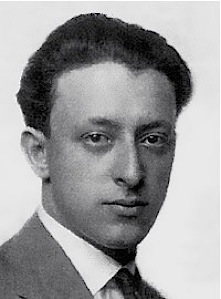
2013-04-06-Rafael_Schachter.jpg
Conductor Rafael Schächter.

Defiant Requiem tells two parallel stories: the first takes place during World War II, when Jews throughout Europe were rounded up by the Nazis and sent to Terezín as part of an elaborate deception to convince the world that Germany treated its prisoners humanely. Among those arrested and dragged to Terezín in 1941 was the young Rafael Schächter, a courageous and steadfast Czech opera-choral conductor.

Distinguished American conductor Murry Sidlin, who discovered the history of Schächter and the Terezín performers in the ’90s, and who went on to found and conduct the Defiant Requiem concerts, notes in the film that “Schächter would have emerged as a great conductor” had his life not been cut short by the Nazis.

Within the confines of Terezín, Schächter lifted the spirits of his fellow inmates by creating a musical program for them to perform — a program that inspired an astonishing outburst of cultural activity, which would eventually include almost a thousand different performances of chamber music and operas, oratorios and jazz music, theatrical plays, and some 2,300 different lectures and literary readings. Included in this were 16 performances of Verdi’s emotional and musically challenging Requiem. As Terezín survivor Zdenka Fantlova explains in the film: “Doing a performance was not entertainment. It was a fight for life.” She later adds, “If people are robbed of freedom, they want to be creative.”

This flurry of activity within the walls of the prison camp — achieved under the most trying possible circumstances of starvation, disease, and abject cruelty — would culminate in a performance on June 23, 1944, of the Requiem in front of the camp’s Nazi brass, visiting high-ranking SS officers from Berlin, and gullible Red Cross inspectors brought in to verify that the prisoners were being well treated.

It was at this point that Verdi’s Requiem, with its dark, apocalyptic Dies Irae (“Day of Wrath”) choral passage — evoking the Last Judgement — and equally harrowing Libera me (“Deliver me”) passage took on connotations that Verdi could hardly have imagined. Serving as both a spiritual catharsis for the prisoners, and as a prophecy of the Nazis’ ultimate fate, the Requiem was immediately transformed by Schächter and his fellow prisoners into an anthem of divine supplication and retribution. Indeed, shortly after this final performance, both Schächter and most of his choir would be sent to Auschwitz.
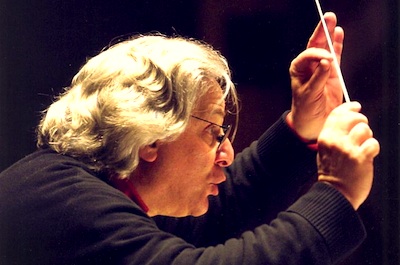
2013-04-06-MurrySidlin.jpg
Conductor Murry Sidlin.

Defiant Requiem‘s second, parallel story takes place in 2006, as Murry Sidlin brings a full orchestra and the Catholic University of America’s chorale ensemble — along with surviving members of Schächter’s chorus — back to Terezin to perform the Requiem once more, this time in tribute. (Sidlin continues to conduct such tribute performances of the Requiem, with concerts scheduled for The Lincoln Center on April 29 and Prague’s St. Vitus Cathedral on June 6.)

The journey to Terezín is clearly a spiritual quest for Sidlin (who has since founded The Defiant Requiem Foundation), who views the modern performance of the Requiem at Terezín as the completion of something begun seventy years before. As Sidlin says at one point in the film: “I brought the Verdi here because I want to assure these people [Schächter and the deceased prisoners] that we’ve heard them.” Sidlin’s staging of the Requiem in the now unassuming confines of Terezín is powerful and gripping — and serves, one senses, as the perfect tribute to Schächter and his fellow performers.

Highlighting the role that individuals can play in keeping important cultural history alive, it was Sidlin’s discovery of the book Music at Terezín in the late ’90s, and his subsequent championing of the concert series, that has brought the otherwise forgotten history of Rafael Schächter and the Terezín Requiem performances back to life. It is a culmination both of Sidlin’s passion for music and of his own personal history; Sidlin’s grandmother and many of her closest relatives were murdered outside Riga, Latvia by Nazi SS assassination squads during World War II.

This June, Sidlin will be awarded the Simon Wiesenthal Center’s Medal of Valor for his efforts to commemorate Rafael Schächter and the Terezín prisoners. Continue reading LFM’s Jason Apuzzo & Govindini Murty at The Huffington Post: Voices Raised in Resistance: Powerful Defiant Requiem Premieres on PBS Sunday, April 7

The Beautiful and the Debauched: LFM Reviews Lotus Eaters

By Joe Bendel. If a future generation ever really wanted to create their own unique identity they would study hard, eagerly join the work force, and compulsively save. Of course, hedonism is more fun – especially when there is a hipster filmmaker around to pretend you invented the dissolute lifestyle. True to the Bret Easton Ellis tradition, Alexandra McGuinness casts a glossy eye on the London smart set in Lotus Eaters, which opens tomorrow in New York.

Except for Alice, nobody in her circle of frienemies has ever held a proper job. She happens to be a model. She would like to transition into an acting career, but that looks unlikely for reasons of talent (or lack thereof). Everyone else spends all their time doing drugs, having sex, and playing mind games with each other. This especially includes her not-so reformed heroin-addict on-again-off-again boyfriend, Charlie. She would like to make it work with him, but he seems too self-destructive even by her friends’ standards. As a result, she starts responding to the duller but wealthier Felix. His ex is none too pleased, whereas master manipulator Orna seems to enjoy the chaos.

All critics seem to agree on how striking Gareth Munden’s Herb Ritts-inspired black-and-white cinematography is, which is all well and good. As a screen drama, though, Lotus is pretty much a mess. The characters are dull, the situations predictable, and the tone is ridiculously self-important. At least McGuinness is not afraid to cut lose. Frankly, by the third act, Lotus seems be deliberately parodying itself and other pretentious art films, concluding with an outrageously over-the-top finale that will either cause your jaw to drop or your sides to ache. That might not be what McGuinness was going for exactly, but at least it makes the film distinctive.

As Alice, the waifish Antonia Campbell-Hughes tends to blend into the white backgrounds unobtrusively. Likewise, the Byronic bad boy thing folksinger Johnny Flynn does as Charlie gets old quickly. Strangely, a lot of the flavor comes from the supporting cast. While some are rather clunky, Cynthia Fortune Ryan is an intriguing presence as Orna while Jay Choi adds some mischievous flair as Lulu.

Oddly enough, Lotus Eaters is really quite a retro viewing experience. It is all about its surface sheen and neo-new wave soundtrack. Had it come out in the 1980’s it would have been a sensation, but three decades or so later just feels like empty sound and spectacle. Recommended for fans of Mommie Dearest and similarly overwrought cult oddities, Lotus Eaters opens today (4/5) in New York at the Village East.

LFM GRADE: C-

Posted on April 5th, 2013 at 4:49pm.

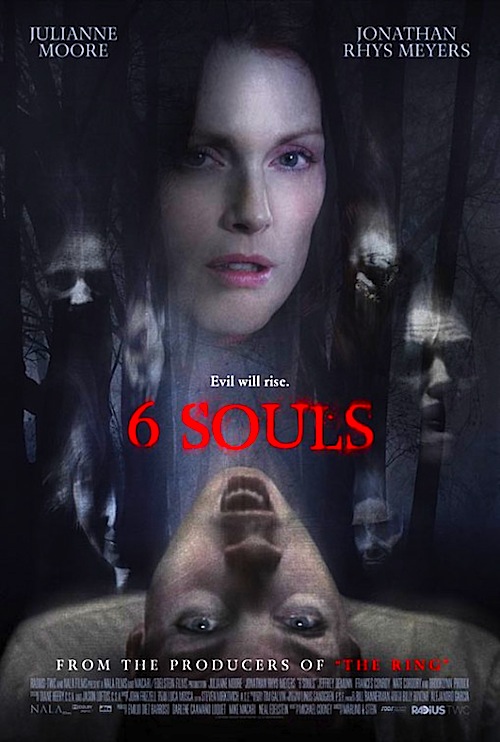
Appalachian Horror: LFM Reviews 6 Souls

By Joe Bendel. There is nothing like eternity to teach atheist materialists a thing or two. A malevolent supernatural entity is out to demonstrate the soul’s existence to those who unfortunately lack faith in Måns Mårlind & Björn Stein’s 6 Souls, which opens this Friday in New York.

Dr. Cara Jessup has no patience with bogus multiple-personality diagnoses. She is perfectly willing to testify against such claptrap as an expert witness for criminal prosecutors. It takes a lot out of her though, because she is a practicing Christian. Her faith was recently tested by the random murder of her husband, yet it remains strong. The same is not necessarily true for her father, Dr. Harding, and her young daughter.

Also a psychiatrist, the old man is more apt to buy into trendy theories. As a challenge to his orthodox daughter, he presents her a particularly volatile but convincing split personality case. Accepting the challenge, Jessup discovers the man’s presumably adopted personas correspond to tragic deaths not far from his hill country roots. In each case, the deceased’s faith had been undermined by misfortune before their actual deaths. It all might involve a snake-handling Hillbilly sect and its spiritual leader, the “Granny.” Of course, while Dr. Jessup follows her clues all the soul-sick people in her life start dying like flies.

If Julianne Moore had created such a sympathetic portrait of a woman of faith when playing Sarah Palin, Game Change would have been the toast of CPAC. Frankly, 6 Souls is more than a bit muddled in its presentation of religious belief, but Moore clearly conveys her Christianity as a source of strength for Jessup. It is smart, earnest work. And then there’s everyone else.

To be fair, veteran character actor Jeffrey DeMunn (the Stephen King prison movie specialist, appearing in Green Mile and Shawshank) is quite engaging as Dr. Harding. Alas, Jonathan Rhys Meyers is far from a suitably sinister presence as Harding’s patient[s]. Indeed, there is no getting around it—he is just plain dull.

6 Souls opens with a grabby sequence that nicely establishes both Dr. Jessup’s character and an atmosphere of foreboding. Unfortunately, it is not really connected to the rest of the narrative. Mårlind & Stein try to maintain the moody vibe, but they keep the proceedings so murky it seems like they might have shot with layer of caked-on mud covering their lens. There is a worthy lead performance and the kernel of a promising idea in 6 Souls, but the execution is too dark (in a literal sense) and erratic. Best reserved for genre die-hards who like their supernatural horror with some Appalachian seasoning, 6 Souls opens this Friday (4/5) in New York at the Village East.

LFM GRADE: C+

Posted on April 3rd, 2013 at 12:52pm.

The Intrigue Before the War: LFM Reviews Alan Furst’s Spies of Warsaw; Debuts Wed. 4/3 on BBC America

By Joe Bendel. In the early 1930’s, Poland was in a tight spot geographically. It was sandwiched between Germany and the Soviet Union. We know what that will mean come 1939. A French military attaché also has a pretty good idea, but his superiors are not so keen to hear it in Spies of Warsaw, a two-night miniseries based on Alan Furst’s novel, premiering this Wednesday on BBC America.

Jean-Francois Mercier saw more than enough combat in World War I. Initially, the decorated aristocrat was not enthusiastic about his posting to the Warsaw embassy. However, as the Polish people start to grow on him, he becomes increasingly concerned about their vulnerability to foreign invasion. Indeed, he fully understands the implications for France should Poland fall. Warsaw has also become considerably more charming for Mercier after the arrival of Anna Skarbek, a sophisticated employee of the League of Nations. Frustratingly, though, she is determined to remain faithful to her lover, Maxim Mostov, a boozy Russian journalist exiled by the Bolsheviks.

While the first installment of Spies is a bit slow out of the blocks, it nicely sets the scene and establishes the geopolitical context. The cloak-and-daggering that eventually takes center-stage is fascinating fact-based stuff, involving the oft-overlooked left wing of the National Socialist Party (a vestige of its trade unionist roots) and the German upper-class’s resentment of the Nazis, mostly for being uncouth and reaching above their proper stations.

Mercier is also rather clear-headed when it comes to appraising the Communists. In fact, he agrees to facilitate the defection of a pair of his Soviet counterparts. As a bargaining chip, they offer clues to the identity of a former NKVD mole highly placed in the German government, who became inactive when his handler was purged. Yet, Mercier’s ultimate mission, inspired by a true historical operation, will be revealed late in the third act.

Janet Montgomery as Anna Skarbek in "Spies of Warsaw."

Spies might have been condensed into feature length, but the extra time allows it to more fully explore the details (we) espionage junkies so enjoy. Even though it presents Warsaw as a city rife with spycraft and skullduggery, Dick Clement & Ian La Frenais’s tele-adaptation is clearly sympathetic to the Polish people. Prominent Polish actor Marcin Dorociński even has a major supporting role, nearly stealing the show as Mercier’s old wartime colleague, Antoni Pakulski, now serving in the Warsaw constabulary with vaguely defined counter-espionage responsibilities. Unlike his gritty turns in Rose and Manhunt, Dorociński has a smooth Errol Flynn-ish thing going on that works so well he could easily carry a Pakulski-focused sequel.

Of course, to BBC America and most of its viewers, the star of Spies is unquestionably David Tennant, the tenth Doctor Who. As Mercier, he supposedly cuts quite the dashing figure. Really? If you say so. Still, he projects a sense of intelligence and a distinct impatience with bureaucracy, both of which are more important for his character’s super-spy credibility.

Veteran British television director Coky Giedroyc (whose credits notably include The Hour) maintains an appropriately noirish mood, emphasizing atmosphere and intrigue more than action. It might seem hard to believe that one of the year’s smartest miniseries – with a pronounced respect for freedom and a healthy skepticism of ideology – would feature a French blue blood and a League of Nations do-gooder as its primary POV characters, but here it is. Highly recommended for fans of cerebral spy fiction in the Le Carré tradition, Spies of Warsaw begins this Wednesday (4/3) and concludes the following week (4/10) on BBC America.

LFM GRADE: A-

Posted on April 1st, 2013 at 11:15am.

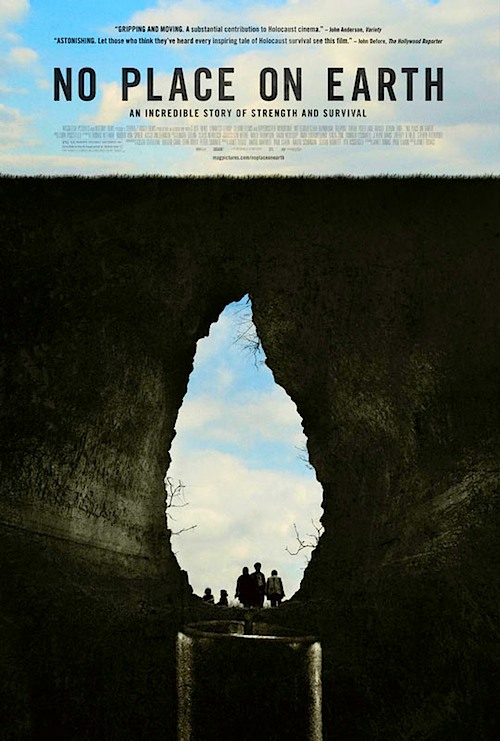
Going Underground in the Ukraine: LFM Reviews No Place on Earth

By Joe Bendel. Most think of caving as the stuff of National Geographic, but for thirty-eight Jewish Ukrainians, it was rather more serious. It was a matter of life, not death. For eighteen months they evaded the German National Socialists by hiding deep in two narrow, naturally-formed caverns. Decades later, the survivors tell their story in Janet Tobias’s documentary, No Place on Earth, which opens this Friday in New York.

As it often happens, it was a New Yorker who brought this story to light. British-born Bronx resident Chris Nicola is an experienced caver who originally traveled to the post-Soviet Ukrainian in search of his roots. While exploring a cave, he discovered a series of artifacts clearly suggesting families had once lived there. Not surprisingly, the locals were not forthcoming with information. Nonetheless, after years of sleuthing, he finally tracked down the Stermers and the Dodyks. They all credit their initial survival to the iron-will of matriarch Esther Stermer as well as the resourceful foraging of the elder Stermer brothers, Nissel and Saul.

When Tobias read about Nicola’s expeditions and investigation (in Nat Geo, of course), she recognized the makings of a good documentary. Fortunately, the production fell into place in time to record the elderly Stermer and Dodyk survivors returning to the caves that once sheltered them, bringing along their children and grandchildren, with Nicola to serve as their guide.

Tobias blends dramatic re-enactments, talking head interviews, and her on-the-scene footage of the families’ underground homecoming (not completely seamlessly, but functionally enough). At times, it has the feel of a cable special (perhaps with good reason, considering it is a co-production of History Films), but there is no denying the power of their story. At one point during their subterranean reunion they cut the lights to fully recreate the experience of living there. Coincidentally, at this point the video went out at the screening I attended, yet it took a roomful of jaded film critics several minutes to realize it was supposed to be dark, but not that dark. One could certainly say we were caught up in the moment. (Eventually the problem was fixed and the film rewound to the point in question).

The Stermer and Dodyk family members are still very sharp interview subjects and Nicola is a particularly charismatic screen presence. As a result, Tobias captures a vivid sense of her subjects’ personalities and their lives in the caves, the quality of which was quite high they repeatedly emphasize, because it was free.

Indeed, this is not the usual survival story often depicted on-film, chronicling the efforts of a good Christian protector. The Stermers and Dodyk’s relied almost entirely on themselves. There is a lot to learn from their inspiring stories. Respectfully recommended for family and student viewing, No Place on Earth opens this Friday (4/5) in New York, at the Angelika Film Center downtown and the Elinor Bunin Munroe Film Center uptown.

LFM GRADE: B

Posted on April 1st, 2013 at 11:14am.

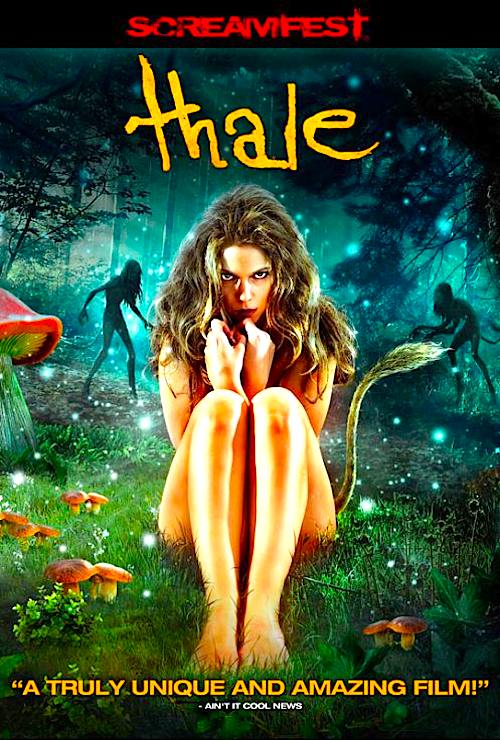
Mythic Scandinavian Blondes: LFM Reviews Thale

By Joe Bendel. Huldra are not your typical mythological woodland creatures. These tailed women from Scandinavian myth are very blonde and can be a lot of trouble. Two forensic cleaners might have one on their hands in Aleksander Nordaas’s Thale, which opens this Friday in New York.

Elvis is not really cut out for his friend’s Leo’s industrial strength cleaning service. Their primary gigs are grisly crime scenes. The work doesn’t seem to bother Leo much, but it keeps Elvis close to a bucket. Their latest assignment has them scouring about for the pieces of an elderly recluse, killed under mysterious circumstances. As they proceed, they stumble upon a secret cellar with a naked woman hidden in a bath tub.

It seems the old geezer had kept her prisoner down there since she was a young girl. While the deceased evidently performed various experiments on her, the cassettes he left behind seem to suggest he was also protecting her from outside parties. As if on cue, we start to see strange, shadowy figures darting through the woods. The feral Thale, as the old man called her, also bears watching. Good luck, dudes.

Although billed as a horror film, Thale is long on set-up and short on gore. This is not necessarily a bad thing. There is a bit of character development in their disparate reactions to splattered blood and entrails that pays off later in the film. Nonetheless, there is not so much to satisfy hardcore genre fans. Instead, Thale plays like a dark Nordic version of Splash.

Nordaas deliberately emphasizes Thale’s animal-like vulnerability. Silje Reinåmo taps into that raw primal innocence. It is a rather brave performance, especially considering she is naked for nearly the entire film. It is hardly erotic, but Seth MacFarlane will clearly be able to see her breasts. Erlend Nervold and Jon Sigve Skard are also relatively engaging as the everyman carnage cleaners. They have bits that stay with viewers well after the initial screening, which says something for the genre. Unfortunately, the third act’s perfunctory lack of ambition is disappointing.

Considering the dearth of huldra movies previously available, Thale undeniably fills a void. In terms of tone and subject matter, it certainly has the virtue of being something different. Despite the simplicity of its narrative, cult film enthusiasts should consider it when it opens this Friday (4/5) in New York at the Cinema Village.

LFM GRADE: B-

Posted on April 1st, 2013 at 11:13am.