Schenectady Blues: LFM Reviews The Place Beyond the Pines

By Joe Bendel. If you shoot a movie in Schenectady, you surely qualify for those New York State tax credits. However, if you just move there looking for regular work, you are likely to get frustrated, especially if your primary skill is motorcycle stunt riding. As a result, drifter Luke Glanton turns to crime, setting in motion a wave of bad karma that will outlive him in Derek Cianfrance’s lumbering family saga, The Place Beyond the Pines, which opens today in New York.

Once a year, Glanton blows through town with the carny, performing his steel cage act. Ryan Gosling obvious spent hours in the gym and having a barrelful of temporary tattoos applied so we will buy him as a steely bad cat. Of course, it fails, putting the film in a credibility hole right from the start. Still, we can believe he is rather thick-headed. That is important, because Glanton will make some very bad decisions.

Romina, his hook-up from the previous year, turns up after his show – but she is acting weird, giving him the Heisman. Dropping by her place to take another shot, Glanton learns she had his baby, but is now engaged to a responsible adult. Much to her surprise, he quits the carnival, intending to settle down and be a father in Schenectady. The only straight gig he finds is low paying mechanic work with the grizzled Robin Van Der Zee. His drinking buddy-boss has other ideas, though.

The idea to start holding up banks involves Glanton’s skill as a driver and Van Der Zee’s cargo truck waiting to whisk him away. Frankly, Beyond’s heist scenes are surprisingly well staged. Regrettably, from this point on, Cianfrance vividly illustrates the principle of diminishing returns with the subsequent story arcs. In the second act, we follow law school grad-police officer Avery Cross, whose path fatefully crossed that of Glanton.

Ryan Gosling in "The Place Beyond the Pines."

Guilt-ridden and gun-shy, Cross finds his career at a standstill, despite his questionable hero status. He is also uncomfortable with the Schenectady force’s systemic corruption. This is fairly standard stuff, somewhat enlivened by Ray Liotta’s dependable crooked copper turn. However, Bradley Cooper never feels right as Cross, looking too old and reserved for a rookie patrolman and too young and bland for a seasoned Attorney General candidate in the third act.

Indeed, the final segment is largely a disaster, aside from the intriguing reappearance of Ben Mendelsohn’s Van Der Zee. Cianfrance drives his “sins of the father” theme into ground when Cross and Glanton’s sons become high school frienemies. Dane DeHaan is cringingly sensitive and damaged as the son Glanton never knew, while Emory Cohen’s inarticulate AJ Cross would be more convincing as the spawn of Cro-Magnons rather than a reasonably educated couple like the Crosses. Forget boarding school, he ought to be kept chained in the attic.

Hardly a subtle stylist, Cianfrance beats on the paternal issue like a rented mule. A talented editor could probably rescue a respectable short from the Glanton section, but with its taxing one hundred and forty minute running time, Beyond is simply far too long and overly melodramatic. Not recommended (unless viewers are intrigued to see the Schenectady experience on the big screen), The Place Beyond the Pines opens today (3/29) in New York at the Landmark Sunshine and Loews Lincoln Square.

LFM GRADE: D

Posted on March 29th, 2013 at 9:01am.

There Will Be Mud: LFM Reviews Detour

By Joe Bendel. As if the taxes and wildfires were not bad enough, here is yet another reason to avoid California. Trapped in his SUV, an ambitious advertising exec asks how the Golden State can have mudslides when there isn’t any water. It is a fair question, but it is obviously rhetorical in William Dickerson’s claustrophobic survival drama, Detour, which opens today in New York.

Jackson was on his way to a pitch meeting (sort of like that three hour cruise) when the picturesque stretch of coastal highway suddenly turned to mud. Buried underneath who knows how much gunk, he has no cell service and a limited supply of food and water. For temporary distractions (and exposition purposes) he can play videos on his smart phone, allowing viewers to meet his wife. Evidently she is pregnant, but he did not receive the news with spectacular good cheer.

As the mud presses in on his vehicle’s structural integrity, Jackson improvises reinforcements. He is actually pretty handy for an ad man. In fact, Dickerson and co-writer Dwight Moody are quite faithful observing the constraints they impose on their hapless protagonist. However, their flashbacks and delusional interludes are nakedly manipulative.

Despite its apparent simplicity, the one-man-against-the-elements genre (in the tradition of 127 Hours) is hard to pull off. Staginess is obviously an inherent pitfall. Still, Neil Hopkins soldiers through reasonably well. While he is forced to mutter to himself quite a bit, he largely sells the messages he leaves on his iPhone, perhaps for posterity. Unfortunately, the sequences outside the mud-trap are flat and awkward. Odder still, it is difficult to tell whether the final scene is meant to be inspiring, ironic, or ambiguous, which is clearly an execution problem.

Detour is far from classic, but it is certainly presentable by b-movie standards. Nonetheless, it is tough to justify at full Manhattan ticket prices, particularly with Aftershock, the Eli Roth-penned Chilean disaster smack-down, waiting in the wings. At least worth falling into eventually on cable, Detour opens today (3/29) in New York at the Cinema Village (and is now available on VOD platforms).

LFM GRADE: C

Posted on March 29th, 2013 at 8:59am.

Dead Ringers: LFM Reviews Orphan Black on BBC America; Series Premieres Sat. 3/30

By Joe Bendel. Technically, she is the doppelganger taking over someone else’s life. When Sarah sees her exact double commit suicide, she lifts the woman’s purse and wallet. The very recently deceased is much better dressed, after all. However, when she temporarily assumes the dead woman’s identity, she gets considerably more than she bargained for in the opening episode of BBC America’s Orphan Black, which premieres this coming Saturday evening.

Angry and irresponsible, Sarah carries the baggage of a childhood spent entirely in the foster-care system. She wants to begin a new life with Felix, her foster-brother, and her daughter Kira, whom she has not had custody of in some time (and for good reason). Her dubious idea of a fresh start involves stealing some inferior grade cocaine from her pseudo-psycho-boyfriend for Felix to sell. Then she sees Beth throw herself in front of a train.

Making her way to Beth’s pad, Sarah finds out where her accounts are. She only intends to stay long enough to clean them out. Naturally, things do not go according to plan. It turns out Beth was a cop facing a disciplinary hearing for a questionable shooting. Of course, Sarah has no inkling of what really went down.  he is also somewhat at a loss for words when Beth’s romantic interest returns early from a business trip. It seems rather obvious, but Felix has to remind her she and Beth are probably connected in some way that could give her clues to her own past. Gee, you don’t suppose any more apparent twins might show up?

Essentially, Orphan is like a combination of Cinemax’s Banshee and Fox’s late but not terribly lamented John Doe. If the latter doesn’t mean anything to you, don’t worry about it. At least, Orphan starts with a jolt. It is not exactly Sion Sono’s Suicide Club, but the tightly staged and edited train station sequence is undeniably grabby. The first episode also has a promising grittiness. Viewers can readily accept Tatiana Maslany’s Sarah and Jordan Gavaris’s Felix are damaged people long accustomed to operating on the fringes of polite society.

Unfortunately, by the time the first episode’s mystery guest shows up, a familiar pattern begins to emerge. It is all too easy to foresee a covert government laboratory and a parade of sketchy informers in Orphan’s future. Frankly, we have been down that road many times in the past and it almost invariably leads nowhere.

It is impossible to render a final critical judgment on the basis of only one episode, but viewers do just that all the time. Orphan assembles a reasonably strong cast, but in service of a so-so premise. It might be a passable distraction, but it is nowhere near as entertaining as Banshee, with which it apparently shares some superficial cop-impersonating plot elements. Perhaps it will grow on genre fans when it takes its place in BBC America’s “Supernatural Saturday” (3/30) this weekend.

LFM GRADE: C+

Posted on March 27th, 2013 at 10:47am.

Czech Rotoscoped Noir: LFM Reviews Alois Nebel on Blu-ray/DVD

By Joe Bendel. He will be one of the last “patients” to witness the business end of a Communist era mental hospital. Ironically, the provincial train dispatcher could benefit from professional psychiatric treatment, but he will have to exorcise the ghosts from his past on his own in Tomáš Luňák’s Alois Nebel, which releases today on Blu-ray/DVD from Zeitgeist Films.

Based on the first Czech graphic novel published after the Velvet Revolution, AN begins during the waning days of Communism. A fugitive Mute has been captured at Alois Nebel’s sleepy station in Bílý Potok, much to the satisfaction of his scheming co-worker, Wachek. A black marketer and snitch, Wachek and his old sinister man are unnerved by news of the fall of the Berlin Wall. However, they still have extensive contacts with the local officials and the nearby Soviet garrison, which they intend to exploit while they still can.

Coveting Nebel’s position, it is rather easy for Wachek to have him institutionalized, especially since the dispatcher is legitimately disturbed. As a child, Nebel witnessed the forced post-war deportations of ethnic Germans from the Czechoslovakian Sudetenland, including very personal atrocities that continue to trouble his mind as dreams and hallucinations. Frankly, his deliriums are becoming more frequent and intense, but he will get little treatment in the sanitarium beyond some mind-numbing drugs. Yet he will find himself compulsively drawn to the mysterious Mute also incarcerated there.

Eventually, Communism will fall and Nebel will be released, but without the security of his former position. The lifelong railroad employee will spend months in the veritable wilderness, living amongst the homeless in Prague’s grand Central Station. Of course, all roads lead back to Bílý Potok for a reckoning of Biblical dimensions.

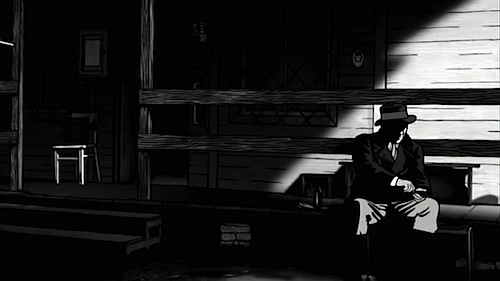
From "Alois Nebel."

Rendered in the rotoscoping style notably employed by Richard Linklater’s A Scanner Darkly, the live action conversion technique is not universally embraced by animation fans. However, Luňák and head animator Pavla Dudová’s striking black-and-white application perfectly suits AN’s moral ambiguities and noir sensibilities. Every frame of this film looks absolutely beautiful, in a moody, atmospheric sort of way.

Indeed, this is a dark film in every conceivable manner. The railroad motif is no accident, representing a wide array of Twentieth Century horrors, including the Holocaust, troop transportation to the front, and the post-war vengeance taking. The rather militarist look of Nebel’s railroad uniform is also hard to miss, especially in light of his German surname (meaning “fog” or “life” spelled backwards).

Given the rotoscope method, real performances went into the making AN beyond mere voice-overs. Although modeled after the graphic novel character, Miroslav Krobot invests the animated Nebel with profoundly heavy world-weariness and guilt. Likewise, Karel Roden helps create a haunted and haunting portrait of the Mute.

Although Alois Nebel presents a decidedly pessimistic vision of human nature, it is not cynical. In fact, one could argue it is ultimately quite humanistic. Nonetheless, it is definitely an animated feature for connoisseurs who prefer their film noirs served straight, no chaser. Visually arresting with an unusually sophisticated narrative, Alois Nebel is highly recommended for fans of ambitious adult animation and Czech cinema. It is now available for home viewing as part of the Kimstim collection from Zeitgeist Films, along with Eric Khoo’s richly rewarding Tatsumi.

LFM GRADE: A-

Posted on March 26th, 2013 at 11:19am.

Graham Greene’s Intrigue and Depression: LFM Reviews Dangerous Edge on PBS; Film Airs Friday 3/29

Watch Preview on PBS. See more from Dangerous Edge: A Life of Graham Greene.

By Joe Bendel. During his tenure with the British intelligence, Graham Greene reported directly to the notorious Soviet mole Kim Philby. It was rather fitting the espionage novelist and chronic adulterer would be so closely associated with such a significant betrayer. Yet, Greene consistently offered tortured defenses of his friend. He was “complicated” that way. Thomas P. O’Connor surveys the writer’s work and ironic life in Dangerous Edge: A Life of Graham Greene, which airs this Friday night on most PBS outlets.

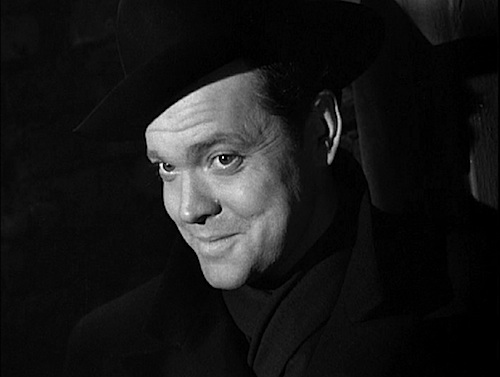
Greene was never awarded the Nobel Prize for Literature, but he was nominated for an Oscar. Indeed, with so many of Greene’s books and screenplays produced for the big screen, O’Connor has a wealth of cinematic imagery available to illustrate Greene’s oeuvre, without ever scraping the bottom of the barrel. In fact, at least two of Greene’s scripts became outright masterpieces: The Third Man and Fallen Idol, both directed by Carol Reed.

Orson Welles as Harry Lime in Graham Greene's "The Third Man."

Essentially, O’Connor focuses on three sides of Greene’s persona: the writer, the adventurer, and the adulterous, spiritually doubting manic depressive. Much is made of Greene’s persistent “boredom,” his euphemism for depression, as well as his conversion to a decidedly flawed but earnest brand of Catholicism. Greene’s biographers point to Greene’s reluctant status as the preeminent “Catholic novelist” of his time, while rather openly carrying-on with a woman who was not his wife, as one of the many great contradictions defining his life. Fair enough.

O’Connor incorporates talking head interviews with some top shelf literary figures, including Sir John Mortimer, Paul Theroux, David Lodge, and John Le Carré, who (quite surprisingly) blasts Philby for coldly and deliberately causing the deaths of numerous colleagues. Again, O’Connor was fortunate to have considerable audio recordings of Greene, sounding like quite the acidic raconteur. Bill Nighy also serves as the supplemental voice of the author, reading his letters and documents when the archival Greene is not available. It is a rather classy package, narrated by Sir Derek Jacobi.

Aside from Le Carré, Edge’s participants largely give Greene a pass on Philby and related Cold War issues. Great pains are taken to portray him as an equal opportunity geopolitical gadfly, but it is far from convincing. Nonetheless, the complexity of Greene’s relationship to his Catholic faith should interest readers and viewers across the spectrum. A well paced examination of a flawed but fascinating figure, Dangerous Edge follows Philip Roth: Unmasked (another unsuccessful Nobel contender, thus far), this Friday (3/29) on PBS stations nationwide.

LFM GRADE: B-

Posted on March 26th, 2013 at 11:17am.

Artists and Models, Fathers and Sons: LFM Reviews Renoir

By Joe Bendel. The Renoirs were no ordinary family. Yet not even they were spared the horrors of WWI. At least the great painter’s middle son could convalesce amid the splendor of his family’s Riviera home. The future French auteur will meet his father’s last great model during his fateful homecoming in Gilles Bourdos’s Renoir, which opens this Friday in New York.

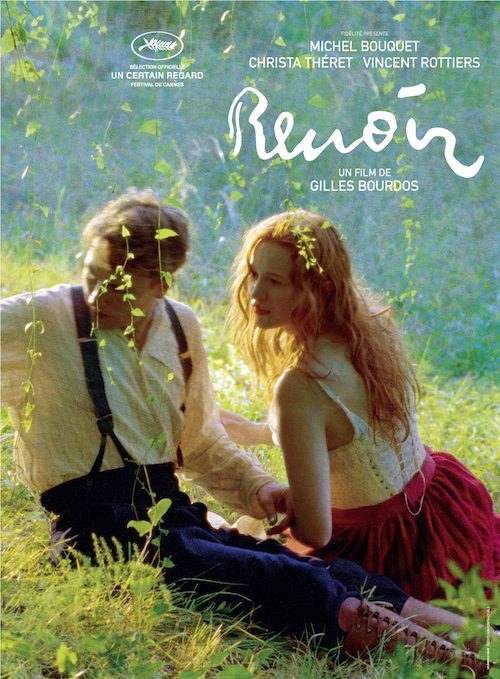
Referred to Renoir for potential modeling work, Andrée “Dédée” Heuschling finds an estate frozen in a state of near paradise, staffed by a veritable harem of her predecessors, doting on the arthritic artist. However, old man Renoir does not rest easy. He still mourns his late wife, while he waits for word of his two eldest sons injured on the battlefront. Yet Heuschling has the perfect Renoir look, inspiring him to begin painting outdoor nude studies once again. She also makes quite the impression on the Impressionist’s son Jean when he returns home on medical leave.

Based on the narrative biography of Jacques Renoir (Pierre-Auguste’s great-grandson and Jean’s great-nephew), Boudros’s film initially appears to be about the artist in his twilight years, but steadily shifts its focus to Jean, the future cinematic artist as a young man. Of course, Heuschling links father and son, eventually serving as muse to both.

Throughout Renoir, Boudros elevates fine art and evocative atmosphere high above messy dramatics. The resulting experience is quite a bit like taking an afternoon nap in the French countryside. It is quite luxurious, but there is not much to tell afterward. Nonetheless, Boudros crafts an elegant period production – even enlisting Guy Ribes, a convicted forger fresh out of the big house, to recreate Renoir’s style and method.

While Heuschling’s coquettish character deliberately remains something of cipher throughout Renoir, cinematographer Mark Ping Bing Lee’s lens absolutely loves Christa Théret, as do Ribes’ canvasses. Audiences will certainly understand the “Renoir look” from her photogenic turn. Vincent Rottiers largely carries the dramatic load as Jean Renoir, creating a convincing portrait of a somewhat confused young man trying to find his way in the world. Yet Michel Bouquet, the crafty old veteran thesp, eventually steals the film back for Pierre-Auguste with some wonderfully subtle but touching scenes of a father coming to terms with his sons. However, Thomas Doret (from the Dardenne Brothers’ The Kid with a Bike) never really gets to stretch beyond the surly wild child as Renoir’s youngest son, Claude (a.k.a. Coco).

Renoir is the sort of quiet but impeccably graceful film French cinema lovers swoon over. The combination of Renoir’s art, the lush natural beauty, Théret’s figure, and even a spot of hot jazz are wonderfully seductive. Recommended for Francophiles and admirers of Impressionism, Renoir opens this Friday (3/29) in New York at the Lincoln Plaza Cinema.

LFM GRADE: B+

Posted on March 25th, 2013 at 9:46am.