LFM Reviews Fellini’s at 50

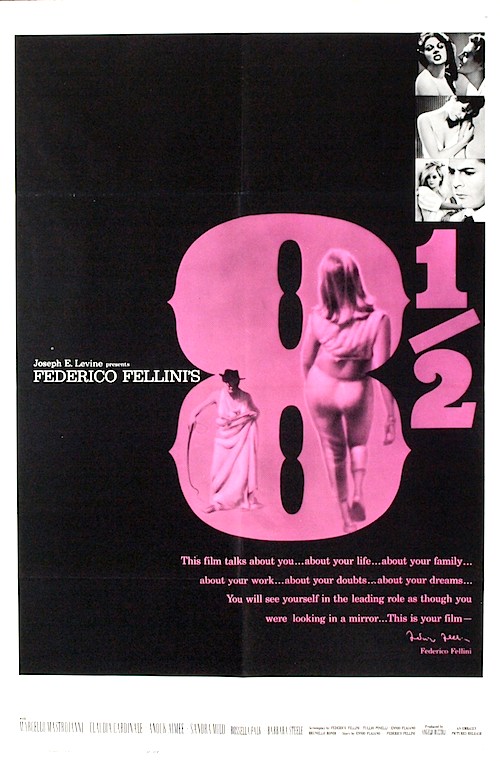
By Joe Bendel. In 1963, Federico Fellini became a bit player in the Cold War when the Moscow International Film Festival’s non-Soviet judges threatened to walk out unless their decision to award the grand prize to was honored. It would be one of many accolades bestowed (grudgingly in that case) on Fellini’s masterpiece. Frankly, finding fresh new insights into the Oscar winner is rather daunting, but the fiftieth anniversary is a fitting occasion to take a shot at it. To mark the milestone, Corinth Films will rerelease this Friday in New York.

and La Dolce Vita may somewhat blend together for many cineastes, because they probably first saw both films – which share similar themes and cast members – in short succession. Dolce has the fountain and has the weird space age scaffolding. Considered by Fellini his 8½th film (with shorts and collaborations counting as halves), it is a film that rewards revisiting at various stages of life. At first viewing, some will be struck by its Fellini-esqueness. However, those initiated into the auteur’s style will subsequently find it has a strong narrative structure and deep emotional feeling.
As everyone ought to know, Guido Anselmi is an acclaimed director “taking the cure” at an upscale sanatorium. Presumably he is being treated for nerves and exhaustion, but he is really addicted to people and drama. He is woefully behind schedule and over budget on his next film. Intended as a profoundly personal statement, it has evolved into a science fiction epic, with that costly behemoth of a set still under construction.

Anselmi would like to save his career and his marriage to Luisa, but he seems incapable of either. Instead, he spends unrewarding time with his married mistress and is visited in his dreams and reveries by women from his past, including his mother and La Saraghina, the town harlot who fascinated him as a child.

Unlike the Soviets, the Vatican willingly joined the chorus of plaudits, putting on its list of the 45 greatest films produced before 1995, even though it is not particularly kind in its depiction of Catholic clergy. By the same token, Fellini’s film never celebrates infidelity or materialism. Anouk Aimee’s Luisa is more sophisticated and beautiful (in an earthy way) than his tarty mistress, but Anselmi cannot give her the emotional commitment she rightly demands.

Aimee is truly a wonder in . Likewise, Claudia Cardinale brings down the roof with her late appearance as Claudia, the glamorous movie star with whom Anselmi has some ambiguous history. Although relatively unheralded amongst a cast of giants, Rosella Falk brings a smart, intriguing edge to film as Rosella, the Anselmis’ family friend and counselor. However, it is Marcello Mastroianni who anchors and defines the film. In a way, it is easy to overlook his performance as he is passively pushed and pulled from one episode to another. Yet, in quiet scenes, such as his pseudo-confession to Claudia and his confused late night attempt preserve his marriage, Mastroianni’s work is powerfully direct and honest.

is one of a handful of films everyone has to see to consider themselves cinematically literate, but you cannot just see it once. With the passage of time, Anselmi’s crisis of confidence will resonate differently. If you have only seen the musical Nine or the various pastiches, you have not experienced the real thing. It really is that good. Recommended unreservedly to anyone who takes film seriously, opens this Friday (3/22) at the Quad Cinema.

LFM GRADE: A+

Posted on March 18th, 2013th at 2:47pm.

Putting a Human Face on Human Trafficking: LFM Reviews Eden

By Joe Bendel. It is time to drastically raise the penalties for anyone involved in human trafficking. Currently, for procurers and mules the rewards simply outweigh the risks in what is estimated to be a $32 billion illicit trade. Is capital punishment unreasonable for those who lure innocent women into depraved enslavement and most likely death? It is time to have that debate, prompted by Megan Griffith’s fact-based Eden, which opens this Wednesday in New York at Film Forum.

Eden is largely based on the experiences of Chong Kim, a naturalized American citizen who spent years as a captive of trafficking ring. Hyun Jae is the name of her cinematic analog, but her kidnappers dub her Eden for their clientele. She has a dangerous secret—she looks younger than she is. Most of the gang’s sex-slaves are disposed of once they reach her age. Partly that is due to their customers’ tastes and partly a function of the extreme abuse they endure.

Determined to survive, Hyun Jae makes herself useful to Vaughan, the erratic deputy of the operation’s local supervisor, Federal Marshall Bob Gault. Vaughan is ruthless and tenacious, but his IQ probably does not break 100. Having Hyun Jae handle the cash and the phones helps the psychologically disturbed thug keep calm and collected. However, Hyun Jae has not given up hope. As she learns the inner workings of the organization, she bides her time.

Jamie Chung was perfectly fine in Man with the Iron Fists and became a breath of fresh air in the otherwise dumber-than-bag-full-of-hammers Knife Fight, but the raw power of her work here is something else altogether. It is harrowing to watch her, but also riveting and ultimately inspiring. You are witnessing a victim resolving to be a survivor, which is heavy. Her scenes with Matt O’Leary’s relentlessly unnerving Vaughan are also genuinely intense and completely convincing.

Unlike other issue-driven human trafficking films, the chess game playing out between Hyun Jae and Vaughan focuses the narrative, building unexpected suspense. This is clearly a film, tightly scripted by Griffiths and Richard B. Phillips, not a white paper-backgrounder. Nonetheless, it exposes the horrifying crimes happening right here in America: Nevada for Hyun Jae and presumably someplace in the southwest for Chong Kim.

Unfortunately, both the general public and law enforcement agencies have not been well trained to detect trafficking. Still, those aiding and abetting should take one lesson from Eden to heart. They are just one mistake away from an anonymous grave in the desert—and it’s exactly what they deserve. Cinematographer Sean Porter effectively conveys the harshness of that wide open landscape (so helpful to the sex-slavers) as well as the dark, grimy conditions in which the women are held.

Eden addresses an important and timely topic, but the fearless performances from Chung and O’Leary will completely hook audiences on an emotional level. Recommended for general audiences, Eden opens this Wednesday (2/20) at Film Forum.

LFM GRADE: B+

Posted on March 18th, 2013 at 2:43pm.

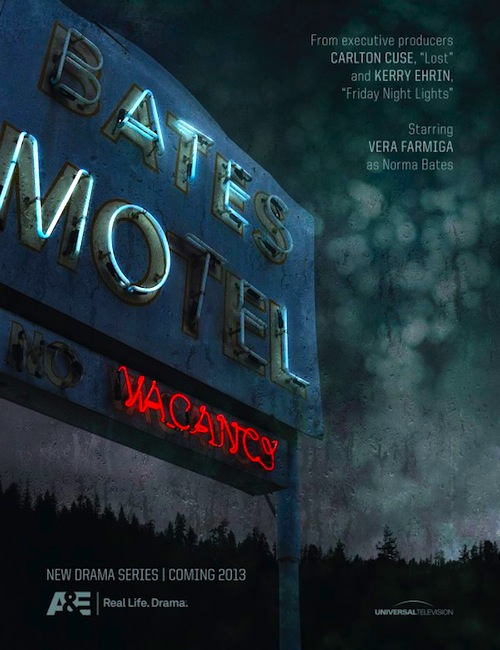
Norman and Norma, Together Again: LFM Reviews Bates Motel; Debuts Tonight (3/18) on A&E

By Joe Bendel. In this day and age, serial killers actually have fans. Maybe it is not the best way to get back at your mother anymore. Nonetheless, a mild mannered teenager named Norman has a complicated relationship with his mother Norma that will eventually drive him to become the definitive psychopath. High school may not help much either. Viewers will learn how he gets from here to there in A&E’s prequel reboot Bates Motel, which premieres this evening.

Norman Bates as played by Anthony Perkins in Hitchcock’s original masterpiece (and a series of better-than-you-might-expect 1980’s cash-in sequels) was always a tragic figure, even when hacking away at a guest in the shower. Despite the body count we never hated Bates, because he never took pleasure from his compulsions. In contrast, Motel periodically intersperses its primary drama with flashforwards to what appear to be the mature psychotic Norman engaged in some Saw-like torture-horrors. It is a rather dubious strategy, undercutting viewer sympathy for the appropriately awkward but earnest Freddie Highmore’s Norman. At least that is the case in the first episode, “First You Dream, Then You Die.”

After some messy but ill defined business with Norman’s father, Norma Bates decides she and Norman need a fresh start. Sleepy White Pine Bay looks like a nice place for it. Buying a foreclosed motel right off the highway with a spooky old house out back, the Bates are ready to start over. Of course, Norma Bates is not about to allow her son to socialize with the school hotties who show an inexplicable interest in him. She also hears some troubling news about a highway bypass. Worst of all, the former owner seems determined to harass her. This will be a profound mistake on his part.

Highmore really could pass for a young Perkins, but seeing Norman Bates with an mp3 player just does not feel right. The character and locale are just so firmly in 1960, any attempts to update them are jarring. Still, the interaction between Norman and Norma plays well for fans of the franchise. Frankly, it is a little scary how easily we accept Vera Farmiga as the mother of all manipulative mothers. It is hard to judge from just the initial outing, but even some of the high school kids show potential to grow as characters. Indeed, innocent young Norman Bates confronting Twins Peaks-style small town mysteries is definitely a promising premise. However, it is hard to get around the pilot’s buzz-killing tonal shifts.

Notwithstanding whatever the heck grown-up Norman is doing (who knows, maybe it is not really him), the first episode of Bates Motel is definitely hooky. It would be nice to judge from a larger sample, but A&E has made shrewd but judicious use of the pilot, unveiling it at SXSW, so evidently most of the press have had to make do with the same. Worth a second look, Bates Motel debuts tonight (3/18) on A&E.

LFM GRADE: provisional B

Posted on March 18th, 2013 at 2:36pm.

LFM Reviews Emperor Visits the Hell @ MoMA’s New Directors/New Films 2013

By Joe Bendel. Before the legendary journey there was a sojourn through Hell. Emperor Li Shimin would eventually sponsor the Buddhist monk Xuanzang’s western pilgrimage in search of sacred texts. However, he must first return from an unplanned detour through the underworld. Luo Li gives the early chapters of Journey to the West an arthouse modernization with Emperor Visits the Hell, which screens during this year’s New Directors/New Films, co-presented by MoMA and the Film Society of Lincoln Center.

Li Shimin is a municipal boss, who murdered his father and brothers to ascend to his “throne.” When Dragon King, a local gangster, shortsightedly refuses to comply with an order from Heaven, he asks the “Emperor” to protect him from Heaven’s Executioner, who just happens to be Li Shimin’s counselor, Wei Zheng. The imperial mayor does his best to occupy his advisor, but he bores the man to sleep. Much to his surprise, the oblivious Wei decapitates Dragon King in his dream, which pretty much does the trick in real life too.

Somewhat disappointed by the quality of Li Shimin’s protection, Dragon King haunts the ruler as an angry ghost. Eventually, he drives the man to his death. All is not lost though. The faithful Wei has some high placed contacts in the kingdom below.

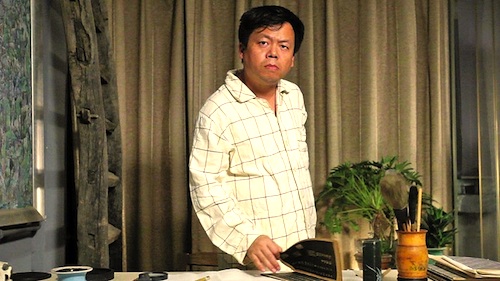
From "Emperor Visits the Hell."

Li Shimin’s tale is one of many discrete chunks of the great Ming era novel that have been adapted for film and television. However, it is a downright bizarre choice to reboot in a contemporary setting. This is not a bloody combat-driven tragedy like Coriolanus. Rather, the mythic elements, such as Dragon King’s decision to forestall the rains at their appointed time, are at complete odds with Luo’s grubby modern day conception. Yet, he keeps doubling down, essentially emphasizing the contrast between the modern trappings and the fantastical story. It is just a weird vibe to take in.

Frankly, Hell looks a lot like Union City through cinematographer Jie Ren’s lens. There is no fire and brimstone, just drab offices and dilapidated slums. Li Wen’s Li Shimin is also a rather cold fish, at least until he gets hammered at the concluding Return of the Jedi-style feast (doubling as the actual wrap party) and proceeds to go off the contemporary state of things.

Although drained of color and deliberately artificial looking, Luo still presents some intriguing images. While decidedly post-modern in its approach, the film is much more about subverting narrative tradition than authority. It lends itself to all kinds of critical literary analysis, which is great if you are covering ND/NF, but it is impossible to recommend it to anyone looking for a movie to get emotionally caught up in. A coldly cerebral film intended for the like minded, Emperor Visits the Hell screens Thursday (3/21) at MoMA and Saturday (3/23) at the Walter Reade as a selection of the 2013 New Directors/New Films.

LFM GRADE: C-

Posted on March 18th, 2013 at 2:34pm.

LFM Reviews From Up On Poppy Hill @ The 2013 New York International Children’s Festival

By Joe Bendel. Hosting the 1964 Tokyo Olympics completed Japan’s post-war rebirth. It would announce the arrival of a new democratic capitalist country on the world stage. However, as Japan prepares for the games in 1963, two high school students will come to terms with their past in Gorō Miyazaki’s From Up On Poppy Hill, the latest animated feature from Studio Ghibli (co-adapted from a manga favorite by the director’s legendary animator father Hayao), which screened as part of the 2013 New York International Children’s Festival, in advance of its Friday opening at the IFC Center.

Umi Matsuzaki is the perfect daughter, who studies diligently when she is not cooking and doing chores for her family’s boarding house guests. Unfortunately, her parents are not present to witness her hard work. Her mother is studying in an American graduate program and her father was lost at sea—or at least so she was told. Nevertheless, every morning she raises signal flags in hopes of guiding her sailor father home again. Her grandmother, siblings, and boarders appreciate all her hard work, but there is still a void in her life.

Suddenly, boys come into her life. Through an odd chain of events, the bemused Matsuzaki falls in with the rabble-rousing leaders of the Latin Quarter, a dilapidated fraternity house for her school’s male-dominated academic clubs. As the editor of the Latin Quarter’s newspaper, Shun Kazama has published his poems inspired by Matsuzaki’s flag-raising. Although the administration has decided to demolish their old building, the practical Matsuzaki becomes instrumental in their campaign to save the Latin Quarter. In the process, she and Kazama fall deeply in manga-anime style love. Unfortunately, Kazama discovers a secret link from their family histories that apparently changes everything.

From "From Up On Poppy Hill."

At least the first third of Poppy is solely devoted to establishing Matsuzaki’s small corner of Yokohama and her various relationships with family, boarders, and fellow students. One could say not much happens, yet it is quite pleasant, in large measure due to the great likability of the virtuous but down-to-earth heroine. When Matsuzaki begins her sweetly awkward relationship with Kazama, while counseling his arrogant but well meaning friends, Poppy takes on the vibe of an upscale anime Archie comic. However, the past will continue to intrude on their reluctant melodrama.

Visually, Poppy is quite attractive, but its backgrounds and cityscapes are not nearly as lush as Ghibli’s two previous American releases, The Secret World of Arrietty and Tales from Earthsea. Still, it presents an appealing protagonist for younger girls, especially those who might feel self conscious about being studious or sensitive. Indeed, the fillm’s tone and characters are all quite endearing, propelled along quite nicely by Satoshi Takebe’s lightly swinging themes.

Reportedly, production on Poppy was interrupted but not derailed by the 2011 earthquake and tsunami, which adds a layer of significance to its story of perseverance and preservation. Comparatively small in scope and firmly rooted in reality, Poppy is like the Ghibli version of an Ozu film. Recommended for pre-teens and up who appreciate character driven animation, From Up On Poppy Hill opens this Friday (3/15) in New York, downtown at the IFC Center and uptown at the Elinor Bunin Munroe Film Center (with the Friday and Sunday screenings to be held in the Walter Reade instead).

LFM GRADE: B

Posted on March 14th, 2013 at 12:30pm.

The Original Media Mogul: LFM Reviews Citizen Hearst

By Joe Bendel. His name has become synonymous with yellow journalism, conspicuous consumption, and raw power. The son of a self-made mining tycoon, William Randolph Hearst always fancied himself a champion of the working people and to his credit, he usually had a good sense of what they wanted to read. Director-editor-co-writer-co-producer Leslie Iwerks profiles the man and the media empire he launched in Citizen Hearst, which begins a run of special nationwide screenings this Thursday to celebrate the one hundred twenty-fifth anniversary of the Hearst empire.

As Indiewire’s Leonard Maltin observes in Citizen, Charles Foster Kane was not exactly Hearst, but it was not that far off. On the other hand, Citizen Kane’s treatment of his actress-lover Marian Davies was pretty harsh. Dropping out of the Ivy League, Hearst started his empire with the San Francisco Examiner, which his father had won as part of a gambling debt. Hearst built what had always been the shabby second fiddle to the Chronicle into the model of his brand of yellow journalism. It was a formula he expanded nationwide, eventually expanding into newsreels and early television stations. Of course, there was also San Simeon, the compulsive collecting, his mostly unsuccessful political campaigns, and his scandalous relationship with Davies.

Citizen emphasizes the up-and-down nature of Hearst’s fortunes within his lifetime. While never destitute, he was humbled at times. That is certainly good dramatic fodder, but only about a third of Iwerks’ film is dedicated to Hearst proper (and completely ignores his principled anti-Communism). The rest of the story follows the company after the death of its larger than life founder. The most fascinating post-Hearst development by far was the fate of the Examiner, a consistent voice of Hearst’s brand of populism, brought to a standstill by a violent union strike. With Examiner advertisers openly intimidated and employees attacked, the 1968 conflict led to one death. Ultimately, the Examiner would be absorbed by its old non-union rival, which in turn was absorbed back into Hearst.

At this point, Citizen Hearst essentially becomes a promotional film for the Hearst of today, celebrating its profitable business decisions, such as changing the A&E network from an arts showcase into a reality programming freak show. Sure, it made money, but what would an art collector like old man Hearst think? Still, there are some interesting conversations with Norman Foster, the architect of their new, innovatively green New York headquarters – but he has his own documentary available, How Much Does Your Building Weigh, Mr. Foster for those intrigued by his geodesic style.

Beyond Maltin, Citizen Hearst talks with many of the Hearsts still involved in the family business. Dan Rather also appears, presumably representing contemporary disgraced/facts-optional yellow journalists. Iwerks even gets celebrity assists from frequent Hearst cover model Heidi Klum and Oprah Winfrey, a television host who once had an afternoon show that was very popular but has since largely disappeared from view. Indeed, the final third of the documentary has the tone of an E! network special.

Hearst, the self-styled progressive, would likely approve of most of the media conglomerate bearing his name today. However, the further Citizen Hearst strays from the enigmatic title figure, the less interesting it will be to non-Hearst employees. Though there is good stuff in the first hour, it is probably best saved for subsequent home viewing. For those soon interviewing with a Hearst division, it screens this Thursday (3/14) in New York at the Clearview Chelsea and 1st & 62nd Street Theatres.

LFM GRADE: C+

Posted on March 12th, 2013 at 10:09am.