LFM Reviews Don’t Stop Believin’: Everyman’s Journey

By Joe Bendel. What is the ratio of jobs lost to positions gained from tweets or any other internet postings? It must be astronomically negative. Arnel Pineda is the exception. Based on performance clips uploaded to YouTube, he would find himself trying out for the biggest prospective gig of his career: filling Steve Perry’s shoes as the lead singer of Journey. Ramona S. Diaz documents a true rock & roll Horatio Alger story in Don’t Stop Believin’: Everyman’s Journey, which opens this Friday in New York.

Pineda was a Filipino bar singer, barely eking out a subsistence living. He had one super-fan posting videos to YouTube. Scouring the internet for a new vocalist, Journey lead guitarist Neal Schon stumbled across Pineda’s covers and fell out of his chair. The other band members could hear what he was talking about, but were a little skeptical of going so far out of the box. Nonetheless, they arranged to bring a flabbergasted Pineda over for an audition.

Presumably, a documentary about how a scuffling singer from the streets of Manila failed his audition for the big time would not get much distribution or festival play, so it is safe to assume Pineda overcomes his initial jitters and earns his shot in the band. Diaz follows the newly reconstructed Journey as they spend their first year on the road together. She had “rockstar” access right from the start, capturing the entire audition process, Pineda’s debut concert, and the wear and tear of a punishing tour schedule.

While Believin’ is all about Pineda’s rags-to-riches story, it is a pretty effective infomercial for Journey, as well. Evidently they started out as an early jam-band, but became more radio friendly to placate their label. It worked. Viewers who are not diehard fans of the stadium-rockers will be surprised by how many recognizable songs are heard throughout their sets. It is more than just the title song, which Diaz shrewdly holds in reserve for the big climatic payoff.

Naturally, the focus is on Pineda and his family, but founding-member Schon also gets his due and considerable camera time as Pineda’s biggest booster and a rock & roll survivor in his own right. And audiences can tell they have real chemistry on-stage.If their band-mates do not get as much attention in the doc, they are still reaping the rewards of a rejuvenated Journey, at least according to Billboard’s figures, ranking them at #12 on the 2012 moneymaking chart, right ahead of Elton John and Katy Perry. The way they have also embraced their legions of new Filipino fans is also a cool subplot.

It is impossible to resist Pineda’s feel-good story, especially when you see the impoverished neighborhoods where he once lived. It might be predictable, but is immensely satisfying. A rare happy look “Behind the Music,” recommended both for the band’s Baby-Boomer fan base and the Facebook generation that will more likely identify with Pineda, Don’t Stop Believin’ opens this Friday (3/8) in New York at the Quad Cinema.

LFM GRADE: B

Posted on March 5th, 2013 at 12:13pm.

LFM Reviews Day of the Crows @ The 2013 New York International Children’s Film Festival

By Joe Bendel. He is a real wild child. His mother is an animal spirit and his father is a mountain man, bordering on a Neanderthal. His socialization has been lacking, but his world is about to expand in Jean-Christophe Dessaint’s animated feature Day of the Crows, which screens during the 2013 New York International Children’s Film Festival.

“Son” is the only name the Gollum-ish looking boy has ever known, but his gruff father does not use it particularly lovingly. At least his dearly departed mother often consoles him, appearing as a mute deer incarnate. When disaster strikes, the other woodland spirits encourage the boy to drag his comatose father into the forbidden village for medical assistance.

It seems many in town remember his father, surname Pumpkin (first name Rupert, perhaps?), and none too fondly. Fortunately, the kindly doctor will not let gossips stand in his way of treating a patient. His young daughter Manon also makes quite the impression on Pumpkin, fils. Naturally, when old man Pumpkin finally wakes up, he is not happy to be back in civilization. As soon as he is back on his feet, he drags the boy back to the forest. Things are back as they were, except Pumpkin, père is even worse than before.

Crows holds the distinction of being the final screen credit of the great Hitchcockian director Claude Chabrol, who gives voice to the good doctor’s warmth and humanity. Refreshingly old school, the film has an endearing hand-drawn look and a beautiful orchestral score composed by Simon Leclerc. Is it also wildly sentimental and slightly New Agey? But, of course. Still, Amandine Taffin’s screenplay (adapted from the novel by Jean-François Beauchemin) clearly suggests the forest might be all very pleasant to visit, but probably is not the best environment to raise an impressionable child. In fact, Crows portrays nature as both a force of beauty and danger in equal measure.

With its striking backdrops and the charming work of Chabrol (astute ears will also recognize Jean Reno grunting and bellowing as old Pumpkin), Crows has enough to satisfy most animation fans. Its themes of forgiveness and compassion are rather touching, as well. At times it appears poised to lambaste the local military garrison (who certainly look French, even if Crows avoids national specifics), but to its credit, the film veers off before getting too didactic.

There really are crows too, but in case viewers start to wonder, they really do not arrive in force until the third act. Recommended for viewers young enough to identify with the junior Pumpkin, but old enough to handle intense scenes of natural ferociousness and problematic parenting, Day of the Crows screens this Sunday (3/10) at the Alliance Française as part of this year’s NYICFF.

LFM GRADE: B+

Posted on March 5th, 2013 at 12:11pm.

LFM Reviews Muay Thai Warrior, Now on Blu-ray/DVD

By Joe Bendel. For displaced ronin, Ayothaya-era Thailand was not such a bad place to relocate. There was a considerable Japanese colony, steady work as mercenaries, and good diplomatic ties with the homeland. Unfortunately, a secret cabal is out to overturn the existing order, but they will have to contend with the legendary hero Yamada Nagamasa in Nopporn Watin’s Muay Thai Warrior (a.k.a. Yamada: the Samurai of Ayothaya), which releases today on DVD and Blu-ray from Well Go USA.

Attached to the Japanese Volunteer Army, Yamada and his comrades are tasked with apprehending roving gangs of Hongsawadee raiders, Ayothaya’s sworn enemies defeated but not vanquished by King Naresuan in the recent Elephant War. However, when Yamada and his men get their hands on a few (dead, of course) they are disturbed to find that they are Japanese. This is dangerous information that nearly costs Yamada his life. Fortunately, Kham and his fellow imperial bodyguards interrupt the ambush just in the nick of time.

Badly beaten, Yamada is taken to Kham’s village to recuperate. It is the first time Yamada finds himself at peace, aside for the occasional assassin sent to rub him out. Kham’s sister Champa certainly makes an impression on him, but he also forges a deep friendship with the fierce Muay Thai fighter. With the help of the Buddhist monk and trusted advisor royal advisor Phra Khru, Yamada learns Muay Thai in hopes of joining the King’s elite bodyguards. He also has some unfinished business with his renegade countrymen.

As an exercise in comparing and contrasting various forms of martial arts, Muay Thai definitely has the advantage in MTW. Whereas it utilizes knees and elbows to devastating effect, the styles of their rivals largely seem to involve impaling one’s self on your opponent’s sword. At least that is how it looks during the massive Hongsawadee beatdown. It is certainly cinematic though, as are the torch-lit showdowns between Yamada and the evil Japanese mastermind.

Seigi Ozeki is an engaging action figure, even if he does not quite have the skills of the real life mustachioed Muay Thai boxers cast around him. Likewise, Kanokkorn Jaicheun is a charismatic presence as Yamada’s chaste love interest. Most notably for Thai film patrons, Sorapong Chatree brings stately gravitas as Phra Khru, more or less reprising his role in HSH Prince Chatrichalerm Yukol’s epic Kingdom of War.

Lushly lensed by cinematographer Chuchart Nantittanyathada, MTW features stunning locales and rich period settings. Oddly enough, it is the fight choreography that is rather inconsistent. Still, it is a rather stirring depiction of honor and loyalty by choice rather than accident of birth. Conceived to mark 124 years of Thai-Japanese diplomatic relations (and just how did you observe the anniversary?), Muay Thai Warrior will certainly entertain fans of historicals loaded with action and intrigue. It is now available for home viewing from Well Go USA.

LFM GRADE: B-

Posted on March 5th, 2013 at 11:34am.

LFM Reviews Emperor

By Joe Bendel. Gen. Bonner Fellers was a principled anti-Communist with a deep affinity for Japanese culture. He sounds like our kind of guy. Known as Gen. MacArthur’s protégé, he was no favorite of Eisenhower’s. Yet, it was the former who assigned him a nearly impossible task. In just ten days, Fellers must determine Emperor Hirohito’s culpability in Japanese war crimes and recommend whether he should be executed or retain his position as formal head of state. Just what did the Emperor know and when did he know it are the driving questions of Peter Webber’s Emperor, which opens this Friday in New York.

As a college student, Fellers really did visit Japan several times. In Webber’s film, he is pursuing Aya Shimada, a shy but admirably progressive Japanese woman, who was forced to withdraw from Fellers’ small Midwestern college when tensions between their countries escalated. While in Japan, he writes his thesis on the psychology of the Japanese military, particularly with regard to their loyalty to the emperor, so he is relatively prepared for his military investigation. However, while he chases down former government and military officials for MacArthur’s inquiry, Fellers also searches just as doggedly for traces of Shimada.

Of course, Shimada’s storyline is a fictional construct. We can only imagine what Gen. MacArthur would have thought of a senior staff officer dividing his efforts between a time-sensitive assignment and personal business. On the other hand, it gave Webber an excuse to cast Eriko Hatsune in a prominent role. Although not especially famous in Japan (an assumption confirmed by a Japanese colleague at the press screening), Hatsune generated international notice for her brief but devastating supporting turn Tran Anh Hung’s Norwegian Wood, which she has now parlayed into a co-starring role in a major English language production. Would you jeopardize re-igniting the bloodiest war in human history to find her again? Sure, probably.

From "Emperor."

Indeed, Hatsune is exquisitely sensitive and rather soulful as Shimada, developing some surprisingly appealing romantic chemistry with Matthew Fox’s Fellers. While Fox hardly ages a gray whisker in his transformation from Earlham undergrad to one-star general, he projects an intelligent presence and a reasonably credible military bearing. At least he does not look out of place in the uniform.

While Tommy Lee Jones (who as you might have heard, did not win an Oscar for Lincoln) sounds perfect for MacArthur, he might just be too perfect. It is all very cool early on when he tells his men “let’s show them some old fashioned American swagger.” However, we have seen this sort of act from Jones before. Frankly, the strutting about, and telling down-home one-liners with his corncob pipe clenched in his teeth gets pretty shticky over time.

If Emperor does any business to speak of, you should anticipate the Fellers blowback to start with a vengeance. He was definitely a right-winger, but his vision of a free and democratic Japan counterbalancing the Soviets’ influence in Asia has essentially been vindicated by history. Likewise, his judgment on Hirohito (which historically literate viewers should expect whether or not they are familiar with Fellers) has proved entirely justified. Expect much to be made of his time as the U.S. military attaché in Egypt before the war, during which the code for his sensitive reports back to Washington had been cracked by the Germans. Although everyone concedes Fellers was blameless in the affair, there is no denying the awkwardness of it. There is another ultra-PC complaint decrying Fellers as yet another white savior figure. Of course, this ignores the reality of Japan’s unconditional surrender and the pressures from Washington to swing Hirohito from a rope.

Emperor presents the challenges of peace in a rather thoughtful manner. Frustratingly, for reasons of presumed convenience, screenwriters Vera Blasi and David Klass let claims of moral equivalency go unchallenged. Yes, America was in the Philippines long before the war, but what happened in Nanjing is an entirely different matter altogether. Watching Emperor one would conclude nothing of the sort had happened under the watch of Hirhito and Tōjō, which does an enormous disservice to history, ultimately cheapening the film. Decidedly mixed, Emperor earns moderate credit for telling the unacknowledged story of Fellers and nicely showcasing a future international star like Hatsune. It opens this Friday (3/8) in New York at the AMC Village 7 and the Brooklyn Heights Cinema.

LFM GRADE: C+/B-

Posted on March 4th, 2013 at 3:13pm.

Into the Shintoho Mind Warp: LFM Reviews Yellow Line

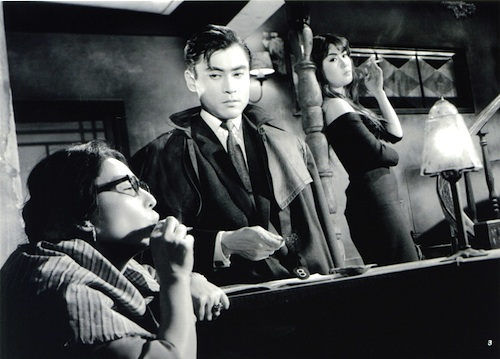
By Joe Bendel. Is there anything more penny wise-pound foolish than stiffing your hitman? Sure, they can’t take you to court, but killing people for money is what they do. Nonetheless, a Kobe vice lord (don’t the words “Kobe” and “vice” naturally seem to go together?) does exactly that in Teruo Ishii’s Yellow Line, which also has its official New York premiere as part of the Japan Society’s 2013 Globus Film Series, Into the Shintoho Mind Warp: Girls, Guns & Ghosts.

Our nameless hired gun offs the new, incorruptible Kobe customs chief. The killer’s clients thought they were setting him up to take the fall, but merely calling the cops while he is at the scene will not nearly be sufficient. Suddenly needing to leave Tokyo in a hurry, the unnamed man forces his company on Emi Kozuki, a rather high maintenance dancer, who just so happens to be traveling to Kobe for a dubious gig. Hiding out in Kobe’s “Casbah” red light district with his pouting hostage, the hitman starts tracking his double-crossers while Kozuki’s journalist boyfriend pursues them both.

From "Yellow Line."

There are so many coincidences, near misses, and chance encounters in Yellow, one half expects to see the Marx Brothers spring out of a closet at any time. That is just how this movie rolls. Indeed, the lurid atmosphere and crazy plot contrivances are a heck of a lot of fun. Still, despite the absence of nudity and relative paucity of blood, Yellow is pretty forthright in its depiction of sex slavery and drug abuse, especially by the standards of 1960.

Shintoho regular Shigeru Amachi is all kinds of awesome as the hitman. Hardnosed in a way that would make Nouvelle Vague auteurs ecstatic, audiences will whole-heartedly root for him, regardless of his amoral code of conduct. As Kozuki, Yôko Mihara is a bit of a pill, but she can definitely shake it on the dance floor, fulfilling the requirements of any good exploitation film. Throughout the Casbah, they are surrounded by a wildly cinematic Rogues Gallery of supporting characters, even including an American in a ragingly politically incorrect role, appearing in blackface as the exotic dancer dubbed “The Moor.”

Frankly, you had better see Yellow Line while you can, because it will be way too hot for most programmers to handle. This is a great, greasy crime drama that delivers satisfaction in spades. Highly recommended for fans of film noir and Japanese cinema, Yellow Line concludes Into the Shintoho Mind Warp next Sunday afternoon (3/10) at the Japan Society. The entire series then continues on a three city tour, spreading joy to Philadelphia, San Francisco, and Vancouver.

LFM GRADE: B+

Posted on March 4th, 2013 at 3:12pm.

LFM Reviews Approved for Adoption @ The 2013 New York International Children’s Film Festival

By Joe Bendel. Growing up in a small country divided between French and Flemish speakers in the shadow of the ever arrogant France must make developing a Belgian identity tricky under any circumstances.  For a Korean adoptee like Jung, the coming-of-age process is profoundly more complicated.  Jung (as the artist simply bills himself) adapts his own graphic novel-memoir, incorporating footage of his emotionally ambiguous return to Korea in Approved for Adoption (see clip above), a multi-hyphenated animated genre-hybrid, which screens during the 2013 New York International Children’s Film Festival.

Jung never knew his birth parents.  He was discovered by a policeman on the streets of Seoul, presumably abandoned.  It was a common fate for children after the Korean War.  Through the Holt international adoption agency, Jung is placed with a Belgian family.  As he matures, Jung mostly gets along with his four Belgian brothers and sisters, especially his sister and closest confidant, Coralie.  However, his relationship with is mother is a different story.  Frankly, most children would have issues with his severe mother, but his are exacerbated by behavioral problems at school and lingering doubts about his place in the family.

From "Approved for Adoption."

Although Jung is a very humane and forgiving film, it is probably the most mature selection of this year’s NYICFF.  There is even brief animated nudity (breasts clearly discernible beyond mere anime fan service).  It also forthrightly addresses Jung’s family drama and eventual tragedy, which might be troubling for younger viewers.  Yet, for adoptee children, it could be quite consoling—even cathartic.

Approved is visually elegant, rendering its expressive characters in 3D animation, against 2D backdrops, with Jung’s original sketches and Korean video integrated throughout.  Young Jung often tries viewer patience as much as his parents’ but at least we can understand where it is coming from.  Indeed, it is easy to understand how art has served as therapy for him.

To his credit, Jung is unflaggingly honest, never dodging significant episodes that might cast him in an unsympathetic light.  The results are revealing and sometimes beautiful.  Recommended for fully informed families who think their children will find it rewarding, Approved for Adoption screens this Sunday (3/10) at the Alliance Française as part of the 2013 NYICFF.

LFM GRADE: B

Posted on March 4th, 2013 at 3:05pm.