The Few, the Proud, The Knuckleballers: LFM Reviews Knuckleball!

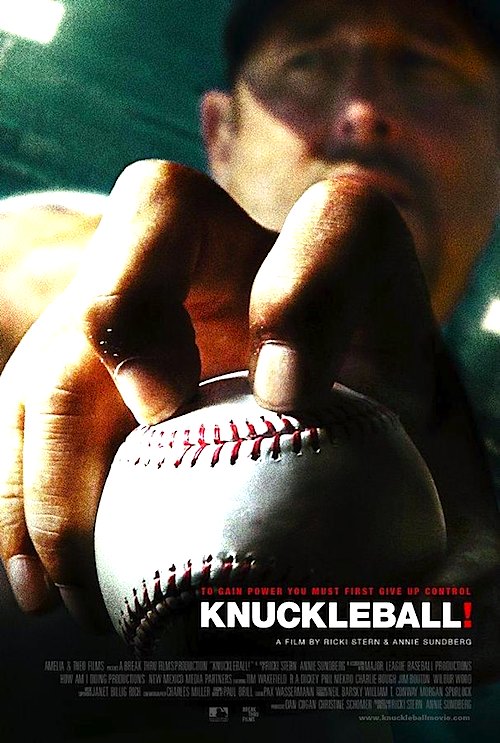
By Joe Bendel. The last two years have been tough for Mets fans, but there have been a few bright spots. They have had the pleasure of watching Bobby Valentine “manage” another team and R. A. Dickey has posted All-Star worthy seasons on the mound. When he signed with the Mets, he was one of two knuckleball pitchers in Major League Baseball. And then there was one. Ricki Stern & Annie Sundberg follow Dickey as he works to make a name for himself, while his knuckleball-throwing colleague Tim Wakefield chases a series of career milestones in the thoroughly entertaining documentary, Knuckleball!, which opens this Thursday at the IFC Center.

Tim Wakefield did just about everything you can do as a member of the Boston Red Sox, an often overlooked Northeastern team best known for trading away Babe Ruth, including giving up the eleventh inning walk-off home run in game seven of the 2003 ALCS. Honestly, that was something of a fluke. Wakefield always had success against the Yankees, which made the Red Sox’s decision to banish him to the bullpen rather baffling. In a year when the Sox were largely out of contention, beating the Yanks whenever possible would have been a logical fallback goal. Nonetheless, Wakefield saw little meaningful time on the mound at the start of the 2011 season, despite the tantalizing closeness of his 200th win.
A journeyman pitcher who stunned the baseball world – particularly including the Amazin’s, by winning a spot on the rotation – R.A. Dickey finally signed a guaranteed contract. However, a nagging injury threatens to put a damper on the party. Fortunately, Dickey can call on the knuckleball support network – especially his mentor, veteran knuckleballer Charlie Hough, for advice.

Some of Knuckleball!’s best scenes capture the get-togethers of this knuckleball fraternity, including Hough, both active proponents, and Wakefield’s early guru, Phil Niekro. As one might expect, they have some funny stories to tell. Wakefield and Dickey do a fine job explaining what the knuckleball pitch does and does not do. However, all knuckleballers are at a bit of a loss to explain the deep-seated disdain for their bread-and-butter pitch. Considering how radically different it looks to batters, one would think every club would want one knuckleballer on staff – but no, not by a long shot.

Stern and Sundberg do something rather remarkable in Knuckleball! by building to a big, satisfying emotional crescendo, even though they are following two pitchers whose respective teams were a country mile away from the pennant chase. It comes through loud and clear that Wakefield and Dickey are not just concerned with their individual stats. They are representing their pitch, like faithful practitioners of an esoteric martial art. Yet, this is exactly what baseball is all about: tradition.

Dickey and Wakefield are consistently likable subjects – and the old school knuckleballers, including Hough, Niekro, and Jim Bouton, are even more so. Prolific documenterians, Stern & Sundberg’s best known work is probably Joan Rivers: A Piece of Work and their most important project is easily Burma Soldier, but Knuckleball! is by far their most enjoyable. Non-sports viewers will still find it completely engaging, but for baseball fans, it is like a bag of salted peanuts at an office getaway game (that’s a good thing). Enthusiastically recommended to general audiences, Knuckleball! (with exclamation point) opens this Thursday (9/21) in New York at the IFC Center.

LFM GRADE: A-

Posted on September 18th, 2012 at 2:24pm.
New Trailer for Steven Spielberg’s Lincoln; Film Opens Nov. 16th

Watch the new trailer above for director Steven Spielberg’s much-anticipated film, Lincoln, starring Daniel Day-Lewis as America’s 16th President.  The film opens nationally on November 16th.

Posted on September 14th, 2012 at 12:34pm.

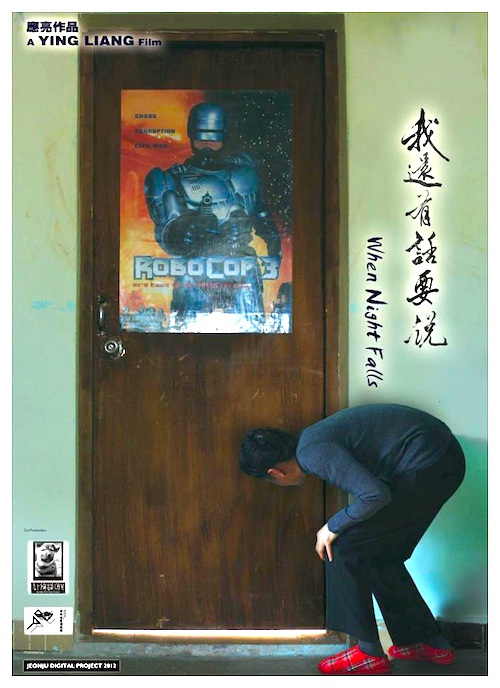
‘Justice’ in Today’s China: LFM Reviews When Night Falls @ The 2012 Toronto International Film Festival

By Joe Bendel. Ying Liang is an artist without a country. In large measure, this film is why. After it premiered at the Jeonju International Film Festival earlier this year, word reached Ying that he should not to return to China—or else. A dramatized documentary about the suspicious irregularities surrounding the prosecution (or persecution) of an accused murderer is hardly the project to curry favor with the Chinese Communist Party. Yet, any production from a filmmaker of Ying’s integrity necessarily entails risk in today’s China. As a result, When Night Falls will be even more timely and significant when it screens during the 2012 Toronto International Film Festival.

After suffering a severe beating at the hands of the Shanghai police, Yang Jia allegedly firebombed the police courtyard, stormed the station, and stabbed six active duty officers to death. This sounds like a man they should have recruited for their special forces. Instead, they tried and convicted him in a series of kangaroo courts, while holding his mother Wang Jingmei incommunicado for one hundred forty-three days in a Soviet-style mental hospital. None other than Ai Weiwei filed a missing person report on her behalf. By the time she is finally released, her son’s fate is effectively sealed, but the mother and a well-meaning but unwieldy group of human rights attorneys desperately try to overturn Yang Jia’s death sentence.

Without question, Night is a forceful indictment of the Chinese justice system, which the government has so cleverly rebutted by harassing Ying’s parents and threatening him with arrest. At each step of the case, Ying makes it clear the police and prosecutors disregarded their own rules to suit their purposes. Several times characters flat-out denounce the state, including the judges passing sentence, as the real criminals in this affair. That is rather bold filmmaking in contemporary China, some might even say foolhardy, but it in no way excuses the Party’s vindictive response.

Ying is a very good filmmaker, but he is also a demanding one. He definitely shares some of the aesthetic sensibilities of Jia Zhangke and the so-called Digital Generation of independent filmmakers. Severely restrained, Night is like an anti-melodrama, despite the gross injustice and tragedy unfolding around Wang Jingmei. Yet, there is no mistaking her terrible anguish thanks to Nai An’s remarkable performance. Viewers can feel in their bones how broken this woman is, as she struggles to find a way to keep fighting for her son.

Ying notably incorporates still photos (some courtesy of the real Wang Jingmei) to establish the facts of the case with economy and quiet authority. Nonetheless, though Night clocks in at a manageable seventy minutes, it is not a film for the easily distracted. Thoughtfully put together and honest in every way, When Night Falls is highly recommended for those who can handle its uncompromising style and a depressing shot of the truth when it screens this Thursday (9/13) and Friday (9/14) as a Wavelengths selection at this year’s TIFF.

LFM GRADE: A-

Posted on September 12th, 2012 at 11:25am.

A Family Survives Mao’s Cultural Revolution: LFM Reviews Mulberry Child, Narrated by Jacqueline Bisset

By Joe Bendel. Paradoxically, it might have been the ardent loyalty of Jian Ping’s persecuted parents that saved them during the Cultural Revolution. At least, they never said anything incriminating their children would have been forced to repeat. Yet, the lingering trauma of the experience makes it difficult for her to relate to her Americanized daughter, Lisa Xia. By exploring their family history, the two women come to terms with their own relationship in Susan Morgan Cooper’s hybrid-documentary, Mulberry Child, which opens this Friday in New York at the Quad Cinema.

True believers, Hou Kai and Gu Wenxiu met and married through the Chinese Communist Party. They bought into the Party’s early rhetoric, which proved to be a profound mistake during the “Anti-Rightist Campaign.” Trying to defend a wrongfully accused colleague, Hou only succeeded in putting himself in the Party’s crosshairs. Despite some trying moments, Jian’s father made it through the first reign of terror, demoted but relatively unscathed. The Cultural Revolution would be a different story entirely.

As a school administer, Jian’s mother was directly in the line of fire. To make matters worse, her father’s history as a one-time Japanese POW was a red flag for the empowered zealots. As the institutionalized madness escalated, Jian’s father was imprisoned and her mother was held a de-facto captive in her school’s boiler room, forced to write self-criticism and pressured to denounce her husband. Largely raised by their grandmother, the children went months without seeing either parent.

How cowardly and cruel must an ideology be that it would force a seven year old girl to condemn her father in school? Yet, the Maoist cult continues to seduce Western academics who never had to live through it. Somehow, though, Jian’s parents still cling to their faith, as if by acknowledging that the source of the horror they lived through—the Chinese Communist Party—would somehow make all their suffering for naught.

Gu Wenxiu (actor Bruce Akoni) and Hou Kai (actress Jody Choi) in film.

Jian and her daughter can apprise the past with more clarity, but they remain susceptible to a romanticized vision of contemporary China. Ironically, their big coming together moment happens during the Beijing Olympic Games, against the backdrop of the striking Bird’s Nest stadium, designed by Ai Weiwei. Yet, the government’s relentless campaign against the artist and teacher ought to undermine the superficial images the Party tries to present to the world.

Nonetheless, when looking backward, Mulberry is quite forceful and moving. Combining Jacqueline Bisset’s voice-overs with dramatized episodes from Jian’s memoir, Morgan Cooper vividly conveys an innocent child’s perspective on an era of state sanctioned insanity. Jody Choi and Bruce Akoni Yong are particularly affecting as young Jian and the much abused Hou (“The Big Traitor”), respectively. However, the candid-style mother-daughter conversations do not carry the same dramatic weight. Yes, there is something universal to their generational disconnect, but it pales in comparison to her experience visiting her father in prison—unaccompanied because only a seven year old girl could visit a suspected enemy of the state without reprisals.

Of course, the difficulties survivors like Jian have expressing affection are the least of the Cultural Revolution’s tragic legacy, but it is what most directly affects her and her daughter. Sensitively produced, Mulberry Child is recommended for its up-close-and-personal insight into the chaos unleashed by Mao’s regime (rather than its wishful thinking for today’s China) when it opens this Friday (9/7) at New York’s Quad Cinema.

LFM GRADE: B

Posted on September 4th, 2012 at 2:34pm.

The Birth of the Han Dynasty: LFM Reviews White Vengeance on Blu-ray/DVD

By Joe Bendel. Power corrupts and the pursuit of power corrupts just as absolutely. This is the lesson an ancient mystery man has for a pompous scholar and his students, startled while paying their respects in the first Han Emperor’s tomb. He will tell them the real story of the Hongmen Banquet and the struggle to succeed the fallen Qin Dynasty in Daniel Lee’s mistitled White Vengeance (trailer here), which is now available on DVD and Blu-ray today from Well Go USA.

The tyrannical Qin Emperor is dead and nobody misses him, least of all Han leader Liu Bang and Chu nobleman Xiang Yu, rival generals who forged an uneasy alliance against the Qin. Of course, the emperor’s death prompts a rather obvious question: who will succeed him? Fearing for his own neck, the caretaker emperor decrees the first to control the Qin capitol of Xianyang wins the throne, hoping to play the warriors against each other. It works.

As sworn brothers turned bitter rivals, there are still a lot of unresolved issues between Liu Bang and Xiang Yu, particularly concerning the royal consort Yu Ji, the latter’s lover entrusted to the former for safekeeping. Among many things, Vengeance is an elegantly austere, almost chaste, love triangle.

There is also plenty of period warfighting in Vengeance, rendered with grit and scope. Lee is definitely in his element staging huge clashes of armies. He really shows viewers exactly what it means to be outflanked and why it is a bad thing. Yet, the film’s real battle is that between the military strategists, Xiang Yu’s longtime family advisor Fan Zeng and the freelance Obiwan Zhang Liang, who sides with his rival because of Liu Bang’s professed lack of ambition. When the two counselors match wits during a game of weiqi, the stakes are significant and bloody.

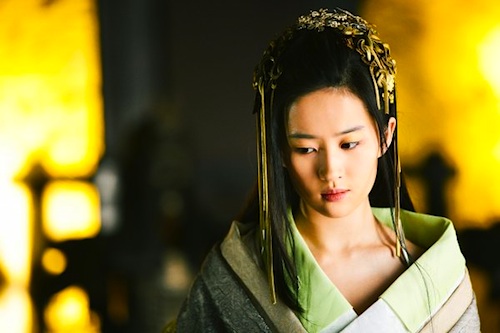
Liu Yifei in "White Vengeance."

Boasting an all-star HK and Chinese cast, Vengeance features memorable supporting performances from top to bottom. Not surprisingly, Anthony Wong dominates the film as the blind but all-seeing Fan Zeng, instantly bringing the gravitas necessary for the cunning yet classically tragic figure. Still, as the crafty Zhang Liang, Hanyu Zhang holds his own with the recognizable Johnnie To veteran.

Unfortunately, neither Feng Shaofeng nor Leon Lai displays the same commanding screen presence as the rival generals. Actually, they are rather bland. In contrast, Jordan Chan packs quite the late inning punch as Han loyalist Fan Kuai, while (Crystal) Liu Yifei is appropriately orchid-like as Yu Ji, but she also makes the most of a bigtime dramatic close-up down the stretch.

Lee rather dexterously shifts viewer sympathies in ways that might even be considered subversive. Indeed, there is definitely a point in Vengeance about the high cost of taking and keeping power. What they say about good intentions still holds true. An ambitious historical epic with plenty of action, White Vengeance is recommended with considerable enthusiasm for fans of Hong Kong cinema. It releases today (9/4) on DVD and Blu-ray from Well Go USA.

LFM GRADE: B+

Posted on September 4th, 2012 at 2:32pm.

Bombs and Bikes: LFM Reviews Quick on Blu-ray/DVD

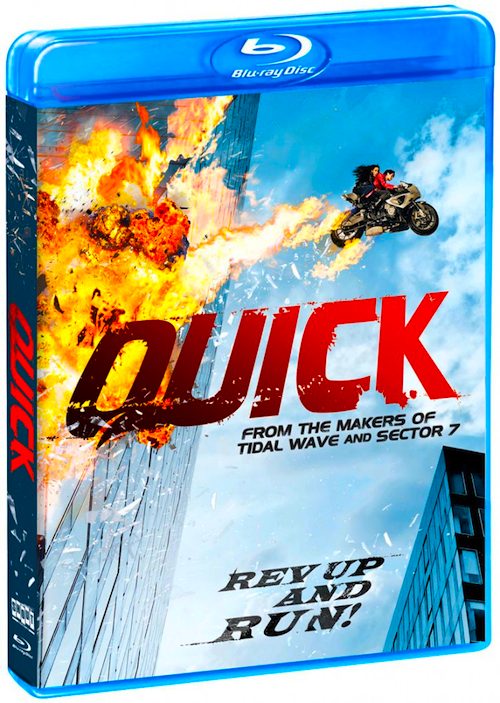
By Joe Bendel. Safety first, kids. Remember, you never know what some psychopath could sneak into your helmet, so you are better off not wearing one – regardless of how recklessly you might race through the city’s streets. One biker turned messenger learns this the hard way in Jo Bum-gu’s Quick, which releases today on DVD and Blu-ray from Shout Factory.

In 2004, Han Ki-su broke up rather spectacularly with his girlfriend, Choon-sim. It is a heck of a pile-up. Seven years later, she has reinvented herself as Ah-rom, the lead singer of an up-and-coming girl group, while he has de-invented himself as motorbike deliveryman. Still fearless on a bike, Han delivers a bomb for a mysterious client unaware of its contents. There will be more where that came from. Unfortunately, his ex Ah-rom will become a part of the madness when she books Han to whisk her off to a gig. Putting on his helmet, she sees a rather ominous countdown clock where there shouldn’t be one. As the voice on Han’s cell phone explains, he has thirty minutes to make a series of deliveries or the helmet goes boom.

While Quick owes an obvious debt of inspiration to Speed, it could also be considered the motorized forerunner to Premium Rush – but with a more talented cast. There will be plenty of breakneck weaving through traffic and unlikely Evel Knievel jumps. There is also a yakuza backstory to the mad bomber’s crime spree so convoluted, even the cops can’t keep it straight. For stunt driving, though, Quick is hard to beat. The hospitalized stuntmen seen visited by cast members during the closing credits can attest to that.

Granted, Kang Ye-won is considerably less annoying than Sandra Bullock, but her character’s initial diva act is a bit cringy for a while. If nothing else, having a bomb attached to your head ought to inspire clarity of thought. Still, she looks good in vinyl as her character eventually settles in and gets serious.

Frankly, the humor in Quick is rather broad and does not travel well. Fortunately, Lee Min-ki never goes for laughs as Han, mostly brooding like a rebel without a cause, except when he is raging against their tormentor. As biker movie protagonists go, he is pretty good really. However, since the identity of the evil mastermind is kept secret until well into the third act, Quick does not have a lot of moustache-twisting villainy.

To recap, Quick has a whole lot of explosions and chase scenes. It is also nice to see the fim’s shout out to the stunt personnel, given the rate the Korean film industry chews them up and spits them out (at least according to stuntman-filmmaker Jung Byung-gil’s documentary Action Boys, which screened at NYAFF four years ago). Never lacking adrenaline, Quick is easily recommended for action fans. It is now available at most online retailers from Shout Factory.

LFM GRADE: B-

Posted on September 4th, 2012 at 2:30pm.