Honore’s New Movie Musical: LFM Reviews Beloved

By Joe Bendel. Prague and Paris have to be two of the most romantic cities in the world. Yet, a mother and daughter have relationship issues in both European capitals. It seems like codependent sexual dysfunction runs in their family in Christophe Honoré’s latest movie musical, Beloved, which opened Friday in New York.

Beloved opens in swinging sixties Paris, as Honoré revisits his acknowledged Jacques Demy influences. It is like a fairy tale, in which shopgirl Madeleine falls in love with Jaromir, one of the prostitution clients she sees on the side. It’s a French fairy tale. After Jaromir completes his specialized medical studies, she moves to Prague with him, becoming his wife. Soon, the hotshot doctor acts like he also has a license to philander, but his wife refuses to recognize it. Things come to head just as the Soviet tanks start rolling through the streets of Prague.

Madeleine divorces Jaromir but she never gets him out of her system. Even though separated by distance and ideology, he maintains a hold on her, despite her second marriage to an adoring gendarme. It will be a pattern that somewhat repeats for her daughter Vera. Her colleague Clément is devoted to her, but she only has eyes for Henderson, a rock drummer from New York, who happens to be (mostly) gay.

Ludivine Sagnier in "Beloved."

Anyone who has ever considered themselves losers for carrying a hopeless torch will feel much healthier once they watch Vera pine away her life. Initially it is rather uncomfortable, but it gets downright tragic. Beloved is far from your typically bubbly movie musical, but it works better than Honoré’s prior attempt, Love Song, largely because the characters are not as irritating and the situations are less stifling. Beloved can make viewers wince, but it also gives them air to breathe.

Honoré walks quite a tightrope, using perhaps the two greatest post-war tragedies, the 1968 Soviet Invasion of Czechoslovakia and September 11th, as backdrops for his mercilessly intimate drama. Honoré focuses exclusively on the micro level, where painful personal conflicts continue unabated, even when the wider world is turned upside down. Nonetheless, some of the “internal contradictions” of post-Prague Spring Czechoslovakia are duly noted and images of the 1968 invasion are suitably ominous. Given their visceral nature, the scenes of 2001 Montreal (where Vera’s flight was diverted) are somewhat iffier, flirting with exploitation by mere association.

Happily, Milos Forman never sings in Beloved, but he is perfectly cast as the old charmingly degenerate Jaromir of 2008. In contrast, Honoré alumnus Chiara Mastroianni handles her husky vocal features fairly well and keeps viewers vested in her angst far more compellingly than in his outright maddening Making Plans for Lena. Her real life mother Catherine Deneuve has some nice moments as Twenty-First Century Madeleine, but it is totally the sort of diva-centric character we are accustomed to see her assume. In contrast, Ludivine Sagnier is appropriately spritely as young Madeleine in the early Cherbourg-esque scenes. Louis Garrel (son of Philippe) is his usual sullen screen presence as Clément, but American Paul Schneider is surprisingly engaging as the commitment-phobic Henderson.

As a musical, Beloved works rather well, thanks to some frequently distinctive songs penned by Alex Beupain. They certainly fit the vibe and context of the film (as well as any movie musical tunes ever do) and often serve to advance the story. While it is a bit overstuffed with characters and hoped for significance, it is definitely one of Honoré’s better works. Recommended on balance for Francophiles and those who appreciate moody musicals, Beloved opens today (8/17) in New York at the IFC Center.

LFM GRADE: B-

Posted on August 18th, 2012 at 2:39pm.
NYPD Blue, Circa 1864: LFM Reviews Copper

By Joe Bendel. Travel back to pre-Miranda New York. The Civil War has turned for the Union, but social strife remains a constant fact of life. For the accused, there is no right to remain silent. “Start talking or start praying” Det. Kevin Corcoran tells one uncooperative witness, cocking his pistol. There is a certain elegant simplicity to this direct approach. In fact, interrogations are probably the only straight forward part of police work in Copper, BBC America’s first original (non-imported) dramatic series, which premieres this Sunday night.

Corcoran bravely served the Union Army, only to find his young daughter murdered and his wife missing upon his return home. In 1864, the primary responsibility for a cop like Corcoran is collecting the Captain’s payoffs. While his personal investigation is his primary interest, the brooding officer tries to do some legitimate police work here and there, since he has the gun and badge. During the course of the first two episodes, Corcoran becomes understandably emotionally invested in the case of a young girl murdered by a sexual predator. Corcoran will risk his life and career to protect the victim’s twin sister from the uber-connected suspect. Fortunately, he will have some help from Five Points’ finest prostitutes.

Much of Copper is indeed set in that neighborhood so squalid, it no longer exists. The morally ambiguous Morehouse family, with whom Corcoran has some complicated history, expects to be the ones to profit from this anticipated urban renewal project. Meanwhile, Manhattan’s African American community is moving north. This includes Dr. Matthew Freeman, the only competent doctor in New York willing to act as Corcoran’s secret pathologist. As one might expect, the thorny racial relations of competing Irish immigrant and free African American communities take center stage in the third outing.

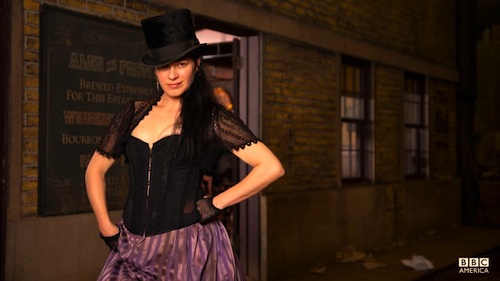
Franka Potente in "Copper."

Granted 1864 was a tough year in our nation’s history, but Copper seems to take perverse glee in reveling in New York’s degradation. Nor does it even attempt to disguise its overt class warfare. At least in episodes one and two, the wealthy are not just venal robber barons – they are also largely pedophiles.

Despite the heavy handed social commentary, Copper works well on the procedural level. MI-5’s Tom Weston-Jones is refreshingly hardnosed as the relatively honest anti-hero. It appears Copper will not be about solving mysteries per se, but figuring out how to dispense justice within a corrupt system. That is actually a potentially rewarding twist on the police drama that worked so well for the cool but canceled Zen.

Weston-Jones and co-writer-creators Tom “Oz” Fontana and Will Rokos compellingly establish Copper’s lead protagonist in the first three installments, but the supporting characters still need a bit of fleshing out. Of course, that is not uncommon at this stage. They have ten episodes to work with, after all. Still, Tanya Fischer’s Molly Stuart, the you-know-what with a heart of at least semi-precious metal, seems to warrant keeping an eye on.

There is some real potential in Copper. It is an impressive period production and when justice is served, it is served satisfyingly cold. Yet, it risks overdoing the Jacob Riis progressive tut-tutting in the early stages, already showing a tendency to fall back on clichéd stock villains. Engaging but uneven, Copper is an easy choice while Masterpiece Mystery is rerunning Inspector Lewises, but it may have a hard time holding its audience when Wallander returns. Whether it continues to develop and make good on what appears promising remains to be seen. Regardless, Copper begins this Sunday (8/19) on BBC America.

Posted on August 18th, 2012 at 2:38pm.

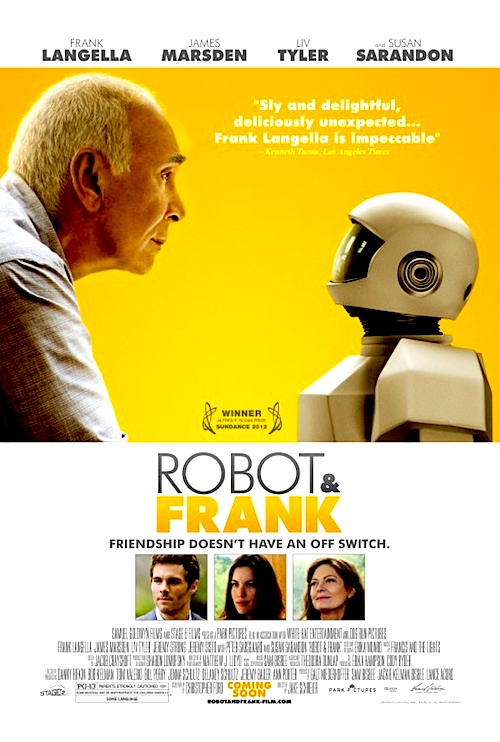
Aging in the Age of AI: LFM Reviews Robot & Frank

By Joe Bendel. Humans anthropomorphize. It is a very human thing to do, especially for objects that move on their own accord. One retired burglar will find himself doing just that with his assisted living droid in Jake Schreier’s very near future Robot & Frank, which opens this Friday in New York.

Frank Weld did not exactly get away scot free, but he is still living out his golden years in complete liberty. Unfortunately, his memory lapses are getting progressively worse. His establishment son Hunter is worried, because concern is what he does best. In contrast, New Age daughter Madison sees no evil when she calls in from exotic backwaters like Turkmenistan. Hoping to reverse his father’s slide, Hunter brings him a robot to help with the household chores and keep the difficult senior on a regular schedule.

Of course, Old Man Weld initially thinks little of his robot helper, nor does his kneejerk Luddite daughter. However, when the former burglar realizes the robot has a knack for things like lock-picking, he has a dramatic change of heart. He also has a perfect target: the oily hipster overseeing the conversion of his beloved library into some sort holographic monstrosity.

Having a purpose seems to do wonders for his mental state. He even starts seriously putting the moves on Jennifer, the librarian he always tentatively flirted with. Needless to say, though, the caper turns out to be a bit more complicated than expected.

Essentially, R&F is an intimate character study with some decidedly gentle SF elements (despite winning the Alfred P. Sloan Award for addressing themes of science and technology in indie film at this year’s Sundance); in other words, neither Frank the character (who is quite well read) nor Schreier is interested in exploring the implications of the singularity, at least not in this film. Yet though Schreier’s style is never all that showy, his restraint serves the material rather well. In fact, a late revelation packs considerable punch precisely because of its understated treatment.

Likewise, Frank Langella never overplays his hand, conveying his namesake’s vulnerabilities and self-doubt in quiet but effective moments. James Marsden does his best work perhaps ever (which is not saying much, with Lurie’s Straw Dogs remake relatively fresh in mind) as the understandably exasperated son. As Jennifer the librarian, Susan Sarandon makes the most of what initially appears to be little more than an extended cameo, but unfolds into something much more significant. Even Liv Tyler is not totally awful as daughter Madison (though “good” would still be pushing it).

Smartly written by Christopher D. Ford, R&F leaves viewers without complete closure, in a way that will ring true for families that have gone through similar experiences as the Welds. A sensitive, only slightly speculative film, Robot & Frank is easily recommended for general audiences (particularly librarians, robotics engineers, and thieves) when it opens this Friday (8/17) in New York at the Angelika Film Center downtown and the Paris Theatre uptown.

LFM GRADE: B+

Posted on August 14th, 2012 at 10:00am.

Cantor Fitzgerald & 9/11: LFM Reviews Out of the Clear Blue Sky @ DocuWeeks 2012

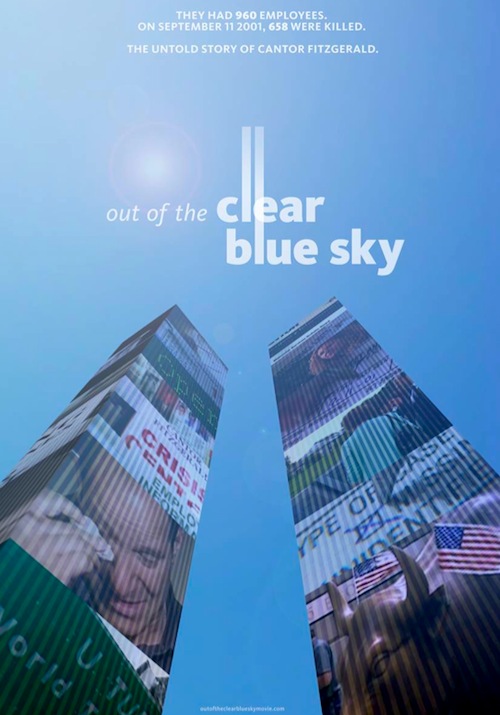
By Joe Bendel. A prestigious Wall Street firm specializing in Treasury securities, Cantor Fitzgerald suffered more losses on September 11th than any other organization, including the New York Police and Fire Departments. The numbers are staggering: 658 of their 960 New York employees died that morning. However, Cantor’s story did not end there. Filmmaker Danielle Gardner, whose brother Doug was one of the 658, documents CEO Howard Lutnick’s efforts to support the anguished Cantor families while desperately working to keep the firm afloat during its darkest hours in Out of the Clear Blue Sky (see clip above), which is currently screening as part of the 2012 DocuWeeks New York.

Had it not been the morning of his young son’s first day of school, Lutnick surely would have been at Cantor at the time of the attack. With offices several floors above the initial impact zone, Cantor employees never had a chance. Rushing to the scene only to witness the Towers’ collapse, Lutnick and a handful of senior staff began scrambling to determine who survived. With the enormity of their loss weighing on him, a distraught Lutnick became the public face of the tragedy. Yet, as some family members lashed out Lutnick in frustration, the media turned on Cantor, hard.

Blue’s stories of grief and remembrance are truly heartrending. Surprisingly, though, it is also a compelling business documentary, providing an inside account of Cantor’s fight to survive during the precarious days following the fateful Tuesday. Their resourcefulness is quite extraordinary, conducting Twenty-First Century financial transactions with scrounged office supplies. Of course, the stakes were high. Had the firm folded, Lutnick’s ability to help Cantor families would have been severely limited. Indeed, that behind-the-scenes look at Cantor’s tenacious rebound is what sets Blue apart and above other well meaning 9-11 documentaries.

As a member of their ranks, Gardner clearly earned the trust of Cantor families, eliciting some unusually eloquent testimony from her interview subjects. While there are many emotionally charged scenes, the film never feels intrusive or exploitative. (The only exception might be Lutnick’s tearful television interviews recorded within days of the attack, which have already been replayed innumerable times in the media.) Indeed, Gardner deftly walks the tightrope, directly conveying the rawness of survivors’ pain, without reveling in it.

While the media does not cover itself in glory for uncritically recycling complaints against Lutnick, the overall film is scrupulously nonpartisan. Too many misguided people would prefer to forget or deny the horrific events of September 11th. Worse still, some might even be inclined to dismiss Cantor as an instrument of the “1%” amid the current polarized climate. Blue acts as a valuable corrective to such impulses, reminding viewers the Cantor employees lost at the World Trade Center were all individuals from diverse backgrounds, who left behind friends and loved ones. Poignantly engaging but also quite an enlightening portrait of corporate resiliency, Out of the Clear Blue Sky screens through Thursday (8/16) at the IFC Center in New York, with a week’s run at the Laemmle Noho to follow (8/17-8/23) in Los Angeles, as part of this year’s DocuWeeks.

LFM GRADE: A-

Posted on August 13th, 2012 at 1:39pm.

Talking With Director Benh Zeitlin About Beasts of the Southern Wild

By Govindini Murty. Benh Zeitlin’s Beasts of the Southern Wild has garnered much acclaim on the film festival circuit and is one of the top indie films in theatrical release right now, having already earned $5.9 million at the box office. The story of a little girl and her father struggling to survive in the flooded bayou of southern Louisiana, Beasts of the Southern Wild won the Grand Jury Prize at Sundance, the Camera D’Or at Cannes, and the Audience Favorite Award at the LA Film Festival. There is already talk that it may be nominated for an Oscar for Best Film, and that Quvenzhané Wallis, the film’s remarkable eight-year old lead, may be nominated for an Oscar for Best Actress.

We had the opportunity to attend the premiere of Beasts of the Southern Wild at the LA Film Festival this summer and enjoyed the Q & A conducted afterward by John Singleton with director Benh Zeitlin and the film’s stars, the irrepressible Quvenzhané Wallis (who utterly stole the show) and the charming baker-turned-actor Dwight Henry.

We spoke briefly with Benh Zeitlin after the screening and also met John Singleton, who expressed repeatedly what a fan he was of the film. Here’s the conversation I had with Zeitlin, followed by excerpts from the Q & A that Singleton held with Zeitlin, Wallis, and Henry.  While there were a variety of topics discussed in the Q & A, my focus here is on the comments that Zeitlin made about the creative and practical aspects of translating his vision to the big screen.

Director Benh Zeitlin at the LA Film Festival.

GM: I was curious about your influences. Were you quoting anyone specific in the film? What inspired you – either in classic or contemporary film?

BZ: The big one for me is this film called Underground by Kusturica. That’s the one that made me most want to make films when I was growing up … the way that the fantasy and reality worked in that film I think was a big deal. And then we watched a lot of documentaries – we watched a lot of Les Blank documentaries. This one called Dry Wood – and all those ‘70s films that he made – were kind of how we came up with the cinematography. But you know, I studied the way that Cassavetes directs actors and Mike Leigh directs actors – and looking at narrative from Disney movies, like Bambi [Zeitlin himself has a background in animation and his parents are folklorists]. So, really, it was from all over the place, from all eras – from high-brow to low-brow – sort of a broad world.

GM: That’s interesting. You mention Les Blank – did you see Burden of Dreams, about Werner Herzog making Fitzcarraldo?

BZ: Oh yeah, of course. Werner Herzog, absolutely.

GM: Because [Beasts of the Southern Wild] just reminded me – the atmosphere – the organic feeling of being in the mud with the animals and the wilderness all around –

BZ: Definitely, yeah. He was a huge inspiration for me. The first time I saw that film I was like “This is what I want to do.”

GM: I interviewed Werner Herzog a few months ago and there’s some great footage from that film [Les Blank’s Burden of Dreams] that’s online. But you know, I was curious, because the film has that blend [of reality and fantasy] that you were mentioning. But I didn’t know about Bambi, that’s going to be interesting to throw in there –

BZ: [Laughs.] You got to go back to Bambi, always got to go back to Bambi.

GM: Well thanks so much, that was fun to see.

BZ: Thanks very much, nice to meet you.

Beasts of the Southern Wild tells the story of Hushpuppy (Quvenzhané Wallis), a six-year old girl growing up on an island off the coast of Louisiana known as “The Bathtub.” The story follows Hushpuppy and her widower father, Wink (Dwight Henry), as they eke out a living on their small plot of land – with the little girl caring for their farm animals and living in tune with the rhythms of the natural world. Her father, who has a mysterious illness, almost like a latter-day Fisher King, teaches Hushpuppy how to fish and emphasizes that she needs to learn how to take care of herself so she can succeed in the world and climb to the “top of the ladder.”

The island community of the Bathtub might lie in the shadow of New Orleans and Lake Pontchartrain, but its rural lifestyle feels a world away. To emphasize this, Beasts was shot in a documentary-verité style on 16mm film, which, when blown up on a large screen, creates a grainy, mysterious image that paradoxically heightens the mythological and poetic themes of the film. Hushpuppy’s view of the world is thus depicted in an alternately realistic and fantastical manner that Benh Zeitlin called “a heightened world built out of very real parts.” For example, Zeitlin noted that though there is no place called the Bathtub in Louisiana, it was based on the real Isle de Jean Charles, an island that is slowly falling into the Gulf and that has gone from 200 families to 20 families in recent years. As Zeitlin explains, “we took elements of things and swirled them together – almost like a folk tale.” Continue reading Talking With Director Benh Zeitlin About Beasts of the Southern Wild

LFM Reviews It is No Dream: The Life of Theodor Herzl

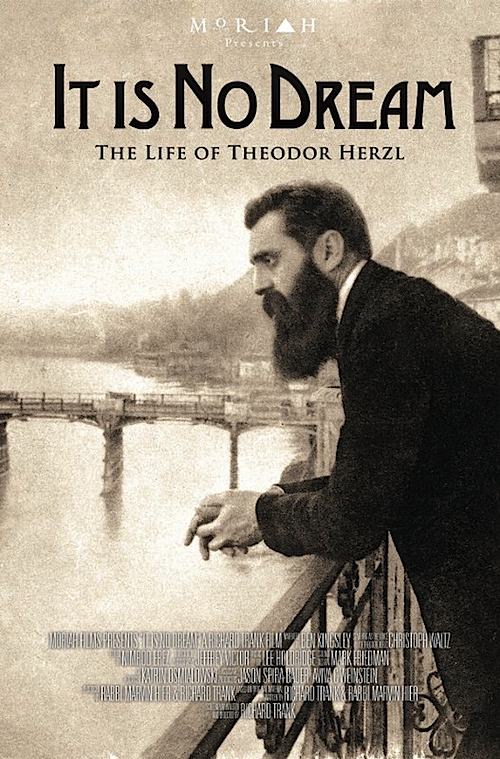
By Joe Bendel. Theodor Herzl once advocated mass Jewish conversion to Christianity, but would nonetheless become a unifying leader for the Jewish Diaspora. Profoundly concerned about the rise of anti-Semitism, his fears would be dreadfully justified in the years soon following his death. Yet, they provided the early impetus for the Zionist movement that ultimately led to the founding of the State of Israel. His life and mission are documented in Richard Trank’s It is No Dream: The Life of Theodor Herzl, which opens this Friday in New York.

Herzl believed that if an anti-Semitic wave could sweep across France, the cultural capitol of Europe in the 1890’s—and it was—it could happen anywhere. Never particularly religious, covering the Dreyfus Affair as a journalist forced Herzl to take stock of his own Jewish heritage and seriously address the increasing volume of European anti-Semitism. His early ideas proved impractical on further reflection, but the notion of a sovereign Jewish state (not original to Herzl) remained a viable option.

For the remaining years of his life, Herzl became the preeminent leader of the movement to forge a Jewish homeland, making his case to some of Europe’s most influential power brokers, including the Kaiser. For Herzl, the only question was where. Eventually, the colonial territory entrusted to England by a League of Nations mandate, known at the time as “Palestine,” became the obvious choice, given the Jewish people’s deep roots to the region. However, Herzl was appalled by the backwardness and poverty of the British Mandate during his first visit. Still, this did not disqualify the small tract of land from consideration. Arguably, it made even more sense on several levels.

Produced by Moriah Films, the Simon Wiesenthal Center’s film production subsidiary, Dream is a welcome and necessary antidote to malicious attempts to make “Zionism” a dirty word in the media. Trank and co-writer-co-producer Rabbi Marvin Hier clearly illustrate the alarming nature of anti-Semitism during Herzl’s lifetime, largely leaving unspoken (but ever-present in viewer’s minds) the enormity of the Holocaust, which would tragically vindicate all his fears.

Narrated by Academy Award winner Sir Ben Kingsley, with fellow Oscar winner Christoph Waltz giving voice to Herzl’s letters and writings, Dream has a fair amount of star power for a serious historical documentary. With an elegant score composed and conducted by the Emmy winning Lee Holdridge (whose credits including Moonlighting), Dream is a pretty prestigious package, but the real attraction is Herzl’s short but epic life-story, which will probably come as a revelation to many viewers outside the Jewish faith. Though perhaps not the target market, it is those viewers of good will not especially schooled in Jewish history who would get the most out of the film.

Consistently fascinating and never dry, Dream tells a compelling story that remains only too timely for the world today. Well paced and informative, It is No Dream is recommended for general audiences, regardless of religion or political affiliation, when it opens this Friday (8/10) in New York at the Quad Cinema.

LFM GRADE: B+

Posted on August 8th, 2012 at 1:05pm.