LFM Reviews Mr. Cao Goes to Washington @ The 2012 Asian American International Film Festival

By Joe Bendel. Anh “Joseph” Cao was elected to Congress in 2008, a generally bad year for Republicans. He was defeated in his re-election bid two years later—a decidedly good year for Republican candidates. In a mere two years, the idealistic former Jesuit seminarian received an eye-opening education in all manner of group-think politics. Cao’s short tenure in office is documented in S. Leo Chiang’s Mr. Cao Goes to Washington, which screens during the upcoming Asian American International Film Festival in New York.

Immigrating to America while his father was still a captive of a Communist Vietnamese re-education camp, young Cao led an eventful life before he even considered a political career. Choosing law school over a life of the cloth, Cao became an activist leader in Versailles, New Orleans’ small but enterprising Vietnamese community (profiled in Chiang’s previous documentary, A Village Called Versailles). Louisiana’s second congressional district was deliberately drawn to elect an African American Democrat, everything that Cao is not. However, the ethical issues dogging William “Cold Cash” Jefferson gave Cao a once in a lifetime opportunity to flip the seat—and he was precisely the transcendent candidate to do it.

The question throughout MCGTW is whether or not Cao can hold his seat against a relatively untarnished Democrat (if one can be found in the Crescent City). Unfortunately, most viewers already know the answer, undercutting the suspense, but also preparing them for the inevitable crushing disappointment.

Chiang and film editor Matthew Martin arduously walk a political tight-rope, trying to frame Cao to be as appetizing as possible to left-of-center film critics. Much is made of Cao’s relative liberalism within the Republican caucus, including many laments that he might be better suited to the other party. Yet Cao remains staunchly pro-life throughout his term of office, so so much for that idea. Frankly, Cao had no complaints with his Republican colleagues, getting more than his share of their earmarks for his ungrateful district. Conversely, the figure who emerges in Chiang’s doc as the poster boy for political hypocrisy and opportunism is none other than the current (but perhaps not long term) occupant of the Oval Office.

From "Mr. Cao Goes to Washington."

Initially wooed by Obama, Cao genuinely believed the President’s pretenses of friendship. Indeed, Cao took a lot of heat voting for the House’s first Obamacare bill. However, when Obama inevitably cuts a commercial for his Democrat opponent (a less than inspiring figure with a history of disbarments and barroom brawling), it is profoundly disillusioning for Cao. Indeed, for all the film’s attempts to distinguish Cao from the national GOP, time and again it is the Democrats (both nationally and in New Orleans) who refuse to look past party labels and racial identity. To their credit, Chiang and his team show this quite clearly.

Nonetheless, MCGTW is so intent on presenting Cao in non-partisan terms, it declines to correct a few inaccuracies. While Cao was the only Asian American Republican in Congress at the time of his election, he was eventually joined by Charles Djou, the first Thai American congressman, who won a special election in Hawaii (but was subsequently defeated in 2010, like Cao). Perhaps more problematically, MCGTW lets a local provocateur’s incendiary racial attacks on the GOP stand unchallenged. Still, it illustrates the sort of rhetoric Cao faced from some extremists.

Perhaps most importantly, MCGTW always treats Cao fairly, recognizing his earnestness and integrity. He is clearly the real Horatio Alger deal, with the attractive wife and cute kids perfectly suited for campaign brochures. Watching his re-election campaign unfold will be a frustrating experience for viewers of most political stripes. If anything, it suggests the greatest problem with the current political system is not money or PACs, but the voters themselves.

That is a real downer of a Pogo-like message, isn’t it? Still, Cao’s frank, vigorous spirit is quite refreshing. After viewing MCGTW, one hopes for a sequel with a more satisfying ending.  Clearly, Cao is talented man and Chiang has a keen understanding of the community he represents. Considering the mildness of its biases, the mostly fair and responsible Mr. Cao Goes to Washington is recommended for political junkies on both sides of the aisle, particularly those who following events in New Orleans from a distance, when it screens this Thursday (7/26) at the Chelsea Clearview as an official selection of the 2012 AAIFF.

LFM GRADE: B-

Posted on July 23rd, 2012 at 8:39pm.
LFM Reviews Chen Kaige’s Sacrifice

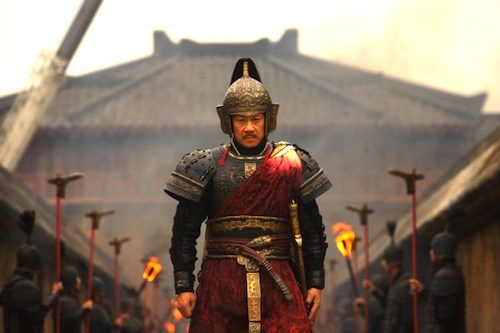
By Joe Bendel. Generally ascribed to Yuan Dynasty playwright Ji Junxiang, The Orphan of Zhao was the first Chinese play to be translated in Europe.  It was even adapted (quite liberally) for the French stage by Voltaire. Profoundly tragic and also rather violent in places, it has timeless elements that continue to appeal to audiences. Celebrated auteur Chen Kaige vividly captures both qualities in his grand big screen version, Sacrifice, which opens this Friday in New York.

General Tu Angu is not a man to take the slights of the Zhao clan lightly. Framing the patriarch and his son, General Zhao Shuo, for the murder of the ruling Duke, Tu uses the outrage as pretext for wiping out the Zhao clan. A swifter, more awe-inspiring massacre you are not likely to see on film anytime soon. However, he misses two of the Zhaos, the young General’s wife, Princess Zhuang, and her newborn baby. Sacrificing herself for her child, Zhuang entrusts the infant heir to her doctor, respected commoner Cheng Ying.

As fate would dictate, Cheng’s wife has also recently delivered. Suddenly having a newborn is dangerous business and Cheng has two. In a truly Biblical turn of events, Tu orders all the town’s babies to be collected at his palace to be duly vetted. Through a catastrophically Shakespearean turn of events, the Zhao and Cheng babies essentially trade places.

From "Sacrifice."

Growing up as Cheng Wu, the presumed son of Dr. Cheng, the Zhao orphan knows nothing of his birthright. However, unbeknownst to the boy, the doctor is grooming him to take wreak his vengeance at the appropriate time. To do this he plays a dangerous game, entering the service of the Tu retinue, manipulating his nemesis into serving as Cheng Wu’s godfather. Needless to say, some rather messy issues of filial loyalty arise.

Some have often knocked Chen’s films as pretty but rather bloodless historical dramas, but this is absolutely not the case with Sacrifice. While the period trappings are as richly detailed as ever, there is also plenty of blood. In fact, the first act is quite a spectacle of mayhem, segueing into a tense cat-and-mouse game, in which the fate of the city’s infants hangs in the balance. The film ultimately settles into a stone cold revenge drama.

Featuring several of Chen’s semi-regulars, Sacrifice’s talented ensemble is equally adept at the stately tragedy and the gutty action sequences. As Tu Angu, Wang Xueqi is in his element. Ruthless yet charismatic, he is the sort of villain viewers find themselves identifying with, in spite of themselves. While Ge You might be better known to American audiences for his shticky work in Let the Bullets Fly, he wrings real pathos from his performance as Dr. Cheng. While her character is not long for the world, Fan Bingbing is a typically ethereal presence as Princess Zhuang. Yet it is Mainland TV star Hai Qing who really lowers the emotional boom as Cheng’s equally ill-fated wife.

Admirers of Chen’s Chinese Opera sagas Farewell My Concubine and Forever Enthralled should still appreciate the classical elegance of Sacrifice. It is based on a play, after all. Likewise, fans of more action-driven Asian cinema should never get bored with the relentless scheming and vigorous swordplay.  Indeed, Chen integrates the intimate and the epic halves quite masterfully. Highly recommended for fans of literate historicals and the wuxia genre, Sacrifice opens this Friday (7/27) in New York at the Quad Cinema.

LFM GRADE: A

Posted on July 23rd, 2012 at 8:37pm.

LFM’s Jason Apuzzo & Govindini Murty at The Huffington Post and AOL-Moviefone: Basketball Diplomacy: An American Point Guard Becomes a Symbol of Freedom in The Iran Job

[Editor’s Note: the post below appears today at The Huffington Post and at AOL-Moviefone.]

By Jason Apuzzo & Govindini Murty. NBA fans know that two-time MVP point guard Steve Nash recently joined the Los Angeles Lakers. Fans are buzzing, because the addition of Nash could soon result in a return to championship glory for the league’s most glamorous franchise. As big as Nash’s impact on the Lakers might be, however, it can’t possibly match the impact that flashy point guard Kevin Sheppard — the former Jacksonville University star and Virgin Islands native — had in 2008 on A.S. Shiraz, a professional basketball team in Iran’s Super League.

The reasons for this go beyond sports, however, because over the course of one gripping and emotional season — a season documented by director Till Schauder and producer Sara Nodjoumi in their extraordinary new documentary, The Iran Job — Sheppard becomes one of Iran’s most popular athletes, and brings a ray of hope into an increasingly repressive and isolated society.

The Iran Job screened last week in Washington, D.C., and had its world premiere recently at the Los Angeles Film Festival, where we had the chance to talk to the film’s creators.

American basketball player Kevin Sheppard in Iran.

As depicted in the film, Kevin Sheppard’s Iranian odyssey begins in the fall of 2008, when he’s offered a spot on A.S. Shiraz’s roster. Having already played professional basketball in South America, Europe, China and Israel, the voluble Sheppard is unfazed by the prospect of playing overseas — but is understandably nervous as an American traveling to Iran. Coming in the midst of a 2008 election in which Barack Obama, Hillary Clinton and John McCain all had sharp words for Iran and its nuclear program, Sheppard nonetheless decides to take the plunge out of a spirit of professionalism.

It was a decision that would change his life, as well as the lives of everyday Iranians — and in particular, those of three young Iranian women.

One of the most compelling aspects of The Iran Job is the way it captures the casual details of life in today’s Iran — a closed society that clearly harbors some unusual stereotypes about the outside world. So for example, the moment Sheppard arrives in Iran and meets up with his Serbian roommate (the team’s 7-foot center, and the only other non-Iranian allowed on the squad), Sheppard learns that his cable TV has been custom-provided with hundreds of pornographic channels — the assumption being that because he is an American, he must be sex-obsessed. The irony that such programming is even available in a “strict” Islamic society, of course, is not lost on Sheppard — who can’t help but laugh at Iranian officialdom’s awkward notions of diplomatic courtesy.

Such ticklish moments aside, however, Sheppard immediately begins bonding with average Iranians. A natural show-off with a wicked sense of humor, Sheppard dazzles everyone around him — even when they barely speak English, and are only able to respond to his warm smile and playfulness. The camera follows him early on as he goes out to grab dinner, and we see regular Iranians high-fiving him and snapping pictures with him before he’s even picked up a basketball. His enthusiasm and dynamic personality ignite smiles everywhere.

We asked Sheppard about the rock-star treatment he received from average Iranians:

“The funny thing about it is, once I got over there — people really love America. The government would say, ‘Down with America.’ They have all kinds of signs — ‘America is the Devil,’ ‘Down with the U.S.A.’ — but once you get to the people, they love American culture, they know everything about America, they love all the American sports. So it was a little bit ironic and crazy for me at first. I was like, how can you have all these signs around? But yet, when you speak to the people it’s totally different. So I know it [hostility toward America] was not coming from the mass of the people in general. This was all pushed upon them by the government.”

As The Iran Job proceeds, however, Sheppard’s innate enthusiasm is challenged by his lackluster basketball team, A.S. Shiraz a new and untested squad in Iran’s Super League, and a team sorely lacking in the kind of talent or winning attitude to which Sheppard is accustomed. Viewers basically get the sense that Sheppard has just joined The Bad News Bears of Iranian basketball, and his first task will be to shake up the underwhelming squad.

It’s worth noting here that The Iran Job follows the usual parameters of sports documentaries in depicting how one inspirational player can turn the fortunes of a franchise around by getting his teammates to believe they can win. That’s precisely what Sheppard does, due in part to his on-court heroics (we watch him win several games with buzzer-beating shots), but mostly due to his cocky swagger and high standards. The intense, demanding point guard simply hates to lose — and refuses to let his teammates ever be comfortable accepting defeat. Continue reading LFM’s Jason Apuzzo & Govindini Murty at The Huffington Post and AOL-Moviefone: Basketball Diplomacy: An American Point Guard Becomes a Symbol of Freedom in The Iran Job

LFM Reviews Matraga @ Premiere Brazil

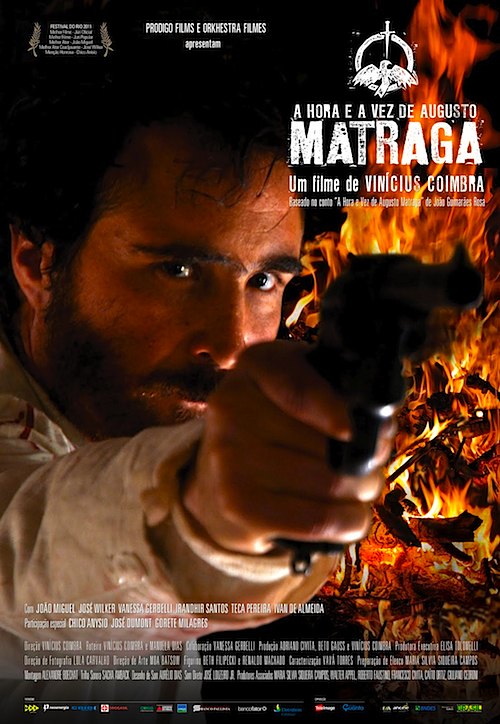
By Joe Bendel. Those who know their Brazilian cinema and literature will know Augusto Esteves, a.k.a. Matraga, is one bad cat. The protagonist of João Guimarães Rosa’s short story, adapted for the screen in 1965 by Roberto Santos, made a triumphant return, sweeping most of the prizes at the 2011 Rio International Film Festival, proving Brazilians appreciate a rugged convert. Once again, he sees the light in Vinícius Coimbra’s Matraga, which screens as part of the 2012 edition of Premiere Brazil!, now underway at MoMA.

Better at drinking and whoring than farming, Esteves has made his share of enemies, most definitely including Major Consilva. Eleven of the local land baron’s gunslingers got the jump on him out in the wild grasslands. It was a decent idea, but they did not bring enough men. They will learn from this mistake. Using the incident as a pretext to banish his wife and child, Esteves continues his reckless hedonism, pressing his luck. Beaten and branded, Esteves is left for dead after pitching head first into a rocky gorge. However, a devout elderly couple nurses his broken body back to health and puts his spirit on the path of righteous.

Though sometimes tempted to give into his inner demons, Esteves holds to the Christian faith of his adopted parents, living with them in anonymous isolation. Eventually, the powerful landlord Joaozinho Bem-Bem and his extra-legal posse of enforcers ride into Esteves’ village, like a Brazilian John Tunstall and the Regulators, hoping to skirt a company of legitimate government troops. Much to their surprise, Matraga receives them in the spirit of Christian hospitality, welcoming them into his home. Recognizing a kindred spirit beneath Esteves’ pious exterior, Bem-Bem feels an instant rapport with the reformed killer. Indeed, their fates will be intertwined.

Matraga is often billed as a Brazilian spaghetti western, and that is fair to an extent. Yet Esteves is as much Paul on the Road to Damascus as the Man with No Name. In truth, it is quite a solid film, but it will be tricky finding the right audience for it beyond Brazilian cinema showcases, such as MoMA’s Premiere. This is a brooding film that treats issues of faith with deadly seriousness. Still, when its go time, everyone gets down to business as the bullets fly.

Glowering impressively, João is convincingly fierce and conflicted as Esteves. He handles the fight scenes quite credibly, but most importantly his depiction of the character’s hard won new faith is grittily realistic and in no way caricatured. Nonetheless, José Wilker earns most of the film’s style points as the smoothly lethal Bem-Bem.

Clearly, Coimbra and cinematographer Lula Carvalho were taken with the wide open vistas of the Minais Gerais countryside, giving it the full John Ford treatment. Yet what is most notable is the manner the film stays true to the expectations of the western genre and the integrity of Esteves’ post-conversion character. That is quite a trick. Partly a moody, unhurried art film and partly a violent western shootout, it is recommended fairly strongly for patrons of Brazilian cinema and those drawn to dark morality tales when it screens Tuesday (7/17) and the following Sunday (7/22) as part of the tenth annual Premiere Brazil! at MoMA.

Posted on July 17th, 2012 at 2:36pm.

LFM Reviews Collaborator

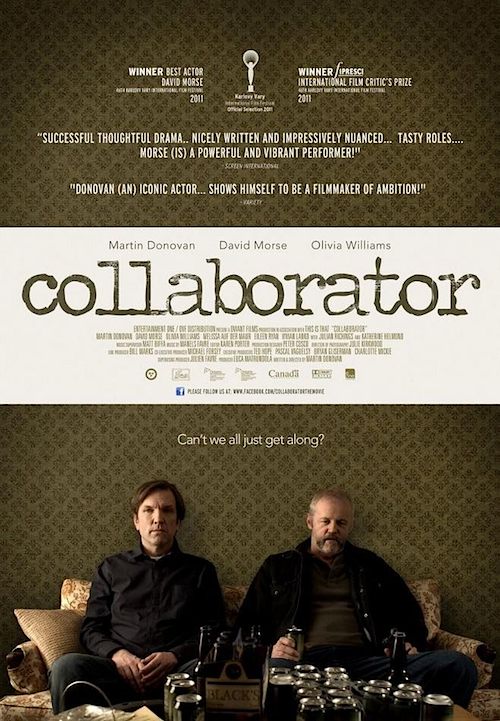
By Joe Bendel. If you are ever taken hostage, start doing acting exercises. Anyone that annoying is sure to be quickly released. It does not quite work that way for snobby leftwing playwright Robert Longfellow, but it is debatable just how much danger his captor really represents in Martin Donovan’s directorial debut and star vehicle, Collaborator, which opens today in New York at the IFC Center.

Smarting from the critical drubbing unleashed on his latest play (the appropriately pretentious sounding American Excursion), Longfellow left New York and his ever patient wife to visit his aging mother. As luck would have it, he is also able to re-connect with his former romantic interest, Hollywood actress Emma Stiles. His childhood acquaintance still living across the street also wants to hang. One of those right-wing ex-cons, Gus Williams has not made good. In trouble with the law again, Williams shows up with a gun and a shopping bag full of beers. Thus begins Longfellow’s hostage ordeal.

Donovan might have been Hal Hartley’s bro-muse in all those great 1990’s indies, but as a director-screenwriter he does not exhibit a natural talent for pacing or characterization. While he deserves credit for his relatively sympathetic treatment of Williams, we never really believe the hostage-taker would pull the trigger, at least with Longfellow on the receiving end. As a result, instead of a taut cat-and-mouse game, the deliberately stagey and static Collaborator feels more like forty-plus minutes of extended endgame, grinding along laboriously.

In lieu of plot progression, Longfellow engages Williams in a series of actors’ improvs designed to show the intellectual superiority of a New York elitist to the bitter red-stater. Yet, the truth is that both characters are just talking in clichés when they debate hot-button issues, such as the Viet Nam War. This is all supposed to reveal the fundamental essences of their psyches, but it really just leaves viewers shrugging, so what then?

Frankly, Donovan’s emotional frozen Longfellow, as well as David Morse’s wounded, anti-social Williams are only too familiar, following predictable development arcs. We have seen similar from both of them before. However, Olivia Williams has some intriguing moments as Stiles. Ironically, in Collaborator, the movie star is the most human character of the lot.

While the premise of Collaborator had potential, the execution never really clicks. There are some well turned moments here and there, especially from Ms. Williams, but it is clearly the product of an insular environment, much to its detriment. Highly skippable, Collaborator opened Friday in New York at the IFC Center.

LFM GRADE: D+

Posted on July 10th, 2012 at 2:02pm.

Looking for Rocky in Sichuan: LFM Reviews China Heavyweight

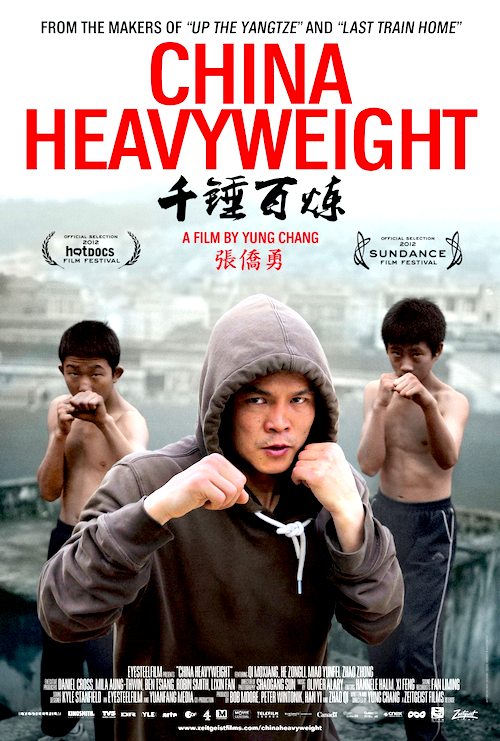
By Joe Bendel. Life in China must be improving. They now have round-card girls. Decades ago, Mao banned Olympic-style boxing on the grounds it was too western and excessively violent. He then launched the Cultural Revolution. Legalized in 1986, the Chinese boxing authorities are now taking a long view, recruiting potential Olympians at the middle school level. Yung Chang follows a contender turned coach and two of his fighters in China Heavyweight, which opens this Friday in New York at the IFC Center.

Boxing is an attractive alternative to working in the tobacco fields for many of the students in the Sichuan countryside. The sport has become a way of life for Coach Qi Moxiang. He recruits young boxers, both boys and girls, and directly oversees their training. He is tough, but popular with his charges.

At first, Chang’s primary POV figures appear to be He Zongli and Miao Yunfei, two boxers about to graduate to the regional level of competition. We see a fair amount of training and the mean condition of life in the province that they hope to escape. However, Heavyweight kicks into narrative gear about halfway through, when Qi decides to return to the ring to face a Japanese belt-holder. Suddenly, there is a traditional underdog boxing story unfolding in Sichuan.

Heavyweight is highly attuned to the economic disparities of contemporary China as well as the conflicts between tradition and the drive to modernize. However, Chang largely overlooks Sichuan’s recent tragic history. Rocked by an earthquake in May of 2008, anger boiled over at the local authorities for allowing the shoddy construction practices that acerbated its deadly toll. Sichuan could use a champion, but that might not be in the interests of the vested establishment.

Still, Chang has a good handle on the conventions of boxing movies, capturing some dramatic ringside action. There is even a scene of Qi’s boxers running up a series of ancient steps that echoes a certain film from 1976. He and cinematographer Sun Shaoguang also convey the harsh and lonely beauty of the surrounding terraced landscape. Viewers get a sense of the milieu, but besides Qi, the boxers’ personalities are not so strongly delineated (He is the shy one, while Miao is the slightly more confident one).

Shifting from an observational doc into old fashioned sports story, Heavyweight becomes more engaging as it goes along. The development of organized boxing post-Maoist insanity is a story worth telling, but as a socio-economic investigation, it is not nearly as telling as a raft of recent depressing Chinese documentaries, such as Zhao Liang’s jaw-dropping expose Petition, or the uncomfortably intimate Last Train Home, helmed by Heavyweight co-executive producer Lixin Fan. Oddly recommended more for the audience of HBO’s Real Sports than for serious China watchers, China Heavyweight opens this Friday (7/6) at the IFC Center.

LFM GRADE: B-

Posted on July 3rd, 2012 at 2:43pm.