A Coming of Age Story for All Ages: LFM Reviews Starry Starry Night @ The 2012 New York Asian Film Festival

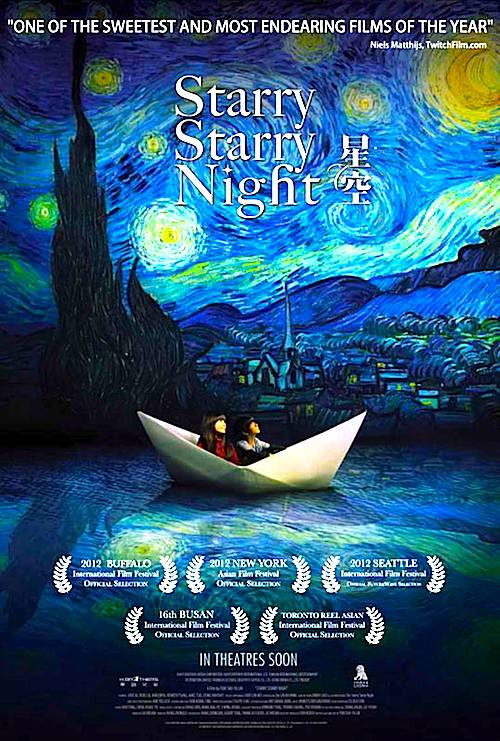
By Joe Bendel. It is tough being the kid with an artistic temperament in school. Having trouble at home is a double whammy for both Mei and Jay. At least they have each other’s support in Tom Shu-yu Lin’s Starry Starry Night, an exquisitely sensitive portrait of young love that opens this Friday in New York following its 2012 New York Asian Film Festival screening this afternoon.

Jay is a shy kid with a remarkable talent for creating art. He has a hard time making friends, because he and his mom must constantly move to new addresses. Mei has many friends, but is not particularly close to any of them. Her mother has taught to appreciate fine art through the jigsaw puzzles they use to put together as a family. Unfortunately, her parents are now too busy fighting to spend quality time with her. She feels her closest connection to her aging grandfather, who lives in a Kinkadean cabin in the woods, until she meets Jay.
At first it is a case of fascination for Mei, but as she and Jay share their mutual interests, an innocent friendship blossoms into innocent love. Grieving her grandfather and upset by the announcement of her parents’ impending divorce, she leads Jay on a journey to the late woodworker’s cottage nestled deep in the mountains.

In a nutshell, Starry could be considered the Taiwanese Moonrise Kingdom, except its young protagonists are far more endearing and their troubles are considerably more real. The closing credits even feature illustrations from Jimmy Liao’s picture book, upon which the film is based. Yet despite the more liberal use of CGI, bringing to life origami animals animated by the duo’s purity of spirit, Starry is much more grounded. Indeed, the emotional stakes involved in growing up and caring for others are quite real throughout Lin’s sympathetic screenplay.

Young Josie Xu carries a disproportionate share of the film’s dramatic load, but she is fantastic as Mei. Charming and vulnerable as circumstance demand, it is a remarkably assured screen performance. While his character is more reticent and reserved, Eric Lin Hui Ming is also quite compelling in Jay’s big revelatory scenes. Starry also boasts a special, too-significant-to-be-a-cameo appearance by Kwai Lun Mei in an epilogue completely one-upping anything Nicholas Sparks ever wrote.

True, Starry is not afraid of a little sentiment, but it earns its pay-off, every step of the way. Firmly but elegantly helmed by Lin, the film treats its young characters and their dilemmas with refreshing respect. Its lush, animated backdrops are truly striking, but the film never really engages in magical realism, per se. It is merely amplifying the feelings of its charismatic leads. Nonetheless, it is quite visually dynamic (with particular credit due to Penny Tsai Pei-ling’s design team), capturing the essence of Liao’s book. Enormously satisfying and hugely commercial, it is precisely the sort of international film that can break into the mainstream. Highly recommended for general audiences, Starry Starry Night opens this Friday (7/6) in New York at the AMC Empire and in Seattle at the AMC Pacific Place, courtesy of China Lion Entertainment.

LFM GRADE: A+

Posted on July 3rd, 2012 at 2:42pm.
Robert Flaherty & The Origins of the Documentary: LFM Reviews A Boatload of Wild Irishmen

By Joe Bendel. Robert Flaherty is considered the father of documentary filmmaking. With Nanook of the North, he not only launched the modern documentary film genre, he also introduced the ethical questions that continue to dog non-fiction filmmakers. The legacy of Flaherty and the relatively small handful of films he actually completed is explored in Mac Dara Ó Curraidhín’s A Boatload of Wild Irishmen, which screens as part of this week’s Robert Flaherty series at the Anthology Film Archives.

Boatload opens with the dramatic closing scene of Flaherty’s masterwork, Man of Aran (see above). Struggling against a powerful surge, the salt-of-the-earth fishermen fight their way to shore. Flaherty did not just happen to be in the right place at the right time to capture the action, however. He either sent them out into the roiling tide, or they volunteered to go. Accounts differ, but everyone seems to agree the money Flaherty was offering played a role. Even then it would not have been much by Hollywood standards, but to residents of the Ireland’s hardscrabble Aran Island, it was significant.

Indeed, Boatload’s various on-screen commentators make it clear that staging scenes was a major part of Flaherty’s working method. Opinions regarding the Irish-American filmmaker appear to be mixed at best amongst contemporary Aran Islanders and Irish film scholars. However, such criticism of Flaherty’s authenticity is largely based on current standards of documentary filmmaking, which are rather selectively applied.

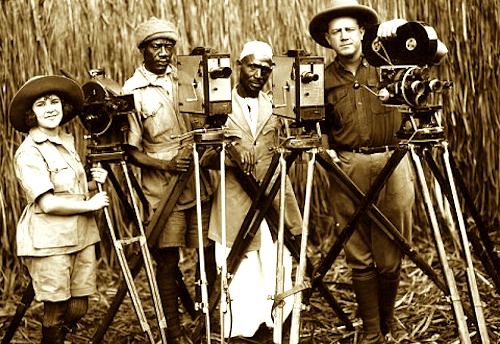
Groundbreaking documentary filmmaker Robert Flaherty (far right).

Ó Curraidhín paints a picture of Flaherty as more of an adventurer than an auteur. Rather than Jacob Riis, P.T. Barnum would be better considered his forerunner. So what if he did stage a scene, or a dozen? It was for the sake of a good show. In contrast, when recent documentaries like Gasland play veracity games, it is far more serious, because they are advocacy broadsides, arguing for punitive measures targeting specific companies and industries.

Clearly, Flaherty was not a take-only-pictures-leave-only-footprints kind of documentarian, as the interview with his Inuit granddaughter fully attests. Yet the Samoans still regularly screen Flaherty’s Moana, enjoying the sight of their ancestors on-screen, even if the episodes they are recreating were from generations before them. Obviously, the point is that there are many different ways to come to terms with Flaherty’s small oeuvre.

Refraining from passing judgment on Flaherty, Boatload emphasizes his larger than life persona and the lasting audience for his films. Ultimately, the people have spoken. Considerably more film patrons will attend screenings of Flaherty’s films this year than those of silent western superstar Tom Mix by a wide margin, a trend that continues this week at AFA. Informative and evenhanded, A Boatload of Wild Irish is a satisfying survey of Flaherty’s work and controversies. Recommended for those who enjoy films about filmmaking, it screens this Saturday through next Monday (7/7-7/9) in New York at the Anthology Film Archives.

LFM GRADE: B

Posted on July 3rd, 2012 at 2:41pm.

LFM Reviews War of the Arrows @ The 2012 New York Asian Film Festival

By Joe Bendel. Sure China invaded Korea, but it was all for the sake of greater regional stability. The year is 1636 and only an unemployable archer with an attitude problem stands between Joseon and an army of Manchurian invaders in Kim Han-min’s War of the Arrows, which screens tomorrow during the 2012 New York Asian Film Festival.

Choi Nam-yi and his sister Ja-in should not be alive. When their father is wrongfully branded a traitor, they barely escape to the home of his lifelong friend, who raises them in secret. Unable to live a productive public life, the grown Choi becomes a sullen slacker, wasting his life with his Falstaffian cronies. He only excels at one thing: archery.

In contrast, his sister has fallen in love with Kim Seo-goon, the son of their protector. Believing they can lead a normal existence together, Kim has convinced his parents to allow their marriage. Unfortunately, the Qing army happens to choose their wedding day for their invasion. They only make one mistake, scooping up Choi’s sister and new brother-in-law along with the rest of their prisoners. Somewhat put out by this, Choi dogs the returning Qing forces, becoming a guerrilla army of one. Of course, the trail of arrow-impaled bodies he leaves in his wake attracts the attention of an elite company of archers led by the seriously hardnosed Jyushinta.

From "War of the Arrows."

A commanding screen presence, Ryoo Syeung-ryong makes quite the villain as the relentless Jyushinta. He seethes with authority and projects a quiet sense of menace perfect for his role as the Qing commando leader. While Park Hae-il’s Choi lacks a similar gravitas, he is a convincing action figure, letting the arrows fly as he careens through the forest.

War is one fierce archery film. Those who considered Hawkeye the biggest take-away from The Avengers are in for a treat. This is warfighting at its most personal level. Though already available on DVD, War of the Arrows is the sort of film that should be a blast to watch with an appreciative NYAFF audience when it finally gets an overdue New York ovation tomorrow. Well worth seeing on a big screen, it would have also made a good 3-D fixer-upper (unlike say, Clash of the Titans), considering how many projectiles come flying out towards the audience. Like the best action historicals, War of the Arrows is both high tragedy and a total blast. Enthusiastically recommended, it screens Friday night (6/29) at the Walter Reade Theater as part of the intrepid 2012 NYAFF.

LFM GRADE: A-

Posted on June 28th, 2012 at 3:21pm.

The Young Inspector Morse: LFM Reviews Endeavour

By Joe Bendel. Consider it a portrait of the curmudgeon as a young man. Inspector Morse would make a name for himself as the prickly but refined Chief Inspector with a taste for opera and poetry. However, in 1965, Endeavour Morse was an Oxford drop-out just hoping to catch on with the Thames Valley force after a stint in the military. His first case will be difficult, bringing him back to his former college in Endeavour, the one-off Inspector Morse prequel, premiering this coming Sunday on PBS’s Masterpiece Mystery.

Mary Tremlett, a local school girl, has been murdered and her former lover, an Oxford student, has committed suicide. It is supposed to look like an open-and-shut affair, but the details do not quite fit. Constable Morse’s inquiry leads him to the faculty member tutoring Tremlett (under questionable circumstances), who happens to be married to Morse’s favorite opera diva.

Though preoccupied on several fronts, Morse doggedly follows the clues leading to sleazy car dealer with half the force in his pocket. To proceed, he will need the career-risking assistance of his prospective mentor, the somewhat Morse-like Detective Inspector Fred Thursday, who drives a Jaguar and has little patience for his colleagues’ corruption.

For a television mystery, Endeavour is fairly successful at misdirecting viewers, despite dropping some fairly obvious clues. It also comes fully approved and vouched for, featuring a cameo appearance from Morse author Colin Dexter, as well as Abigail Thaw, the daughter of the late John Thaw (the star of the original Morse series), appearing briefly as the editor of the Oxford newspaper. Frankly, it seems strange that Endeavour was initially produced as a one-shot, much like the Morse spin-off, Inspector Lewis, but in each case the viewers have clearly spoken. A full four episode season of Endeavour is reportedly already in the works.

Shaun Evans as Endeavour Morse.

In his eponymous first outing, Shaun Evans looks appropriately awkward and earnest as Constable Morse, but it will be interesting to see how the character and his performance evolve over time. Indeed, it is easy to understand how this early case would appreciably contribute to his disillusionment. Fortunately, Roger Allam (who once played a suspect on the flagship Inspector Morse) provides plenty of color as the flamboyant but principled DI Friday. The only real weaknesses on Constable Morse’s maiden voyage are his suspects, who are a rather bland lot, in an English upper crust sort of way.

Sure to please the preexisting base, Endeavour should also appeal to viewers of PBS period dramas. There is definitely a sense of nostalgia here that should help the prequel series establish its own discrete identity. An entertaining feature length murder mystery that has plenty of potential for growth (again, much like Lewis before it), Endeavour is easily recommended for Brit TV fans when it airs this Sunday (7/1) on most PBS stations nationwide.

LFM GRADE: B

Posted on June 28th, 2012 at 3:19pm.

LFM’s Govindini Murty at The Huffington Post: New Film Words of Witness Testifies to Egypt’s Hopes for Democracy

[Editor’s Note: the post below appears today at The Huffington Post.]

By Govindini Murty. Egypt’s government announced on Sunday that an Islamist has won Egypt’s first competitive presidential election. The superb new documentary Words of Witness, screening at the Human Rights Watch Film Festival in New York through June 26th, sheds much needed light on how Egyptians got to this point. Directed by Mai Iskander, the film depicts the complex reality of an Egypt in which long-suffering citizens genuinely desire democracy, but must deal with the less than ideal reality of having to vote either for the Muslim Brotherhood or for remnants of the former Mubarak regime – with the military looming over any choice they might make.

Against this backdrop, Words of Witness makes the smart decision to focus its story on a young Egyptian woman, journalist Heba Afify. The documentary follows the 22 year-old Afify, a reporter for the English-language newspaper Egypt Independent, as she covers Egypt’s transition to democracy – from the heady days of the revolution in early 2011, through Egypt’s chaotic year and a half under military rule, to the recent months of buildup to Egypt’s first free presidential election. Completed in just the last few weeks, Words of Witness has a remarkable timeliness and immediacy in depicting the contending forces that are challenging Egypt’s journey to democracy.

Like her fellow citizens, Heba Afify finds herself torn between tradition and progress. Her traditional Muslim family worries about her career and her safety, while Afify’s chief concern is reporting the truth of the Egyptian revolution so that she may contribute to her nation’s democratic future.

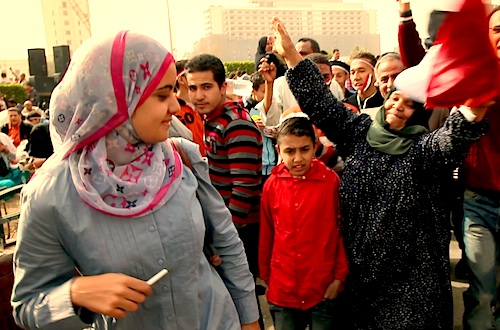
Heba Afify in Tahrir Square.

As Afify poignantly says: “I can’t abide by the rules of being an Egyptian girl if I want to be a good reporter.” And if she can’t be a good reporter, the implication is that she can’t help her country, as a free press and democratic liberty go hand in hand. Afify adds, “It’s hard to live under a dictatorship – if you say the wrong thing, they will knock on your door and take you away forever.”

The film documents the remarkable degree to which Afify and other young Egyptians like her are willing to buck authority in order to bring about freedom and progress. It is her faith in these ideals that leads Afify to volunteer to cover the most dangerous demonstrations, despite the fears of her family. Afify’s conviction and her willingness to put her ideals on the line are what ultimately make her such a compelling protagonist.

In one extraordinary scene, Afify hears that there is a protest taking place outside the State Security headquarters. This is the home of the hated secret police who have been arresting (and reportedly torturing) thousands of pro-democracy activists. Even though it is nighttime, and reports indicate that the situation is dangerous, Afify doesn’t hesitate to join the demonstration. What follows is shocking footage, shot by Afify herself, in which the demure young woman dives right into the crowd of protesters in the dark – joining them as they break into the building. They’re hoping to free political prisoners, but as they turn on the lights in the building, they discover something even more surprising: boxes of surveillance files kept by the secret police on government employees, media, public figures, and countless ordinary Egyptians. A colleague of hers hands Afify boxes of files, saying “This happens only once in history, Heba.” Afify shakes her head at the magnitude of the surveillance, commenting: “The number of files is unbelievable.”

As Afify later examines the files in her office, she finds a transcript of an actress’ phone call; Afify wonders why the state police felt the need to write down every word of this woman’s personal phone conversation. As the film suggests, such an abuse of authority engenders a moral corrosion that is an important reason why authoritarian societies have such trouble adapting to freedom. It can take generations to overcome the cynicism, paranoia, and bad faith created by a system in which the government spends more time repressing its own people than in serving them.

Heba and her mother at home.

Another important point made in the film is the need for religious tolerance. Afify shows concern when the unity between Muslims and Christians – that had largely prevailed in the early days of the revolution – breaks down in the wake of attacks on Christians. When a church is burned down in the village of Atfeeh, leading to riots in Cairo, Afify goes to the village herself to find out what has happened. When she gets to the village, she finds a curious scene – the kind of scene that often doesn’t make it into the Western media. A local Muslim leader addresses a large group of villagers, telling them that they should show support for their Christian brothers and work to have the church rebuilt. However, a large army presence watches the scene, and Afify is prevented from visiting the site of the church. Indeed, no-one is allowed to go near the church site, and the rumor ripples through the crowd that it is the State Security apparatus itself that burned the church down in order to inflame religious tensions in Egypt and justify the old regime hanging on to power.

Continue reading LFM’s Govindini Murty at The Huffington Post: New Film Words of Witness Testifies to Egypt’s Hopes for Democracy