LFM Reviews Japanese Shorts, Made in America, at the Asia Society

By Joe Bendel. Japan has long been a source of inspiration for American artists, and vice versa. In that spirit, the Asia Society hosts a screening of seven short films of varying degrees of Japanese-ness from filmmakers working in America. Diverse and intriguing, the New York Japan CineFest: Short Film Program will be a treat for short film connoisseurs this Friday night at the venerable Park Avenue institution.

For diehard fans of Japanese cinema, the highlight of the evening will doubtless be Justin Ambrosino’s The 8th Samurai. Absolutely not purporting to tell the behind-the-scenes story of Kurosawa’s Seven Samurai, it speculates what might have happened if a cap and sunglasses donning director had a dream telling him to cut one of the eight samurai from his upcoming epic, just prior to the start of shooting. While Kurosawa’s film is an obvious inspiration, one luckless actor’s wickedly supernatural mother-issues suggest the influence of Kaneto Shindo, the director of ambiguous horror classics like Kuroneko and Onibaba, who recently passed away after reaching the century milestone.
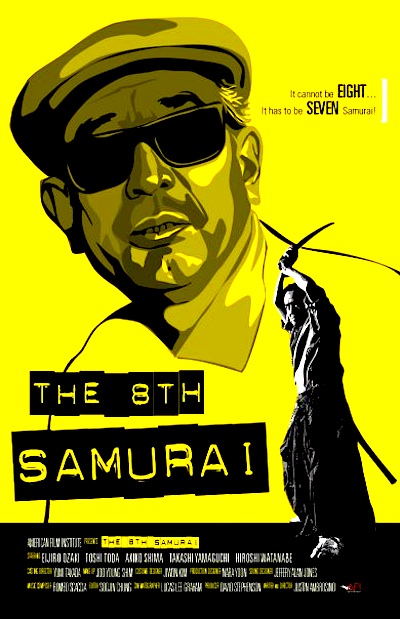
Filmed in glorious black-and-white by cinematographer Lucas Lee Graham, the subtitled Samurai is a moody but loving valentine to Japanese cinema. Though Ambrosino is not anymore Japanese than he sounds, Samurai features almost the entire Japanese supporting cast of Eastwood’s Letters to Iwo Jima. The second longest selection of the program at twenty-eight minutes, it is a fully realized, enormously satisfying film, by any standard.

Yet, perhaps the best film of the evening is the hardest to describe, combining elements of narrative, essay, and experimental filmmaking. Observing the terms of his mother’s will, the introverted narrator of Ken Ociai’s Frog in the Well (trailer here) travels throughout Japan spreading her ashes, as directed. Sometimes employing quick-cut film stills to create a live-action flip book effect, Frog has a decidedly unusual visual style yet it never overshadows the emotional significance of the grown son’s travels. Indeed, it is surprisingly touching, while also enticing viewers to visit Japan. Frankly, considering how gorgeous it makes the country look, starting in the snowy north and traveling down to Okinawa, the Japanese tourism board ought to buy television air time for it around the industrialized world.

Though much simpler and more straight-forward, Chisa Hidaka’s three minute Together: Dancing with Spinner Dolphins is also lovely to look at, following a swimmer as she frolics underwater with the beloved marine mammals. It sounds great too, thanks to a shrewdly chosen excerpt from Ketil Bjørnstad’s The Sea, featuring ECM label mates Terje Rypdal, David Darling, and Jon Christensen.

Though something of a brief irony-driven short, Yoriko Murakami’s richly rendered stop-motion animated Corazon en Fuego / Heart on Fire puts a twist on the O. Henry twist, ultimately guiding its bereaved protagonist somewhere quite life-affirming. Yasu Suzuki’s New York set Radius Squared Times Heart is even more upbeat, depicting a shy Japanese scientist courting a fellow tango dancer through his skills in the kitchen. With its accessible, Friends-style humor, it could easily be the crowd favorite of the evening.

Far heavier, Haruhito Naka’s Into the New World rather awkwardly addresses big picture topics like God and 9-11 through half-baked magical realism. Fortunately, Kosuke Furukawa’s only slightly metaphysical Uguisu is much subtler. It also features an excellent supporting turn from Seiji Kakizaki, who has such presence as a diner customer getting under the skin of a hipster artist simply through his soft-spoken honesty, he sort of fools viewers into investing undue significance in his character. Furukawa’s sparing use of color is also quite distinctive, as are the sly hints at the fantastical.

Overall, the New York Japan CineFest night of shorts is very strong, including two excellent films, 8th Samurai and Frog in the Well, plus several other quality selections. Since most films are American productions, at least to an extent, it also represents an interesting change of pace for the Society, while still staying true to their mission and focus. It is another example why New York cineastes need to follow their programming closely. Definitely recommended, the short film program screens this Friday night (6/8) at the Asia Society.

Posted on June 7th, 2012 at 6:18pm.
Jaycee (Son of Jackie) Chan Takes Over the Family Business: LFM Reviews Double Trouble

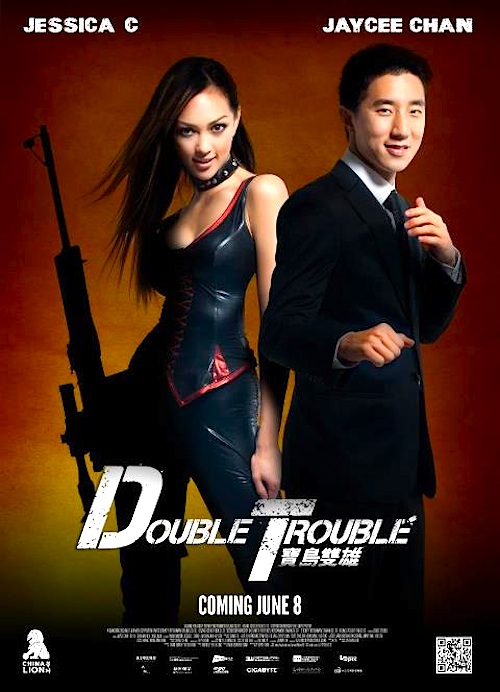
By Joe Bendel. Some were skeptical when fifty-eight year old Jackie Chan announced his retirement from the action movie genre at Cannes. Whether this is one of those Depardieu retirements or he actually really means it, only time will tell. Regardless, the scheduling is fortuitous for the release of an old-fashioned action-comedy starring Chan’s son. Jaycee Chan steps into some big shoes as half of a pair of mismatched security guards trying to foil an art heist in David Hsun-wei Chang’s Double Trouble, which opens this Friday in New York.

Jay is a take-charge loose cannon, which earns him plenty of demerits for poor team-building skills. However, his reckless disregard for procedure is rooted in a tragic episode from an earlier period of his life. He is the one Taipei Palace museum guard an elite gang of art thieves would not want to tangle with, but he is the perfect candidate for a frame-up. Frankly, that was not part of the plan for two slinky Cat Woman-attired robbers, but the result of the bumbling interference of Ocean, the comic relief security guard-tourist visiting from Beijing. Dragging along Ocean is a lot like taking the proverbial accordion into battle, but Jay is forced to, for the sake of clearing his name.

As the earnest Jay, Jaycee Chan exhibits something of the rubber face and rubber bones that made his father an international movie-star. He also has a similarly likable on-screen demeanor. Unfortunately, Double Trouble is a bit too much like late Hollywood period Jackie Chan than his early cult favorites for fans to pronounce the baton has been fully passed. However, it is safe to say HK model Jessica C. (a.k.a. Jessica Cambensy) has arrived as an action femme fatale. After all, there is a reason she is on the poster with Chan, even though they are bitter foes in the film. As for his reluctant crime-fighting partner, a little of Xia Yu’s Ocean goes a long way.

Indeed, the bickering bromance is laid on rather thick and the humor is almost entirely of the slapstick variety. Nonetheless, the depiction of border-crossing friendship (and maybe even romance with another member of Ocean’s tour group, appealingly played by Deng Jiajia) is rather pleasant, because it never feels overly soapboxey or clumsily forced.

There are some nice stunts in Double and it also has Jessica C. going for it. It sincerely aims to please, but it is hardly has the grit or heft of a Police Story or even the relatively recent Shinjuku Incident. A harmless distraction, Double Trouble may indeed be remembered as a stepping stone for its promising young cast. It opens this Friday (6/8) in New York at the AMC Empire and Village 7, as well as in San Francisco at the AMC Cupertino and Metreon, courtesy of China Lion Entertainment.

LFM GRADE: C+

Posted on June 6th, 2012 at 10:01pm.

Russia’s Bernie Madoff: LFM Reviews Pyrammmid @ The 2012 Brooklyn Film Festival

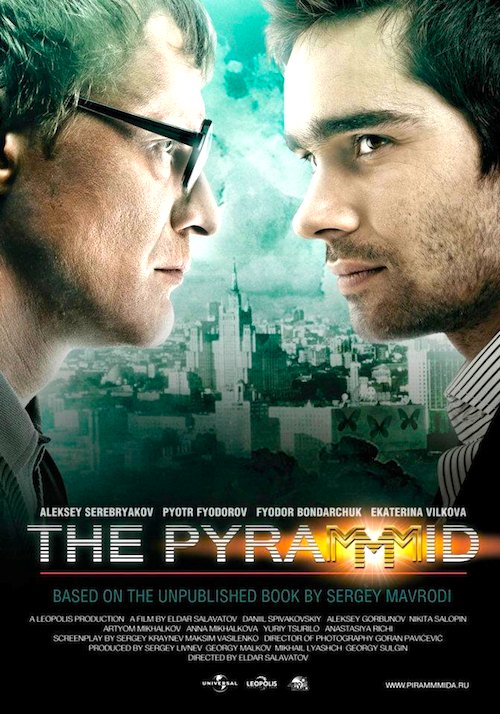
By Joe Bendel. Only Russia could celebrate a Ponzi scheme con artist as a national hero. It’s a complicated place. Transparently based on Sergei Mavrodi, the Russian Madoff, a bizarre episode of post-Soviet economic history is only slightly exaggerated in Eldar Salavatov’s Pyrammmid, which screens during the 2012 Brooklyn Film Festival.

Mavrodi’s dodgy financial empire was also known as MMM and its commercials promising forty percent returns on investment were a constant presence on Russian television during its heyday. Many Russians blamed its inevitable collapse on the government thanks to conspiracy theories no doubt nurtured by Mavrodi. However, the fictional Sergey Mamontov’s MMM really is the target of the corrupt national government and their oligarchic allies. Understand: Mamontov is no mere charlatan. He is scamming all that money in order to preserve Russian ownership of the old state-owned enterprises being sold to the well-connected at fire-sale prices, through a dubious privatization process. Well, that’s Pyrammmid’s story and its sticking to it.

It gets quite complicated, though. Raking in cash, Mamontov plans a fatal run on his major banking rival, while getting involved in weird sidelines, like buying the major Russian beauty pageant. Most of those distractions are the brainchild of maverick mathematician Anton who loses sight of the big picture. Frankly, the film is a bit overstuffed with plot, sacrificing the dead weight of transitions to fit it all in. As a result, audiences watching it in subtitles really have to keep on their toes.

Reportedly, Pyrammmid is based on an unpublished manuscript by Mavrodi, which must be considered either a novel or a memoir, depending on whether or not you happen to be Sergei Mavrodi. Ideologically, it is a bit of a head-scratcher, unambiguously lionizing exactly the sort of financial plunderer the current regime made its name inveighing against. Still, the symbolic significance of Mamontov’s choice of car is hard to miss: a vintage Soviet Chaika sedan. In fact, the film has nothing to say regarding the lack of consequences faced by the oppressive former Communist hardliners. Indeed, that refusal to account for the past has led the country precisely where it is now. The presence of Putin favorite Nikita Mikhalkov’s son Artyom and daughter Anna Mikhalkova in the ensemble cast further muddies the waters.

Having played more traditionally action-oriented protagonists in previous films (such as the Da Vinci Code-ish Golden Mean), Alexey Serebryakov is surprisingly convincing as the owlish Mamontov (those specs are another Mavrodi trademark). Unfortunately, he is largely surrounded by stock characters existing simply to serve the plot, like Gutov the shifty lawyer and Vera the ambitious muckraking photojournalist.

Frankly, the fact that this movie exists is downright mind-blowing. Imagine a slick, big budget American film positioning Bernie Madoff as a misunderstood hero, whom we should give good money to, for the sake of the country. That is about how Pyrammmid shakes out. It is a fast-moving big-canvas conspiracy thriller that does not always make a whole lot of sense. Yet, it is more stylistically grounded than the thematically related Generation P. Flawed but fascinating for Russia watchers, it screens again this Wednesday (5/6) at IndieScreen as part of this year’s Brooklyn Film Festival.

Posted on June 4th, 2012 at 9:31pm.

LFM Reviews Rose @ The 2012 Brooklyn Film Festival

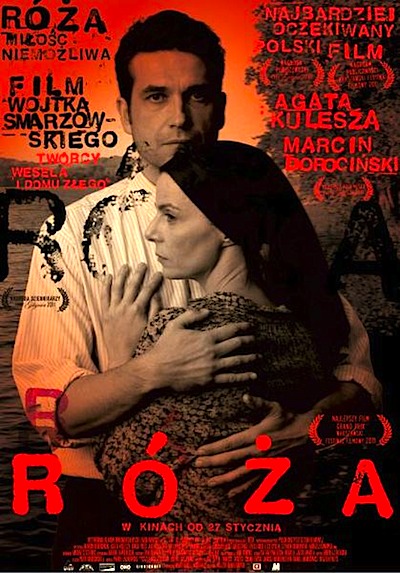
By Joe Bendel. The war is over, but for many Polish women it’s hard to call the aftermath “peace.” This is especially true for ethnic German Masurians, formerly of eastern Prussia, like Rose Kwiatkowska. Though Poland has been “liberated,” they are constantly reminded that “their side” lost, and are treated as treasonous pariahs, accordingly. Yet, Kwiatkowska’s situation is especially dire, as a mysterious Polish veteran slowly discovers in Wojtek Smarzowski’s uncompromising Rose, which opened the 2012 Brooklyn Film Festival Friday at the Brooklyn Heights Cinema.

Tadeusz Mazur is a world-weary Home Army veteran, who witnessed things during the Warsaw Uprising no man could forget. He watched as his wife was raped and murdered by the rampaging National Socialists, and was also present during the death of Kwiatkowska’s husband. She is not exactly welcoming when he turns up to deliver some of her husband’s effects, yet a bond slowly forms between them. Kwiatkowska needs protection from the Soviet-aligned bandits, who literally rape and pillage their way through the Masurian countryside. She could also use his help clearing the landmines from her fields, so they can harvest the potatoes. As for Mazur, he has his reasons to lay low, hoping not to attract the attention of the NKVD. However, Masuria is not the best place to be to avoid trouble.

Michał Szczerbic’s screenplay is brutally direct and honest about the treatment of women during wartime by the Germans, the Soviets, and their minions (indeed, they all seem to blend together throughout the film). The sheer volume of sexual assaults in Smarzowski’s historical drama is overwhelming, but they are never treated in a lurid or sensationalized fashion. Rather, it is a harrowing depiction of an ugly period of institutionalized score-settling.

Yet incredibly, Rose is a fundamentally a love story, sensitively bringing to life the brief but intense relationship that develops between Kwiatkowska and Mazur. There are no cute courtship rituals or romantic contrivances. They simply fall in love (or something near enough to it), while banding together to survive. It is definitely not pretty, but in a way, it is kind of beautiful.

Marcin Dorociński is riveting as Mazur, portraying him as both a flinty man of action and a tragic romantic hero. It is a bit surprising how thoroughly he dominates the film (since it is called Rose), but he does. Agata Kulesza is also quite haunting as Kiatkowska, creating a profile of herculean endurance. Their scenes together are quite special.

Despite somewhat rushing the third act (which features a few “wait, he did what?” moments), Smarzowski (previously represented at BFF with the gritty Martial Law-era noir The Dark House) deftly helms Rose, capturing the sweep of terrible historical forces, but maintaining an intimate focus. He forces viewers to confront the nature of the crimes committed against Kiatkowska and other Masurian women, up close and personal. Polish free jazz bass clarinetist Mikołaj Trzaska’s eerie minimalist score also heightens the unsettling mood.

Rose can be tough to watch, but it is an excellent film. Highly recommended, it screens again this coming Thursday (6/7) at IndieScreen, as part of this year’s Brooklyn Film Festival.

LFM GRADE: A

Posted on June 4th, 2012 at 9:30pm.

When Papa Met His Match: LFM Reviews HBO’s Hemingway & Gellhorn

By Joe Bendel. Ernest Hemingway deliberately cultivated his notoriously macho image – yet he somehow found four women willing to marry him at various points of his life. That was a lot of optimism, on everyone’s part. Though she had the shortest tenure as a “Mrs. Hemingway,” war correspondent Martha Gellhorn was the most notable. Matching and at times surpassing his feats of war zone journalistic daring, Gellhorn fired his passion and inspired his professional respect and jealousy. Their tempestuous relationship is dramatized in Philip Kaufman’s HBO Film Hemingway & Gellhorn now currently airing on the network.

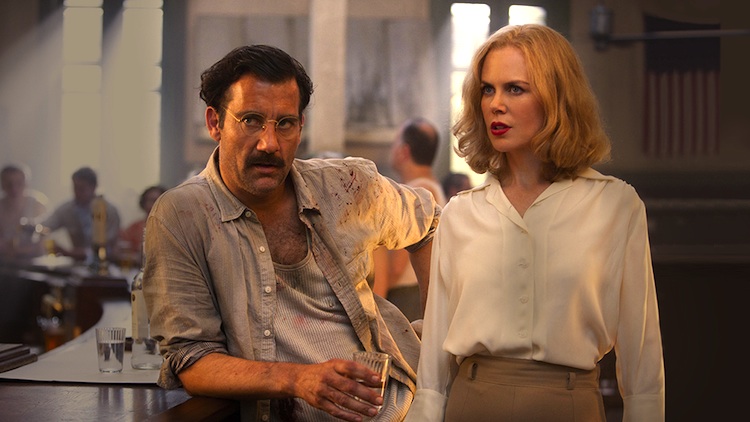
When ambitious young magazine writer Martha Gellhorn first meets the funky, grungy Hemingway in a Key West bar, they can barely resist tearing the clothes off each other. The fact that he is married hardly matters to either of them. However, their animal attraction will have to briefly wait until they reunite covering the Spanish Civil War, at the behest of ardent Spanish Republican supporter John Dos Passos.

Working with Dutch Communist documentarian-propagandist Joris Ivens, Hemingway and Dos Passos film The Spanish Earth (with Gellhorn tagging along), for the purpose of rallying American audiences to the Republican cause. Frankly, it is considerable more compelling to watch their run-and-gun shooting process in H&G than the historical documentary itself. That adrenaline also fuels the war reporters’ torrid affair.

Just like Hemingway and Gellhorn’s relationship, the film really clicks during their time together in Spain. Viewers are served a liberal helping of Nationalist atrocities, but the portrayal of the Soviet forces is also refreshingly unvarnished, particularly with respects to the fatal purging of heroic Loyalist soldier Paco Zarra, a stand-in for Dos Passos’ doomed friend José Robles. While the literary power couple is shown fawning over Chou En-lai and sneering at the gauche Chiangs in China, Gellhorn also reports from Finland, unequivocally siding with the Finns against the Soviet invaders.

Clive Owen and Nicole Kidman in HBO's "Hemingway and Gellhorn."

Unfortunately, the film loses vitality with the aging Hemingway, sliding into the long denouement of his dubious u-boat chasing Cuban years and sad final days in Idaho. By the time America enters WWII, screenwriters Jerry Stahl and Barbara Turner clearly suggest Gellhorn was more of a man than Hemingway. Of course, this is a common problem with bio-pics. To be accurate, they can almost never end with the good stuff.

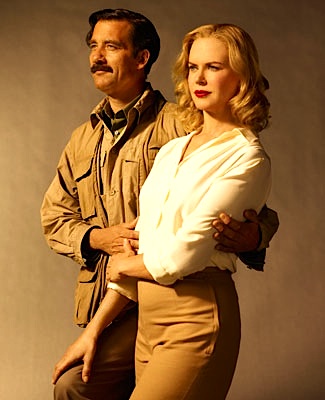
Regardless of his character arc, Clive Owen totally goes for broke as Hemingway. One of the few actors working today who can come across as both manly and literate, he bellows and carouses with relish. It is a larger than life performance, bordering on camp, yet he is still able to convey Hemingway’s inner demons and nagging self-doubts. He also manages to dial it down periodically for some saucy Tracy-and-Hepburn bantering with Nicole Kidman’s Gellhorn. Likewise, Kidman is on a very short list of actresses who can play smart, sophisticated, and alluring, simultaneously. In fact, she could be channeling Hepburn and the Rosalind Russell of His Girl Friday as the fast-talking, khaki-wearing journalist crusading against injustice, which is frankly pretty cool.

A tempestuous relationship.

In addition to the strong chemistry between the leads, H&G boasts a strong supporting ensemble. David Strathairn is particularly engaging as the disillusioned idealist, Dos Passos, serving as a subtle corrective to Hemingway’s ethical malleability. Metallica’s Lars Ulrich adds notable color as Ivens, while Tony Shaloub conveys a sense of both the menace and tragedy of the Stalinist true believer Mikhal Koltsov, who is considered to be the source for the Karkov character in For Whom the Bell Tolls. Again, the most inspired work comes during or prior to the Spanish Civil War sequences.

Frequently approximating the look of black-and-white news reels and Ivens’ documentary footage, H&G is highly cinematic (getting a vital assist from cinematographer Rogier Stoffers). Kaufman is a big canvas filmmaker, with sufficient artistic stature to merit a recent MoMA film retrospective—a high honor indeed. While steamier and gossipier than The Right Stuff, it is downright staid compared to his Henry & June and The Unbearable Lightness of Being.

An appropriately messy film sprawling all over the place, H&G is rowdily entertaining, capturing a good deal more historical insight than one would expect. Definitely recommended for those who appreciate the Hemingway oeuvre and persona (as well admirers of Gellhorn or Dos Passos), Hemingway & Gellhorn airs again on HBO June 2nd, 7th, 10th, 11th, 15th, and 19th and on HBO2 on June 4th, 6th, 12th, 17th, 21st, 25th, and 30th.

LFM GRADE: B

Posted on May 31st, 2012 at 9:21am.

The Fight for Religious Liberty in Mexico: LFM Reviews For Greater Glory

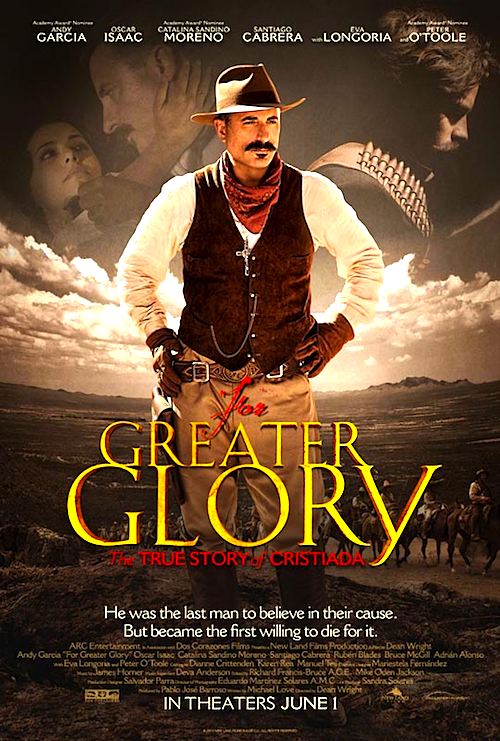
By Joe Bendel. It could be said socialist “President” Plutarco Calles made Mexico a holier place. After all, he was ultimately responsible for the canonization of twenty-five Mexican saints, by martyring them during the Christero War. His brutal “anti-clerical” laws inspired a heroic rebellion, however, dramatized in Dean Wright’s For Greater Glory, which would have been thematically appropriate for Memorial Day weekend but which opens this Friday across the country instead.

General Enrique Gorostieta Velarde does not believe in the Catholic faith, but in religious liberty—perhaps enough to even die for it. He has also been offered an unusually high salary to take command of the hardscrabble Christero forces. Before his appointment, the Christero rebels had won embarrassing victories, but they were not considered a serious threat to the Calles regime. However, Gorostieta is a man to be reckoned with.

Calles is a duly elected dictator, who razes churches and executes foreign born priests like the kindly Father Christopher, played by Peter O’Toole (who must enjoy the irony of such a pious role, given his notoriously checkered private life). Glory is not shy about depicting the violent oppression meted out by the Calles forces, most notably with their treatment of José Luis Sánchez del Río, the captured mascot of Gorostieta’s army, who joined the Christeros after witnessing the state-sanctioned murder of Father Christopher. However, the film does not just wave the bloody shirt. Christeros like the legendary “El Catorce” take the battle to the Federales good and hard, heedless of their superior numbers, in several satisfying scenes of vintage warfighting.

Of course, Glory is a prime example of one of the fundamental laws of cinema: don’t mess with Andy Garcia. Perfectly cast as Gorostieta, he captures both the swagger and the gravitas of the principled man of action. It is easy to see why men would follow him into battle. Just as Garcia looks the part of Gorostieta, Ruben Blades is the near spitting image of Calles, aptly conveying his arrogance and ruthlessness.

Santiago Cabrera is also quite a riveting presence as Father Vega, a priest turned guerrilla general, while young Mauricio Kuri is surprisingly poised as Sánchez del Río. It is a strong and accomplished cast, even featuring Oscar nominee Catalina Sandino Morena (for Maria Full of Grace) as Christero fund-raiser Adriana. Though a bit of an undercooked role, she projects a strong presence nonetheless. However, Eva Longoria seems to be dropped into the film merely for decorative effect as Gorostieta’s wife, Tulita. Arguably the most intriguing supporting turn comes from the ever-reliable Bruce Greenwood as American Ambassador Dwight Morrow, sent to broker a deal to keep the petroleum flowing, duly fulfilling his brief despite the twinges of his conscience.

Indeed, Glory shines a spotlight on some conveniently overlooked Mexican and American history. Had Coolidge been more Reaganite and backed the Christeros, the Twentieth Century might have been much more prosperous and pleasant for Mexico. Instead, Calles’s PRI party would dominate Mexico for decades, whereas Calles himself briefly took refuge in America during a period of involuntary exile, where he fell in with the marginalized fascist movement (maybe he even met Morrow’s future son-in-law, Charles Lindbergh). Frankly, he ought to be regarded as one of history’s worst despots.

Granted, Glory is not exactly the most nuanced film, but there is not a lot of room for subtlety in such a brazen episode of religious persecution. Though director Dean Wright’s background is in special effects, he shows a strong aptitude for old school cavalry and artillery battles. (The English language dialogue is a bit of a misstep though, in contrast to the greater authenticity subtitled Spanish would have lent the film.) Pretty stirring stuff, For Greater Glory is earnestly recommended for everyone concerned about state encroachments on religious liberty,and who can still enjoy a sweeping historical tragedy. It opens nationwide this Friday (6/1), including at the AMC Empire and Village 7 theaters in New York.

LFM GRADE: B+

Posted on May 29th, 2012 at 2:58pm.