Tribeca 2012: LFM Reviews The Fourth Dimension

By Joe Bendel. Representing the fourth dimension in 2D is quite the daunting challenge. Fortunately, none of the filmmakers participating in a new hipster sci-fi anthology take it seriously. Nor will annoying glasses be necessary when watching The Fourth Dimension, three short films produced and assembled by Vice and Grolsch Film Works (cheers, mate), which screened again this afternoon as part of the 2012 Tribeca Film Festival.

In the opening The Lotus Community Workshop, Harmony Korine (yes, but don’t panic) takes us to a world much like our own, where Val Kilmer plays a low rent motivational speaker named Val Kilmer. Addressing church groups in roller rinks, he passes off ego-centric tripe as New Agey pearls of wisdom. Occasionally hinting at the metaphysical, Lotus seems more like a confessional piece from Kilmer, admitting to his fans: “I realize I was once Iceman in Top Gun and now I’m kind of a slob, but at least I still don’t have to work at a real job.” This is a case where brevity is definitely Korine’s ally. Given the relatively short running time, the self-referential joke maintains its novelty better than one might expect.
Making a bit of a concession to the film’s umbrella premise, Alexey Fedorchenko’s Chronoeye involves indirect time travel. Employing some analog-style technology, a misanthropic Russian scientist (is there any other kind?) is able to glimpse into the past. However, there is an attractive neighbor above him to remind viewers not to lose sight of the present. Fedorchenko (probably best known for the strikingly austere road movie Silent Souls) maintains a fable-like vibe, preventing Chronoeye from descending into the realm of romantic cliché.

Jan Kwiecinski’s Fawns might come closest to revealing the fourth dimension, since it induces Armageddon. Much like Abel Ferrara’s meandering 4:44 Last Day on Earth, doomsday vaguely involves global warmish-ing, but here it is more Biblical. A cataclysmic flood has led to worldwide evacuation, but a group of Polish slackers are too cool to pay attention. Instead, they careen about a provincial town, hinting at the sexual tensions within their group. Suddenly though, the end of the world takes a serious turn for the aimless youth. Frankly, none of the Kwiecinski’s characters are particularly well defined, but as a mood piece, it is quite eerie.

Defiantly disregarding the theme that ostensibly holds it together, The Fourth Dimension lurches all over the place, but it is not without merit. Indeed, there should be enough eccentricity in each constituent short film to satisfy some strange subset of cult film fandom out there someplace. Recommended for those in search of a bit of bemusement, it screened yesterday as part of the 2012 Tribeca Film Festival.

LFM GRADE: B-

Posted on April 28th, 2012 at 8:56pm.
Tribeca 2012: LFM Reviews Cheerful Weather for the Wedding

By Joe Bendel. In 1932, the British economy was also rather depressed, but appearances had to be kept up, nonetheless. A well-to-do widowed mother is determined to see her eldest daughter married in proper style, even if it kills the rest of her family in Donald Rice’s Cheerful Weather for the Wedding, which screens during the 2012 Tribeca Film Festival.

Dolly Thatcham became re-acquainted with her rich, twittish fiancé during a grand tour of Albania. She was most definitely on the rebound, following the end of her affair with Joseph Patten, a promising young academic. He was somewhat self-centered, but there was real passion between them, as the audience sees in multiple flashbacks. Her controlling mother could make the rest of the family sufficiently miserable on her own, but when the sullen Patten shows up at the house, it puts everyone further on edge. The fact that the bride has locked herself in her dressing room with a bottle of rum hardly helps matters either.

Based on the novella by Julia Strachey, a member of the Bloomsbury Group whose work has gained popularity in recent years, Cheerful Weather could be considered a lite beer version of Downton Abbey, but Rice and Mary Henley Magill’s adaptation clearly lacks Sir Julian’s delicious wit. Of course, the presence of Elizabeth Montgomery in the rather thankless role of Thatcham’s overbearing mother further invites such comparisons.

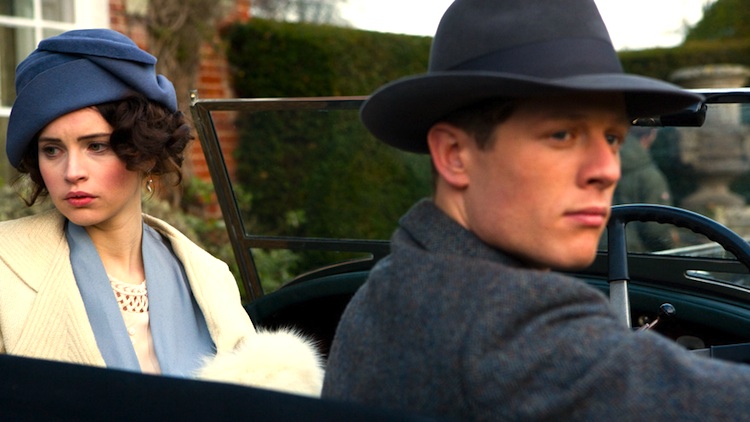
From "Cheerful Weather for the Wedding."

Still, Cheerful Weather offers a number of memorable moments, largely courtesy of its snappy supporting cast. Indeed, Mackenzie Crook and Fenella Woolgar steal scene after scene as the bickering Dakins, who largely reconcile through their shared distaste for his family. Julian Wadham also adds a humane touch to the film as the not-as-dumb-as-he-looks bumbling Uncle Bob, while Zoe Tapper brings considerable allure and even a bit of depth to Evelyn Graham, Thatcham’s fortune hunting maid of honor.

Unfortunately, Cheerful Weather’s weak romantically-doomed leads undermine the audience’s investment in the actual wedding. Looking rather dazed, even in the flashbacks, Felicity Jones’ turn as Thatcham is a pale shadow of Michelle Dockery’s Lady Mary Grantham. More baffling is the complete lack of screen presence displayed by Luke Treadaway as the morose Mr. Patten.

Frankly, it is hard to understand why Thatcham or Patten would pine for each other, but it is easy to see how this family would annoy the Dakins. Yet viewers can enjoy elements of the picture once they have shifted their sympathies accordingly. An okay but hardly exceptional period drama, Cheerful Weather seems best suited for PBS’s Masterpiece. For diehard Anglophiles, it screens again this Saturday (4/28) as this year’s Tribeca Film Festival enters its final weekend.

LFM GRADE: C+

Posted on April 27th, 2012 at 12:14am.

A UN-Inspired Catastrophe? LFM Revews Baseball in the Time of Cholera @ Tribeca 2012

By Joe Bendel. The United Nations has long acted like one of the four horsemen of the apocalypse; in the case of Haiti, it is literally pestilence. Allegedly thanks to the UN peacekeeping force, a deadly wave of cholera has swept the dysfunctional country. Viewers witness the epidemic from the vantage point of a young ball player in David Darg & Bryn Mooser’s short documentary, Baseball in the Time of Cholera, which screens as part of the Help Wanted programming block during the 2012 Tribeca Film Festival.

Joseph Alvyns and his friends should simply be spending an innocent summer on the baseball diamond. They play as often as they can, but it is impossible to ignore the post-hurricane chaos around them. Yet when Alvyns sees the devastation of the 3/11 hurricane and tsunami in Japan, he is compelled to reach out in a spirit of solidarity. His efforts attract international attention, even earning him a VIP trip to Toronto, courtesy of the Blue Jays. Unfortunately, when he returns cholera strikes at the heart of his family.

Technically, Darg and Mooser do not conclusively establish the Nepalese “peace-keepers” are the source of the cholera outbreak. Still, the sight of raw sewage spilling from their latrine into Haiti’s central river – coupled with the Heisman pose the Nepalese commander gives their camera man – constitutes a pretty convincing circumstantial case. The film also asks a legitimate question: why are there peace-keepers stationed in a country that has not been at war for centuries? However, they largely let the successive authoritarian and socialist governments off the hook for bringing the Haitian state to the brink of complete failure.

Time boasts some unusually big names behind the camera, including executive producers Olivia Wilde and Tesla Motors entrepreneur Elon Musk (one of three POV figures in Chris Paine’s Revenge of the Electric Car, which screened at last year’s Tribeca). To its credit, the film community has rallied to Haiti’s aide, yet there has not been a similar celebrity rush on behalf of Japanese recovery efforts. Therefore, it is worth taking the time to note that those wishing to follow Alvyns’ example can also donate to the Japan Society’s relief fund (details here).

For a short documentary, Baseball in the Time of Cholera nicely balances muckraking and heartrending tragedy. It should screen at Turtle Bay, but instead it will screen again in lower Manhattan this Friday (4/27) and Sunday (4/29) as the Tribeca Film Festival continues throughout the weekend.

Posted on April 26th, 2012 at 11:39pm.

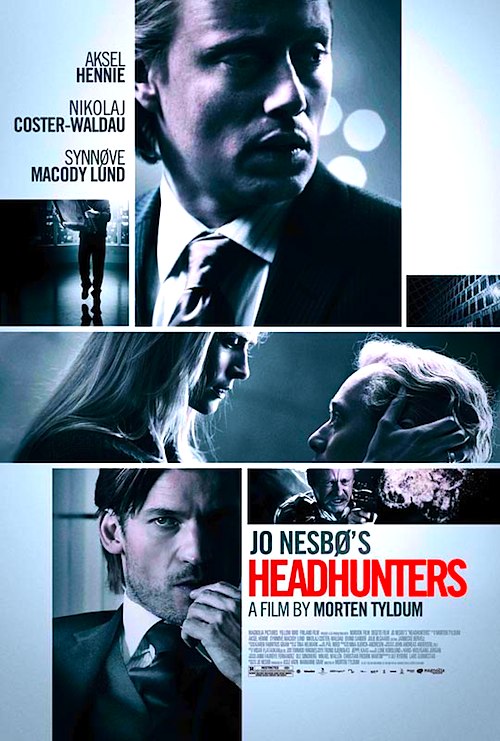
Blond Noir: LFM Reviews Headhunters

By Joe Bendel. Right now, Norway’s economy is a lot like our own. There are way more job-seekers than open positions to fill. At such times, if a recruiter sends you on an interview, you go, even though you might be leaving a few stray valuable objects d’art lying about your home unguarded. That is Roger Brown’s racket, but it turns unexpectedly deadly in Morten Tyldum’s Headhunters, which opens this Friday in New York and also screened yesterday as part of the San Francisco International Film Festival.

Brown is a man slight of stature, married to his bombshell wife, Diana. Suffering from a king-sized inferiority complex, he has allowed them to live beyond their means by burglarizing the homes of his executive search clients. With his house of cards on the brink of collapse, Brown’s prayers appear to be answered in the person of Claes Greve. Not only is the former tech CEO the perfect candidate for a plum position Brown must fill, he also owns a genuine Rubens painting of rather dodgy providence. Win-win, right?

However, when Brown starts to suspect the younger man and his wife are carrying on an affair behind his back, he sabotages Greve’s campaign for the position. At this point, Greve reacts more forcefully than Brown anticipates. Mouse, meet cat.

Headhunters is quite a nifty one-darned-thing-after-another thriller. Tyldum has a good handle on the material, constantly ratcheting-up the tension, but periodically using black comedy to release some steam. In his hands, the frequent twists are entertaining rather than forced or exhausting.

Tyldum also has a nice looking cast to focus on. Especially bankable is the presence of Game of Thrones alumnus Nikolaj Coster-Wladau, now world famous for playing Lena Headey’s brother (and other things), Ser Jaime Lannister, here perfectly cast as Greve. As Diana Brown, former model Synnøve Macody Lund certainly looks the part, but she also has some nice dramatic moments as well. In the lead, Aksell Hennie’s Brown holds the film together while coming to grief quite effectively.

Based on Norwegian mystery writer Jo Nesbø’s first book outside of his bread-and-butter series, Headhunters engages in some of the same far-fetched anti-corporate humbug undermining so many recent domestic crime dramas. However, Tyldum keeps the rollercoaster loop-de-looping at such breakneck speed, it is not so distracting. Definitely a dark but thoroughly enjoyable exercise in skullduggery, Headhunters is easily recommended and opens theatrically this Friday (4/27) in New York at the Landmark Sunshine.

Posted on April 26th, 2012 at 11:38pm.

Tribeca 2012: LFM Reviews Journey to Planet X

By Joe Bendel. If Ed Wood finally had an epiphany telling him to step up his technical game, imagine what he would have produced. That is sort of-kind-of the challenge two amateur filmmakers looking to go pro (or at least semi-pro) set for themselves. The production of their ambitious, new zero-budget science fiction short film is well documented in Myles Kane & Josh Koury’s Journey to Planet X, which screens during the 2012 Tribeca Film Festival.

Eric Swain and Troy Bernier are genuinely credentialed, buttoned-down scientists. Like many of their colleagues, they have always been attracted to science fiction. For years, Swain was essentially a hobbyist filmmaker, employing cheesy 1990’s technology.  An invitation to appear in one of Swain’s films led to a fast friendship and a close creative collaborative relationship between the two. However, cognizant of the advances in digital technology, Bernier is no longer content with their current level of professionalism. He convinces Swain that it’s time to produce a film that can compete on the film festival circuit.

Swain and Bernier (or Bernier and Swain) proceed to make that film, to the best of their abilities. The plot of Planet X (a.k.a. Planet X: The Frozen Moon, a.k.a. Planeta Desconocido, a.k.a. who knows what) remains rather baffling even after watching the co-directors shoot nearly every scene. However, they do seem to improve on a technical level, upgrading to HD and switching from an old blue screen to the more digital friendly green. They have a legitimate casting call and hire a small but professional crew. Whether they pull it off or not, they are really going for it, which is cool to witness.

Simply the notion of producing a feature length documentary about the behind the scene making of an upstart short film will sound odd to many people. Frankly, it also rather sporting of Tribeca to select Journey, considering both co-directors are co-founders of the Brooklyn Underground Film Festival and Bernier’s efforts courting South Florida’s Geek Film Festival factor prominently in the third act. Good for them, but they are missing out by not scheduling a special screening of Planet X (or whatever it’s called now) as well, because anyone who sees Journey will immediately want to watch Swain and Bernier’s film, on the big screen, in all its raging glory.

Kane and Koury (or Koury and Kane) capture a lot of drama in Journey, but it is the right kind of drama. The audience sees a lot of lunacy going down, but it never feels intrusive or voyeuristic. Ultimately, it is a film about two only slightly mad filmmakers’ friendship and their shared passion for sci-fi and movie-making. An endearing documentary, Journey is enthusiastically recommended for genre fans and those fascinated by the filmmaking process when it screens again this Saturday (4/28) as part of the 2012 Tribeca Film Festival.

LFM GRADE: A

Posted on April 24th, 2012 at 12:47pm.