Tribeca 2012: LFM Reviews El Gusto

By Joe Bendel. It is time to rock the Casbah, but the music will be Algerian Chaabi rather than British punk. A romantic and elegiac fusion of Arab-Berber and Andalusian musical forms, Chaabi was the popular music of Algiers’ coffeehouses, frowned upon by the classical elites. Of course, the average Algerians loved it, including both Jews and Muslims. Split apart by politics, one of the leading Chaabi orchestras of the 1940’s and ‘50’s reunites in Safinez Bousbia’s El Gusto, which screens during the 2012 Tribeca Film Festival.

Like an Algerian Duke Ellington, bandleader El Hadj M’Hamed El Anka established Chaabi as a music worthy of concert hall respectability, while never losing touch with his fans on the street. He led the top outfit, featuring both Muslim and Jewish musicians, reflecting the Casbah’s demographics. Unfortunately, following independence in 1962, the Jewish band-members found it advisable to seek refuge in France, as did nearly all Jewish Algerians. Surely the UN is still working overtime to protect their right of return, aren’t they? Yeah, just checking.

Frankly, Bousbia largely steers clear of politics – past, present, and future – which is a rather shrewd strategy. Instead, she concentrates on the Chaabi old-timers, who she plainly fell in love with, ever since she wandered into the antique (junk) store of Monsieur Ferkioui. After a few of his stories about the glory days with El Anka, she was hooked. Over a two year span, she tracked down the surviving members in Algeria and France, eventually producing their reunion concert in Marseilles. Needless to say, it was a hit, leading to subsequent dates, a CD supported by a full tour, and finally El Gusto, the documentary she has been filming the entire time.

It is a perfectly apt comparison, but let us try to get through this review without mentioning a certain Wim Wenders documentary about Cuban music. El Gusto is worthy of its own distinct identity. Frankly, by music doc standards it is unusually well made. In her arresting opening vistas, Bousbia dramatically illustrates the Casbah’s crumbling grandeur, resembling an ancient Rio overlooking the Mediterranean. She then takes us on a picturesque tour of the winding backalleys leading to Ferkioui’s shop. Suddenly it is easy to understand how Pépé le Moko could hope to get lost here.

When the musicians finally assemble, there is plenty of backslapping and some relatively amusing anecdotes. Without question though, the music is the main event. Perhaps not to the tastes of those raised on fast food music, the elegance, lyricism, and insinuating rhythms of El Gusto Orchestra’s Chaabi still ought to appeal to aesthetically mature listeners, even if they are not well versed in the musical traditions of the region.

Although Bousbia is a constant presence throughout the film, she has a knack for staying out of the way. As a result, some lovely sights and sounds are captured in her documentary. Recommended for world music listeners and students of Arab-North African culture, El Gusto screens this coming Monday (4/23), Tuesday (4/24), and Saturday (4/28) as the Tribeca Film Festival continues in venues across the city.

LFM GRADE: A-

Posted on April 21st, 2012 at 12:22pm.
Tribeca 2012: LFM Reviews Alekesam

By Joe Bendel. South African trumpeter Hugh Masekela survived Apartheid and drug addiction. Though the musician was often something of an absentee father, his son Selema more-or-less had to survive them too, by proxy. Their complicated musical father-and-son story is told in Jason Bergh’s short documentary Alekesam, which screens as part of the Triptych program at the 2012 Tribeca Film Festival.

Anyone who reads Masekela’s memoir Still Grazing might easily get the sense he remains nostalgic for his hard partying days. Regardless, according to his son (often known as “Sal”) his father could not have withstood much more substance abuse. Fortunately, Masekela got clean, with the help of lifelong friend and producer Stewart Levine, who is still close to both Masekelas.

Alekesam focuses somewhat more on the son, who grew up with an unreliable father. Yet, he was able to make his own way in the world, becoming a well known surfer and extreme sports commentator. Following his father’s recovery and reconciliation, the junior Masekela has also made his way back to music, as a vocalist. In fact, he has a smooth, appealing voice. Nonetheless, most fans will want to hear more of the senior Masekela’s invigorating yet easy-going trumpet work they know so well from his soulful records.

Bergh elicits some honest reflections from both Masekelas and gets several amusing soundbites from Levine, a natural raconteur. However, he seems to give short shrift to the younger Masekela’s mother, considering the critical role she played during his formative years. Frankly, Alekesam could have been much longer than its manageable thirty-four minutes, without risk of overstaying its welcome, which is ultimately quite a compliment.

It is nice to have a documentary end on a happy note for a change. Alekesam is a rather uplifting testament to the power of family and friendship—with good music, of course. Recommended for fans of Hugh Masekela’s jazz-pop-African fusion blend and Sal Masekela’s extreme sports set, Alekesam screens again as part of the Triptych shorts block tomorrow (4/21), Wednesday (4/25), and Sunday (4/29) during this year’s Tribeca Film Festival.

Posted on April 21st, 2012 at 12:04pm.

Tribeca 2012: LFM Reviews Side By Side

By Joe Bendel. Photochemical film is having its Buggles moment. It has been killed by digital video, but the death rattle is not quite over yet. While some holdouts still shoot the old school way, digital has steadily become the norm. The aesthetic and economic implications of this sea change in motion picture production are explored in Chris Kenneally’s Side By Side, which screens during this year’s Tribeca Film Festival.

If you think Martin Scorsese might have something to say about this moment in cinema history, you would be correct. He is one of small army of directors and cinematographers interviewed by co-producer and on-screen host Keanu Reeves. While Scorsese has mixed emotions, George Lucas is all in for digital, while Christopher Nolan stubbornly clings to his photochemical film. To oversimplify the debate, digital is cheaper and more easily manipulated, whereas film has more dynamic character, in much the same way vinyl favorably compares to digital music.

Side By Side gives a brisk and lucid overview of the development of digital technology and its rise from the domain of slacker indies to 3D tent-poles. Most of the interview subjects are exactly the sort of experts one would want to hear from, including David Lynch, Lars von Trier, Danny Boyle (whose Oscar-winning Slumdog Millionaire was a digital watershed), and both Wachowskis, as well as top flight cinematographers such as Vilmos Zsigmond and Vittorio Storaro.

However, it is impossible to ignore the snickering that erupts whenever a filmmaking giant prefaces an answer with: “Well Keanu, I’ll tell you. . .” Poor Reeves. He actually seems like an okay guy when he explains some of the Matrix effects to a young extra on the set of his upcoming 47 Ronin. He just has a certain presence and persona at odds with his on-screen role here.

Kenneally, Reaves, and company demystify a lot of the technical process, without losing sight of cinema as a form of (hopefully) artistic storytelling. As one would expect, every point is generously illustrated with clips from classic films. Some traditionalists might regret a more spirited defense was not mounted on behalf of photochemical film. Still, as it stands, Side By Side is an informative and rather entertaining look at the state of movie-making, considerably superior to the recent National Film Registry documentary, These Amazing Shadows. Recommended for those who enjoy movies about movies, Side By Side screens this coming Tuesday (4/24), Thursday (4/26), Friday (4/27), and Saturday (4/28) as part of the 2012 Tribeca Film Festival now running in New York.

LFM GRADE: B

Posted on April 20th, 2012 at 4:10pm.

Tribeca 2012: LFM Reviews Death of a Superhero

By Joe Bendel. Drawing evil vixens and costumed crime-fighters usually is not the best way of winning over high school girls. Unfortunately, Donald Clarke does not have long to figure that out. He is dying of leukemia, but has a few obvious teenager goals he would like to accomplish first in Ian Fitzgibbon’s Death of a Superhero, which screens at the 2012 Tribeca Film Festival.

Clarke is an understandably angry young man. If he was not socially awkward before, his bald head leads him to retreat further into himself. His only satisfaction comes from his comic art and his escalating graffiti escapades. Hoping to improve his state of mind, his well meaning parents take him to Dr. Adrian King, an art therapist who specializes in helping terminally ill patients come to terms with their mortality. Shrewdly, King does not try too hard to win Clarke’s confidence, thereby establishing a level of comfort between them. About the same time, Clarke meets a rather cute and rebellious transfer student he might actually stand a chance with, if he is not distracted by stupid high school pettiness.

Periodically, interludes of Heavy Metal-style animation provide a glimpse inside Clarke’s head, depicting his alter-ego battling The Glove, a Doctor Doom-like villain symbolizing his illness, and enduring the torments of the shapely Nurse Worsey, who embodies all his pent-up angst. Frankly, they are cool enough to give Superhero a genre appeal such material would not ordinarily hold. However, the third act may seem familiar to some viewers, following almost precisely the same narrative path as Ian Barnes’ Oscar nominated 2009 short film Wish 143. Since Anthony McCarten adapted Superhero from his own 2006 novel, you can assume whatever you will.

Thomas Brodie-Sangster is convincingly bitter and troubled as Clarke, but he has some nice chemistry with Aisling Loftus as his potential girlfriend. Taking a break from the motion-capture suits, Andy Serkis also demonstrates wise restraint as Dr. King, making this movie shrink exponentially easier to take than Robin Williams in Good Will Hunting.

It is hard to imagine a dying teenager film that refrains from heart-tugging manipulation, and Superhero is certainly no exception. Yet the retro noir animation gives it a real edge. That unique look and several well tempered performances help earn its inevitable big emotional crescendo. Surprisingly effective, Death of a Superhero screens during the 2012 Tribeca Film Festival next Friday (4/27), Saturday (4/28), and Sunday (4/29), with a regular theatrical release soon to follow.

LFM GRADE: B+

Posted on April 20th, 2012 at 3:56pm.

Humanism vs. Authoritarianism in Education: LFM Reviews Monsieur Lazhar

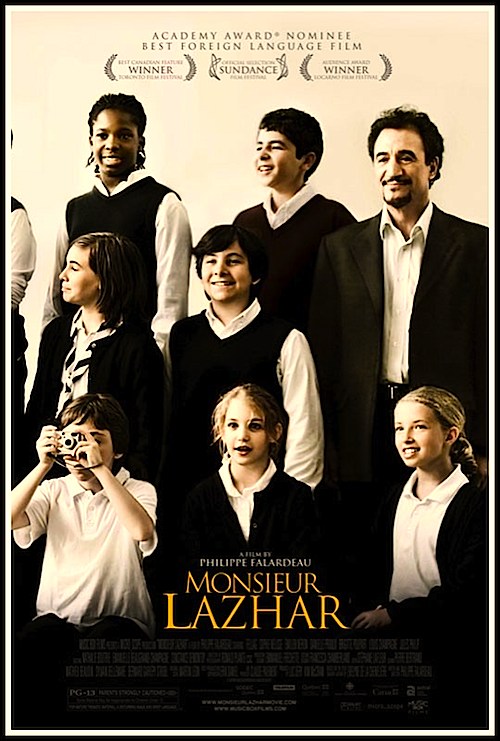
By Patricia Ducey. Oh, Canada! Every so often, out from beneath the ice and snow of our northern neighbor, emerges a film so en pointe that it seems intended for an American audience. Like The Barbarian Invasions, another French Canadian offering, with its stinging comparison of Canada’s health system to ours, Monsieur Lazhar takes on education — and the well meaning but destructive political correctness that apparently stultifies both our systems. But beyond the concerns of the day, Monsieur Lazhar resonates in the tradition of school teacher movies from The Children’s Hour to Stand and Deliver, embracing the light and dark tones of both – and is totally affecting, earning its many Canadian awards and nomination for the Academy’s Best Foreign Film Oscar.

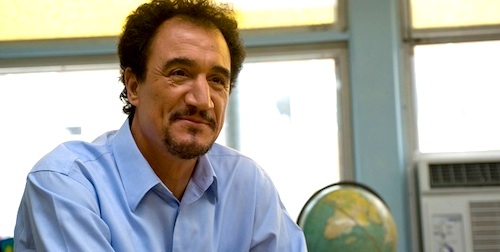
Algerian-born comedian and humorist Mohamed Fellag stars as Bachir Lazhar, the substitute teacher in a Montreal grade school class that recently lost its beloved teacher Martine through suicide, a death seen as even more horrific because she hanged herself in the classroom where she knew the children would find her. The story opens as Lazhar, an asylum seeker from Algeria, interviews for a substitute teacher position with the school’s principal, Mme. Vaillancourt (Danielle Proulx). He has read about the teacher’s death in the paper and presents his CV to the harried principal.

She soon hires him and he begins his work with the bereaved class. First off, he is mystified by the classroom setup, where all the desks form little semi-circles to enhance the team approach to learning (to avoid any child being shamed by giving a wrong answer). He orders the desks rearranged in orderly rows. Each child is now an individual again, on his or her own – which awkward use of the personal pronoun brings me to Lazhar’s next problem. In a grammar lesson the children school him on the “new” system of pronouns they must use – pure edu-babble – to what end, he cannot fathom but he accedes. The school psychologist arrives, and chides him to leave the handling of grief that bubbles up unbidden from the children to her, as if this human and empathetic activity could not possibly be managed by a non-professional. Finally, a boy acts up in class, and Lazhar cuffs him lightly on the cheek. This is the straw that breaks the camel’s back, and the principal brings him in for a meeting, where she informs him of modern educational rules – among them, no touching of a child, ever — not even to put sunscreen on a child, as the gym teacher recounts.

But Bachir’s students thrive in the new, structured environment. More importantly, they trust the empathy that comes from his heart and from his experience. The adults, who are “freaking out” more than the kids, apply and misapply silly nostrums that ultimately make the kids feel worse. But his story and the kids’ grief are connected, and we learn more about the troubled boy Simon and his connection to the tragic Martine, and of Bachir and the reason that he is alone in Montreal. Suffice it to say that he and his family fell victim to another system that repressed and forbade certain kinds of speech and carried that diktat to calamitous ends. He knows all too well what lies at the end of this utopian vision, and eventually he must decide where he will draw the line. As they come together, both stories echo the themes of the movie, both personal and political.

Philippe Falardeau, who won the Canadian best director for this film – and deservedly so – suppresses any tendency towards cuteness or sentimentality, with a totally naturalistic look and feel of a wintry Montreal. His actors do not appear fussed over by stylists or makeup staff, and they seem to live and work in cluttered, lived in spaces. In addition, he wisely pulls back the dialogue and direction when histrionics or sappiness would have been easy, yet this subtle and understated style makes the eventual impact even more transcendent.

Mohamed Fellag as Bachir Lazhar.

Fellag is endearing, sometimes humorous, and conveys much emotion with the lift of an eyebrow. Sophie Nélisse as Alice and Émilien Néron as Simon, the children who discover the teacher’s body, rise to equal footing with Fellag and the other adults with performances so artful and natural that Falardeau and his young actors must be commended. (Here Falardeau talks with critic Dan Persons about the film, and gives what amounts to a master class in directing children. Hollywood directors, take a listen.)

The film does indeed honor the power of the student-teacher relationship, its power to heal and to inspire, but it also calls into question the folly of the authoritarian impulse that undergirds so much of education today. In the end, Bachir stands for humanism and, paradoxically perhaps, order. They hinge one upon the other – he knows that one child is not interchangeable with another, and that each child flourishes best in an atmosphere of basic order paired with open, honest communication. The movie ends fittingly with Bachir’s final act of defiance against the regime — a small act, but one perfectly in keeping with his larger lesson to the kids that “a classroom is a place of friendship, of work, of courtesy, a place of life.”

Posted on April 17th, 2012 at 3:19pm.

Conscripted by The Soviets, Nazis & Imperial Japanese: LFM Reviews My Way

By Joe Bendel. Kim Jun-shik could have been an Olympic champion marathoner, but the milestones defining his life involve involuntary military service. Impressed into the Imperial Japanese, Soviet, and National Socialist armies, Kim’s journey ultimately brought him to Omaha Beach on D-Day. It is an epic story (rather loosely based historical fact), told with appropriate grit and grandeur in Kang Je-kyu’s My Way (trailer above), which opens this Friday in New York.

Kim could always run fast, and from a young age his fate will be intertwined with that of Tatsuo Hasegawa. The grandson of a high-ranking Japanese officer, Hasegawa quickly becomes Kim’s primary competition on the track. Not surprisingly, the Japanese authorities put the fix in for Hasegawa at the Olympic trials, precipitating a full scale riot among outraged Korean spectators. Forced into the Japanese military as punishment, Kim eventually finds himself serving under Hasegawa, a harsh martinet in the tradition of his grandfather.

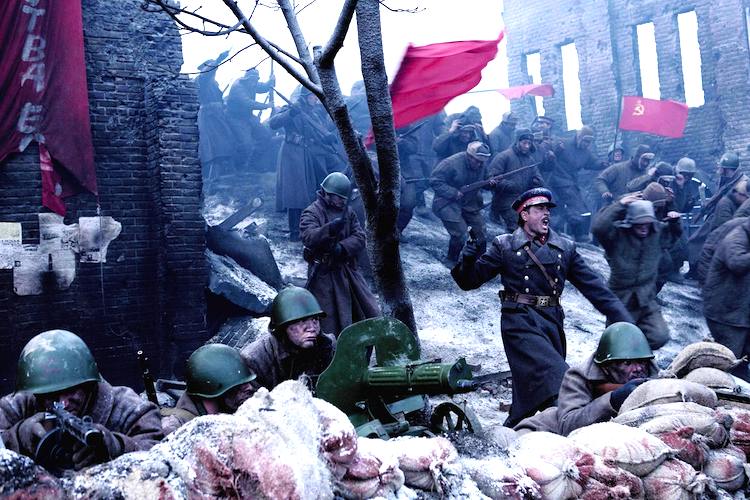
Needless to say, the campaign in Mongolia does not go well. Leading his men into a crushing defeat, Hasegawa is captured, along with Kim and several fellow Korean conscripts. Conditions in the Soviet labor camp are unbearably brutal, except for Kim’s friend Jong-dae, who becomes the Communist enforcer amongst the prisoners. Not unexpectedly, he reserves the harshest mistreatment for the Japanese, particularly Hasegawa, which troubles Kim despite their checkered history. When the war temporarily turns against the Soviets, the prisoners are given a grimly illegal choice: summary execution or service on the Eastern Front. Both are essentially death sentences.

From the new World War II epic, "My Way."

Somehow surviving the ensuing carnage, Kim and Hasegawa head west, ready to declare themselves Japanese POWs when they encounter the Germans. Ironically, the conditions of service under the Nazis appear relatively mild compared to their stints with the Soviets and militarist Japanese, at least for a while. However, there are eerie (if unsubtle) parallels between all three militaries that clearly demonstrate the underlying similarities of oppressive regimes.

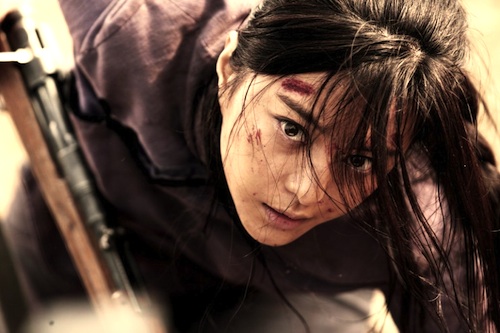
Like a cross between Saving Private Ryan and Chariots of Fire, My Way is a sprawling chronicle of sport, combat, and statist regimes that employs its flashback structure quite adroitly. There are a number of spectacularly rendered large scale battle scenes (in which it definitely helps to be swift of foot), but the film still packs a real emotional punch, particularly when depicting Kim’s brief relationship with Shirai, a captured Chinese sniper out to avenge her family.

Fan Bingbing as Shirai.

One of the world’s most beautiful women, Fan Bingbing is absolutely heartbreaking as Shirai. Yet, it is Jang Dong-gun and Joe Odagiri who really carry the weight of the picture, as Kim and Hasegawa, respectively. They convincingly portray the two soldiers’ evolution from bitter enemies to stateless brothers-in-arms. On paper, much of their narrative would sound forced, but they make it work on-screen every step of the way.

Audiences should look past the oddly nondescript title, because it is hard to imagine there will be a better war film this year than My Way. Considerably superior to The Front Line, it is a cinematic saga worthy of the 70mm Cinemascope era. Highly recommended, it opens this Friday (4/20) in New York at the AMC Empire, the Beekman Theatre, and the Village East.

Posted on April 16th, 2012 at 3:09pm.