Brad Bird’s fabulous re-launching of the Mission: Impossible series, Ghost Protocol, comes out on Blu-ray/DVD tomorrow. Hopefully some of you got the chance to see that in an IMAX theater – it was quite spectacular. Feel free to order Ghost Protocol below through the LFM Store.
In related spy news, this fall brings the release of Bond 50, the new Blu-ray set commemorating the 50th anniversary of the James Bond film series – which launched in 1962 with the release of Dr. No. This new Bond 50 set (see the trailer above) features all 22 James Bond films on Blu-ray disc in one set for the first time, including nine 007 films never before available on Blu-ray: The Spy Who Loved Me, You Only Live Twice, Diamonds are Forever, On Her Majesty’s Secret Service, A View to a Kill, Octopussy, The Living Daylights, Goldeneye and Tomorrow Never Dies. Needless to say, the Sean Connery and Roger Moore films will be the best.
The set also includes more than 130 hours of bonus features – so it should be quite comprehensive. You can pre-order the set above.
By Joe Bendel. The Communists loved their paperwork and with good reason. It was one of their most effective tools for controlling people. Yet, Vacek’s mother seems to have a talent for it, navigating the red tape required for immigration while writing four scores of undeliverable missives to his defector father in Václav Kadrnka’s Eighty Letters, which appropriately screens at Bohemia National Hall as part Disappearing Act IV, the annual showcase of films unjustly overlooked after their well received festival runs, co-presented by the Czech Center.
Alarmed to find himself home alone one morning, Vanek catches up with his mother at the tram stop, essentially forcing her to take him with her on her mysterious errands. They do not talk much during the day, but they are not visiting places conducive to conversation. Confused and a bit withdrawn, Vanek whiles away the time in series doctor’s waiting rooms and government lobbies. It is not until we hear his mother’s voiceover composing another letter to his father that we appreciate how close she is to completing the deliberately arduous application process. Of course, that begs the question: then what?
Eighty is a film that refuses to look the audience in the eyes, which might be understandably off-putting for some viewers. Indeed, we watch most of Kadrnka’s pseudo-autobiographical story from sidewalk level, but there is a reason for that. The last time I was in Prague I asked my Czech friends why everyone identified me as an American before I ever spoke a word of awful Czech. My nondescript wardrobe was hardly a giveaway. They said it was because of the way I held my head up when I walked. Seeing this film helps explain that answer.
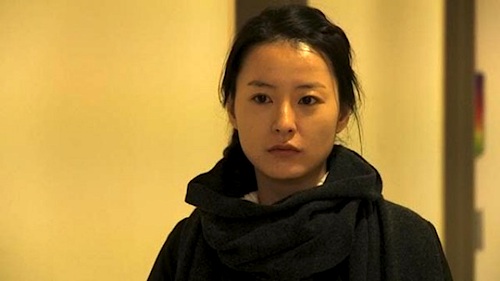
From "Eighty Letters."
Unfolding from Vanek’s POV, Eighty is a quiet film with quite a bit of running through the streets of Prague. It could almost be considered The Red Balloon’s Kafkaesque cousin. Unfortunately, Zuzana Lapcikova and Martin Pavlus are strangely cold screen presences. However, they certainly look and feel convincing as mother and son.
Kadrnka masterfully sets the mood and frames his shots. Despite the emotional aloofness of the cast, it is an interesting film to watch purely for its craftsmanship. It is certainly worth a look, particularly this Sunday (4/15) when it screens free at BNH as Disappearing Act IV continues in New York. It is also a great opportunity to catch up with Jaak Kilmi and Kiur Aarma’s wonderfully sly and illuminating documentary Disco and Atomic War (see here and here), which also screens for free on Sunday, right before Eighty Letters.
By Joe Bendel. They say one should write about what you know. Hong Sang-soo knows about film school, or at least his characters do. Their lives and films freely blur and overlap in his sort of but not really braided-story film, Oki’s Movie, which opens this Monday at the Maysles Cinema as something of a ringer in their Documentary in Bloom film series.
Oki’s Movie is actually four short films featuring the same cast of characters or characters based on them. When we first meet Jingu in A Day for Incantation, he is a young film school instructor with a handful of less than enthusiastically received short films to his record. After psyching himself up to face a new day, he gets far too drunk at a faculty lunch, offending the department chairman, Professor Song, before leaving for a disastrous screening of one of his shorts. As King of Kisses opens, it would appear Incantation is Jingu’s thesis project, which Professor Song praises effusively. In fact, Jingu seems to be one of his favorites, but the student is more interested in wooing Oki, oblivious to her clearly implied relationship with Song.
In the sketchiest segment, After the Snowstorm, Song questions his academic career when only Oki and Jingu brave a snowstorm for his class. For their efforts, he entertains their meaning-of-life questions, answering with canned profundities. However, Oki’s Movie rebounds with the concluding title segment, in which Oki compares and contrasts two trips she took to Acha Mountain, first with Song and then with Jingu. Demonstrating a fascination with repeated cycles, Oki’s Movie, the sub-film, nicely leads into Hong’s The Day He Arrives, which as luck would have it opens next Friday in New York.
Jung Yumi in "Oki's Movie."
Instinctively, viewers will want to impose a sequential order on Oki’s Movie, presumably beginning with the characters in their present day, followed by three successive flashbacks. However, Hong deliberately problematizes such linearity by consciously presenting the opening and closing segments as films-within-films (emphasized with their separate but identical credit sequences), with Oki apparently appearing as an actress in Jingu’s A Day for Incantation.
Despite his narrative puzzle-making, Hong is often compared to Woody Allen and it is easy to see why throughout drily witty Oki’s Movie. While his three major characters all rather self-centered and neurotic, he never judges them too harshly. Indeed, there are even moments of biting self-awareness, particularly from Oki, but also to a lesser extent from Song, rendered as an almost tragic figure in Oki’s short. By American standards, it is also a bit politically incorrect, deriving gleeful humor from the outrageous things said as a result of inebriation. While Hong never moralizes, he certainly shows the repercussions of over-indulgence.
Indeed, Hong is a master at depicting incidents of social awkwardness and the human foibles that magnify them. Lee Sun-kyun is quite the convincing blindered sad sack, but manages to keep Jingu relatively grounded. In contrast, Jung Yumi is a consistently intelligent and intriguing screen presence as Oki, the reluctant femme fatale.
In a sense, Hong represents the road too often not taken by postmodernists. Like his thematically related short Lost in the Mountains and his forthcoming The Day He Arrives, Oki is light and droll rather than dour and didactic. Even with its eccentric structure, it is a highly accessible film suitable for viewers who usually confine their international cinema patronage to relationship comedies in the French tradition. Solidly entertaining, Oki’s Movie is definitely worth a trip uptown when it screens Monday (4/16) through Sunday (4/22) at the Maysles Cinema.
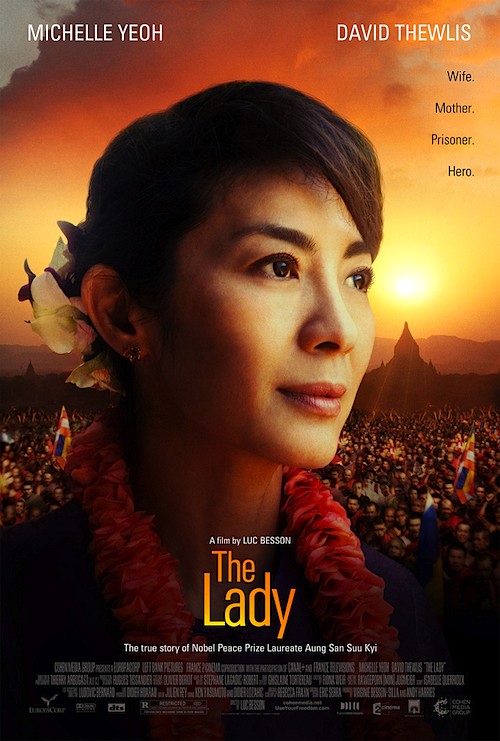
By Joe Bendel. Nobel Peace Laureate Aung San Suu Kyi’s recent parliamentary election sounds like a breakthrough for a free and democratic Burma. However, it is important to remember past promises of liberalization have evaporated into fresh repression time and time again. Suu Kyi has witnessed those periodic crackdowns from a distinctly personal vantage point, becoming the international face of the Burmese opposition, at tremendous personal cost. Her courageous activism and sacrifices are stirringly dramatized in Luc Besson’s The Lady, which opens tomorrow in New York.
Suu Kyi’s father, General Aung San, was the hero of Burma’s drive for independence. A committed nationalist, he was assassinated by allies-turned-rivals when Suu Kyi was just a child. As the daughter of the revered General, Suu Kyi would be seen as a natural leader for the developing Burmese democracy movement.
In the late 1970’s and early 1980’s, Suu Kyi lived a quiet but pleasant life as an Oxford academic with her husband, Dr. Michael Aris, a specialist in Himalayan culture. Returning to comfort her ailing mother, Suu Kyi agreed to lend her prestige to the opposition on the eve of the 8.8.88 uprising. It began a period of activism defined by her fifteen non-consecutive years spent under solitary house arrest.
The Lady directly conveys the lonely reality of her imprisonment, as well as the heartbreaking tragedy. Denying her husband and sons entry visas, the military government forced Suu Kyi to choose between her family and her country. As a result, she would never have the chance to tend to Dr. Aris during his fatal bout with cancer.
Though obviously partly intended as an advocacy film on behalf of Suu Kyi’s democratic coalition, The Lady is most effective as a thinking person’s romance. It is clear Aris and Suu Kyi’s relationship was one of the world’s great love stories. Indeed, it was a perceived weakness the military regime unsuccessfully sought to exploit.
Former Miss Malaysia and legendary HK action star Michelle Yeoh delivers a career performance as Suu Kyi. Still one of the greatest movie-star beauties of all time, she radiates warmth and dignity throughout the film. Yet she is not engaging in an overrated, Meryl Streep-like screen caricature (that Streep took home the Oscar while Yeoh was not even nominated was an injustice of cosmic proportions). This is a passionate, flesh-and-blood woman, who suffers acutely in the absence of her beloved husband and sons.
Likewise, David Thewliss transforms himself into the earnest Tibetologist, developing some achingly touching chemistry with Yeoh. Despite her vastly more elegant appearance, viewers really will believe they are a devoted couple. He is also devastatingly convincing when portraying Aris’s declining health. Benedict Wong (recognizable from the original State of Play) also provides a nice assist as Karma Phuntsho, Aris’s former student and close spiritual advisor.
Granted, The Lady is not exactly perfect. Rebecca Frayn’s screenplay only does a so-so job of establishing the political and historical context of Suu Kyi’s struggle, and Besson’s depiction of the ruling military elite occasional veers towards the cartoony. However, anyone can understand Yeoh and Thewliss’s performances and even the most jaded will find themselves getting choked-up (in spite of themselves) during the third act.
According to reports, the film has been banned by the Chinese Communist authorities, so what more fitting endorsement could one ask for? An unequivocally pro-democracy film and a truly heartfelt love story, The Lady is sincerely recommended for the on-screen work of Yeoh and for the real life work of Suu Kyi when it opens tomorrow (4/11) in New York at the AMC Loews Lincoln Square and the Regal Union Square.
By Joe Bendel. Nursing homes are a booming business in Hong Kong, yet you still hear seniors referred to as “uncles” and “aunties.” The terms “sir” and “ma’am” just are not the same—and those are heard less and less often even here. Social and generational change might be sweeping Hong Kong (and the Mainland), but one dutiful film producer still tends to his family’s ailing servant in Ann Hui’s A Simple Life, which opens this Friday in New York and San Francisco.
Chung Chun To, preferably known as Ah To, has worked for the Leung family since the Japanese Occupation. She is content to serve Roger, her favorite of the Leung children and the only one remaining in Hong Kong. It is a quiet, uneventful life for them both, when he is not traveling to the Mainland to negotiate deals. Returning late one night he finds Ah To collapsed after a stroke. Suddenly, it will be Leung taking care of Ah To.
There are no melodramatics in Hui’s refreshingly down-to-earth and true-to-life film. Leung is a cold fish, but he requires no clichéd awakening of his conscience, immediately understanding he will have to step up to the plate for Ah To. Yet there are plenty of awkward moments and difficult choices in store for him, such as the nursing home he places her in. Again, it is not great, but it is not a standard movie horror show. Rather, it is much like the average facility one might reluctantly accept anywhere in Hong Kong or America (and at least it is overseen by the attractive Nurse Choi, played by the up-and-coming Qin Hailu, scratching something out of the seemingly thankless role).
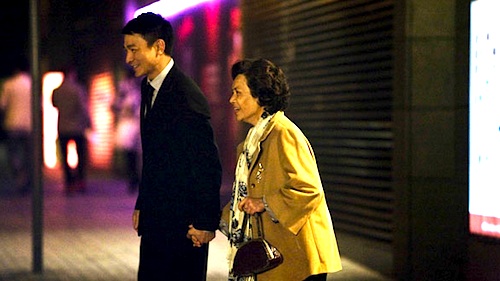
Andy Lau and Deanie Ip in "A Simple Life."
Instead, A Simple Life works quietly, depicting the role reversal with patience and honesty. Superstar Andy Lau’s work as Leung is remarkably assured and restrained. In a way, Deanie Ip has it easier, because she has room to “act” when portraying Ah To’s slow physical decline, but again she scrupulously maintains her dignified reserve.
Despite the serious subject matter, A Simple Life will also interest fans of Asian genre cinema, featuring many big name stars in cameo roles. In an extended sequence, Sammo Hung and Tsui Hark play themselves, hashing out a production budget with Leung. Anthony Wong also appears in a small supporting role, getting perhaps five minutes of screen time, but it is a cool five minutes.
Reportedly based co-producer-co-writer Roger Lee’s real life family retainer, A Simple Life is like a tear-jerker with too much self-respect to jerk tears. That is exactly why the payoff hits home so hard. Officially submitted by Hong Kong as its recent best foreign language Oscar contender, it might well have caught on with the Academy in a less competitive year. (Unfortunately, those are the breaks.) Happily, audiences can catch up with it now. Highly accessible, it is definitely recommended for mainstream audiences when it opens this Friday (4/13) in New York at the AMC Empire and in San Francisco at the AMC Metreon, courtesy of China Lion Entertainment.
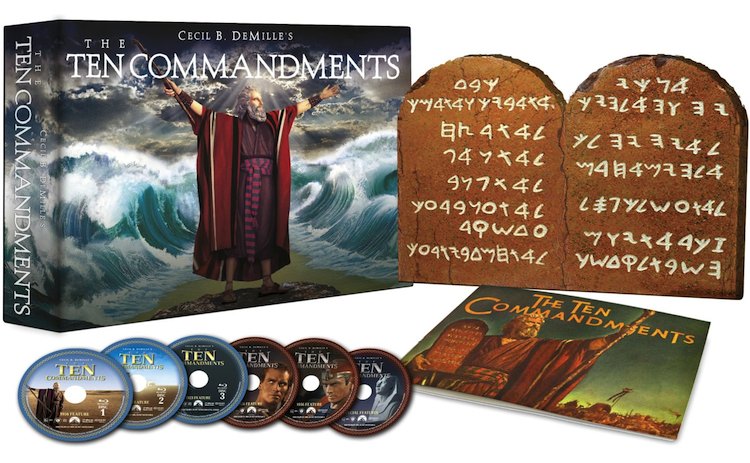
By Jason Apuzzo. The new Ten Commandments Blu-ray comes out this Tuesday, March 29th (see the trailer for the Blu-ray at the bottom of this post). Paramount will be releasing a 2-disc Blu-ray set of the classic film, and also a Limited Edition 6-disc DVD/Blu-ray Combo set, that features both Cecil B. DeMille’s 1956 and 1923 versions of the film – and a host of goodies, including a handsome archival booklet that may be worth the price of the set on its own.
The Ten Commandments is a special favorite of mine. Not only is the film one of Hollywood’s greatest epics of the 1950s, the film is also a timeless and enduring ode to human freedom – and one which seems to grow only more timely and urgent as the years go by. The Ten Commandments is a film that will always remain powerful and ‘relevant’ so long as there are souls yearning for freedom – even, as we’ve seen recently, in contemporary Egypt and North Africa where so much of The Ten Commandments was filmed.
We had the pleasure of showing what was then the best existing print of The Ten Commandments at our first Liberty Film Festival in 2004, when we invited cast member Lisa Mitchell to talk about her recollections of Mr. DeMille – and how influential he was in her life. Several years later Govindini and I spent time with Cecilia DeMille Presley, granddaughter of Cecil DeMille and a caretaker of his legacy – who shared some wonderful memories of her grandfather with us. Most special, however, was the opportunity Govindini and I had years ago to meet Charlton Heston himself at The Egyptian Theatre in Hollywood, when he introduced a special screening of The Ten Commandments. (We actually sat right behind him during the screening – and watched his reactions to the film, which he still seemed to take great delight in so many years later.) It was an extraordinary thrill to meet him; even late in life, he was still handsome and rugged, with a biting wit – but also a warm and generous spirit. He was the consummate gentleman.
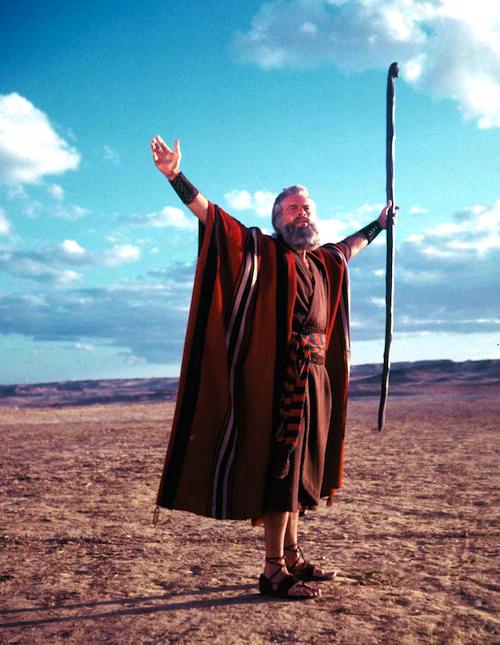
Charlton Heston in "The Ten Commandments."
The Ten Commandments is without a doubt one of the best films Hollywood has ever produced, and a carrier of important ideas about freedom, so I thought we’d take a little look back at it today. It also happens to be a magnificent showpiece for the Blu-ray medium – with the film’s rich, saturated colors, beautiful costumes and production design, endless desert vistas, and iconic visual effects sequences. To put it mildly, The Ten Commandments is not only an emotional spectacle of the heart … it’s also an eyeful.
Interestingly,The Ten Commandments happens to be the fifth highest-grossing film of all time, adjusted for inflation. When the film was released in 1956, theater tickets cost about 50 cents – and the film still grossed over $65 million. What this means is that at today’s ticket prices, The Ten Commandments would have grossed over $1 billion at the domestic box office. In the history of American moviemaking, only Gone With the Wind, Star Wars, The Sound of Music and E.T. have fared better at the box office than did DeMille’s extraordinary film.
I don’t mention The Ten Commandments‘ box office success because that denotes anything in particular about the film’s merits – success at the box office can always be misleading – but to suggest the kind of powerful bond this film has with the public. The Ten Commandments is, as it turns out, a beautifully written, directed, acted, photographed and scored film – a majestic and emotional voyage into one of the primary myths of Western religious life. It’s also the crowning achievement of one of America’s greatest moviemakers. At the same time, The Ten Commandments is something else: it’s a part of American popular mythology, as important to America’s filmic conversation about freedom and individual dignity as Casablanca, Gone With the Wind or On the Waterfront. Continue reading For Easter & Passover: A Review of The Ten Commandments on Blu-ray