Parka Dude Attacks! LFM Reviews ATM

By Joe Bendel. Brace yourself for Parka Dude. The latest would-be horror movie franchise figure is so bland and boring he does not even have a name or a face. However, he will thoroughly terrorize three young corporate drones stranded inside a stand-alone automated teller in David Brooks’ ATM , which opens tomorrow in New York at the IFC Center.

David Hargrove always feels like a pathetic loser at his firm’s annual Christmas party, because he never can work up the courage to talk to his big time crush Emily Brandt. Yet, since this is Brandt’s final day with the company (and perhaps on Earth in general), his loud mouth buddy Corey Thompson successfully goads him into making one last try. However, just when Brandt agrees to let Hargrove drive her home, Thompson decides to play third wheel, insisting they drop him off too, but first stop for a slice of pizza. Of course, he has to hit a cash machine on the way, potentially signing their death warrant in the process.
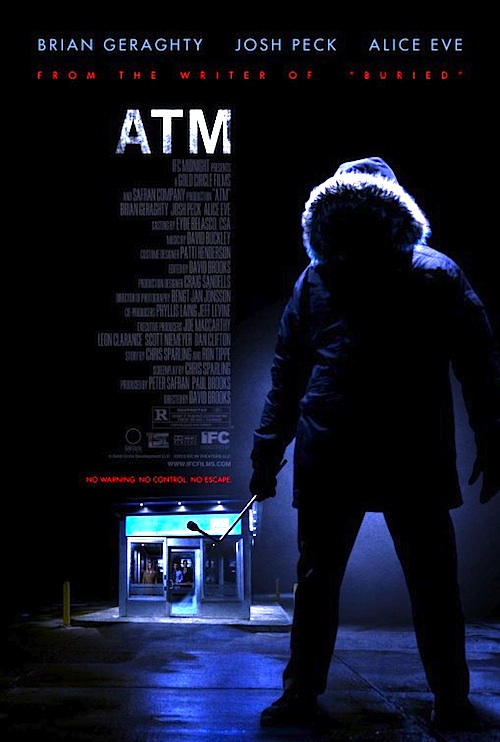
Some large cat in a hooded parka evidently has a thing about terrorizing people in remote ATM islands. He has all the blueprints for the fateful kiosk Thompson chooses, but he does not have a bank card to get inside. Thus begins a game of cat and mouse, as Parka Dude lays siege to the ATM.

Naturally, everyone’s cell phone is either out of juice or out of reach. Still, that’s more or less an acceptable horror movie convention. How sad is it, though, that three able-bodied grown-ups cannot rush one faceless dude with a hooded coat and a tire iron? Instead, they stand around in said ATM, letting hunger and the freezing temperatures do Parka Dude’s work for him.

The most irritating thing about ATM is that is does not bother to give us the smallest pretense of resolution. Instead, after a climax involving a ludicrously contrived set of circumstances, we are assured Parka Dude is out there planning his next industrial park ATM outing. Maddeningly, screenwriter Chris Sparling gives viewers absolutely no reward for sitting through this exercise in stupid stalking, except the promise of more of the same to come.

As Brandt, Alice Eve nicely turns the film’s one well written scene. Before the entire mess comes crashing down, she attempts to alleviate Hargrove’s guilt over getting her into this fix. Rather philosophically, she argues it was a myriad of decisions she made over the course of years that led her to be in that ATM on that night. It might be a valid point, but viewers will not be pinning the responsibility on Hargrove. We blame Thompson, just for being such an annoying jerkheel.

This is the kind of film that makes an audience audibly groan in frustration. However, it does not have enough character to at least be campy. In fact, both the lead protagonist and his malevolent nemesis are irredeemably generic. Completely unsatisfying, ATM should definitely be skipped when it opens tomorrow (4/6) in New York at the IFC Center.

LFM GRADE: D-

Posted on April 6th, 2012 at 2:35pm.

Alien Warfare! New Clips from Battleship and Falling Skies, Plus a New Image from Halo 4

Cortana and Master Chief in "Halo 4."

For those of you following Earth’s seemingly endless conflicts with alien invaders, a new clip of Battleship just went online featuring alien ‘shredders’ attacking a Marine base (see above), plus there are some new promos out for the next season of TNT’s Falling Skies (including the first 3 1/2 minutes of the Season premiere). Battleship opens May 18th (Men in Black 3D opens a week later, btw), while Falling Skies Season 2 debuts June 17th.

There’s also a new image out today of Master Chief and Cortana from the forthcoming Halo 4. Cortana’s certainly looking sexier than ever.

For the real die-hards, you can also check out the new production blog for Ender’s Game.

Posted on April 6th, 2012 at 2:34pm.

At Last: LFM Reviews Stony Island

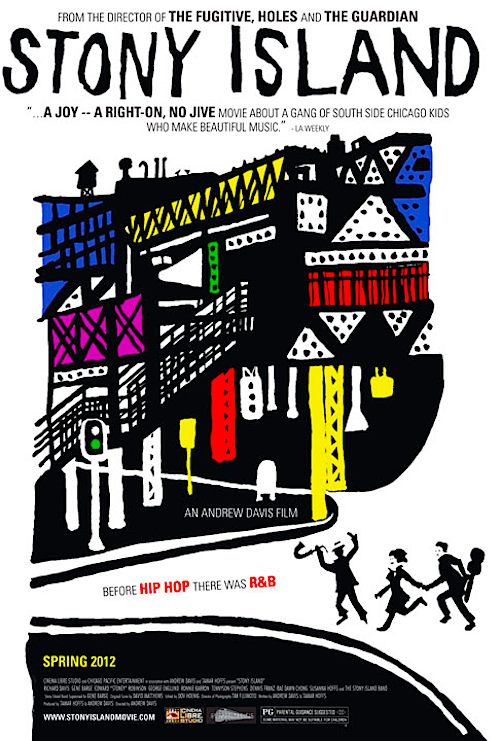
By Joe Bendel. Some things never change. In the late 1970’s, Chicago was home to musicians who played the blues and crooked politicians who gave them, just as it is now. For his feature directorial debut, future Fugitive helmer Andrew Davis captured the vibe of his hometown in the hip musical drama Stony Island (a.k.a. My Main Man from Stony Island). Despite the talent involved in the production, it has been nearly unseen for decades, known mostly to diehard record collectors familiar with the smoking hot soundtrack LP. Happily, this will soon change. Stony Island screens this Wednesday and Thursday at Chicago’s Gene Siskel Film Center, in advance of it April 24th DVD release from Cinema Libre.

Guileless guitarist Richie Bloom has come to Chicago with a dream. He wants to start a band, so he does with the help of his vocalist Stony Island neighbor Edward “Stoney” Robinson and Percy Price, a beloved tenor sax veteran of the Chicago music scene. Slowly, they piece together a grooving big-funk band, but just as it all starts to click, Price, their spiritual leader, tragically dies. With their first big gig on the horizon, the Stony Island Band must pull together to find a way to give the destitute Price a proper send-off.

Comprised largely of tunes arranged and composed by David Matthews (the CTI Records house arranger), the Stony Island soundtrack should have been more sought after by vinyl hounds. Though ostensibly R&B, the Stony Island Band often plays more in a greasy soul jazz bag, which is very cool. A lot of great musicians’ musicians appear in the film, such as Chess Records mainstay Gene Barge, making a strong impression as Price. Those heard but not seen include studio warriors like alto saxophonist David Sanborn (during his groovy CTI, pre-smooth days), guitarist Hiram Bullock, and bassist Mark Egan.

Some of Island’s musician-actors are a bit awkward on-screen, but they always mean well. In contrast Barge gives a fantastically soulful and assured performance as Price, the Obi-Wan Kenobi of funk. Likewise, Ronnie Barron, a onetime sideman to just about everyone from New Orleans, brings the film a fresh jolt of energy as keyboard player Ronnie Roosevelt. His NOLA arrangement of “Just a Closer Walk with Thee” is also one of the film’s highlights.

Viewers should keep an eye out for jazz vocalist Oscar Brown, Jr. in a nonmusical role as the corrupt Alderman Waller. Ironically, a young Rae Dong Chong has a mostly musical rather than dramatic part, appearing as Janetta, a back-up vocalist. Likewise, Susanna Hoffs, the future Bangle and daughter of co-writer-co-producer Tamar Hoffs, never sings a note as Bloom’s girlfriend Lucie.

Even more than his crime dramas like Code of Silence, Davis vividly conveys to viewers of Island a sense of Chicago, soaking up its distinctive sights and sounds. He even uses Daley Sr’s real life funeral as a surreal backdrop. Considering the future big name stars appearing here early in their careers (Dennis Franz as a sleazy hustler? You bet) and the highly regarded (if not exactly world famous) musical talent heard throughout, it seems downright bizarre the film was not reissued far earlier. Cheers to Cinema Libre for getting it.

Granted, the let’s-get-a-band-together story is a bit predictable, but its earnest enthusiasm is endearing. Sentimental in the right way, Island feels like the last gasp of big city innocence. Featuring a swinging, funk-drenched soundtrack and a wonderfully humane supporting turn from Barge, Island is a criminally neglected movie musical gem. Highly recommended for blues-funk-R&B-soul jazz fans, Davis will personally present both screenings at the Siskel Center this Wednesday (4/4) and Thursday (4/5), with the mother and daughter Hoffses set to attend both nights and the great Barge also scheduled to appear at the first screening. For those outside Chicago, it releases nationwide on DVD and screens at Los Angeles’ American Cinematheque on April 24th.

Posted on April 3rd, 2012 at 2:25pm.

Smokeless Romance: LFM Reviews Love in the Buff

By Joe Bendel. It was smoking that brought together Cherie Yu and Jimmy Cheung, but it might be everything else in life that splits them apart. They met during cigarette breaks soon after Hong Kong workplaces went smoke-free in Pang Ho-cheung’s Love in a Puff. Unfortunately, work and time undermine their romance in Pang’s completely stand-alone sequel Love in the Buff, which opened this Friday in New York.

It seems the couple has quit smoking to judge from Buff, but that might be the only responsible thing Cheung has done in his personal life. He has gotten serious about his career, but at the cost of his relationship with Yu. She is something of his mirror image, ready to make a commitment to him, but sleepwalking through her days working retail for Sephora. Eventually, they break-up, with a shrug rather than a bang. That lack of definitive closure will become an issue for them both when they later cross paths again in Beijing.

Transferred by their companies (for very different reasons), the ex-lovers planned to start fresh on the Mainland. Each will find a significant other who would seem much better suited to their respective temperaments. Yet before long, they have reverted to form, sneaking around with each other behind their partners’ backs.

From "Love in the Buff."

Do not get the wrong idea. The “Buff” in the title is only really there because it rhymes with “Puff.” In truth, Buff is about as risqué as an average episode of Friends, perhaps even less so. Yet it is definitely a film for adult sensibilities (in the best sense of the term). In fact, Pang’s treatment of their relationship issues and dynamics is brutally honest and at times rather caustic.

As a result, viewers will feel acute sympathy for the deceived lovers. Indeed, the earnestness of the beautiful Shang You-you and Sam, the gentlemanly divorcee, will make viewers want to see them get together instead. However, Buff is too sincere for such “change partners” gimmicks (though there are a number of novelty cameos from Chinese/HK celebrities that will be largely lost on American audiences).

Instead of trying to be compulsively likable, Miriam Yeung and Shawn Yue are consistently maddening in a very realistic, down-to-earth way as Yu and Cheung, respectively. They really convey a sense of flawed chemistry that is central to the film. Not simply set decoration, Mimi (Mi) Yang projects a tangible, needy vulnerability that should have quite the effect on audiences. As for Xu Zheng’s Sam, well okay, he is rather likable.

At times Buff approaches the edge of melodrama, yet always pulls back at the last minute, just in the way people do in real life every day. Altogether it is a well-written look at the pitfalls of romance with a highly attractive cast and an appealingly swinging soundtrack. Recommended for movie-goers looking for something smart but not too heavy, Love in the Buff opened this past Friday in New York at the AMC Empire and AMC Village 7 as well as in San Francisco at the AMC Metreon, courtesy of China Lion Entertainment.

Posted on April 2nd, 2012 at 2:45pm.

The New Total Recall Trailer; Film Opens August 3rd

In case you haven’t seen it yet, here is the new trailer for Sony’s Total Recall. The new version of Total Recall concerns a worker in the future, Douglas Quaid (Colin Farrell), who suffers from schizophrenic nightmares – suspecting that he’s actually a spy whose memories have been replaced. Rather than memories of Mars (as in prior versions of the story) however, in the new film Quaid uncovers suppressed memories pivotal to an ongoing rivalry between ‘Euroamerica’ and ‘New Shanghai’ – two fascistic, technologically advanced superstates fighting for economic control over Earth’s future.

Directed by Len Wiseman, the film opens August 3rd.

Posted on April 2nd, 2012 at 2:44pm.

Welcome to the New Russia: LFM Reviews Generation P

By Joe Bendel. Only a bold film would invoke the name “Ishtar,” but Victor Ginzburg is clearly a bold filmmaker. The context is much different here, of course, but Elaine May’s notorious box office dud might have been quite popular in the old USSR, since it co-starred Reds helmer Warren Beatty. As it happens, Soviet era nostalgia plays a significant role in Generation P, Ginzburg’s adaptation of Viktor Pelevin’s Illuminatus!-esque novel of late Yeltsin-era Russia, which screens this week as part of the 2012 New Directors/New Films.

Eventually viewers learn that the Babylonian goddess Ishtar has a special relationship with Russia and its secret history. Though previously oblivious to the byzantine machinations of the behind-the-scenes power players, Babylen Tatarsky has always felt a kinship to all things Mesopotamian because of his name, originally conceived as a hybrid of Yevtushenko’s poem Babi Yar and Lenin. A failed poet working in a kiosk owned by the Chechen mob, Tatarsky falls backwards into a “creative” gig at one of the upstart Russian advertising agencies catering to Russia’s nouveau riche industrial class.

Tatarsky specializes in calibrating campaigns to appeal to Soviet nostalgia. He does not believe in it himself, though, because he does not believe in anything. That ideological flexibility allows him to advance to larger, more connected firms. However, he has a spiritual advisor in the person of Gireyev, a Buddhist mystic and expert harvester of psychedelic mushrooms.

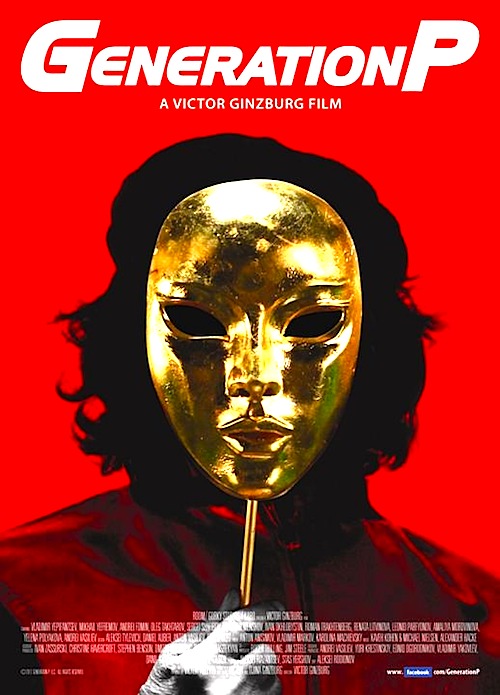
The “P” in Generation P is an ironic reference to Pepsi, the cola of Glasnost. Though it never outright glamorizes terrorism, P is not that far removed from V for Vendetta, exhibiting similar anarchistic inclinations. However, the closest comparison might be Fear and Loathing in Las Vegas, giving viewers a hallucinogenic tour of Russia worthy of Hunter S. Thompson.

P arguably peaks halfway through. At its most inventive, it mixes Mesopotamian and Soviet imagery to evocatively hint at ancient mystic secrets. However, once Tatarsky reaches the inner circle, the film gets bogged down in rather standard, dog-wagging conspiracy rigmarole.

Beyond its heavy-handed critique of consumerism, it is hard to get a bead on P’s exact ideology. While Tatarsky’s cynical nostalgia campaigns are clearly intended to be problematically simplistic, the only real reference to Russia’s Communist past are the fondly remembered Pioneer Days, which are presented with a Norman Rockwell-like patina of lost innocence. The film also has little love for Yeltsin, but plot developments ironically absolve him of much of his buffoonery. Likewise, there is constant white noise equating all capitalists with oligarchs, but they constantly wind up assassinated for running afoul the mob or the government.

Yet, the similarities between a blunt-talking nationalist “reformer” (literally created on a hard-drive) and the current Russian president – who refuses to relinquish his grip on power – are difficult to miss.

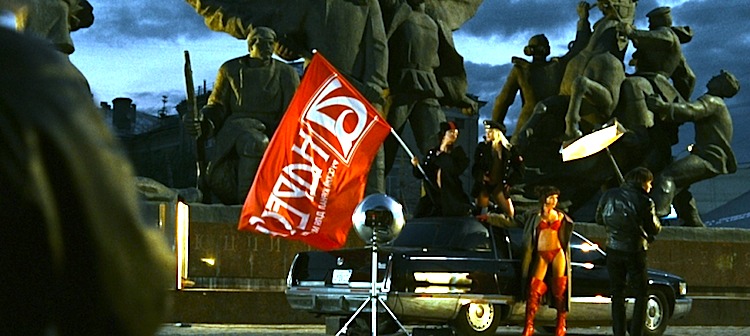
A relentlessly satirical look at the new Russia.

Amidst the maelstrom of satire and metaphysics, Vladimir Epifantsev somehow creates a memorable, multidimensional portrait of Tatarsky, the everyman turned insider. Ginzburg also keeps viewers’ feet solidly on the ground, giving them plenty of narrative handles to guide them through the complicated and surreal storyline. It is a very accomplished work, but it is not clear what it all adds up to, particularly for those coming from what the film somewhat mockingly refers to as a “Soviet mentality.” A strange, sometimes dazzling film certainly worth attempting to decode – but in no way to be considered the final word on the immediate post-Soviet years – Generation P screens this Friday (3/30) at the Walter Reade Theater and Sunday (4/1) at MoMA, as this year’s ND/NF concludes in New York.

Posted on March 28th, 2012 at 5:00pm.