LFM Reviews Gerhard Richter Painting (and Scraping)

By Joe Bendel. Perhaps no artist represents the force of creative destruction better than Gerhard Richter. Not surprisingly, such a Schumpeterian painter was ill-suited to the Social Realist doctrine dominant in the former DDR. Finding refuge in the West two months before the construction of the Berlin Wall, Gerhard’s work has reached dizzying prices at recent auctions. Filmmaker Corinna Belz documents the artist at work in Gerhard Richter Painting, now showing in New York at Film Forum.

For some, Richter’s work probably confirms their uncharitable preconceived notions about modern art. The Dresden-born artist is best known for his large abstract paintings and photo-realistic work that would seem to be stylistically at odds with each other. Throughout the film, Belz captures the increasingly self-conscious Richter at work on two canvases in the former style.

After seeking asylum in West Germany in 1961, two Richter murals in the East were painted over out of dogmatic spite. Ironically, Richter deliberately subjects his work to similar treatment, roughly scraping his canvasses with paint squeegees to see how it alters their character. This process might continue past the point paintings are hung for exhibition. Indeed, there is something very Darwinistic about his approach, causing his assistants to openly speculate whether certain paintings will be able “to hold their own.”

GR Painting follows in the tradition of similar documentaries from Kino Lorber-Alive Minds, observing an artist or craftsman at work in their studio-space. However, the portrait of Richter is considerably more engaging than Gereon Wetzel’s El Bulli or Sophie Fiennes’s Over Your Cities Grass Will Grow, because Belz brings a more visually dynamic approach to bear on her subject, without the same hushed reverence. However, Richter and his colleagues do not offer the sort of witty commentary heard fly-on-the-wall style from photography book publisher Gerhard Steidl and his roster of artists in Wetzel & Adolphe’s shockingly entertaining How to Make a Book with Steidl.

While Belz touches briefly on Richter’s fateful flight west, her focus falls squarely on his creative process. Frankly, for those with more traditional aesthetic inclinations, each successive scraping often renders the two canvasses in question less interesting, blurring the color contrasts and breaking down the paintings’ implied compositional structure. That is just the reality of his working method. Many will find it fascinating, many others will not. At least Richter is a rather interesting figure to spend time with. Recommended for patrons well steeped in the contemporary art world, GR Painting screens through Tuesday the 27th at Film Forum in Manhattan’s eternally chic West Village.

Posted on March 16th, 2012 at 10:40am.
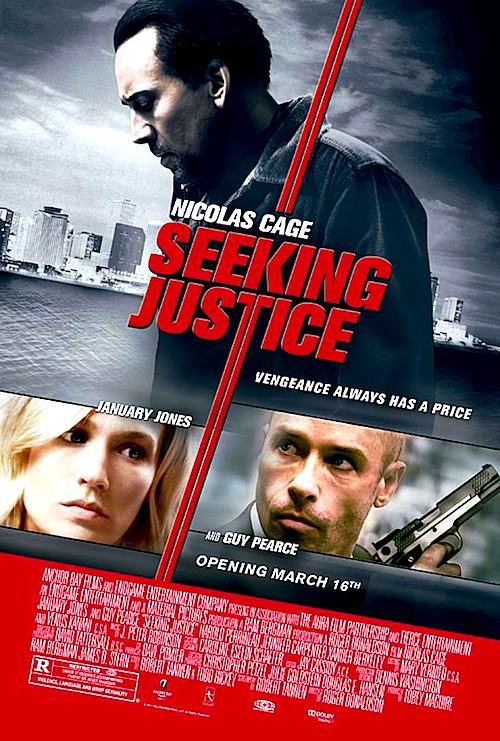
The Cinema of Nic Cage: LFM Reviews Seeking Justice

By Joe Bendel. In some evil alternate universe, “the hungry rabbit jumps” is about to become a massive catch-phrase. Thanks to a benevolent creator, we do not live in that world. In our reality, Nicolas Cage keeps sinking to lower lows with each new b-movie he appears in. The lowest yet is Roger Donaldson’s Seeking Justice, which opens today in New York.

Happily married Will Gerard’s life crumbles when his much smarter and more attractive wife Laura is attacked. While anxiously awaiting news in the hospital, Gerard is approached by a suspicious man. Simon, as he will be called, tells Gerard his associates know who did it and can “take care of him” if he agrees to do them a favor in the future. After an agonizing period of hand-wringing, Gerard agrees. The deed is done, his wife begins her recovery, and life appears to right itself. Then Gerard gets the call with those magic words: “the hungry rabbit jumps.” That means it is time to collect.

Evidently, the mystery man represents a shadowy cabal of vigilantes (encompassing just about everyone in the city of New Orleans) based on the principal of paying vengeance forward. It is now Gerard’s turn to off someone. However, his target is not who he was represented to be. It seems the conspiracy forgot about the private justice aspect of their business and became all about killing.

Only Cage would make a self-loathing vigilante movie. Face it, this is what he does. However, why a quality filmmaker would helm such depressing vehicle is a mystery. Roger Donaldson’s last film The Bank Job was smart, sophisticated, and lively. What happened? It is also baffling how January Jones’s management could let her squander her Mad Men capital in a Nic Cage picture. In truth, she is perfectly fine as Laura Gerard, but it is not exactly a part of great depth.

At least in Trespass, Cage’s previous blink-and-you-missed-it release, Ben Mendelsohn understood how to chew the scenery as a larger than life villain. In contrast, Guy Pearce looks physically uncomfortable as Simon, like he was suffering from a bad case of food poisoning during production. The only spark in the picture comes from Xander Berkeley, doing his shtick as the corrupt Lt. Durgan with a ridiculous New Orleans accent, presumably to help stave off boredom.

It’s great that Justice was shot in New Orleans, but it is frustrating that the production did not take advantage of the Crescent City’s richly diverse music scene. That would have at least helped offset some of the film’s blandness. Altogether, the film lacks character, energy, and conviction. Highly skippable, it opens today (3/16) in New York at the Village East and AMC Empire.

Posted on March 16th, 2012 at 10:39am.

Hope and Healing One Year Later: LFM Reviews Pray for Japan

By Joe Bendel. The numbers are staggering: 319,000 individuals evacuated, at least 269,000 buildings destroyed, roughly $325 billion in damages, and over 20,000 souls missing or confirmed dead. It happened exactly one year ago yesterday, when the Tōhoku coast of Japan was devastated by a cruel earthquake-and-tsunami tandem. Yet the enormity of the tragedy was matched by the resiliency of the average Japanese citizenry. Tokyopop founder Stu Levy pays tribute to the heroes and victims of the 3/11 disaster throughout his documentary Pray for Japan, which screened yesterday in New York as part of the Japan Society’s anniversary programming, in advance of a special national screening this Wednesday at participating AMC Theaters, followed by a weeklong New York theatrical run starting this Friday.

Last year, 3/11 was a Friday. It happened to be the Ogatsu Middle School’s graduation day. As a result, their students had already gone home when the 2:46 earthquake hit. As they made their way to shelters, the Ogatsu faculty reconstructed their class rosters from scratch and set about verifying their students’ safety over the following hours and days. Miraculously, none had been killed. However, little else remained of their school.

In alternating segments, Levy focuses Pray on four groups dealing with the quake-tsunami’s impact: school, family, shelter, and volunteers. Each features inspirational and heartbreaking stories, but the rebirth of Ogatsu Middle School is truly emblematic of the courageous rebuilding process. What viewers do not hear is any finger-pointing or complaining. However, the grief remains raw and painful. Even the most jaded viewer will be deeply moved by one teenager’s koi-nobori tribute to his little brother on children’s day.

Indeed, Pray is a film that will make you cry repeatedly. Anyone of good will would be deeply moved by the stories Levy documents. To his credit, he has the good sense to stay out of the picture himself, letting the survivors tell their stories directly. Yet the evocative animated title sequence and Okuda Tamio’s theme song “jp” greatly contribute towards setting the elegiac but empowering tone right up front.

Unfortunately, the breadth and severity of the Japanese disaster seem lost on our media and elected leaders, who have generally failed in marking this solemn anniversary of our close friend and ally. That probably shows us all we need to know about them.

In contrast, Levy and a handful of filmmakers like Lucy Walker (whose Oscar nominated The Tsunami and the Cherry Blossom also screens today at the Japan Society) recognized an important human story, which continues to develop. Unfortunately, the Japanese people’s fundamental decency and modesty works against them when it comes to grabbing the global media’s attention, yet seeing that spirit manifest itself in acts of compassion and volunteerism is not just inspiring, but ennobling. Both films capture that impulse, making them important and stirring works of cinematic reportage.

Highly recommended, Pray for Japan screens Wednesday (3/14) at select AMC Theaters nationwide, including the AMC Empire in New York and the AMC Cupertino in San Francisco, with a further weeklong theatrical engagement set for the Empire and the Burbank Town Center, starting this Friday (3/16).

Immediately following the events of 3/11, the Japan Society took the lead spearheading relief efforts in New York. You can learn how to support their laudable efforts here.

LFM GRADE: A

Posted on March 12th, 2012 at 12:28pm.

LFM Reviews Dear Pyongyang

By Joe Bendel. In the 1960’s and 1970’s, Japan’s Korean population sharply divided into camps aligned with the North or the South. At the time, the DPRK-supporting Chongryun ran circles around their counterparts, convincing many Koreans in Japan to “return” to the North. As a co-founder of Chongryun, Yang Yonghi’s father encouraged many such “returnees,” including her three older brothers. In retrospect, this was a mistake. Yang examines the disconnect between the ideology she was born into and the reality of life for her North Korean family in Dear Pyongyang, which screens this Sunday as part of Extreme Private Ethos, the Asia Society’s latest film series surveying provocatively intimate Japanese documentaries.

Yang was truly a red diaper baby, raised by her ardently Marxist father to revere the “fatherland” and the “Great Leader.” Although she attended one of the DPRK funded “Korean” schools in Japan, she was also a young person coming of age in an open society. As a result, she had some context to help her question the propaganda she was steadily fed in class. However, her first class trip to Pyongyang and her brief reunion with her brothers clearly began her ideologically questioning in earnest. As the years passed, her parents would ship more and more provisions to their sons, simply to keep them alive. Yet they never backed down from their allegiance to the rogue state.

Without question, Yang is profoundly disturbed by her parents’ apparent self deception, but she is rather circumspect in pressing the issue on-camera, for obvious reasons. Indeed, it is fascinating to read between the lines in Dear Pyongyang. She implies quite a bit about the miserable conditions there, but leaves much unspoken. After all, she has family in the North. On a more personal level, she also worries her father will consider any criticism of the DPRK as a rebuke of his life’s work. Just the same, she cannot ignore what she sees with her own eyes on each trip to Pyongyang.

Evidently, Yang successfully walked her tightrope, since she was able to make a follow-up film focusing on her niece Sona, whom she identifies with for living the life she might very well have led, had her parents also “returned.” She also was able to get her father to seriously take stock of many fateful decisions he made, on camera, before his health issues put an end to such discussions late in the documentary.

Understandably, an atmosphere of regret hangs heavily over the entire film. While Korea remains divided by circumstances beyond their control, Yang’s family is divided by choices they made. To her credit, she examines their implications as forthrightly as was prudent, given the nature of the Communist regime. Deeply personal but also highly relevant, it is an intriguing, frustrating, and forgiving film.  Definitely a highlight of Extreme Private Ethos, the respectfully recommended Dear Pyongyang screens this Sunday afternoon (3/11) at the Asia Society in New York.

Posted on March 9th, 2012 at 8:42am.

An Indie Darling Turns Scream Queen: LFM Reviews Silent House

By Joe Bendel. The multiplex kids probably have never seen Alfred Hitchcock’s Rope (let alone Alexander Sokurov’s Russian Ark), so the supposed single continuous “real-time” tracking shot making up the latest indyish-genre outing from Open Water directors Chris Kentis and Laura Lau might seem like a fresh gimmick to them. Remaking the recent Uruguayan horror movie (including the aforementioned uninterrupted take), they show fewer seams than Hitchcock but more distracting narrative issues come to the fore in their remake, Silent House, which opens this Friday in New York.

Sarah’s family had some good times in their lake house, but vandals and weather damage have taken a toll. Her father and Uncle Peter are trying to restore it, but their bickering makes the going slow. It looks peaceful outside, but with the windows boarded up and the power kaput, the house is pitch dark inside, even during high noon. It would be a scary place to be locked in with a psycho killer, which will be the case for Sarah. After she establishes the lack of phone lines and cell service with an old childhood chum she cannot remember, her menacing begins.

When it comes to the mechanics of skulking about the old dark house, Silent is more than competent. However, when it drops its clues, they clang like anvils. Frankly, anyone who isn’t on to the big twist by the half hour mark must be remarkably guileless, even if they have not seen the Uruguayan original. Unfortunately, this makes it devilishly difficult to buy into Silent as a funhouse ride. Instead, viewers will more likely feel as if they are watching the film play out the string.

Still the toast of the indie circuit for her work in Martha Marcy May Marlene, Elizabeth Olsen handles her scream queen duties rather capably. There is actually more to Sarah than the typical teens chased through slasher movies, which Olsen evokes quite convincingly. However, Adam Trese and Eric Sheffer Stevens are just glaringly miscast as Papa John and Uncle Peter respectively, looking more like aging hipsters on a photo shoot for Restoration Hardware than adults with any kind of connection to the real world.

Ironically, the one take device is the least distracting aspect of the film. Indeed, the filmmakers should avoid the game of poker, because they display all kinds of “tells.” As a result, the creepy vibe and some nice work from Olsen, duly framed to maximize viewer leering, largely go to waste. For the curious, Silent House opens today nationwide.

LFM GRADE: D

Posted on March 9th, 2012 at 8:41am.