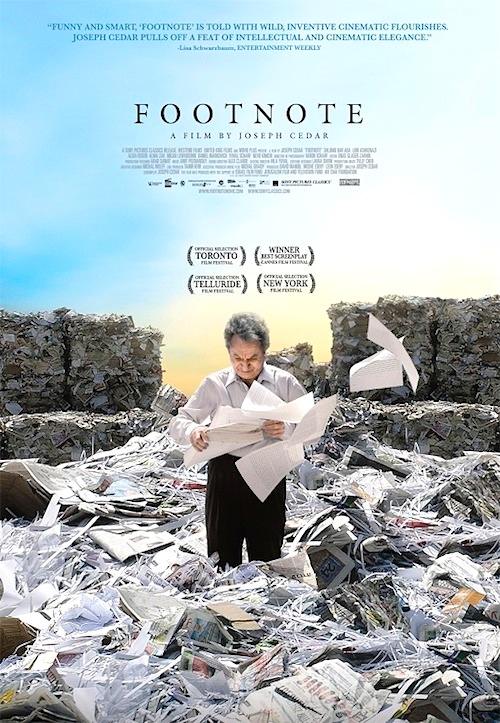
By Joe Bendel. Eliezer Shkolnik might not look like a national treasure. According to his colleagues, the standoffish Talmudic scholar has a rather thin resume of accomplishments. Yet Shkolnik is about to learn that he will be awarded the Israel Prize, the country’s highest honor for scholarship. However, the circumstances surrounding his belated recognition are rather complicated in Joseph Cedar’s Oscar nominated Footnote, which opens this Friday in New York.
As Footnote commences, the senior Shkolnik must squirm in ill-concealed discomfort as his son Uriel receives another honor long denied to him. Eliezer Shkolnik is openly contemptuous of his son’s trendy work. He might regard it as rubbish, but Uriel Shkolnik publishes an awful lot of it. The same cannot be said of the father, whose life’s project was undermined by archaeological discoveries and the manipulations of a bitter academic rival. Every year, the elder Shkolnik is nominated for the Israel Prize – but to no avail, until now.
Unfortunately, Uriel Shkolnik has an awkward truth dumped on him by the Prize committee, including his father’s lifelong nemesis. That call was meant for him, not his father. Convinced the public humiliation would destroy what is left of his father’s psyche, the younger Shkolnik desperately negotiates to maintain the honors list as is, just as his father begins to vent his opinions about Uriel’s brand of scholarship in the media.
Though there is no violence on-screen, Cedar’s razor-sharp screenplay draws real blood. All the pettiness and jealousy of academia is on full display throughout Footnote, while the father-son contentions take on the dimensions of classical tragedy. Indeed, their research might only be of interest to a rarified circle of scholars, but they fight over it like a strategic hill on a blood-soaked battlefield.
Lior Ashkenazi (an Israeli Film Academy Award winner, whose credits include Israel’s first slasher film, Rabies) convincingly portrays the conflicted son, while Shlomo Bar Aba is maddeningly but effectively inscrutable as the reserved and rather squirrely father. Yet Israeli theater director Micah Lewesohn really makes it all crackle and spark as the senior (and eventually junior) Shkolnik’s foil, the Moriarty-like Prof. Yehuda Grossman.
Visually, Footnote is surprisingly dynamic, especially given the esoteric concerns of its characters. Cedar employs montages, sly captions, and rapid edits for shrewd comedic effect, in ways that support rather than overwhelm the central drama. Indeed, cinematographer Yaron Scharf and editor Einat Glaser-Zarhin were clearly key collaborators in stylishly rendering Footnote’s sophisticated look and acerbic vibe.
Part of a very strong field of foreign language Oscar nominees this year, Footnote was a worthy contender. Ironically, despite facing criticism from Islamist hardliners, the state media has trumpeted Asghar Farhadi’s Academy Award for A Separation as an Iranian triumph over Israel, cheapening his moment on the world stage as a result. In fact, while in no way a political film per se, the constant security checks Cedar’s characters go through serve as a grim reminder of the homicidal hatred average Israelis must defy just by going about their everyday lives. Intelligently written and executed, Footnote is highly recommended when it opens this Friday (3/9) in New York at the Angelika Film Center.
We wanted LFM readers to know that Jafar Panahi’s This is Not a Film opens this Wednesday (2/29) at New York’s Film Forum, and will soon thereafter be playing at select theaters across the country through May. For bookings in your area, please visit the film’s official website.
This is Not a Film depicts in heartbreaking detail the house arrest of acclaimed Iranian filmmaker Jafar Panahi, who was accused in 2010 of making a film critical of the Iranian government. Panahi vehemently denies the charges, yet he currently faces six years in jail and a twenty-year ban on filmmaking. Nonetheless, in This is Not a Film Panahi not only documents his own house arrest, revealing how the banal details of daily confinement can crush the human spirit; he also reveals how the creative impulse can survive even the most repressive circumstances, and inspire hope.
LFM’s Joe Bendel reviewed This is Not a Film at the New York Film Festival, calling it “an inspiring example of the creative impulse as it flows like water through the cracks of an oppressive state.” LFM’s Govindini Murty and Jason Apuzzo also ranked This is Not a Film as the #1 Pro-Freedom Film of 2011 in their “The Cinema of Liberty: The Top 10 Pro-Freedom Films of 2011” blog post for The Huffington Post.
We hope you take the opportunity to see this important film when it comes to your area.
By Jason Apuzzo. Celebrities will invade Los Angeles this weekend for the 84th Academy Awards ceremony. Searchlights will blaze and flashbulbs will pop as Hollywood stars will descend from the heavens — or maybe just the Malibu hills — to touch the ground that regular Angelenos walk on each day.
They’ll smile and snarl our traffic. They’ll toss their hair and forget to thank their husbands. They’ll praise each other for their bravery, while collecting $75,000 gift bags.
L.A. is accustomed to such strange invasions, of course. If you’re a movie fan, you already know that L.A. has been invaded over the years by everything from giant atomic ants (Them), to buff cyborgs (The Terminator), to rampaging 3D zombies (Resident Evil: Afterlife). So Angelenos take invasions from movie stars in stride.
But this weekend marks an anniversary of an invasion you might not know about: L.A.’s first alien invasion.
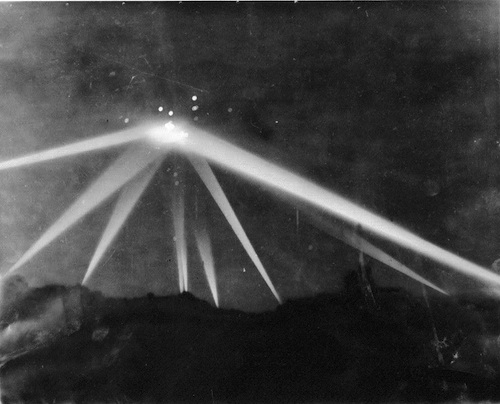
A surviving image from The Battle of Los Angeles.
This February 24th-25th is the 70th anniversary of The Battle of Los Angeles, also known as The Great Los Angeles Air Raid, one of the most mysterious incidents of World War II — and also one of the key, oddball events in U.F.O. lore that’s still inspiring movies and TV shows to this day.
Between the late evening of February 24th, 1942 and the early morning hours of February 25th, the City of Angels flew into a panic as what were initially believed to be Japanese enemy aircraft were spotted over the city. This suspected Japanese raid — coming soon after the Pearl Harbor bombing, and just one day after a confirmed Japanese submarine attack off the Santa Barbara coast — touched off a massive barrage of anti-aircraft fire, with some 1400 shells shot into the skies over Los Angeles during the frantic evening.
Oddly, however, the anti-aircraft shells hit nothing. Despite the intense barrage, no aircraft wreckage was ever recovered.
Indeed, once the smoke had cleared and Angelenos calmed down (the public hysteria over the raid was mercilessly satirized by Steven Spielberg in 1941), no one really knew what had been seen in the sky or on radar. Were they weather balloons? German Zeppelins? Trick kites designed by Orson Welles?
Many people believed the aircraft they’d seen were extraterrestrial – one eyewitness even described an object he’d seen as looking like an enormous flying ‘lozenge’ – and some accused the government of a cover-up. Conflicting accounts of the incident from the Navy and War Departments didn’t help clarify matters.
As if to confirm public fears of extraterrestrial attack, one famous photograph emerged (see above) from the incident showing an ominous, saucer-like object hovering over the city. This much-debated photograph, which even appeared in some trailers for Battle: Los Angeles last year, inspired America’s first major U.F.O. controversy — a full five years before Roswell.
To this day, no one knows for sure what flew over Los Angeles that night and evaded the city’s air defenses. (The raid itself is recreated each year at Fort MacArthur in San Pedro.) But since it’s more fun to assume that it was aliens than weather balloons, we’ve decided to honor The Battle of Los Angeles by ranking the Top 10 movies in which aliens attack L.A. (See below.)
To make this list, a film must feature aliens on the warpath — no cuddly E.T.’s here — and their attacks must take place in L.A. proper, rather than out in the suburbs or desert (eliminating films like Invasion of the Body Snatchers).
As the list demonstrates, no city — other than perhaps Tokyo — has suffered more on-screen calamity at the hands of extraterrestrials than Los Angeles. At the same time, there’s no apparently no other city that’s easier for aliens to hide in.
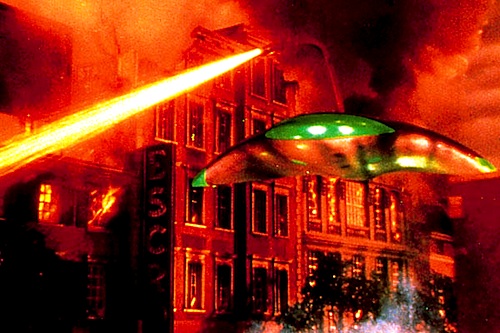
From George Pal's "War of the Worlds."
1) The War of the Worlds (1953)
Producer George Pal’s adaptation of the H.G. Wells’ novel is the granddaddy of ’em all, and still the best L.A.-based film about alien attack. Gene Barry plays Dr. Clayton Forrester, a natty scientist at ‘Pacific Tech,’ who along with his girlfriend Sylvia van Buren (a perky USC coed, played by Ann Robinson) struggles to prevent Martian invaders from destroying human civilization. Highlights of the film include a boffo attack on downtown L.A. (which Pal initially wanted to film in 3D) by the graceful, swan-like Martian ships, and an Air Force flying wing dropping a nuclear bomb on the Martians. Filmed in vivid Technicolor, The War of the Worlds was a huge hit, broke new ground in visual effects technology, and helped kick off the 1950s sci-fi craze.
Best exchange of the film: “What do we say to them [the aliens]?” “Welcome to California.”
2) Independence Day (1996)
Director Roland Emmerich’s funny, exhilarating and patriotic summer hit from 1996 borrows key elements from The War of the Worlds, but adds a few of its own: 15-mile-wide flying saucers, a president who flies fighter jets … and Will Smith. In the role that made him a megastar, Smith plays a trash-talking Marine fighter pilot paired with an MIT-trained computer wiz (played by Jeff Goldblum, channeling Gene Barry) who fights an alien saucer armada out to demolish humanity. ID4 is easily the best of Emmerich’s apocalyptic films, largely due to its tongue-in-cheek humor. Watch as ditzy Angelenos atop the Library Tower cheerfully greet an alien saucer, only to be zapped into oblivion a moment later. Only in L.A.
Best line of the film: “Welcome to Earth.”
3) Transformers (2007)
There’s mayhem, and then there’s Bayhem. Michael Bay’s Transformers redefined sci-fi action cinema in 2007, featuring a spectacular climax in downtown Los Angeles — a riot of colossal urban warfare and aerial strikes as the U.S. military and Autobot robots unite to fight Decepticon robots out to enslave Earth. A key sequence showcased Autobots and Decepticons ‘transforming’ at 80 mph on a busy L.A. freeway, swatting aside cars and buses while fighting each other — living out the fantasy of every aggressive L.A. driver. Unlike the stately saucers of ID4, or the graceful war machines of War of the Worlds, Bay’s Decepticon robots are fast-moving, anthropomorphic and nasty. Like certain Hollywood celebrities, they trash talk, strut and propagandize as they smash through buildings and otherwise inflict as much collateral damage as possible. The film that made stars out of Shia LaBeouf and Megan Fox, Transformers delivers heaping doses of humor, curvy women and robot carnage; it’s Bayhem at its best.
Best line: “You didn’t think that the United States military might need to know that you’re keeping a hostile alien robot frozen in the basement?!”
From the NBC miniseries "V" (1983).
4) V (1983)
These alien ‘Visitors’ look just like us, and they come in peace … except that underneath their false skins they’re actually lizards and want to eat us. That’s the premise of Kenneth Johnson’s apocalyptic NBC miniseries from 1983, a show that leans heavily on references to Nazism, communism and other pernicious forms of group-behavior. V is also the show that first gave us gigantic motherships hovering over major cities, years before ID4. The best part of V, however, is the scene-chewing performance by Jane Badler as the alien leader Diana; somebody should put that woman in charge of GM. Otherwise, in V the human resistance movement against the aliens centers around Los Angeles — possibly because it’s hard to cop a tan while saucers are blocking the sun.
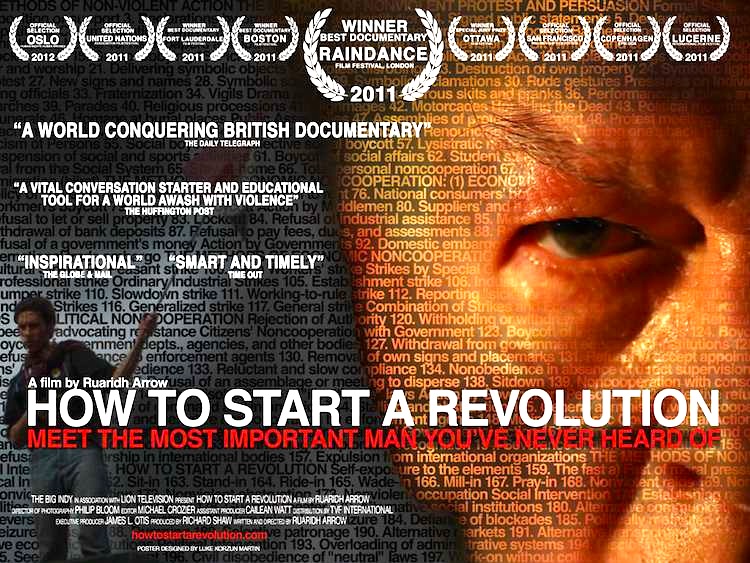
By Joe Bendel. Dr. Gene Sharp has been vilified by Hugo Chavez, the Iranian government, and bizarrely, the Occupy Oakland blog. Whatever such a man has to say is worth listening to, unless of course you are trying to protect the ruling party. In contrast, Dr. Sharp always sides with the revolutionaries, but advocates strictly nonviolent tactics. Journalist-filmmaker Ruaridh Arrow, who reported from Tahrir Square for the BBC, profiles Sharp and documents the applications of his work in How to Start a Revolution, which opens this Friday in Brooklyn at the ReRun Gastropub theater.
Dr. Sharp literally wrote the book on nonviolent revolution. It is called From Dictatorship to Democracy and it is available as a free download from the Albert Einstein Institute he heads. If you ever wondered why so many protests around the globe have signs written in English, it is because Dr. Sharp recommends it. He has a lot of general tactical advice, but eschewing violence is the essential point.
Nonviolence might sound hippy-dippy, but Dr. Sharp comes across as a rather down-to-earth nonpartisan scholar. He has just as readily advised democracy advocates struggling under leftist dictatorships – such as in Venezuela, Burma, Georgia, and Ukraine – as regimes considered friendly to American interests, like Mubarak’s Egypt. Despite the canard that he is a CIA puppet, his independence seems pretty evident, based on the Egyptian and Syrian activists who pay homage to Sharp in the Institute’s shoebox offices.
Arrow lucidly lays out Dr. Sharp’s principles and how various democracy movements have put them into practice. However, the results seem like more of a mixed bag than he would like to admit. In fact, Dr. Sharp’s celebrated volume was originally written for the Burmese, who have yet to shake off their military oligarchy, despite the enormous personal price nonviolently born by Aung San Suu Kyi. While applauding their courage, Dr. Sharp also argues the Tiananmen Square protests lacked proper planning and direction. They certainly were not able to co-opt the police and military, which is a crucial step in his playbook. As for Egypt, the jury is still out, but they seem to have traded a corruptocracy for military rule (if they are lucky, that is).
Probably the strongest material in Arrow’s film logically involves the greatest success: Serbia’s ouster of Slobodan Milošević. Trained in Dr. Sharp’s methods by his unlikely protégé, retired Col. Bob Helvey (who is as colorful an interview subject as ever there was), the opposition youth movement Otpor did everything right. It is a fascinating and inspiring story that remains woefully under-reported in this country.
HTSAR to will not spur wholesale conversions to pacifism. However, it will likely challenge and broaden the way people think about the continuing struggle for freedom and constitutional democracy around the world. Indeed, it is rare that a film offers so much to engage with. Unusually provocative and intellectually rigorous, HTSAR is (surprisingly) recommended quite keenly when it opens this Friday (2/24) at the ReRun Gastropub Theater.
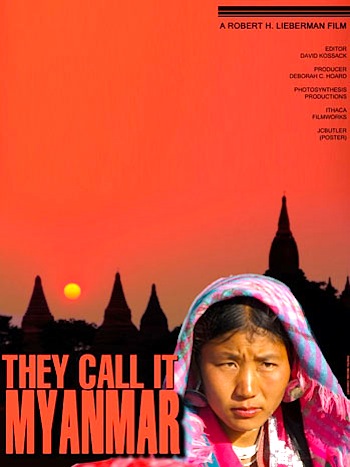
By Joe Bendel. Even the Buddhist monks are fed up with Burma’s oppressive military regime. A deeply devout nation, the Burmese people were shocked when the army fired on their peaceful demonstrations. Yet, the junta still rules. Physics professor, novelist, and independent filmmaker Robert H. Lieberman explores the tragic dynamics of the Southeast Asian country from a layman’s point of view in They Call It Myanmar: Lifting the Curtain, which screens for two nights only this coming Monday and Tuesday in New York.
Perhaps because of the wide variety of professional hats Lieberman wears, he was recruited to participate in a State Department sponsored filmmaker mentoring program. Having gained entrée into the “second most isolated country on the planet,” Lieberman recognized what an unusual opportunity he had. Over the next two years, Lieberman furtively filmed the people and their customs, keeping his eyes peeled for anything that might shed light on the nation’s political and social realities. He even scored an on-camera sit-down interview with the recently released Aung San Suu Kyi.
Culled from hours of footage, Call mixes sort of National Geographic-style appreciations of Burma/Myanmar’s stunning temples and their distinctive application of thanaka facial paste for cooling and cosmetic purposes via handheld camcorder, with legitimate muckraking. Indeed, at not insignificant personal risk, Lieberman conveys a real sense of the fear and paranoia fostered by the military police state. Yet, perhaps even more shocking are the truly Sisyphean hand-to-mouth living conditions endured by the overwhelming majority of Burmese, vividly documented in Call.
For obvious reasons, Lieberman scrupulously maintains the anonymity of his interview subjects. Their commentary is consistently illuminating and more often than not depressing, suggesting the regime’s pervasive oppression has even affected the populace’s psychological ability to think as political free agents. Still, for true profundity, it is hard to top Suu Kyi’s parting words: “politicians who think they’ve gone beyond being politicians are very dangerous.” Someone should carve that in marble where the current and future occupants of the Oval Office will see it every day.
There is nothing more frustrating than an ostensibly independent filmmaker producing a puff piece in a notorious closed society (as was the case with Justine Shapiro’s whitewashed Our Summer in Tehran, for instance). To his credit, Lieberman chose to take the tougher path. The result is a solid, boots-on-the-ground overview of contemporary Burma, periodically spiked with moments of shocking outrage. Interested viewers who find it a good general introduction can then fill in the details with more specific case studies, like HBO2’s Burma Soldier and Luc Besson’s upcoming Suu Kyi biopic The Lady. Recommended for general audiences, They Call It Myanmar screens Monday and Tuesday (2/27 & 2/28) at New York’s Landmark Sunshine, with similar two-evening Landmark engagements to follow in Philadelphia, DC, and Boston.
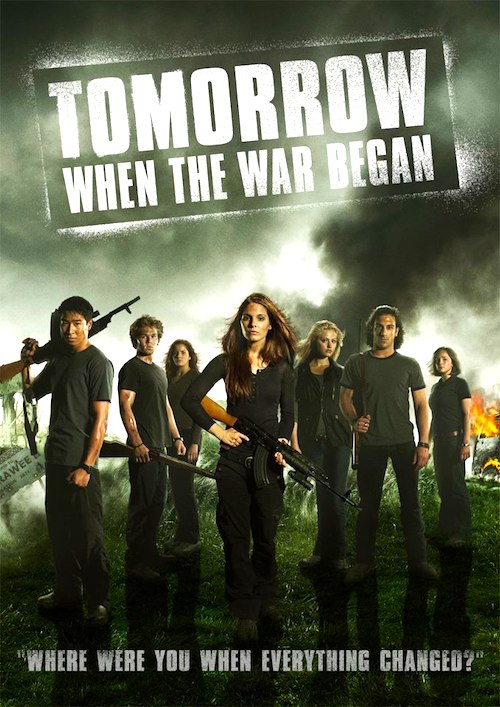
By Joe Bendel. The freedom of Australia depends on a handful of teenagers. Fortunately, they are mostly quite good looking. That means they have even more to lose and will therefore be fiercer fighters. A rag tag band of students duly unleash their inner Wolverines in Stuart Beattie’s Tomorrow When the War Began, which opens this Friday in select cities and streams on demand via Freestyle Digital Media’s Facebook platform.
The time is twenty-for hours from now. The place is coastal New South Wales. It is a nice area to grow up and raise a family. At least it was until a foreign military invaded. Ellie Linton and her friends do not know that yet. They have been camping out in a remote mountain clearing misnamed “Hell.” When they return, cell service is out, the land lines are down, and their families are nowhere to be found.
Eventually, they discover the town’s fairground has been turned into a detention center by a vaguely Asian looking army. After a few narrow escapes and a considerable amount of bickering, they decide it is time to take the fight to their invaders – and that strategically positioned bridge looks like a good place to start.
Based on John Marsden’s bestselling Tomorrow series of YA novels, TWTWB obviously owes a debt to the original old school Red Dawn, but that’s okay. Considering how cool the classic Dawn remains, it is downright bizarre that it has not been emulated more often. Frankly, Beattie somewhat tarries in the first act, establishing full well and good just which teens like whom (Linton has a thing for the Lee Takkan, while the well heeled Fiona Maxwell fancies Homer Yannos, the slightly delinquent son of Greek immigrants).
Still, he juggles a lot of teen angst relatively nimbly. His adaptation also treats evangelical character Robyn Mathers with respect, even when presenting her reverence for life as a source of friction with her less conflicted friends. (Why not just throw some St. Thomas Aquinas books at her? Or better yet, throw them at the enemy.)
On one hand, the conspicuous effort taken to not identify the nationality of the invaders is somewhat problematic (one would think that would be valuable intel to suss out). Based on their rhetoric about natural resources and establishing stability in the Pacific region, China sounds like an obvious suspect. Yet it allows the film to effectively ratchet up the teens’ mood of what-the-heck-is-going-on bewilderment and perhaps sets the scene for big revelations in films to follow.
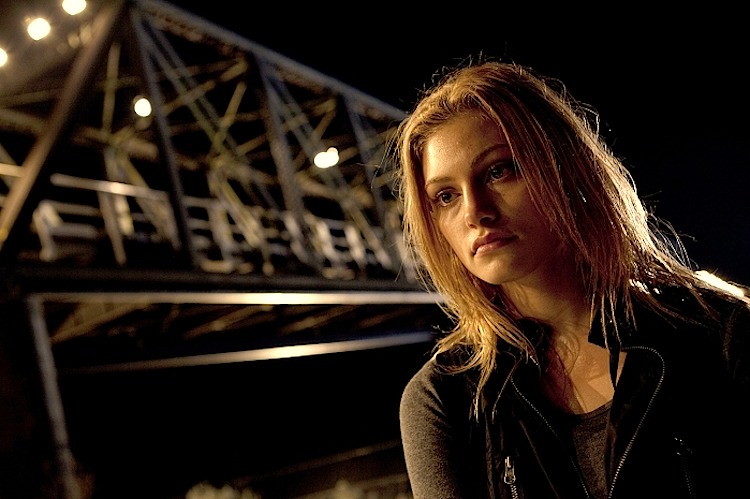
As Linton and Takkan, the more-or-less leads, Caitlin Stasey and Chris Pang are reasonably charismatic presences and wholly credible action figures. Phoebe “The Secret Circle” Tonkin is also surprisingly engaging as the Clueless-esque Maxwell, but Deniz Akdeniz’s Yannos seems to be looking for a Welcome Back Kotter reboot much of the time.
Phoebe Tonkin in "Tomorrow, When the War Began."
Once Linton and her comrades get organized and down to business, the film starts cooking nicely. It certainly sets up viewers, leaving us wanting more. Since TWTWB ranks as Australia’s highest grossing domestically produced release of 2010, more is indeed reportedly on the way. That is rather welcome news. TWTWB is certainly fun and professional grade popcorn fare that also seriously addresses themes of freedom, responsibility, and sacrifice. It is exactly the sort of film that could make a mint for Hollywood, but apparently they are content to leave such money on the table.
As is customary for most imports, TWTWB will only open in select cities this Friday (2/24) including the Criterion 7 in New Haven and the Palace 18 in Miami, but it will also be accessible to audiences nationwide, through Freestyle’s digital distribution on Facebook. Recommended as a non-taxing teen action picture with a good message and the promise of even better installments down the road, TWTWB is definitely worth checking out from the comfort of your own laptop.
 Unfortunately, Uriel Shkolnik has an awkward truth dumped on him by the Prize committee, including his father’s lifelong nemesis. That call was meant for him, not his father. Convinced the public humiliation would destroy what is left of his father’s psyche, the younger Shkolnik desperately negotiates to maintain the honors list as is, just as his father begins to vent his opinions about Uriel’s brand of scholarship in the media.