From Studio Ghibli: LFM Reviews The Secret World of Arrietty

By Joe Bendel. The love for fantastical little people is pretty universal. Perhaps that is why Mary Norton award winning British YA novel The Borrowers transferred rather easily to Koganei, a Tokyo suburb that happens to be home to legendary animator Hayao Miyazaki’s Studio Ghibli. Following several well-received live action adaptations from the likes of Hallmark Hall of Fame and the BBC, Studio Ghibli produced an anime treatment helmed by their youngest feature director to-date and co-written by Miyazki himself. Set to become Disney’s most widely distributed Ghibli release on a reported 1,200 screens, Hiromasa Yonebayashi’s The Secret World of Arrietty opens today nationwide.

The so-called Borrowers are tiny but proportional people who live in the cracks and crevices of country homes. They survive by “borrowing” supplies that will not be missed from the human household, like a sugar cube. Up until now, the borrowing has been the sole responsibility of Arrietty’s quietly protective father Pod, but having reached a certain age, it is time for her to learn how to survive as a borrower. As her high strung mother Homily anxiously awaits, she and her father venture into the big house. However, their foray leads to disaster when a recent arrival spies them.
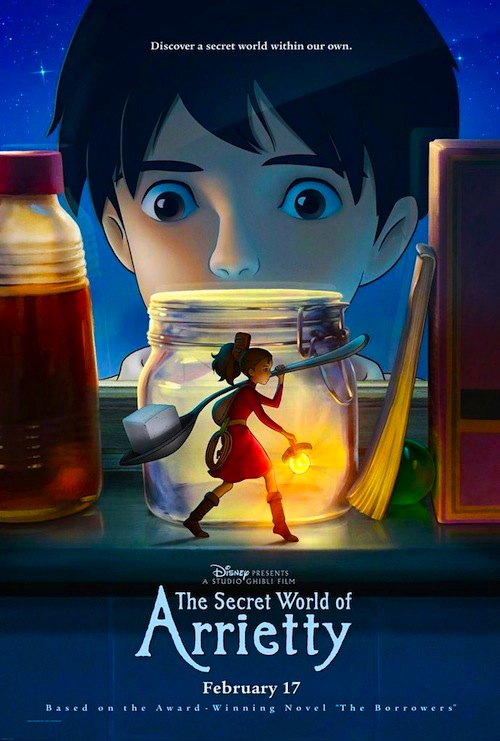
Shō is a sickly human boy, trundled off to the secluded cottage to rest up for an upcoming operation. He instantly recognizes the borrowers from the family legends of the little people living under the floor boards. Even though the scale is problematic, he is also pretty psyched to talk to a girl. Unfortunately, Arrietty’s father is adamant: once borrowers have been seen, they must move on post-haste. Frankly, his concern is not misplaced. Though Shō means them no harm, Haru, the maid of the house, also suspects their presence and intends to treat them like any conventional infestation.

Aside from some CGI here and there, the mostly hand drawn Secret looks richly detailed and lushly evocative. Indeed, the verdant garden is particular suited to the Ghibli magic. The film has plenty of style, but beyond Ghibli’s considerable circle of admirers, it will largely skew towards younger viewers. Still, it is rather watchable for adults so inclined.Indeed, Arrietty is much more agreeably plucky than cloying. Likewise, Shō might be a bit of a sad sack, but at least he is not an energy drain on the film. Even the original songs by French pop-star Cécile Corbel are surprisingly graceful and distinctive.

The only real drawback is the American dubbing, including an over-the-top Carol Burnett as Haru, the bland Will Arnett as Pod, and several tweeners adults will not recognize. Somehow they just do not sound right. (In contrast, the British release features the voice talent of Mark Strong, Olivia Colman, and Saoirse Ronan, which certainly looks more interesting on paper.)

Secret looks great and parents can feel safe and confident taking their children. Although Haru’s maniacal streak seems a bit excessive (from a credibility standpoint), the overall film is quite gentle and charming. A solid B+ outing from Studio Ghibili, Secret opens today (2/17) in New York at Regal Union Square and AMC 34th Street and in San Francisco at the AMC Van Ness.

Posted on February 17th, 2012 at 9:52am.
A Neo-Communist Youth Movement: LFM Reviews Putin’s Kiss

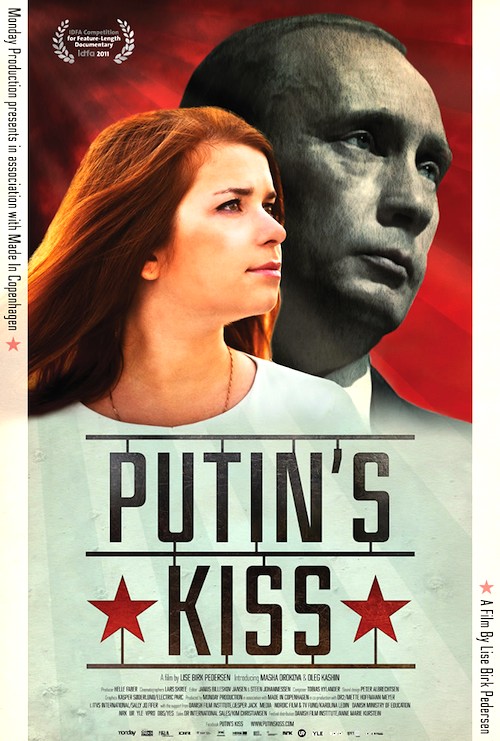
By Joe Bendel. Perhaps nothing signified the all-encompassing totalitarianism of National Socialism better than the Hitler Youth. Likewise, the Komsomol, or Communist Union of Youth, was emblematic of Soviet oppression. According to independent observers, the names are different, but the Komsomol has risen again in the guise of Nashi, a Kremlin-backed youth group fiercely loyal to the current Russian Prime Minister. Though once a prominent spokesperson for the group, one young woman began to understand the realities of the regime she served. Lise Birk Pedersen documents her fascinating story in Putin’s Kiss, which opens this Friday in New York.

Masha Drokova was an ambitious student who believed the government’s propaganda. She joined Nashi, rocketing up the ranks after she famously kissed the titular Russian strongman on state television. She became a national media figure and dogged foe of Putin’s democratic critics. However, her interest in journalism brought her into contact with independent reporters, like Oleg Khasin.

While remaining committed to Nashi, she found she enjoyed the open and robust debates with her new friends. Unfortunately, this did not bode well for her standing within the Putin Youth. When Khasin is brutally beaten thugs considered by everyone except the most willfully blind Nashi loyalists to be acting at the behest of the Kremlin or its allies, Drokova reaches a crossroads.

Only in her early twenties, Drokova is still at an age when peer pressure has very real consequences. To her credit, she stood by her injured friend, joining those demanding a proper inquiry, at no little risk to her well being. Yet she does not repudiate her time serving Putin’s interests. As real journalists say, this story is still developing. Shrewdly, Pedersen never tries to impose a preset narrative, scrupulously recording the messy ambiguities of Drokova’s circumstances instead. Indeed, that is what makes the film so fascinating. Rather than a neat and tidy epiphany, we watch her reservations and doubts begin to stir.

Frankly, Drokova is not yet a fully mature adult, which can lead to viewer frustration with her as their POV protagonist. However, it is important to remember this is exactly why Nashi recruited Drokova and those like her. Indeed, Pedersen conveys a frighteningly vivid sense of Nashi’s reach and influence. After watching Kiss, it is impossible to accept claims that the group is a nonpartisan service movement.

Kiss is an important film that shines an international spotlight on Putin’s youthful enforcers. Pedersen rakes a fair amount of muck, while capturing a very personal story with wider political implications. Mostly scary and only occasionally encouraging, it is highly recommended for viewers concerned and interested in the state of the world. It opens this Friday (2/17) in New York at the Cinema Village.

Posted on February 15th, 2012 at 10:35am.

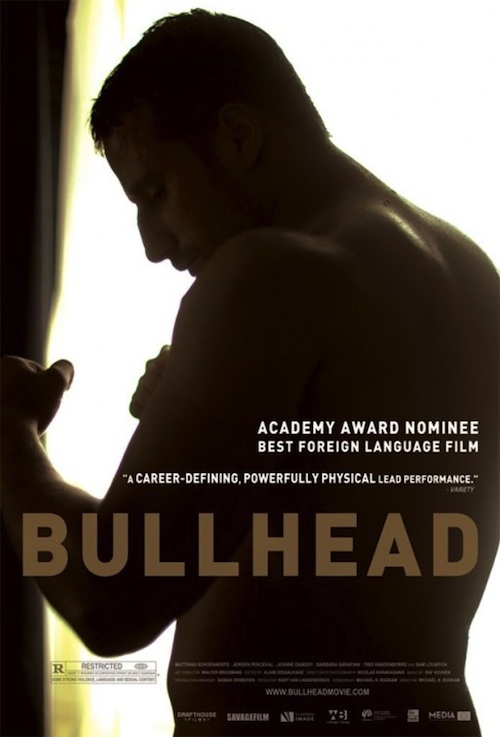
Oscar Gets Juiced: LFM Reviews Bullhead

By Joe Bendel. It is hard to believe Belgium has any comparative advantage in the beef packing industry. Regardless, watching the Flemish bovine mafia ply their cattle with hormones will not inspire global consumer confidence. One angry breeder takes massive doses himself. Regrettably, he has a very good reason for such treatments, which viewers see in painful detail early in Michaël Roskam’s Bullhead, Belgium’s surprise best foreign language Oscar nominee, opening this Friday in New York.

Jacky Vanmarsenille resembles the bulls he sullenly tends (hence the title). He looks all man, but an incident in his childhood left him somewhat less so. To compensate, he has built up his body, but the constant cocktails of testosterone and steroids have exacerbated his anger issues. Poorly socialized, Vanmarsenille’s resentment metastasizes over time. When figures from his past suddenly reappear, his behavior becomes more erratic. Unfortunately, this leads his family to discount his warnings not to get involved with Marc De Kuyper, the duplicitous Godfather of growth hormones.

Bullhead is quite an unlikely Oscar contender. Indeed, Belgium raised many eyebrows when it submitted Roskam’s film instead of the Dardenne Brothers’ French language The Kid with a Bike, but they seem to have known what they were doing. This is a tough picture that is difficult to pigeon hole. As a character study, it broods in a class by itself. Indeed, there may be no protagonist that is as equally sympathetic and scary as Jacky Vanmarsenille. Yet, its gangster movie elements are not mere window dressing for the naturalistic morality play. Roksam’s screenplay also reflects Belgium’s Flemish-French divide in ways not especially flattering to the latter, adding a further layer of context for those who can pick up on it.

Without question though, the key to the film is Matthias Schoenaerts, who really is quite extraordinary as Vanmarsenille. His physical transformation into the hulking protagonist has been compared to De Niro’s bulking up for Raging Bull, but that is really the least of it. With little dialogue, he conveys volumes, keeping the audience fully invested in his character, even when he commits terrible deeds. This is ferociously intense work. Jeroen Percival provides an effective counterpoint as the nervous Diederik Maes, Vanmarsenille’s oily childhood friend and polar opposite physically, sexually, and temperamentally.

Bullhead’s deliberate pacing and wince-inducing plot developments might discomfort less adventurous viewers, but under Roksam’s sure hand they become high tragedy. In truth, few films so directly address what it means to be both a man and a monster. On Oscar night, it will be the longest of long shots, but Bullhead can go toe to toe with any of its fellow nominees, including Asghar Farhadi’s A Separation, considered the frontrunner amid a very strong foreign language field this year. Highly recommended, Bullhead opens tomorrow (2/17) in New York at the Angelika Film Center and AMC Empire and next Friday (2/24) in San Francisco at the Bridge Theatre.

Posted on February 16th, 2012 at 10:33am.

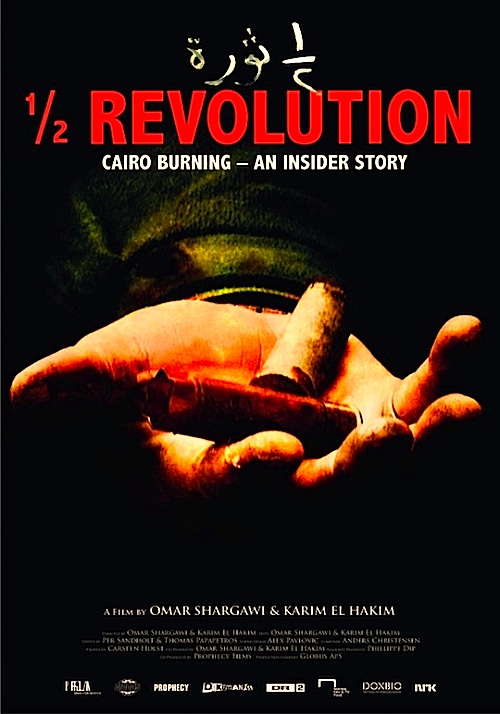
LFM’s Govindini Murty at The Huffington Post and AOL-Moviefone: As Egypt Fights for Democracy, New Documentary 1/2 Revolution Goes to the Front Lines

[Editor’s Note: This post appears today at The Huffington Post and at AOL-Moviefone.]

By Govindini Murty. As the Egyptian military government prepares to put nineteen American employees of pro-democracy NGOs on trial, and thousands of Egyptians continue to demonstrate over the stalling of democratic reforms, the new documentary 1/2 Revolution offers a striking look back at the Egyptian revolution of one year ago.

Premiering recently at the 2012 Sundance Film Festival, 1/2 Revolution depicts the revolution through the eyes of a group of Egyptian activists directly involved in it. Using cell phone cameras and hand-held camcorders, the filmmaker-activists capture dramatic footage of clashes between average Egyptians calling for freedom and the repressive government forces attempting to stop them.

As co-director Karim El Hakim said after the film’s recent Sundance screening, “You can’t get any more cinema verité than this.”

Danish-Palestinian director Omar Shargawi and Egyptian-American director Karim El Hakim live with their families just a few blocks from Tahrir Square in Cairo. When hundreds of thousands of Egyptians take to the streets on January 25th, 2011 to demand the ouster of dictator Hosni Mubarak, Omar and Karim head down from their apartments to record the events. Viewers are immediately thrown into the visceral experience of the revolution. Crowds of protesters run through the streets shouting “Egypt! Egypt! “Join us! Join us!” “Freedom! Freedom!” When gangs of government-paid thugs and police start beating and shooting the protesters, the protesters shout “No violence! No violence!” This call to non-violence is one of the early strong points of the documentary. To emphasize the theme, Shargawi points out a crowd of demonstrators who surround a group of police yet refrain from assaulting them.

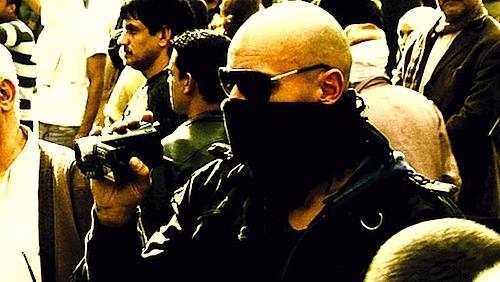
Over time, though, these commendable calls to non-violence are drowned out by the tide of chaos and bloodshed that overtakes the demonstrations when the government attacks. Police fire into the roiling crowds of protesters with live ammunition, loud booms announce the launching of tear gas canisters through the air, and demonstrators and counter-demonstrators fight back and forth with truncheons, rocks, and knives. Demanding to see their passports, secret police harass Karim and Omar as they attempt to film the events, and Omar pulls a scarf around his face to disguise his identity.

Later, Karim is gassed in the face and stumbles home partially blinded, while Omar is severally beaten in a dark alley, barely emerging alive. Government snipers start shooting people through the windows of their apartments in the blocks around Tahrir Square – making viewers fear for the safety of the filmmakers in their own homes, particularly as one of them has a baby who keeps wandering close to the windows. Late in the film, government thugs even take over the street below the apartment building and start harassing the residents, which is what finally forces the filmmakers to question staying in the country.

Omar Shargawi filming "1/2 Revolution."

In capturing the tumult of the Cairo protests, 1/2 Revolution depicts more violence than most Hollywood action movies – but tragically, the mayhem here is all too real.

The seemingly intractable rage captured in the film – both from democratic protesters righteously angry over the suppression of their human rights, and from entrenched government elites determined to hold on to power at any cost – highlights the central challenge facing the Egyptian people today. How will they overcome this bitterness and anger – these scars from decades of violence, repression, and authoritarian rule – in order to build a peaceful democracy?

In his seminal 1947 study of German film, From Caligari to Hitler, Siegfried Kracauer pointed out that the details of life captured in a film often reveal a country’s unconscious predilections. The details captured in 1/2 Revolution are ominous: activists repeatedly declare their willingness to die and become martyrs, the camera dwells on shattered heads and limbs, bodies on stretchers being rushed away, a man lifting up his shirt to show a bullet wound in his back, a pool of blood on the pavement with the word ‘Egypt’ traced in Arabic. Even more ominous are the anti-American and anti-Jewish symbols scrawled onto anti-Mubarak protest signs. One particularly ugly sign depicts Mubarak as the devil with pointy ears and a Star of David stamped on his forehead.

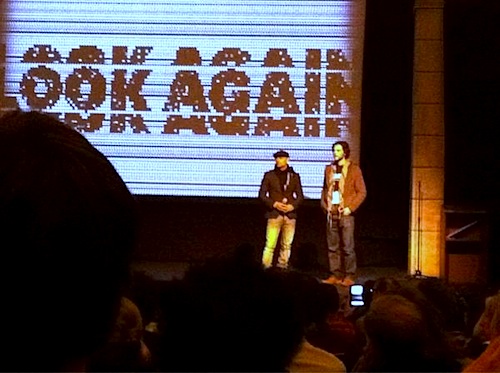
The filmmakers at the Sundance screening.

Sadly, the filmmakers and their friends engage in implicitly anti-Israeli rhetoric themselves. Co-director Omar Shargawi, whose father is Palestinian, says with pride of the demonstrations, “It was like being part of the intifada or something.” One of his friends, a woman also of Palestinian origin, expresses fears that “the Israeli army is massing at the border” and worries that the U.S. might invade. Given that Israel’s population of only 7.8 million is vastly outnumbered by Egypt’s population of 81 million, and given that the American government was generally supportive of the Egyptian revolution, these kind of fears come across as over the top. But this is the dark side of the revolution: the urge to look for blame in outside bogey-men – in this case, America and Israel – rather than look internally to ask why so many Arab states have failed to achieve lasting democracy. Continue reading LFM’s Govindini Murty at The Huffington Post and AOL-Moviefone: As Egypt Fights for Democracy, New Documentary 1/2 Revolution Goes to the Front Lines

Still the Baddest: LFM Reviews I Am Bruce Lee

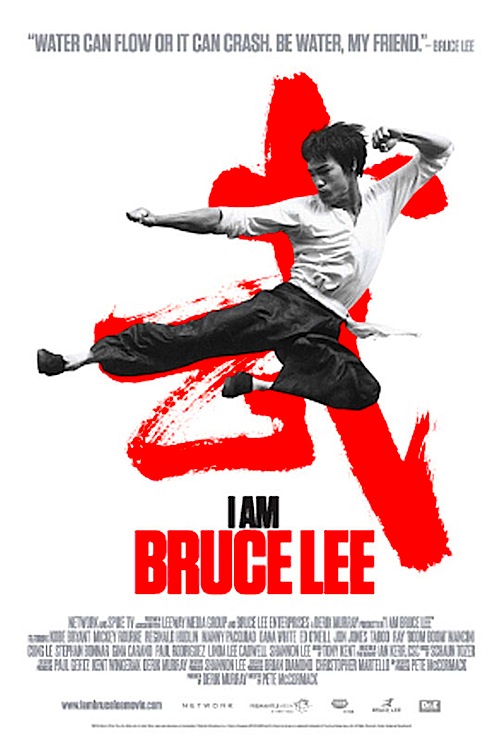
By Joe Bendel. Here’s a Chuck Norris fact: Bruce Lee laid a monster beat-down on him in Way of the Dragon. Frankly, it was a good thing for the then-reigning karate champion’s career. He was one of many world class martial artists who studied with Lee and were later recruited for roles in his films. There has only been one Bruce Lee, though. His friends and admirers pay tribute to the master in Pete McCormack’s I Am Bruce Lee, which has the first of two special screenings this Thursday throughout the country.

Lee was a man of destiny. A child star in Hong Kong, he learned the Wing Chun style of Kung Fu from master Ip (or Yip) Man, who has recently become the subject of a host of film treatments, including the internationally popular franchise starring Donnie Yen. Most viewers will know Lee’s story chapter and verse, but McCormack shoehorns in some interesting details. The 1957 Hong Kong cha-cha champion?  But, of course.

In terms of format, I Am is not all that different from Fuel-TV’s recent tribute series Bruce Lee Lives, mixing film excerpts with reminiscences from his family and colleagues, as well as commentary from contemporary mixed martial arts fighters, nearly all of whom revere Lee. However, the participation of Lee’s widow, Linda Lee Cadwell, and breakout martial arts movie star Gina Carano distinguish I Am. Nearly all of Lee’s films are discussed in length, but clips of Lee’s epic battle with Norris in the Roman Coliseum take pride of place.

While celebrating Lee’s mystique, I Am tries to put to rest many of the rumors surrounding his life, particularly notions that an ancient curse or the triads were responsible for his untimely death. It also attempts to minimize the non-dogmatic approach of Lee’s Jeet Kune Do as a forerunner to mixed martial arts, but apparently UFC founder Dana White did not get that memo.

Nonetheless, it certainly seems Lee inspired most of his fighters, including Cung Le, who also appears in the film. Yet perhaps the best advertisement for Lee’s Jeet Kune Do and related philosophy would be his friend and fellow teacher, seventy-something Dan Inosanto (the weapons master in Game of Death) who looks like he could be at least two decades younger in his I Am interview segments.

Built around Lee’s super cool “be like water” interview, I Am moves along at a quick pace, while emphasizing the spiritual aspects of his story. Just about every surviving figure in his life is heard from, except Norris. Granted, Lee fans have seen documentaries like this before, but we really cannot get enough of the icon. It might be hagiography, but it’s entertaining and appropriate. After all, this is Bruce Lee we are talking about. Proper respect must be paid. Recommended as a communal experience for fans (and isn’t that everyone?), I Am Bruce Lee screens this Thursday (2/9) and next Wednesday (2/15) nationwide, including the AMC Empire in New York and the AMC Metreon and 4 Star Theatre in San Francisco.

Posted on February 7th, 2012 at 11:35am.

Sundance 2012: LFM Reviews Bestiaire

By Joe Bendel. Zoos, farms, and taxidermy shops are good places for gawking at animals. French Canadian filmmaker Denis Côté essentially invites viewers to do precisely that. Supposedly, the clever part is that the animals will gawk back. However, they do not seem particularly interested in holding up their end throughout his non-narrative documentary Bestiaire, which screened as a New Frontier selection of the 2012 Sundance Film Festival.

Côté’s title is derived from the medieval bestiaries, which evoke images of lavish illustrations on gilt-edged illuminated pages. He takes rather the opposite approach, de-emphasizing the exoticism of the animals, focusing instead on the drabness of their surroundings. Unlike recent animal documentaries, such as the Jouberts’ Last Lions, Nick Stringer’s Turtle: the Incredible Journey, and even Nicholas Philibert’s Nenette (a film much closer akin to Bestiaire in terms of tone), Côté discourages attempts to impose individual personalities on the animals by framing them from off-kilter perspectives and completely eschewing mood-setting soundtrack music.

A considerable portion of Bestiaire was shot at Quebec’s Parc Safari, whose animal handlers are likely to stoke the zeal of anti-zoo protestors with their dispassionate professionalism. Indeed, Bestiaire could almost be considered an expose for people who really need films to be about something. Regardless, less adventurous viewers will be decidedly uncomfortable during the sort-of observational doc.

If you want to learn something about the process of taxidermy, Bestiaire eventually delivers the goods. On the other hand, if you want to get to know some of the beasts, Côté will deliberately undercut any such attempts. There is no question the filmmaker accomplishes exactly what he set out to do. Yet it remains wholly fair to ask “so what?” Probably more interesting as a concept than as a viewing experience, Bestiaire was definitely for the New Frontier track die-hards at this year’s Sundance Film Festival.

SUNDANCE GRADE: C

Posted on January 30th, 2012 at 12:18pm.