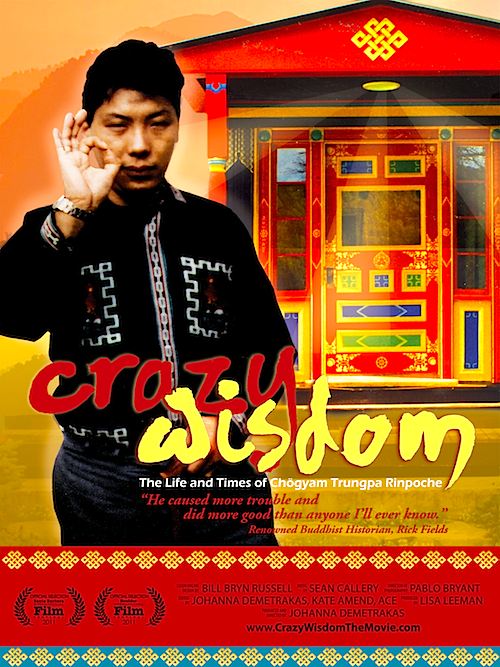
Tibetan Buddhism in a Business Suit: LFM Reviews Crazy Wisdom

By Joe Bendel. Chogyam Trungpa, Rinpoche was a Tibetan Buddhist teacher who embraced the 1960’s counterculture, but could not abide rock & roll. He drank significantly more than he should have, openly and often, but he had no use for drugs. A former monk, Trungpa renounced his robes, developing ways to teach Tibetan Buddhism in the western vernacular. A study in paradoxes, Trungpa’s all too brief life avoided cliché, making him a rich documentary subject in Johanna Demetrakas’ Crazy Wisdom: the Life and Times of Chogyam Trungpa, Rinpoche, which opens this Friday in New York at the Rubin Museum of Art.
A recognized reincarnation, Trungpa was the last of his generation to be entirely educated in Tibet. After the Chinese Communists invaded in 1959, he took a leading role securing the teachings and documents of his faith, personally guiding a group of his fellow monks to safety in India. Living in exile, Trungpa chose to embrace the west, trading his robes for a business suit. It was the start of a transformation that was decidedly controversial with his elders.

Living in Scotland, Trungpa married a young British woman and began teaching Tibetan Buddhism to hippies. For obvious reasons, they were attracted to his “crazy wisdom,” a recognized approach to enlightenment celebrating the eccentric and unconventional, sort of the rough Tibetan Buddhist analog to drunken master martial arts. However, Trungpa liked to keep people guessing.

As one of his students recalls, at the height of the anti-war movement, Trungpa was once asked to comment about aggression in America, to which he replied: “I want to talk about the aggression in this room.” Ouch. He was also evidently a stickler for the Queen’s English, perhaps giving scores of hippies their first elocution lessons. However, the greatest irony must have been the Dorje Kasung, the military drill team he established at Naropa University, the American Buddhist school Trungpa founded in Boulder, Colorado. Continue reading Tibetan Buddhism in a Business Suit: LFM Reviews Crazy Wisdom
LFM Review: Garbo the Spy

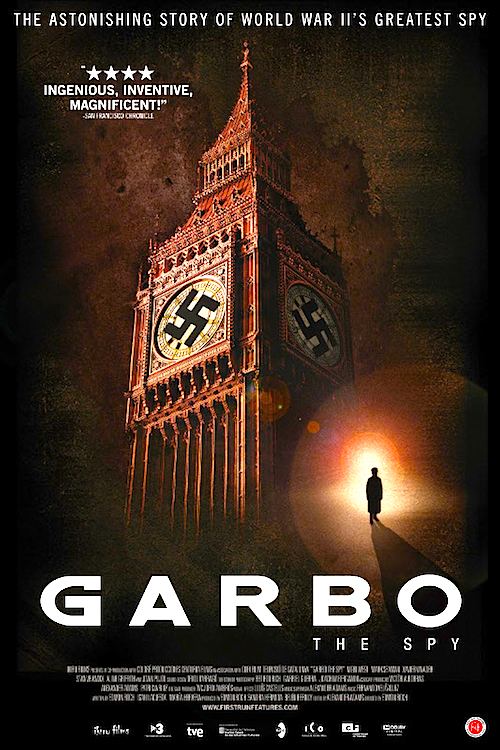
By Joe Bendel. Juan Pujol was the all-time greatest writer of spy fiction, but he wrote for a very select audience: German intelligence. Supposedly based in England, the Spanish double agent wrote incredibly verbose reports to his unsuspecting German handlers, riddled with disinformation and imaginary sub-agents, but it all boiled down to one word: Calais. Misdirecting the National Socialist war machine was the intrigue of a lifetime in Pujol’s life of intrigue, idiosyncratically documented in Edmon Roch’s Garbo the Spy (trailer above), which opens this Friday in New York.

The Germans knew him as Alaric, but the British code-named him Garbo. A deserter during the Spanish Civil War, Pujol’s story is so unlikely it would be difficult to believe without documentation. In fact, MI-5 did not believe him when the unprepossessing man came cold-calling. Rebuffed but undeterred, Pujol next approached the Germans, who immediately recruited him as an agent.

Pujol fed the Germans a steady diet of information largely culled from old newspapers that nonetheless built up his controllers’ trust. Eventually, after several further overtures, the British realized Pujol was legit and began directing his work. While he passed along a great deal of misleading intel, his most important assignment was Operation Fortitude, a concerted campaign to convince the Germans the D-Day invasion would land at Calais rather than Normandy.

Eventually, the war ends satisfactorily for Pujol. A bit of time passes, he disappears, and at some point is reported dead. Obviously though, there will be more to the master of the deception’s story. Military historian Nigel West (and former conservative MP under his given name, Rupert Allason) would tell the full tale when he literally wrote the book on Pujol, finally giving the remarkable spy his proper due.

Roch’s film is incredibly cinematic, employing extensive archival footage and clips from vintage war and espionage films as illustrative devices. In fact, the video sampling strategy often threatens to overwhelm the deadly serious subject matter, giving Garbo a vibe somewhat akin to a Jay Rosenblatt short film collage. Frankly, it occasionally borders on the inappropriately ironic. Still, the substance of Pujol’s story consistently rises above any stylistic excesses.

Garbo the film also boasts a relatively small but highly specialized cast of interview subjects, including West (as he is billed) and Aline Griffith, Countess of Romanones, a contemporary of Pujol’s working clandestinely for the OSS. Everything they have to say is quite noteworthy. It also interviews members from both of Pujol’s families, neither of whom knew of the other until West discovered his fate.

There is no question Pujol saved many Allied lives. Perhaps hundreds of thousands of servicemen survived the European theater because the Germans were dug in at Calais. The strange details and anecdotes surrounding Operation Fortitude by themselves are well worth the price of admission. Totally fascinating history, briskly if somewhat distractingly rendered on-screen by Roch, Garbo is definitely worth seeing, particularly for history buffs and espionage junkies, when it opens today (11/18) in New York at the Quad Cinema.

Posted on November 18th, 2011 at 3:52pm.

The New Iron Lady Trailer

By Jason Apuzzo. While we’re on the subject of major figures of the Cold War era (see the J. Edgar review below), a new trailer has just arrived for The Iron Lady, about Margaret Thatcher.

So will this be the hit job many people are fearing, or something more complex and true-to-life? Judge for yourself.

Posted on November 14th, 2011 at 11:26am.

Afghanistan in the Spotlight: LFM Reviews George Gittoes’ The Miscreants of Taliwood

By Joe Bendel. If the Taliban mullahs want to call you something heavy, they will probably label you a “miscreant” (a villainous heretic). Unfortunately, for entertainment-starved Pakistanis, just about everyone involved in artistic endeavors is automatically considered a “miscreant,” most definitely including actors and filmmakers. Ironically though, the cottage Pashto film industry was largely based in the Taliban stronghold of Peshawar, which is where Australian filmmaker-artist George Gittoes took his camera for an up-close and personal look at militant intolerance in The Miscreants of Taliwood (see a 6-minute preview above), which screens during Anthology Film Archives’s upcoming retrospective of Gittoes gonzo-ish filmmaking.

If truth be told, Gittoes was probably fortunate to live through the first thirty seconds of Miscreants. Fortunately, he was only roughed up a bit while filming Islamists building a bonfire of CDs and DVDs in Islamabad, a city that Gittoes reminds viewers contains nuclear weapons. However, as Gittoes pursues his story, he becomes increasingly a part of his own film, at considerably further risk to his own well being.

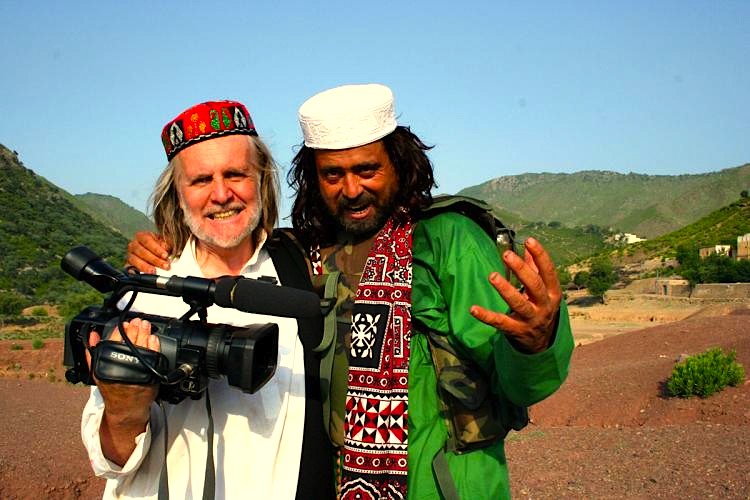
While it is ordinarily annoying to see filmmakers inject themselves into their own documentaries, Gittoes was hardly motivated by self-aggrandizement. To gain access to the world of Pashto filmmaking, he became an actor himself, forming a fast friendship with his co-star Javed Musazai. When the Taliban terrorized Taliwood into submission, Gittoes financed two films on his own in order to keep the documentary going. Though hardly well-heeled, Gittoes is able to scrape together seven grand, sufficient funds for two Pashto films.

George Gittoes & Javed Musazai in "The Miscreants of Taliwood."

Continue reading Afghanistan in the Spotlight: LFM Reviews George Gittoes’ The Miscreants of Taliwood

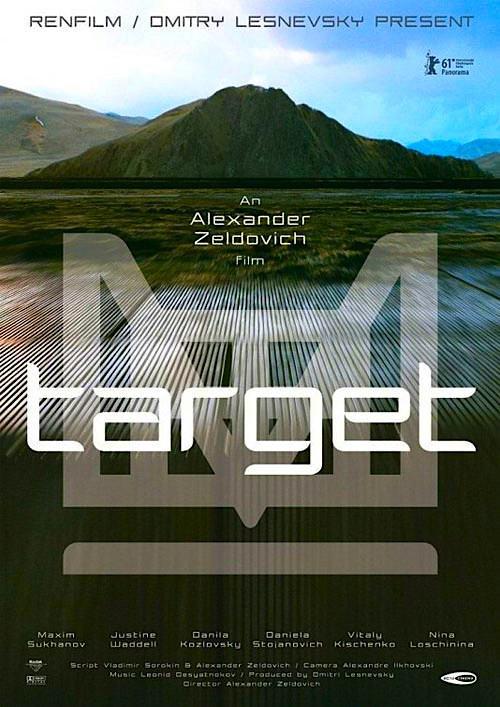
Russian Film Week 2011: LFM Reviews The Ambitious Sci-Fi Epic The Target

By Joe Bendel. In near future Russia, red signifies good and blue designates evil. Ahem. Russia’s powerful natural resources minister is preoccupied with a device that reveals the good-to-evil ratio of everyone and everything viewed through it. He would like to put this information into practice and he ought to have the time to do so, considering he will more or less live forever. Of course, nothing is quite so simple in Alexander Zeldovich’s science fiction fable The Target (trailer above), which screens during the eleventh annual Russian Film Week in New York.

Somewhere in Nowherestan, there is a colossal abandoned Soviet astrophysics research facility. Built into the ground, it looks like a giant target from the surrounding mountains. The bull’s eye collects not just radiation, but also chi force. Those who spend the night in the focal point will apparently live forever. For a man of privilege like Minister Viktor Chelshchev and his increasingly discontented wife Zoya, it is a trip worth the expense and inconvenience.

With Zoya’s brother Dmitri and his friend Nikolai, a thrill-seeking border enforcement officer, they make the long journey east. They also share their passage with another postmodern pilgrim, who turns out to be the woman of Dmitri’s dreams. Together they spend a fateful night in the Target, which turns out to be everything it was promised to be and then some.

Initially, everyone feels energized, buzzed even. However, it quickly becomes clear the target acts as a karmic steroid shot. Their emotions become rawer and their passions more intense, overriding their empathic affinities. As Zoya and Nikolai launch into an affair, taking the film on a futuristic Anna Karenina detour, Chelshchev boldly announces his intention to screen mines and worksites to avoid evil deposits (for real). How do you think that goes over?

A strange but not implausibly exotic environment, Target initially brings to mind the austere, almost antiseptic near future vibe of classic 1960’s-70’s science fiction films like 2001, World on a Wire, and, dare we say it, Solaris. However, things get rather messy in a hurry. Indeed, Target is a tricky film to get a handle on, because it veers into some trippy territory that has very real narrative consequences. Yet, despite the nature of its themes and motifs, there is nothing New Agey about the film. It is never proscriptive. Rather, it returns to one of the central cautionary principles of speculative fiction: those who would become like gods . . .

As Zoya/Anna, South African born English actress Justine Waddell (who had a smaller supporting role in Bernard Rose’s Anna Karenina) is a brittle, haunting presence, bringing to mind Anouk Aimée and Anna Karina in the films of Fellini and Godard. Likewise, Maxim Sukhanov finds unexpected depths of humanity in Chelshchev, somewhat resembling a Russian Mastroianni. Indeed, Target is better thought of in Nouvelle Vague and surrealist traditions than as genre cinema per se.

From the Russian sci-fi epic "The Target."

Ambitious in scope, cinematographer Alexandre Ilkhovski’s wide vistas of the Target and surrounding mountains are visually arresting. This is definitely big picture filmmaking. Still, in several respects Target is an alarmingly current film, positing a Russia ever more dominated by a resource hungry China. It also depicts the violent cruelty of mobs in no uncertain terms. Even if they are poor, they can still be evil.

In just about every way, Target is an uncompromising film for the ‘top one percent’ rather than a simpleminded rabble. For those who enjoy science fiction at its most challenging, Target is strongly recommended. It screens again tomorrow night (11/1) during Russian Film Week in New York.

Posted on October 31st, 2011 at 12:13pm.