The Cold War Returns: LFM Reviews The Double

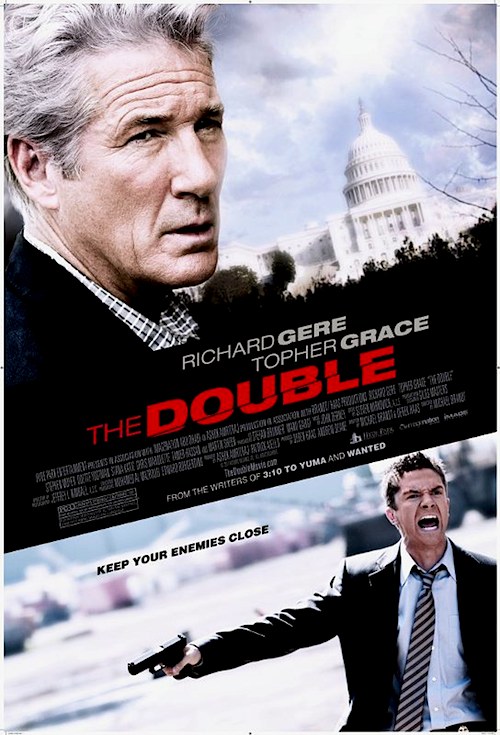
By Joe Bendel. The Cold War is over, technically speaking, but a lot of unfinished business remains. A notorious Soviet assassin is one of those loose ends. Never captured but presumed dead for years, the American intelligence services are slightly concerned when the body of a murdered senator bears the signature techniques of the killer code-named Cassius. Unfortunately, the game is afoot once again for his temporarily retired CIA nemesis in Michael Brandt’s The Double, which opens this Friday in New York.

Paul Shepherdson thought it had all ended with a bang. Cassius’s body was never recovered, but since the killings stopped, closure appeared to be achieved. Years later, the Senate’s leading critic of neo-Soviet Russian aggression is brutally murdered. Pointing to a few variations here and there, Shepherdson insists it is the work of a copycat. However, FBI analyst Ben Geary is certain it is Cassius’s work. He is also something of an expert on the old Soviet bogeyman, having written his master’s thesis on Shepherdson’s investigation. Reluctantly, the CIA veteran agrees to an inter-agency odd-couple pairing with Geary, trying to pour cold water on his enthusiasm every step of the way.
Refreshingly, the Russians and the Soviets before them are the villains in The Double, while the Americans simply scramble to counter their infiltration campaign. (It is a bit of a stretch making the murdered hawkish senator a Democrat and his Russian puppet counterpart a Republican, but if that is the concession that had to be made, so be it.) On the macro political level at least, Double is quite sound and realistic.

Double takes great delight in springing two big twists on the audience, yet inexplicably gives away the first one in the trailer (above). Several more follow, which naturally alter our perceptions of characters a second time. While viewers will be primed for the second switcheroo, Double has some very smart investigative detail that makes the dot-connecting process considerably more engaging than usual.

As Shepherdson, Richard Gere has the right steely, grizzled presence, maintaining a consistent world weary character throughout his character’s revelations. Frankly, Double is his best work in years (maybe since Chicago). Conversely, Topher Grace’s Geary looks like a mere boy among men. Granted, he is a rookie, but he does not even look convincing wearing a suit. His presence is a major albatross weighing down the film. Still, the film has Martin Sheen, suitably commanding as CIA director Tom Highland and True Blood’s Stephen Moyer nicely projects feral cunning as Brutus, the only captured member of Cassius’s team.

In his directorial debut, 3:10 to Yuma co-writer Brandt maintains a decent if not exactly breakneck pace. He has a nice handle on the details, but never delivers a centerpiece action sequence. Still, it is a solid Cold War-reloaded thriller genre fans and Russophobes should enjoy when it opens Friday (10/28) in New York at the AMC Empire and Village 7.

Posted on October 28th, 2011 at 10:11am.
NBC Developing The Infidel as a TV Series

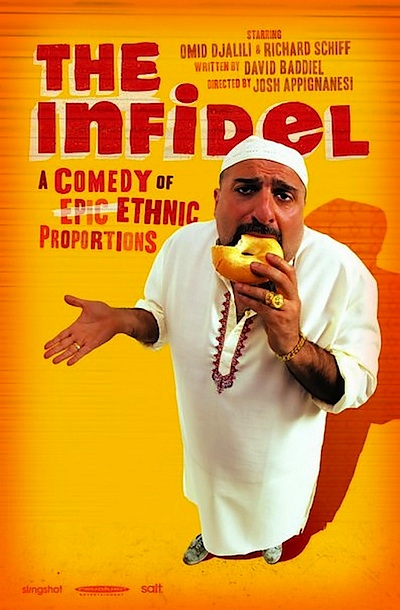
By Govindini Murty. One of the reasons we champion independent film here at Libertas is because of the crucial role it plays in incubating talent. One of the first indie films we talked about when we launched Libertas Film Magazine was The Infidel, a quirky little British comedy that screened at the Tribeca Film Festival in the spring of 2010. The Infidel tells the hilarious story of a middle-aged Muslim man, Mahmud, who finds out that he was actually born Jewish – at the very same time that he also discovers that his son is about to marry into the family of a radical Islamic cleric.

One of the reasons we liked the film so much was because of the lead performance of Omid Djalili, the Iranian-British comic who plays the hapless Mahmud. You can read Jason’s review of The Infidel here, and you can see a number of Djalili’s hilariously un-PC comedy skits on YouTube. One of my favorite Djalili skits is “Arabs at the airport” (Djalili describes getting freaked out when he sees Arabs at the airport), and I also like his satires of immigrant Iranian life – they remind me of the earthy and very funny ethnic humor of Nia Vardalos’ My Big Fat Greek Wedding. Check out Djalili’s “Iranian in UK,” a satire of Sting’s “Englishman in New York.”

Now Deadline Hollywood reports that NBC is developing a TV series to be based on The Infidel. The series would star Djalili, who would also produce the show with his wife. This seems like a timely idea to me. A comic of Iranian descent succeeding in mainstream American TV while satirizing radical Islamist mores would send a great message to the rest of the world – one that advocates for moderation over extremism in the Muslim community. It would also be a rebuke to the repressive Iranian regime, which, as we’ve documented numerous times here, jails and abuses it own leading filmmakers and film artists in one of the most anti-art dictatorships on earth.

Finally, a TV series based on The Infidel is a good idea because it would also just be funny. I don’t find a lot of today’s comics very amusing, but Djalili is one of the few who seems to have a natural ability to make people laugh based on character and timing – not just gross-out jokes. This is a great thing, whether or not it leads to world peace and understanding. I hope the NBC series stays true to the courageous, un-PC spirit of the original film. I find the Brits are a lot braver in their satire than Americans, and I truly hope that NBC doesn’t water down the comedy of the original Infidel or reverse its message. Check out the trailer for The Infidel above and I think you’ll see why we welcome this becoming a TV series.

Posted on October 26th, 2011 at 7:51pm.

Totalitarian Kitsch: The Juche Idea on DVD

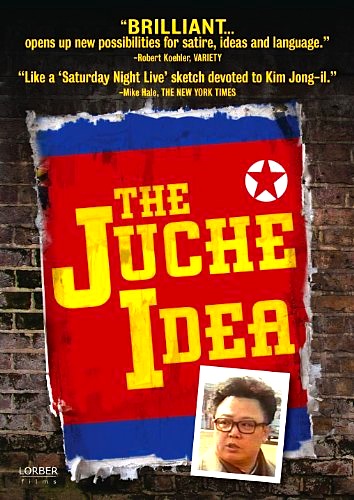
By Joe Bendel. Before Kim Il-sung, mass-murdering megalomania had never been so kitschy. The Kim dynasty’s tyrannous misrule has been marked by imposingly ugly architecture, stilted cinema, and truly bizarre mass “arirang” stadium performances, all of which promoted the so-called Juche Idea, his crypto-Confucian brand of self-isolating socialism. An expatriate leftist South Korean filmmaker takes on the challenge of making Juche propaganda art films for an international audience, when not weeding the vegetable patch of a North Korean arts collective in The Juche Idea (trailer above), Jim Finn’s experimental mockumentary mash-up, now available on DVD.

Before he bravely led the proletariat into the future, the crown prince Kim Jong-il wrote North Korea’s definitive book on film studies. Not surprisingly, he concluded any honest, class conscious film should scrupulously adhere to his father’s Juche Idea concepts. DPRK films tended to be a wee bit formulaic as a result, typically culminating with a tearful self-criticism session and a vow to rededicate one’s self to Communist Party, as Finn illustrates with several clips crying out for the Crow and Tom Servo treatment.

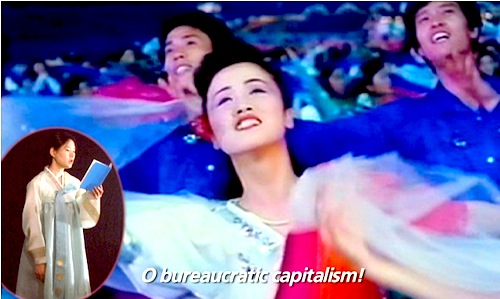
As Yoon Yung Lee, the filmmaker-in-residence, splices together her strange Chuck Workman-like Juche films, the insular nature of the North’s ideology-driven culture becomes inescapably obvious. As soon as any distance is applied to the cheesy visuals and overblown synchronized dance numbers, irony rushes in like air into a vacuum. There is also an unexpected abundance of accordion music to heighten the surreal vibe of it all.

Finn never directly addresses the brutal reality of DPRK concentration camps, intrusive secret police, and widespread famine. As a result, Juche Idea really ought to be seen in conjunction with other North Korean documentaries, like Mads Brügger’s fearlessly subversive Red Chapel, which Lorber Films has also just released on DVD.  Unlike the play-it-safe “Yes Men,” Brügger and his colleagues punk a target that wields absolute, unchecked power, on its own turf. You have yet to truly live until you have witnessed a pair of Danish-Korean comedians perform a slapstick rendition of “Wonderwall” for an audience of stone-faced DPRK apparatchik-minders in this mad expose-performance art hybrid.

In contrast, Juche Idea is all about the outrageous over-the-top propaganda serving the Great and Dear Leaders’ personality cults, without any reality-based context. Though it seems hard to miss the joke when a Russian tourist’s loose bowels lead to a lecture on the merits of North Korea’s socialized medicine, some of those protesting downtown might just swallow it whole.

Clearly, Finn is not exactly an underground conservative filmmaker, having also produced the short film Dick Cheney in a Cold, Dark Cell, which should have certainly maintained his standing in the experimental film community. Still, after watching Juche it is clear North Korea is a profoundly scary place, at least by any rational aesthetic standard.

Viewers who missed Brügger’s Chapel in theaters should definitely catch up with it first and then supplement it with Juche’s head-spinning images and sly satire. Though only sixty-two minutes, there are some nice supplements on the DVD, including some deleted scenes, such as a whacked-out Juche comic book given the motion-comic treatment, as well as Finn’s short film Great Man and Cinema, which essentially boils down the essence of Juche Idea to three minutes and forty-nine seconds. Recommended for the ironically-inclined and the propaganda-savvy, Juche Idea and Chapel are easily two of last week’s most notable DVD releases.

Posted on October 13th, 2011 at 5:05pm.

The Act of Valor Trailer; Film Opens Feb. 17th


By Jason Apuzzo. A trailer has just been released for Act of Valor, the Navy SEAL-themed movie that Govindini mentioned in her Atlantic column from yesterday, and that I mentioned in my first Terror Watch update.

On balance I like the look of the film, and the scale of it seems impressive for an indie production. Obviously the cooperation of the military was critical here. My understanding is that Act of Valor began as a documentary-style production about SEAL operations and then gradually morphed into a more conventional narrative – and the trailer certainly has a hybrid, docudrama feel to it. In any case, it looks like something that will be worth seeing in IMAX when it’s released in that format come February of next year.

Take a look and tell us what you think.

Posted on October 13th, 2011 at 5:04pm.

Libertas @ The NYFF: Martin Scorsese’s George Harrison Living in the Material World; Film Debuts on HBO Oct. 5th & 6th

By Joe Bendel. He was frequently dubbed “the Quiet Beatle,” but George Harrison could also be called the cineaste Beatle. One of his first solo projects was the original soundtrack for Joe Massot’s psychedelic Wonderwall, completed while the Fab Four were still together. After the band broke up, he eventually founded Handmade Films, providing a jolt of capitol for independent British filmmakers. Harrison himself gets a full 208 minutes of screen-time in Martin Scorsese’s definitive documentary, George Harrison: Living in the Material World, which screens this Tuesday at the 49th New York Film Festival, just ahead of its HBO premiere.

Yes, George Harrison was a lad from Liverpool. The youngest Beatle, he was initially recruited because he could actually play. The general gist of the Beatles story will be generally familiar to just about everybody: initially, Lennon and McCartney were front-and-center, carrying the songwriting load, but slowly Harrison asserted himself, introducing the sitars and tablas into their later, trippier recordings. Since Yoko Ono consented to an on-camera interview, their eventual break-up is presented solely in terms of the stress of working so closely together for such a long time. Still, it is hard not to get sucked into Scorsese’s Harrison-centric retelling of the Beatles mythos.

However, it is something of a surprise how eventful Harrison’s post-Beatle years were, despite his often deliberately low profile (essentially constituting the second half of Material). Of course, his spiritual quest continued, which is a major focus for his widow, co-producer Olivia Harrison. Those who saw the IFC Channel’s behind-the-scenes history of Monty Python will already be well aware of Harrison’s close personal relationship to the comedy troupe, but who knew he was a Formula One Racing fan? In fact, one of the most touching interview segments features his friend Jackie Stewart, the “Flying Scotsman.”

If Ono gets a pass, at least Eric Clapton is forthright enough to address on-camera the whole business of how he romanced Harrison’s first wife while they were still married, albeit rather gingerly. Yet, for personal drama, the events surrounding the violent home invasion Harrison survived late in life effectively serves as a rather stark climax.

Harrison’s friends and family make a compelling case he just might have been the most interesting Beatle. Scorsese calls in some major star power, including both surviving Beatles as well as fellow Traveling Wilbury Tom Petty. It is also a pleasure to see Jane Birkin (from Wonderwall) on-screen in any context, but it is just plain creepy when his one-time producer Phil Spector shows up.

Material is a very good rock doc, but the nearly three and a half hour running time is pushing the limit. According to IMDB, it is almost half an hour longer than Ken Burns’ Thomas Jefferson—and Jefferson was the first to do just about everything. Nonetheless, it is consistently more engaging than the Lennon documentary that screened at last year’s NYFF. As a further point in Material’s favor, Scorsese, Olivia Harrison, and their collaborators almost entirely avoid politics, focusing squarely on the musical, spiritual, and personal aspects of his life, essentially in that order of concentration. Informative and entertaining, Material screens this Tuesday (10/4) at Alice Tully Hall as a Main Slate selection of the 2011 New York Film Festival and airs on HBO in two parts this Wednesday and Thursday (10/5 & 10/6).

Posted on October 4th, 2011 at 2:00pm.

A Tale of Two Releases: Red Dawn Remake Finally Gets a Distributor; Ben-Hur Blu-ray Arrives Tomorrow (9/27)

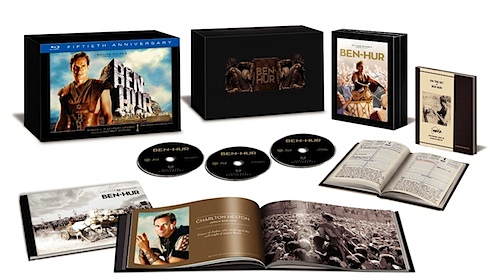
By Jason Apuzzo. I wanted to briefly comment today on two releases of note. First of all, the 1959 classic Ben-Hur is getting a lavish new Blu-ray release that arrives in stores tomorrow. I’ve embedded the Blu-ray trailer above, and you can read here about the details of this fabulous-looking set – which includes a documentary featuring newly-discovered behind-the-scenes footage from the set of the film provided by Fraser Heston (Charlton’s son). The Blu-ray set will also include a reproduction of Charlton Heston’s set diary, along with behind-the-scenes photographs taken by Heston’s wife, Lydia. All in all, it looks to be a wonderful release for one of Hollywood’s landmark films of the 1950s – an epic tale of one’s man’s struggle to regain freedom for himself, his family and for his people.

The new "Ben-Hur" Blu-ray box set.

Govindini and I had the pleasure of attending the recent exhibition of Debbie Reynolds’ costume-and-props collection, at which we saw Charlton Heston’s, Stephen Boyd’s and Sam Jaffe’s costumes from Ben-Hur – along with a variety of props from the film. It was an incredible experience seeing these things in person, with the film having been such a favorite of ours over the years. I’m not certain what’s happened to those items since, in terms of whether they’ve already been auctioned; whatever their fate, it seems a tragedy that Reynolds’ collection couldn’t have been kept together. In any case, after so many years it was a thrill to see items from Ben-Hur, at all. (Amazingly, Reynolds’ collection even included Francis X. Bushman’s winged helmet from the original 1925 Ben-Hur) I hope this Blu-ray release further burnishes the film’s legacy for a new generation.

In other news, according to the LA Times today the Red Dawn remake has finally picked up a distributor, FilmDistrict (Drive). As regular Libertas readers know, Libertas is still the only media outlet that’s seen the original, uncensored version of the film (see our exclusive review of the new Red Dawn) that featured the Chinese communist People’s Liberation Army as the villains. The forthcoming, digitally-altered version of Red Dawn – which apparently features some sort of generalized Asian communist menace, led by North Korea – will now likely be arriving in theaters sometime in 2012.

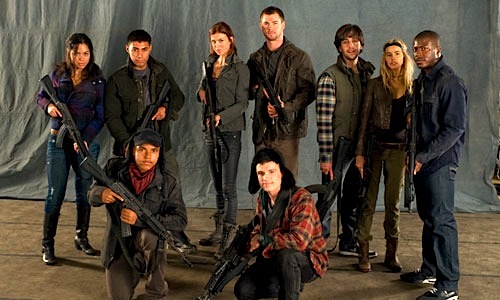
Chris Hemsworth and Adrianne Palicki lead the cast of the new "Red Dawn."

Somewhat lost in the controversy when we initially published our review of Red Dawn was that we actually liked the film, and were simply disappointed at the corporate decision to re-edit it in order to placate the Chinese. I still don’t like MGM’s decision to re-edit the film because of what that decision implies about freedom of speech in Hollywood, particularly at a time when many of China’s own ‘D-Generation’ (‘digital generation’) filmmakers are currently risking their lives and careers (see our review of Once Upon a Time Proletarian from just this week) in telling truthful stories about China’s oppressive regime. The re-editing/censoring of Red Dawn is a much bigger deal than, say, whether Han or Greedo shot first in the Mos Eisley cantina – because it has broader implications for what can and can’t be said by mainstream American filmmakers about the human rights situation in China.

As Charlton Heston himself used to say, “Film is our best export next to freedom,” and it’s best when the films America exports also say something about freedom. Red Dawn had that opportunity – an opportunity to say something sharp, poignant and specific about one particularly tyrannical modern regime (in the same way John Milius’ original Red Dawn had) – but the makers of the film apparently flinched when corporate profits were on the line.

That’s not a very inspiring example, certainly not in the way Ben-Hur was.

Posted on September 26th, 2011 at 4:32pm.