LFM Reviews The Man from U.N.C.L.E.

By Joe Bendel. In the 1960s, the MGM-produced Man from U.N.C.L.E. was one of the few TV shows that was successfully repackaged for American theatrical release. A little bit more action and seduction was added to two-part episodes that were then distributed in color, at a time when most televisions were in low def black-and-white. Frankly, it is rather surprising it has taken this long for the franchise to get the Hollywood reboot treatment. Happily, Guy Richie and co-screenwriter-co-producer Lionel Wigram harken back to the original first season more than the three shtickier years that followed. Nor do they attempt to update it for younger, dumber generations. The sixties are swinging and the Cold War is slowly boiling in Richie’s The Man from U.N.C.L.E., which opens today nationwide.

Napoleon Solo is a suave as it gets. The roguish CIA agent reluctantly agreed to put his talents at Uncle Sam’s disposal, when his career as an international art thief was thwarted through dumb luck. His latest mission will be smuggling Gaby Teller out of East Berlin.

Illya Kuryakin is an ardent Communist. That means he is not suave at all, but as a KGB agent, he is decidedly lethal. His latest mission will be keeping Teller in East Berlin. He will fail, but he will soon meet Solo and Teller again in Rome, ostensibly working together.

In a rare case of Cold War collaboration, the rival intelligence services will combine forces to stop a rogue element from building a super potent nuclear weapon with the help of Teller’s long estranged scientist father (Teller is indeed a credible name for a nuclear physicist, after all). Of course, it will be every spy for himself when it comes to retrieving this Teller’s research.

Like the source television show, the new U.N.C.L.E. kind of-sort of represents an idealist manifestation of détente during the height of the Cold War. However, Kuryakin’s backstory of doggedly striving to compensate for his family’s fall from grace during the Stalinist Purges would hardly earn Alexander Cockburn’s seal of approval. However, it adds a note of clear-headed historical context and makes Kuryakin’s proletarian plugger considerably more compelling.

Frankly, he needs the help, because Henry Cavill’s Solo eats Armie Hammer’s Kuryakin for lunch time and again during the film. Cavill’s scenery chewing work represents a star-establishing turn that out-Bonds James Bond, without descending into outright camp. Further upstaging Hammer, Alicia Vikander finally lives up to her hype as the next big thing smoldering up the screen as Gaby Teller.
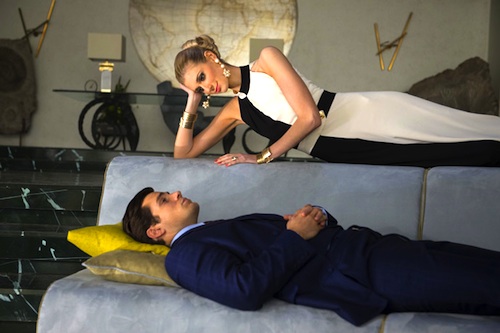
From "The Man from U.N.C.L.E."

Unfortunately, Elizabeth Debicki and Deutschland ‘83’s Sylvester Groth are just okay as the standard issue Euro-villains, but Rome sure looks fab. Arguably, Richie is the most stylish director whom a major studio would trust with the keys to their shiny new prospective franchise reboot—and his sensibilities are perfectly attuned to the look and tenor of vintage Fellini Rome. His U.N.C.L.E. just oozes attitude and sophistication. He also has a hip ear for music (even though Les McCann & Eddie Harris’s rendition of “Compared to What” would have been even cooler for the opening titles than Roberta Flack’s).

Thanks to Richie’s disciplined flamboyance and key contributions from cinematographer John Mathieson and costume designer Joanna Johnston, U.N.C.L.E. is retro but not kitschy. Altogether, it is rather a good deal of throwback fun. Recommended for fans of the old school spy thrillers, The Man from U.N.C.L.E. opens wide today (8/14), including the AMC Empire in New York.

LFM GRADE: B+

Posted on August 14th, 2015 at 8:54pm.
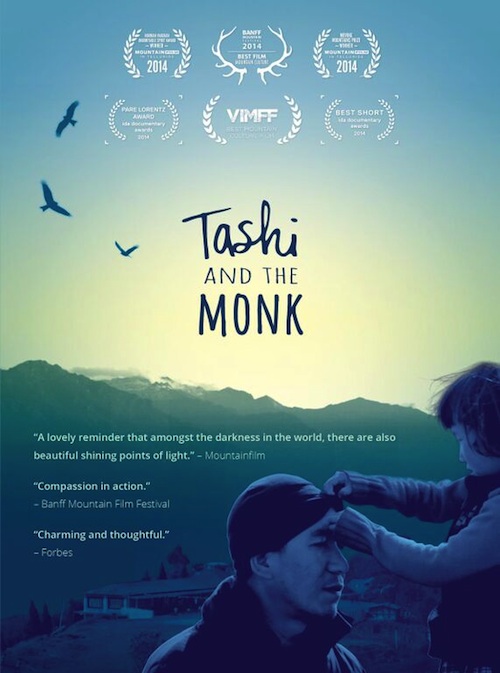
LFM Reviews Tashi and the Monk on HBO

By Joe Bendel. Lobsang Phunstok is sort of the Father Flanagan of Tibetan Buddhism. At the foot of the Indian Himalayas, he founded Jamtse Gatsal, or “The Garden of Love and Compassion,” an orphanage and school for abandoned children. He might be a former Buddhist monk, but he has the patience of a saint when it comes to difficult children like Tashi Drolma. However, you have to feel for the five year old, considering how much she has already faced up to in her young life. Lobsang Phunstok and his staff will help her find her place in Jamtse Gatsal and start to heal her trauma in Andrew Hinton & Johnny Burke’s Tashi and the Monk, which premieres this coming Monday on HBO.

Drolma’s alcoholic father abandoned her sometime after her mother died at a tragically young age. That is more than any kid should have to deal with, so it is hardly surprising her behavior tends towards the aggressive. There is no question she is disruptive, but when you hear her make-up revealing stories about little girls just like her that are haunted by ghosts, it is easy to see she is hurting. Lobsang Phunstok understands only too well. He was also abandoned during childhood. That is why he will not give up on a trouble-maker like Drolma, even while he wrestles with difficult administrative dilemmas, especially his admissions process.

Clocking in well under an hour, T&M is comparatively brief, but it pummels viewers’ heartstrings. The disarmingly innocent looking Drolma will activate every protective instinct the audience might have, so it is rewarding to see her finally settle in, thanks in large measure to Raju, her “big brother.” However, the film also makes it painfully clear the good monk simply cannot save every child in need, showing us the tragic consequences for one child he was unable to admit.

We often think of Tibetan Buddhist monasteries as exotic places of spiritual sequestration. In contrast, T&M and Frederick Marx’s Journey to Zanskar paint a dynamic portrait of Tibet Buddhism as an activist faith, very much engaged with the welfare of the young and desperately disadvantaged. Both documentaries capture deeply moving human stories, while acting as a corrective to Lost Horizon-style exoticism.

After watching T&M for forty-some minutes, you will ardently care about what happens to both Tashi and her guardian. Hinton & Burke also have a good eye for visuals, giving viewers a vivid sense of the stunning Himalayan environs. It is a truly inspirational film that never feels saccharine or manipulative. Highly recommended for those interested in Himalayan culture and faith in action, Tashi and the Monk airs this Monday (8/17) on HBO.

LFM GRADE: A

Posted on August 14th, 2015 at 8:54pm.

LFM Reviews Ping’an Yueqing @ Cinema on the Edge

By Joe Bendel. Experts contend the greatest degree of corruption in American government happens at the local level, because that is where most land use decisions are made. Apparently, it is the same in China, but more lethally so. The late Qian Yunhui was a rare breed—a village chief who actually protested the government’s land appropriation schemes. That may very well be why he is now the late Qian Yunhui. Ai Weiwei and his filmmaking team investigate the suspicious circumstances surrounding his death in Ping’an Yueqing, which screens as part of Cinema on the Edge, a retrospective tribute to the Beijing Independent Film Festival now playing in New York at Anthology Film Archives.

If you were still unclear how independent the Beijing Independent festival was and why the Communist government so resented their maverick programming, just start watching Ping’an Yueqing. Sadly, the village of Yueqing is anything but “peaceful.” Qian was imprisoned for over four years, but the village refused to elect another headman, because he was faithfully representing their concerns. Then one morning, Qian was conveniently struck and killed by a heavy truck owned and operated by the local power authority.

After an unseemly short investigation, Qian’s death was ruled an accident and his two deputies were arrested for obstruction of justice. Sensing a cover-up, the internet quickly took up the case. As the citizen investigators explain to Ai Weiwei, the traffic surveillance camera was ever so strangely offline for maintenance exactly during the so-called accident. However, video recorded by Qian’s smart-watch device (like his own, personal Zapruder film) did not match the description of the scene in police reports. The few eye witnesses willing to testify also contradict the official story in various ways. Yet, perhaps the most damning circumstantial evidence is the pattern of troublesome Zhejiang officials who were previously done in by similar traffic accidents.

Teacher Ai and his team do their best to put the dissembling officials on the spot. It is not always pretty, but the state mouthpieces generally conduct themselves more shrewdly than the apparatchiks in his classic Disturbing the Peace and So Sorry. However, the most disturbing sequences are the dozens of Yueqing villagers who tell Ai’s camera crews “if I talk to you, they will make me disappear tonight,” in exactly those terms. Regardless of the Qian case, this is obviously a profoundly ailing community, suffering from oppressive corruption.

From "Ping’an Yueqing."

Ping’an uses the same straight, unfiltered approach as seen in other Ai Weiwei documentaries, but in this particularly complicated case, it would have been helpful to have an on-camera presence to help marshal the often contradicting testimony and to occasionally provide context. Of course, Teacher Ai would have been perfect for such a role, but he is not inclined to inject himself into other people’s stories.

Regardless, Ping’an is a courageous example of independent filmmaking and investigative journalism. It shines a searing spotlight on a tawdry episode the Party would love the world to forget. Yet, thanks to Ai Weiwei and the Beijing Independent fest, cineastes who have never heard of Qian Yunhui will keep revisiting the events in Yueqing. A bold and chilling work of non-fiction filmmaking, Ping’an Yueqing is highly recommended for anyone who really wants to see what speaking truth to power really looks like when it screens again this Thursday (8/13) at the Anthology Film Archives and as part of the forthcoming tour of the Cinema on the Edge retrospective.

LFM GRADE: A

Posted on August 12th, 2015 at 10:11pm.

LFM Reviews Female Directors @ Cinema on the Edge

By Joe Bendel. If you think it is tough for women to get a fair shake in Hollywood, try breaking into the business in mainland China. Two young and jaded film school grads have been stymied thus far, so they are making their own darned movie now. However, their hybrid mockumentary will reveal more than they anticipated in Yang Mingming’s Female Directors, which screens as part of Cinema on the Edge, a retrospective tribute to the Beijing Independent Film Festival now playing in New York at Anthology Film Archives.

Even though they are the compromised guardians of Mao’s leftist revolution, the Party is rather puritanical when it comes to sex. It therefore takes all of ten seconds to figure out why Female Directors had to be produced outside the system. There is more “slut-shaming” in its caustic forty-three minutes than in of Amy Schumer’s films to-date, repeatedly played ten times in a row. Of course, it is important to remember, when Yang and her cohort Guo Yue make naughty jokes, they are actually running real risks with the powers-that-be, whereas Schumer is hailed as the new Sarah Silverman, until the next one comes along.

Soon after Ah-ming and Yue Yue (their fictionalized personas) commence shooting their DIY chronicle of creative unemployment, they discover they have both been carrying on with the same married sugar daddy. Neither professes to feel much for the wealthy little creep, yet they each clearly resent how the other has allegedly cashed-in on the relationship. Actually, they use terms for this that would be inappropriate for a family site. Will their friendship survive? Will they finish the film? Will they confront the man they dub “Mr. Short?”

From "Female Directors."

Given the running time, we will have these answers in short order, but one thing is certain—they will not be welcomed into the filmmaking establishment anytime soon. At one time, Yue Yue might have had a shot. She joined the Party during her high school years, but was expelled for attending an Ingmar Bergman retrospective, which is depressing in multiple ways.

Even by western standards, Female Directors’ dialogue is unusually explicit, but the film never shows any actual whoopee-making and very little skin. Compared to Ah-ming and Yue Yue, the Sex in the City characters sound like Amish women at a quilting circle. Yang and Guo Yue are incredibly charismatic and acerbic, wielding their cutting dialogue like machetes. They seem so believably messy and frazzled playing off each other, and the entire film feels uncomfortably real.

Regardless, Yang is critical of more than just double standards and glass ceilings. The film is also disrespectful to most forms of authority. As a result, the finished package is sly, tight, and surprisingly refreshing, but absolutely not for kids. Recommended for fans of adult meta-comedy, Female Directors screened again with Listening to Third Grandmother’s Stories this Wednesday (8/12) as part of Cinema on the Edge at Anthology Film Archives.

LFM GRADE: B+

Posted on August 12th, 2015 at 10:10pm.

The Mean Streets of Waikiki: LFM Reviews Paradise Broken

By Joe Bendel. This is not Steve McGarrett’s Hawaii. Behind the luxury hotels, sex and drugs are openly sold, with nary a cop in sight. Even though they are locals, a junkie-pimp and his prostitute-girlfriend have a hard time making it on Waikiki’s mean streets in James Sereno’s Paradise Broken, which MarVista Entertainment releases this week on VOD platforms, including Vudu.

Ray Geronimo and Misha Domingo vaguely dream of owning their own beachfront bungalow, but their day-to-day concerns solely focus on their next hit of smack. Towards that end, Geronimo reluctantly started pimping Domingo out. It was really her idea. She thinks they can do better if they join forces with the Mainlander known only as “Pimp” (seriously, that is all it says on his business cards), but Geronimo sees him as just another outside exploiter. He would rather poach the gangster’s greenest new street-walker. However, Geronimo’s expansionist plans incite Domingo’s jealousy, leading to a messy split at an inopportune time.

Whether together or apart, Geronimo and Domingo will do junkie things as junkies do, which isn’t very pretty to watch, but it is relentlessly honest. Similarly, Sereno is determined to reinforce the notion of two radically different Hawaiis, immediately following up every glamour shot of the coast line or the night club with an up-close-and-personal look at the underclass squalor of Dante’s life.

From "Paradise Broken."

As Geronimo, Dante Basco (a veteran of the Awesome Asian Bad Guys) is a tightly coiled spring, always ready to explode with rage. Nadine Nicole Heimann is also plenty erratic as Domingo, while Katherine Emily Mills is a disturbing picture of innocence as the girl he tries to recruit. However, the demonically charismatic Khalil Kain steals scene after scene as Geronimo’s more ruthless rival. Some might consider it a dubious honor, but Kain’s nameless antagonist might be the most distinctive movie pimp performance since Morgan Freeman’s Oscar nominated turn in Street Smart.

Although there is a bit of an over-reliance on flashback devices, Sereno’s execution is still pretty smooth and the ensemble performances are faultless. Still, there is no getting around the fact this is one downer narrative. Nevertheless, it is genuinely a film of and by Hawaii, featuring some breakout-worthy work from its principals. Recommended for those who appreciate gritty, street smart dramas, Paradise Broken launches this week on VOD, from MarVista Entertainment.

LFM GRADE: B+

Posted on August 12th, 2015 at 10:09pm.

LFM Reviews Banjo Romantika @ The 2015 Kingston (NY) Film Festival

By Joe Bendel. They were called “Tramps,” but you could say the post-WWI Czechoslovakian back-to-nature movement was somewhat Bohemian. In some ways, they were early outdoorsmen-environmentalists, but they also had an affinity for Americana culture. They were the closest things to cowboys in Eastern Europe, who formed the original nucleus of the most significant Bluegrass scene outside of the United States. Ethnomusicologist Lee Bidgood & director Shara K. Lange explore the continuing Czech Bluegrass tradition in Banjo Romantika: American Bluegrass Music & the Czech Imagination, which screens during the 2015 Kingston (NY) Film Festival.

Yes, Bluegrass was definitely associated with America—and yes, that was a little awkward during the Communist era. Nevertheless, local musicians and fans managed to hold the nation’s first international Bluegrass festival in 1972. These were hearty, hardy folks who often embraced American music and drove U.S. Army jeeps to express defiance. Not surprisingly, Bluegrass often accompanied the Velvet Revolution protests, particularly the music of Robert Křest’an, whom Lange films recording his latest album.

Thanks to American Armed Forces Radio, pioneers like Marko Čermák heard all the American greats. While they can do their share of fleet Scruggs-inspired picking, they processed the music into something very Czech, yet the affinity for the country hills remains. Frankly, there is an unexpected soulfulness to the music performed in Romantika that sounds wonderfully inviting.

From "Banjo Romantika."

As a documentary, Romantika offers a good balance of performance and cultural context. Lange’s interview subjects clearly establish Bluegrass’s Cold War significance as a symbol of freedom, without belaboring the point. East Tennessee State Prof. Bidgood serves as our guide through the history of Czech/Czechoslovakian Bluegrass, but he does all his talking on the bandstand, leading his combo through a set of the music under discussion. They sound great too.

If you have ever spent time in the Czech Republic, especially in the countryside, Romantika will bring back happy memories and make wish for a return trip, which is not something you would expect from a Bluegrass documentary. This is just a terrific, terrific film. Clocking in just under seventy minutes, it is on the short side but it is well worth every minute spent. Hopefully, it will eventually find a further audience on PBS (or somewhere), because it deserves a chance to be seen widely. Very highly recommended, Banjo Romantika screens this Friday afternoon (8/14) as part of the 2015 Kingston Film Festival in Ulster County.

LFM GRADE: A

Posted on August 12th, 2015 at 10:09pm.