LFM Reviews A Quintet @ The 2015 Bosnian Herzegovinian Film Festival

By Joe Bendel. There is a reason some people stay in hostels even when they can afford nicer digs. They crave those brief but memorable incidental encounters. Travel is broadening, especially for those coming from or going to Berlin in the five-part multinational anthology film A Quintet, which screened during the resiliently scrappy 2015 Bosnian Herzegovinian Film Festival in New York.

Of the five constituent short films, one of the best is the late night tale set in Sarajevo—a fact that should hardly surprise anyone. In Kosovar filmmaker Ariel Shaban’s “The Tourist,” a disgusted Sarajevan reluctantly protects a German visitor from the consequences of his hedonism. Slowly, a connection is forged, but the fatalistic Bosnian understands better than the naïve German that their friendship mostly likely expires when the sun rises. Bosnian actor Armin Omerovic is terrific as the Samaritan, but what really distinguishes “The Tourist” is the way Shaban captures the strangely calm feeling one gets when completely lost in an Eastern European city late at night, when you do not speak the language. If you have ever been there, you will recognize it immediately.

Lebanese filmmaker Elie Lamah’s “Friend Request” is the other head-and-shoulders high point and it also happens to be the boldest. Rami, who coincidentally happens to be a Lebanese filmmaker, has been enjoying the German festival that programmed his film, until a colleague invites a group of Israelis to join them for drinks. While the Israelis are more than happy to overlook past tensions between their countries, Rami is not so gracious. However, he has some reason to be cautious, since, as he pointedly reminds everyone, he could be tried for treason by his government merely for associated with citizens of Israel. Nevertheless, he might just start to loosen up a little when he walks back to the festival hotel with Ayala, the Israeli director.

From "A Quintet."

“Friend Request” packs a real punch precisely because Lamah never resorts to facile sentimentality or Pollyannaish takeaways. Instead, he suggests in no uncertain terms, hatred and misunderstanding are allowed to persist when average people like Rami are afraid to take the tiniest of stands.

There are also some lovely performances in Sanela Salketić’s opener, “The House in the Envelope.” It is a small story about a Turkish woman briefly returning home from Germany and the cabbie she keeps hailing, but it is a crowd-pleaser. Screenwriter Demet Gül brings a wonderfully subtle and refined presence to the film as the expat Leyla, while Salketić fully capitalizes on the Istanbul backdrops.

Despite its brevity, the narrative of Roberto Cuzzillo’s “Polaroid” is oddly (but not intentionally) disjointed. However, the work of cinematographer Roberto Montero and segment composer Enrica Sciandrone is quite striking. Unfortunately, Mauro Mueller’s New York-set closer, “The Cuddle Workshop” is about as cloying as it sounds.

A Quintet is all about fleeting moments and there are enough good ones in the film to make it worth your time. Recommended for fans of Bosnian-Kosavar-Turkish-Lebanese-German-Italian cinema, it screened at the Tribeca Cinemas, as part of this year’s BHFFNYC.

LFM GRADE: B

Posted on May 27th, 2015 at 9:55pm.
LFM Reviews Forbidden Empire; Now on VOD

By Joe Bendel. The 1967 Mofilm adaptation of Nikolai Gogol’s short story “Viy” is considered the first Soviet horror movie, aside from whatever real life torture porn might be hidden away in the KGB archives. Ukrainian filmmaker Oleg Stepchenko originally set out to remake Gogol’s tale, but the scope of their long stop-and-start production expanded over the years. The guts of the macabre story are still there, but there is also plenty of witch-hunting and map-making in Stepchenko’s Forbidden Empire (as it was bafflingly retitled for the international market), which launches today on VOD.

British cartographer Jonathan Green hopes to make his fame and fortune mapping the sleepy hamlets of southern Europe and Ukraine, so he can return home to claim his loyal fiancée from her judgmental father. However, he will reluctantly find himself swept up in the dirty dealings of a small village. As will soon be explained to Green, when a wealthy Cossack’s daughter died under suspiciously supernatural circumstances, a baffled divinity student was brought in to pray over her body for three bump-filled nights, per her last request. The precise blow-by-blow of that third night will be revealed over time. Regardless, the aftermath was disturbing enough for the sheepish villagers to seal off the church and shun it thereafter.

Distressed that his daughter never had a proper funeral, the Cossack hires Green to map the area surrounding the church. You might well ask why, but it certainly shakes things up. Before long, Green and a mute servant girl are accused of witchcraft, while the malevolent spirit known as Viy continues to terrorize the village with impunity.

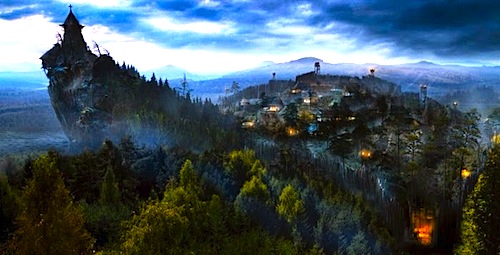
Empire is a weird viewing experience, due to a number of factors, including the feverish religious imagery, the fairy tale-like stylization of the sets and backdrops, and the disembodied dubbing voices. Frankly, this film would probably be a good deal better with subtitles. Czech Airlines used to show a garish looking 1960s fairy tale film, sans subtitles, during the breakfast service of its New York bound flights. Watching Empire produces a similarly disorienting effect.

From "Forbidden Empire."

Ironically, the best sequences by far are those that harken back to the original Viy source material. It is impossible to not appreciate the scene in which the coffin animated by foul spirits chases the divinity student throughout the church, trying to ram him like a sinister bumper car. That is the kind of stuff movie magic is all about.

On the other hand, when the narrative focuses on Green, it wildly veers from broad shticky comedy to demonic horror, throwing in didactic jabs at religion’s supposed hostility towards science and reason for good measure. Reportedly, without the story’s rustic, folkloric elements, the materialistic Soviet authorities never would have greenlighted the 1967 Viy. However, they would have loved Stepchenko and co-screenwriter Aleksandr Karpov’s depiction of the venal, power-hungry priest.

There are a lot of bald dudes with Fu Manchu mustaches in Empire, so it is often devilishly difficult to differentiate the various cast-members. However, Jason Flemyng (probably just famous enough to justify some British co-production investments) is a good sport, pivoting at a moment’s notice to be goofy one moment and resolute the next. This is a loud, dark, defiantly illogical film, but at least the resulting spectacle is a strange sight to behold. In short, it is a mess, but in bizarrely compelling, can’t-stop-watching kind of way. Recommended accordingly (I guess), Forbidden Empire hit VOD platforms last weeek and recently had a special screening at the Arena Cinema in Los Angeles.

LFM GRADE: C+

Posted on May 27th, 2015 at 9:54pm.

LFM Reviews Love at First Fight

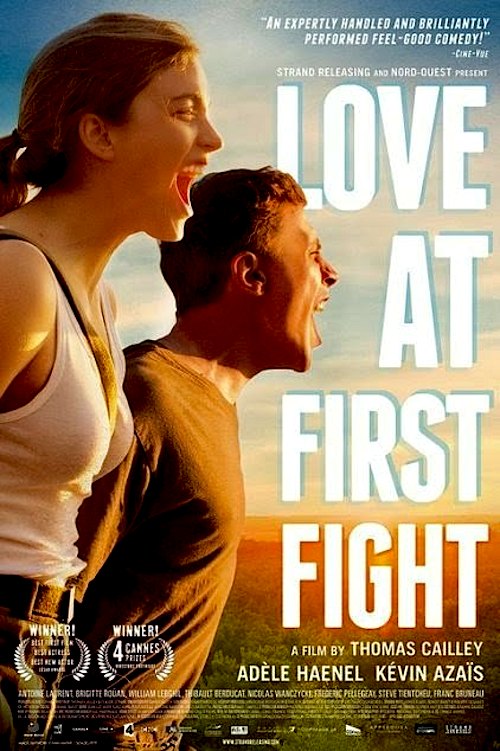
By Joe Bendel. Arnaud Labrède would prefer to be a lover rather than a fighter. Madeleine Beaulieu will opt for the fighting every day. That is the only way she believes she will be prepared for the coming doomsday. Clearly, it will be an awkward courtship for Labrède, but that is always the case when you are young and stupid. However, if Armageddon holds off long enough, they might just mature a little (or perhaps not) in Thomas Cailley’s Love at First Fight, which opened this past Friday in New York.

Times are tough in the wooded Landes region of France. The Army seems to be the only employer recruiting in town. Labrède has gone to a few information sessions to pick-up the free swag, somewhat befriending the recruiters in the process. However, he assumes he will stay at home and help his older brother Manu rebuild the family carpentry business. Like their recently deceased father, both brothers are handy with tools. Yet, it is still hard for Labrède to get Beaulieu to acknowledge him.

Granted, their first meeting is hardly ideal. She will put the big hurt on him during an Army-sponsored self-defense exhibition, until Labrède pulls a Tyson and bites her. Labrède finds she is still rather sore over the whole thing when her parent hire him and his brother to build a shed in their backyard. Little by little, Beaulieu slowly thaws, until Labrède feels sufficiently encouraged to sign up for her special summer training camp for prospective commando enlistees.

To his credit, it is hard to get a blanket sense of how Cailley views the military, preppers, and End Times anticipators. It is safe to say Beaulieu is . . . intense. Nevertheless, there is no denying the credible fashion in which their relationship develops or the electric chemistry shared by co-leads Adèle Haenel and Kévin Azaïs. At times, their verbal sparring is rather sly and quite revealing. Unfortunately, the third act reversal, in which Labrède’s easy going nature turns out to be better suited for team-building and unit cohesion, becomes predictably formulaic. Even the mildly apocalyptic climax feels like a pre-programmed inevitability (nonetheless, it is executed surprisingly evocatively).

Haenel (recently seen in In the Name of My Daughter) is convincingly surly, but it is hard to understand the initial attraction. Maybe you just have to be French, since she seems to be the latest minor “It” sensation. On the other hand, Azaïs pulls off something trickier and more interesting, showing how his character quietly changes in response to the people and environments he is exposed to. Antoine Laurent also has some nice moments as the big brother out to prove his worth.

First Fight is a small film that does not amount to much, despite a few sharply written scenes and some deftly turned performances. It has probably received disproportionate critical and festival attention, just because smart setters are so amazed by the notion of French survival preppers, as if that would be a phenomenon confined to the mountainous regions of southern border states. Many of the cast and crew should have very bright careers ahead of them, but this will probably be remembered as a promising early minor work. Mildly recommended for Francophiles and Francophones, Love at First Fight opened this past Friday (5/22) in New York, at the Village East.

LFM GRADE: B-

Posted on May 26th, 2015 at 3:55pm.

Caviar and Crossbones: LFM Reviews The Pirate; Now on DVD

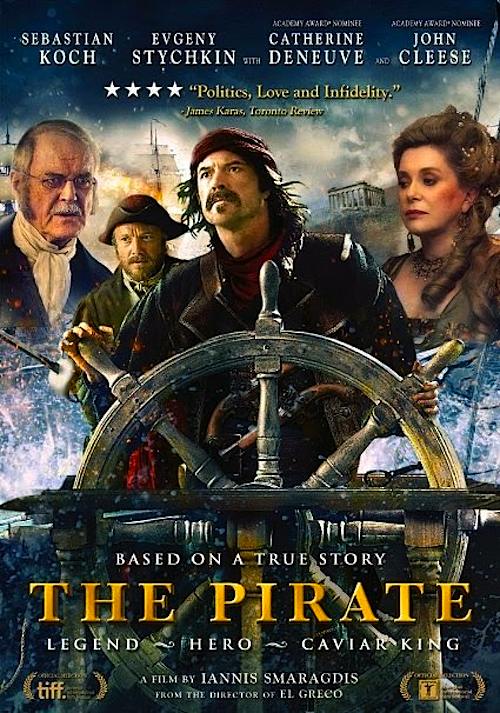
By Joe Bendel. For centuries, Greeks have maintained a commanding share of the global shipping business. Arguably, Ioannis Varvakis was part of that tradition. He specialized in re-routing Ottoman shipments. He was a proud pirate, but he became a Russian officer and nobleman, while never relinquishing his Greek identity. Yannis Smaragdis, Greek cinema’s prestigious bio-pic specialist turns his attention to the swashbuckler in his English language production, The Pirate (a.k.a. God Loves Caviar), which just released on DVD and is still available on multiple VOD platforms from Vision Films.

The dreaded pirate Varvakis will end up old and infirm, living as a secret captive in a remote British “clinic” for infectious diseases. We know this because the film starts at this cheery point, telling his story in competing flashbacks. Lefentarios, a dodgy veteran of the Greek resistance, will explain to the British superintendent how he goaded the buccaneer into more direct action, while Varvakis’s former servant will explain to a group of street urchins how great his former master truly was.

Varvakis had always fought the Turks ship to ship, claiming the spoils for his efforts. However, at Lefentarios’s urging, Varvakis hatches an unlikely plan to wipe out the entire Ottoman fleet (apparently by setting his ship on fire and pointing it toward several hundred Ottoman vessels). Needing safe haven, Varvakis offers his services to Catherine the Great, who appoints Varvakis her personal agent for the Caspian.

The mostly reformed rogue makes decent coin tending to her interests, but he becomes vastly wealthy when he develops methods to ship caviar without spoilage. Russians love caviar. So do the Persians, which lends his operations additional strategic significance. Catherine is well satisfied with Varvakis, bestowing rank and title upon him. Unfortunately, his personal life is a mess.

Frankly, the Greek resistance to the Ottoman occupation is not exactly over exposed in Western media. The Pirate’s home viewing release comes at an opportune time, countering Russell Crowe’s ripping well-made Water Diviner, which views Greco-Turkish conflicts through the lens of Smyrna. However, Smaragdis devotes an awful lot of time to Varvakis’s loveless marriage to the unfaithful Helena, his strained relationship with a grown daughter from a previous union, and the whiny son who can never live up to his father’s expectations.

Even though it is a minor role, John Cleese not surprisingly delivers all the best lines as McCormick, the British administrator. Sebastian Koch (still best known in America for The Lives of Others) has the appropriate presence for a figure of Varvakis’s stature, but despite no shortage of makeup, he never looks like he is the right age for the character’s successive stations in life. In contrast, Evgeniy Stychkin never ages a day as Ivan, the loyal servant who manages to make his way to Varvakis’s double-secret island prison without arousing any suspicion. Of course, Catherine Deneuve does her stateliest as Catherine II, but her screen time is limited.

The Pirate was a big hit domestically, arriving to bolster national spirits in a time of austerity. Tellingly, the Greeks would look to a pirate, who lives off contraband appropriated from others, as a source of inspiration. Still, there is something appealingly old school about its earnest approach to historical drama. You can practically hear the voiceovers announcing “special guest stars” Cleese and Deneuve. Recommended for those looking for some unselfconscious, slightly creaky, throwback entertainment, The Pirate (a.k.a. God Loves Caviar) is now available on DVD, as well as on VOD services like iTunes, DirecTV, and Vudu.

LFM GRADE: C+

Posted on May 26th, 2015 at 3:54pm.

LFM Reviews The Sarajevo Assassination @ The 2015 Bosnian Herzegovinian Film Festival

L'ATTENTAT DE SARAJEVO from CMCA on Vimeo.

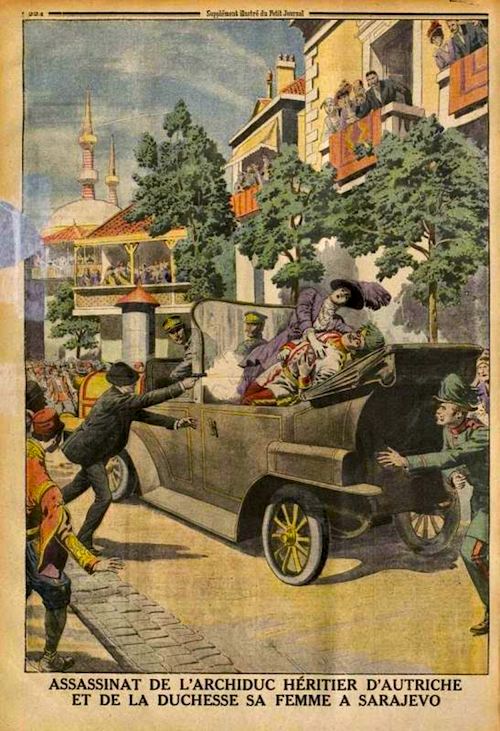
By Joe Bendel. Many historians believe Archduke Franz Ferdinand was far more progressive than your typical early Twentieth Century aristocrat. He generally advocated for greater decentralization of power and provisionally lent his support to the unlikely concept of a “United States of Austria.” Unfortunately, he was the perfect crowned head to kill if you wanted to ignite a war. Eastern European history professor Paul Grandvohl will re-open the Archduke’s cold case in Nedim Lončarević’s The Sarajevo Assassination, which screened during the 2015 Bosnian Herzegovinian Film Festival in New York, proudly celebrating its twelfth anniversary as one of the most welcoming fests in the City.

The way textbooks typically dismiss the Archduke as a historical footnote is problematic in its own right. Even more dubious are the frequent descriptions of the assassin, Gavrilo Princip and his accomplices as Dostoyevskian pan-Slavic revolutionaries. While Grandvohl probably does not collect enough evidence for a court indictment (nearly 101 years after the fact), he makes a strong circumstantial case, suggesting a certain government played an instrumental role planning and financing the attack. Needless to say, it was not Bosnia (where the Archduke was particularly popular).

As a sidebar to the historical inquiry, Lončarević also follows Grandvohl as he researches his own family history in Sarajevo’s traditional Jewish quarter. What he discovers is much more satisfying than the roots of Ben Affleck’s family tree. Through the process, viewers also get a sense Sarajevo was an unusually tolerant and cosmopolitan city, especially by the standards of pre-WWI Europe.

Although Assassination clocks in with a TV-friendly running time just under an hour, it is chocked full of interesting historical background and context. It is particularly eye-opening to see how Princip was venerated as a revolutionary hero under the Communist regime and remains a celebrated figure in Serbia today.

PBS really ought to pick-up Assassination for broadcast in America. Frankly, the murder of the Archduke and his morganatic wife, the much-maligned Sophie, Duchess of Bavaria is something everyone has heard of, but very few really understand to any significant extent. While the film never feels drily academic, Lončarević and Grandvohl shoehorn in a good deal of informative and telling history. Highly recommended for those fascinated by WWI (and the ultimate origins of WWII), The Sarajevo Assassination screened Saturday (5/23) as part of this year’s Bosnian Herzegovinian Film Festival, which has become an annual tradition both for the expat community and a growing number of cineaste supporters.

LFM GRADE: A-

Posted on May 26th, 2015 at 3:54pm.

LFM Reviews Winning: the Racing Life of Paul Newman

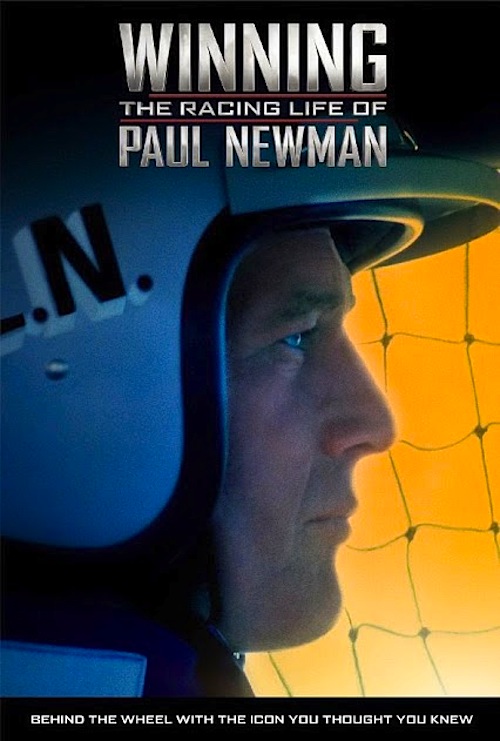
By Joe Bendel. Paul Newman and Joanne Woodward were way too classy to ever appear in a reality TV show. However, for decades racing fans were able to get a good close look at Newman that was entirely different from what one could glean from the glossy entertainment magazines. He was a competitor through and through, who is fondly remembered by his colleagues and teammates in Adam Carolla’s Winning: the Racing Life of Paul Newman, co-directed by Nate Adams, which releases on VOD this Friday.

Winning was a 1969 Newman-Woodward vehicle that was reasonably successful at the box office, but it had special significance in Newman’s life. In preparation to play Frank Capua, Newman was sent to racing school, where he quickly discovered a real aptitude for driving. It quickly became a passion. As a successful movie star, Newman could indulge an eccentric hobby, but it eventually became a bona fide second career.

Throughout Winning the documentary, Newman’s former rivals give him credit for putting in the time and effort to develop his skills. He was willing to lose a lot of races before he started winning. He was legit, coming in first in his class and second overall at the 1979 Le Mans (the subject of the 1971 Steve McQueen movie). Frankly, it is really cool how to hear how Newman became an accepted and respected part of the racing world.

Believe or not, Carolla is building an impressive portfolio as a filmmaker. Following up the solidly entertaining Road Hard, the comedian (who collects and restores Newman’s former vehicles) has assembled a first-rate sports doc. Fans should understand, there is not much material concerning Newman’s film career here, besides Winning and the Pixar animated film Cars, for which Newman voiced the character of the Hudson Hornet. However, Carolla did score a sit-down with an old Newman friend and co-star by the name of Robert Redford.

Winning (2015) also features interviews with Winning (1969) co-star Robert Wagner, Cars director John Lasseter, both Mario and Michael Andretti, and trailblazing African American driver Willy T. Ribbs, who credits Newman’s support for his big break in motorsports. Sometimes amusing and other times revealing, their anecdotes paint a compelling portrait of Newman the sportsman.

It is just great to have a new Paul Newman film nearly seven years after his death. However, Carolla’s interview subjects make it pretty clear Newman’s zeal for racing necessarily resulted in fewer films for posterity. On the other hand, he therefore chose projects with a discernment that well served his cinematic legacy. Wholly entertaining and surprisingly insightful, Winning: the Racing Life of Paul Newman is highly recommended for fans of the man and the sport when it launches on VOD this Friday (5/22). Fittingly, it will also have a special screening at the Indiana State Museum IMAX Theater in Indianapolis on the same night.

LFM GRADE: A-

Posted on May 18th, 2015 at 10:06pm.