LFM Reviews Saint Laurent

By Joe Bendel. Last year, Jalil Lespert’s Saint Laurent biopic was the first out of gate, simply but aptly titled Yves Saint Laurent. Now, Bertrand Bonello follows with the even more basically titled Saint Laurent. Evidently, the next filmmaker who tries his hand at the celebrated fashion designer’s story will have to call it Laurent, or maybe the evocative YSL. Regardless, the second duly follows the first, boasting a more famous French cast but lacking the blessing of YSL’s longtime partner, Pierre Bergé. Break your Mondrian dress out of mothballs for the American release of Bonello’s Saint Laurent, which opens this Friday in New York.

For the backstory, refer to Lespert. Bonello picks the film up in 1967 and just runs with the era’s excesses. Saint Laurent is poised to explode globally and Bergé, his partner (both in love and business) will make the deals to fully exploit his notoriety. Unfortunately, as the chemically infused parties blur into each other, Saint Laurent becomes increasingly preoccupied with the sexual charms of model Jacques De Bascher. From time to time, Bergé will even create a bit of a scene, but he can usually get the faithless designer to come home whenever he buys a new piece for their remarkable art collection.

That is kind of it. Bonello’s film is a rather static portrait that luxuriates in the hedonistic surface of YSL’s life and never digs into the iconic figures’ inner workings. To judge solely from the film, it is absolutely baffling how an uptight square like Bergé and a drug-soused sex addict like Saint Laurent could ever be a couple. There is no explanation of their relationship, except for an admittedly brilliant scene of them admiring a newly acquired painting. Bonello’s take on Saint Laurent is entirely an example of style over substance, but what dazzling style it is.
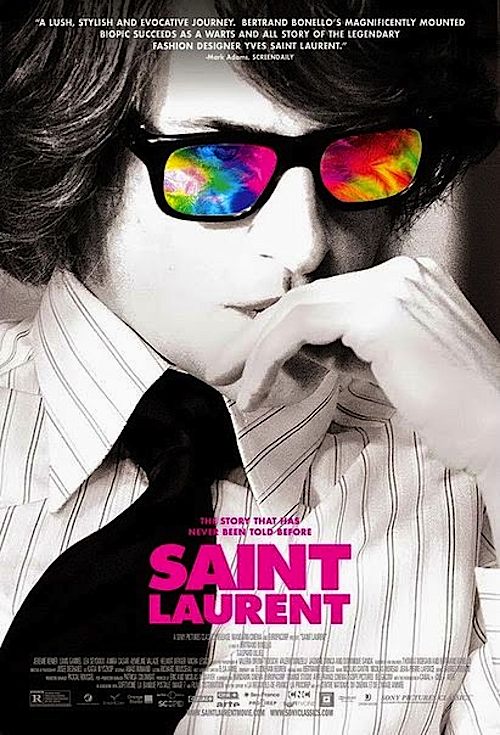
Although Saint Laurent spends most of the film lounging on a couch, Bonello’s camera darts and pans restlessly, soaking up the debauched nightlife. He makes inspired use of split screens, evoking a fashion magazine’s layout. Frankly, this is probably the most visually dynamic film of the year—and that counts for a lot.

Arguably, the cast-members are just accessories to the ensemble Bonello creates. Gaspard Ulliel’s Saint Laurent is a lifeless cipher who is rather unpleasant to spend time with. Helmut Berger’s third act appearance as the designer in 1989 adds little depth, serving mainly as a curtain call. Jérémie Renier conveys some of the maturity and determination of Bergé, but the film stacks the deck against him, largely portraying him a jealous lover. Adding color if not substance, Louis Garrel out-preens Maria Callas as De Bascher, while model Aymeline Valade exhibits enough snap and verve as model Betty Catroux to suggest she might have potential in a film with actual human interaction.

Bonello’s film is all about the gloss, which is why it is so seductive. This is probably the version Saint Laurent would enjoy more, whereas Bergé would better appreciate Lespert’s approach, even if he were not more closely associated with it. Indeed, he deserved better treatment from Bonello, especially considering how he stood up to the Chinese government’s bullying when he was liquidating the collection he amassed with YSL. Pointedly, he offered to return two Qing Dynasty bronzes they claimed if they started to “observe human rights and give liberty to the Tibetan people and welcome the Dalai Lama.” Of course, that is a little outside the scope of either film. Bonello’s Saint Laurent is an immersive work that overwhelms the senses, but leaves little emotional trace behind. For those in the mood for something flashy and slick, Bonello’s Saint Laurent can’t be topped when it opens this Friday (5/8) in New York, at the Angelika Film Center.

LFM GRADE: B-

Posted on May 6th, 2015 at 9:57pm.

LFM Reviews Gangnam Blues

By Joe Bendel. This is a Korean gangster movie all New Yorkers will relate to, because it is all about real estate—and the high cost thereof. In 1970, an increasingly over-crowded Seoul needed to develop the sleepy backwater district of Gangnam. For those in the know, there was a land rush to scope up parcels before the civic expansion plans were announced. Of course, only politicians and gangsters would have that sort of insider information. It is dashed difficult to tell the difference between the two in Yoo Ha’s Gangnam Blues (a.k.a. Gangnam 1970), which screens this coming Thursday as part of the free Korean Movie Night series at New York’s Asia Society.

Kim Jong-dae and Baek Yong-ki are sworn brothers who left their orphanage together hoping to scratch out some sort of life in the rough & tumble Gangnam district. Arguably, in the late 1960s, there are more thugs to be found there than paved roads. Kim and Baek briefly run afoul of some of Kang Gil-soo’s men, but the clan leaders chooses to recruit them for a job rather than inflict punishment. They will join a busload of hooligans sent to disrupt a political rally. Unfortunately, the job quickly goes sour, leading to the temporary disgrace of Kang’s political ally.

Separated during madness, Kim and Baek will not see each other again for three years. Kim will return to Kang, living as his adopted son. Having seen the writing on the wall, Kang tries to retire from crime, living a modest life as a launderer (of clothes). Despite his outward obedience, Kim longs to see Kang lead his old clan back to prominence. Secretly, he has laid the groundwork to facilitate that goal, but it inevitably leads to conflict with the rival gang Baek joined. Discovering themselves on opposite sides of a potential gang war, Kim and Baek form their own personal non-aggression pact. Of course, they will eventually have to make some hard choices about where their loyalties truly lay.

If you are thinking about that rap song, just forget it. Gangnam is now one of Seoul’s most prosperous and prestigious districts, so its hard fought development represents one of the grandest cases of “gentrification” ever. Imagine buying up Greenpoint or Williamsburg before the hipsters moved in. Those are the stakes at play in Blues.

From "Gangnam Blues."

Frankly, this is exactly the sort of Korean film that best translates for American audiences. It is a big, sweeping gangster story, but told from a distinctly personal perspective. Although not blood relations, there is something almost Biblical about Kim and Baek’s relationship. The grungy period look adds to the appeal, evoking memories of cynical 1970s cops-and-robbers films.

Korean TV superstar Lee Min-ho is impressively earnest and edgy as the tightly wound Kim. In contrast, Kim Rae-won is rather cool and distant as Baek, but that is rather the point. Regardless, neither of the young toughs can match the veteran hardnosedness of Jung Jin-young’s Kang, who towers over the large colorful supporting cast. There are dozens of seedy characters conspiring with and against each other, but Kim Ji-su stands out as Min Sung-hee, Kim’s early tutor in real estate speculation.

At times, viewers could really use a scorecard to identify which gang is aligned with which crooked politico. Still, that degree of sophisticated plotting is quite refreshing. For action fans, Blues also boasts a massively awesome gang fight scene in the middle of a mud-splattered cemetery. Highly recommended for fans of Korean gangster epics, Gangnam Blues screens (for free) this Thursday (5/7) at the Asia Society on Manhattan’s fashionable Upper Eastside.

LFM GRADE: B+

Posted on May 6th, 2015 at 9:56pm.

LFM Reviews The Shaman @ Tribeca 2015

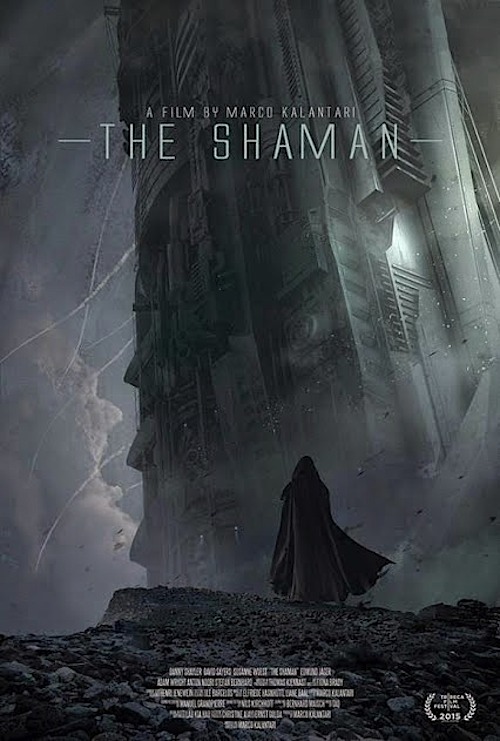
By Joe Bendel. Imagine the Terminator franchise, but with metaphysics replacing artificial technology. In the year 2204, humanity has been in a state of constant war for seventy-three years. Not content simply developing the latest lethal hardware, the warring factions have also weaponized shamanism. Great battles are joined in the Netherworld, where shamans try to convert or kill the souls of machines existing in our plane of reality. One such spiritual intermediary will face his most dangerous mission yet in Marco Kalantari’s epic short film The Shaman, which screened at the 2015 Tribeca Film Festival (as part of the Interference programming block).

It might be a short film, but it is long on concept. Clearly, writer-director-producer-editor Kalantari can only establish the basic essentials of this shamanistic dystopia in the film’s mere eighteen minutes. Through the help of sympathetic musical accompaniment, shamans like our unnamed titular character are able to cross over to the realm where the souls of machines exist in corporal form, at least for the duration of the tune. The Shaman’s target is the soul of the Colossus, a devastating new Death Star-like battle droid. Unfortunately, the Colossus seems to be expecting him. Nevertheless, the Shaman insists on an unusually short composition, perhaps out of respect for Kalantari’s budget.

Frankly, a short film with this level of special effects would have been unimaginable ten years ago. Kalantari creates a sinister futuristic landscape of enormous scope that is initially maybe a bit reminiscent of the Terminator, but he takes it in a wholly original direction. If this short was produced in the hope it will lead to an expanded feature, it is likely to win the requisite backing, because in this case, seeing is believing.

The very idea of a massive space battles also being waged on the subconscious level and within the soul is heady stuff and even a little disturbing. It is a rich vein Kalantari should be able to profitably mine over multiple films. Hopefully, he will bring back Susanne Wuest, because she is terrific as the Soul of Colossus. He also gets a key assist from cinematographer Thomas Kiennast (who also lensed the moody strudel western Dark Valley). He gives this universe a darkly distinctive look, while Kalantari blends the trappings of science fiction and fantasy quite effectively.

Minute for minute, The Shaman has considerably more ideas than most big budget genre movies. Easily the best science fiction at this year’s Tribeca Film Festival, it is prime candidate for later genre fests like Fantasia. Highly recommended, indie sf fans should definitely keep an eye out for it.

LFM GRADE: A-

Posted on May 6th, 2015 at 9:55pm.

LFM Reviews Peggy Guggenheim—Art Addict @ Tribeca 2015

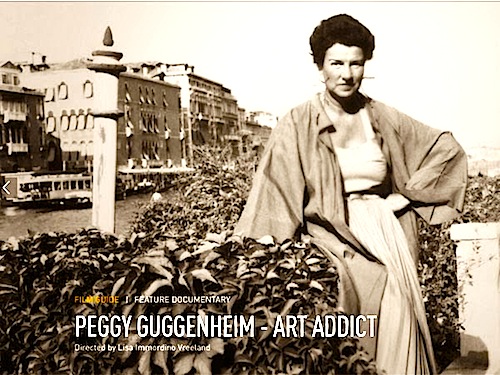
By Joe Bendel. Without Peggy Guggenheim, there would be no Jackson Pollock, at least not as the modernist icon as we have come to know him. Dozens of important Twentieth Century artists were supported and nurtured by Guggenheim. She was the preeminent American gallerist before the term came into vogue and amassed a personal collection that would rival the Barnes. Her passionate career is chronicled in Lisa Immordino Vreeland’s Peggy Guggenheim—Art Addict, which had its world premiere at the 2015 Tribeca Film Festival.

Amy Madigan played Guggenheim in Ed Harris’s Pollock bio-picture, so you know it had to be an important role. By Gilded Age standards, her branch of the Guggenheims was not so fabulously wealthy, but it would be a gross understatement to call them “comfortable.” Her family life was somewhat problematic, considering her father perished on the Titanic, but his mistress survived. Awkward, right? Supposedly not exactly a great beauty, Guggenheim never looked for high society validation, but she had a keen interest in grubby intellectuals and a true eye for beautiful and/or provocative art.

In addition to Pollock, Guggenheim was an important early collector and exhibitor of artists like Clyfford Still and Robert De Niro, Sr. (and ever so coincidentally, her documentary screened at Tribeca). At one point, she was married to Max Ernst, but their union sounds like a bit of a train wreck. Regardless, she fortuitously collected early works from towering figures of modern art, much like Albert Barnes. Frankly, it would be prohibitively expensive to amass equivalent collections in today’s market.

It is just jaw-dropping to see the collected pieces now ensconced in the Peggy Guggenheim Collection, idyllically located in Venice. Originally, it was not affiliated with the Solomon R. Guggenheim Museum on 89th Street, but a joining of forces would launch the Guggenheim as perhaps the first truly multinational museum. Plus, she reportedly took scores of lovers, which Vreeland’s experts allude to, without getting excessively gossipy.

Art Addict is an appropriately classy package that moves along at a brisk pace. J. Ralph’s upbeat soundtrack also keeps the energy up, sometimes evoking the spirit of the Hot Club era. After watching the film, audiences just have to give Guggenheim credit for doing it her way and snagging the best pieces. Not to belabor the point, but Vreeland (granddaughter-in-law and documentarian of Diana Vreeland) clearly understands the social eco-system in which Guggenheim rebelled and thrived. The result is a well-balanced, nicely contextualized portrait. Highly recommended for art lovers, Peggy Guggenheim—Art Addict screens next month at the Nantucket Film Festival (exact dates tk), after premiering at this year’s Tribeca Film Festival.

LFM GRADE: B+

Posted on May 2nd, 2015 at 11:38am.

LFM Reviews Over Your Dead Body @ The 2015 Stanley Film Festival

By Joe Bendel. If you are playing the part of an unfaithful lover who meets a grisly supernatural end opposite your real life lover, it is bad karma to betray her off-stage, especially if she arranged the gig for you. Unfortunately, Kousuke Hasegawa is exactly that sort of cad. Life will duly imitate art in Takashi Miike’s Over Your Dead Body, which screens during the 2015 Stanley Film Festival.

Hasegawa and Miyuki Goto have the leads in the classical macabre kabuki drama Yotsuya Kaidan, adapted for the screen many times, including as Nobou Nakagawa’s pretty awesome The Ghost Story of Yotsuya. As the cast rehearses, a great deal as meta-ness unfolds backstage. Like his character, the sociopathic ronin Tamiya Iemon, Hasegawa is cheating on Goto (cast as the tragically trusting Iwa) with the younger actress playing her younger on-stage rival, Ume.

Iemon will do cruel and evil things to destroy Iwa to be with Ume. In ostensive real life, Hasegawa is maybe not as proactively duplicitous, but he clearly has no regard for Goto’s feelings. However, there are ominous portents of a malevolent force afoot. Eventually, even Hasegawa starts to pick up on the bad vibes.

Despite the bring-it-on title, OYDB is a remarkably restrained horror film, especially from a master of mayhem like Miike. In truth, it represents a return to the austere elegance displayed in his moody Jidaigeki tragedy Hara-Kiri: Death of a Samurai. That might disappoint the faithful at the Stanley, but it certainly constitutes distinctive filmmaking.

From "Over Your Dead Body."

Indeed, the play within the film would be well worth seeing in its own right. Watching the massive sets created by co-art directors Yuji Hayashida and Eri Sakushima rotating on and off the stage is quite an impressive sight. There is also a really creepy doll used as a surrogate for the play’s infant. Frankly, it is surprisingly easy to get caught up in Iwa and Iemon’s story.

Kô Shibasaki scores a knockout punch as Goto, coming undone like Glen Close in Fatal Attraction, but with far greater subtlety. Likewise, well-regarded kabuki actor Ebizô Ichikawa is appropriately reptilian as Hasegawa and Hasegawa in the role of Iemon. There is a cast of dozens on the set within the film. Yet, only Miho Nakanishi gets much screen time of substance, but when her entitled Ume gets caught up in Iwa’s wrath, it is a great scene.

Miike has probably already made ten films since wrapping OYDB, but it would be an awful shame if it was lost in the shuffle. It is one of the most darkly sophisticated life-parallels-art films you will see, easily putting to shame Polanski’s overhyped Venus in Fur and the very odd but well-intentioned 1915. Highly recommended, Over Your Dead Body screens tomorrow (5/2) and Sunday (5/3) as part of this year’s Stanley Film Festival.

LFM GRADE: A-

Posted on May 2nd, 2015 11:38am.

LFM Reviews Reality

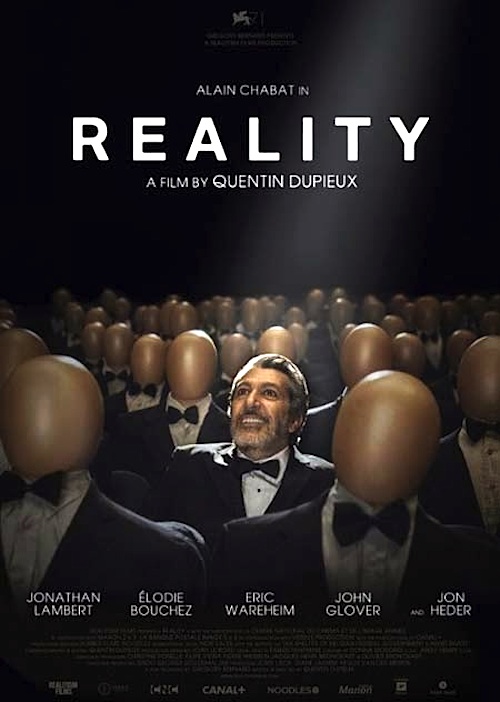
By Joe Bendel. Something about Philip Glass’s Music with Changing Parts brings to mind Torgo’s theme from Manos: the Hands of Fate. That is not a criticism. In fact, it is another reason why it works so well as the soundtrack to Quentin Dupieux’s latest mind-trip. Reality with get twisted up and bent over double in Dupieux’s ironically titled Reality, which opens tomorrow at the IFC Center.

Her name is “Reality” and her hunter father just bagged a wild boar. Nobody believes her, but she knows she saw a blue VHS tape pop out of its stomach while her Pops was removing the entrails. She will duly retrieve that tape, but the director filming her story will take his sweet time before he lets us watch it. His name is Zog and he is driving his French producer Bob Marshall to distraction with his cost-overruns. Marshall is the decisive type. He is fully willing to fund Jason Tantra’s horror movie if he can produce the perfect groan of misery to express its essence.

In between his groan sessions, Tantra works his day job as a camera man for a cooking show hosted by a man in a rat costume suffering from phantom eczema. All that scratching is starting to turn viewers against him. Frankly, the viewing experience can be trying in Reality, as when Tantra accidentally takes his wife to see his film before he starts making it. Rather upset with the sound mix, he tries to stop the screening, so he can fix it in the future. Then things start getting strange.

As weird as Dupieux’s first act undeniably is, it is nothing compared to the lunacy that follows. Dreams and films will interrupt and fold back into each other, as each strange subplot doubles back and refers to itself. Edited by Dupieux (a.k.a. Mr. Ozio), Reality has an extremely complex structure mere mortals could not even begin to diagram.

Granted, Reality lacks the warmth and sweetness that made Wrong such an unexpected pleasure, but it is still a blast to watch Dupieux juggle an infinite number of balls in the air. Each new reverse is a thing of beauty onto itself. It is easy for actors to get overwhelmed in such an auteurist spectacle, but John Glover gives one for the ages as the supremely confident Zog. Alain Chabat’s Tantra is like an everyman from an alternate universe (and maybe he is), while Napoleon Dynamite’s Jon Heder really looks like he is suffering from a nasty rash in that rat suit.

By now, you really should know within a 99.99 degree of certainty whether Reality is your cup of tea or not. If you’re not sure, go anyway, because part of Reality’s subversive fun is watching other audience members getting confused and upset. Highly recommended for Dupieux fans and connoisseurs of cult cinema, Reality opens tomorrow (5/1) in New York, at the IFC Center.

LFM GRADE: A-

Posted on April 30th, 2015 at 4:49pm.