LFM Reviews A Sinner in Mecca @ The 2015 Hot Docs

By Joe Bendel. The extra security provided openly gay Muslim filmmaker Parvez Sharma at this year’s Hot Docs is an ominous development, but in a perverse way, the death threats prompted by his latest film constitute a ringing endorsement. Nonfiction-filmmaking does not get much gutsier than Sharma video-documenting his hajj. Frankly, it is a bit surprising the ever-so open Saudi government granted his hajj visa. They probably already regret it, but not for reasons you suspect. Ignore the overheated internet trolling and honestly engage with the issues raised by Sharma’s A Sinner in Mecca when it screens again at the 2015 Hot Docs in Toronto.

Sharma had already been on the receiving end of a minor fatwa, because of his prior documentary on the Muslim LGBT experience, A Jihad for Love. After marrying his partner, Sharma decided to take his hajj, hoping to reconcile his faith with his sexuality. Of course he will secretly document the process. He is a filmmaker. That is what he does. Frankly, nobody is more aware of the potential danger for an internationally recognized LGBT activist in Wahhabist Saudi Arabia than Sharma. He was consciously risking his life to make the film, but he was completely unprepared for the rampant exploitation and abuse all pilgrims must endure.

Critics of Sharma will latch onto his sexuality because they are homophobic (and misogynistic and anti-Semitic), but the real arsenic in the film are the many scenes exposing the Saudi government’s neglect and overt commercialization of Islam’s holiest site, bar none. Tellingly, one fellow pilgrim tells Sharma: “I’m glad they don’t allow non-Muslims, so the Western world cannot see this.”

As Sharma struggles to complete the pilgrimage rituals, he must navigate filthy streets teeming with rubbish, amid what is supposedly a holy and protected city. Unquestionably though, the most disturbing incident comes when Sharma relates a conversation he had with a man whose wife was sexually molested while circling the Kaaba, which Muslims consider to be the first house of worship, constructed by Abraham. Apparently, this is not an uncommon experience.
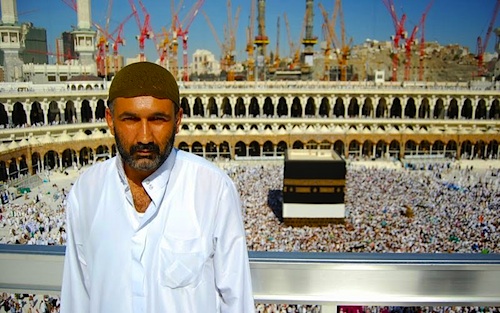
From "A Sinner in Mecca."

Much of Sinner would be legitimately horrifying, even if Sharma was not constantly worried his true identity might be revealed. That is why the coda in which he declares his faith is renewed feels completely out of place and inconsistent with everything that preceded it. One suspects that Sharma is trying to convince himself for his own personal reasons. We have to respect that, but the footage he covertly shot (on mini-handhelds and his iPhone) speak thunderously.

First and foremost, Sinner thoroughly indicts the Saudi custodianship of Mecca. If you really wanted to be provocative you could argue the global Muslim community would be much better served if Mecca were in Israel, because the Israeli government understands how to respect and preserve artifacts and landmarks associated with other religions (exhibit A: the Dead Sea Scrolls). Regardless, Sharma’s hajj is a very personal act, but his documentation has much greater implications. Bold and stingingly truthful, A Sinner in Mecca is very highly recommended when it screens again tonight (4/30) and Saturday (5/2), as part of this year’s Hot Docs.

LFM GRADE: A-

Posted on April 30th, 2015 at 4:48pm.
LFM Reviews Hyena @ Tribeca 2015

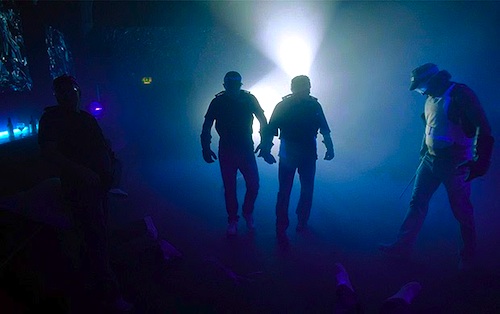
By Joe Bendel. If they hadn’t become corrupt cops, Michael Logan and his team probably would have been football hooligans. Unfortunately, there probably isn’t enough time for the husky louts to go less crooked. Karma will be harsh to some in Gerard Johnson’s Hyena, which opens this Friday in New York, following its U.S. premiere at the 2015 Tribeca Film Festival.

After plundering a large quantity of cocaine in a night club shake down, Logan’s team is in the mood to party. That is often the case, but this time Logan has bigger fish to fry. He has a meeting with his partner in a new Turkish drug trafficking scheme. This is not an undercover operation. It’s an investment. Inconveniently, Logan secretly witnesses the psychotic Albanian Kabashi Brothers murdering his contact. At least Logan manages to secure their first shipment. The Kabashis will be looking for that.

Things will steadily go from bad to worse for Logan. Initially, he tries to forge a temporary working arrangement with the Kabashi Brothers, but nobody believes that will last. He also must contend with an Internal Affairs investigation, while his mates become increasingly erratic and drug-addled. Seriously, how hard could it be to bust these knuckleheads?

From "Hyena."

Yes, we have seen this all before—and we’ve seen it better. The opening sequence is a stylistic tour-de-force, but from there on Gerard is indecisively torn between old school exploitation movies and affected art cinema. To a large extent, you can determine a film’s pretentiousness by comparing the amount of screen time devoted to the back of the protagonist’s head as they grimly trudge onward versus more conventional (and engaging) frontal and profile shots. In Hyena, the ratio is nearly one-to-one, which means tough sledding.

When we can actually see his face, Peter Ferdinando is pretty good as Logan. Likewise, Ben Wheatley regular Neil Maskell is obviously on comfortable ground as Logan’s sleazebag subordinate, Martin. His Kill List co-star MyAnna Buring also brings some verve to the film as Logan’s exasperated girlfriend, Lisa. Inexplicably, cult favorite Mem Ferda is almost completely wasted in what is effectively a cameo as Turkish crime lord Akif Dikman. Like Buddy Sorrell on the old Dick Van Dyke Show, he spends most of his screen time lying on a couch. Yet, he is still cool.

Speaking of Ferda, Hyena obviously follows in the tradition of Luis Prieto’s Pusher remake, but it cannot match the frenetic energy. Johnson tries to compensate with 1970s era pessimism and nihilism, but that gets old after the first act. However, fans of The The will get an nostalgic charge out of their original soundtrack. Not recommended, Hyena opens this Friday (5/1) in New York at the Cinema Village, after screening as a midnight selection at this year’s Tribeca Film Festival.

LFM GRADE: D

Posted on April 29th, 2015 at 11:57am.

LFM Reviews Monty Python—The Meaning of Live @ Tribeca 2015

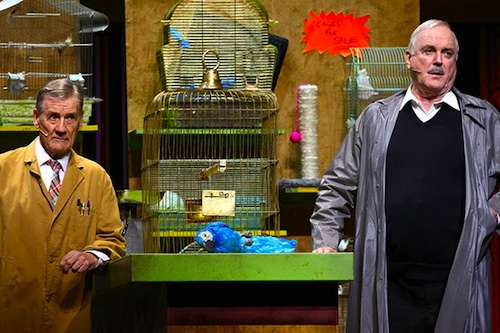
By Joe Bendel. The surviving members of Monty Python have little use for solicitors and lawyers, no matter how silly their walks might be. They have good reason, measurable in pounds. After fighting a nuisance suit for years, the Pythons found themselves holding a mountain of legal debt. Not getting any younger, they wanted to pay it all off as quickly and cleanly as possible. For Monty Python that meant returning to live performance. Roger Graef OBE & James Rogan document the preparation and behind-the-scenes camaraderie of their resulting sold-out stadium shows in Monty Python—the Meaning of Live, which screened as part of a Python celebration at the 2015 Tribeca Film Festival.

Meaning of Live should not be confused with The Meaning of Life or The Life of Brian (which also screened at Tribeca) and it certainly should not get mixed up with Douglas Adams’ The Meaning of Liff. This is strictly a fan’s eye view of the Pythons at work and in-performance. Fortunately, they are all still pretty funny, so you never know when they are going to unleash some of the old magic.

Yes, this is all about paying tribute and singing along to “Always Look on the Brighter Side of Life.” However, there are some interesting tidbits to be gleaned on the economics of a Monty Python farewell concert. Evidently, it is so costly to rent London’s massive O2 Arena, you really need to play for about a week to get into the black and you will not have the luxury of much tech rehearsing in the actual space. Hence, the Pythons signed on for ten shows. Frankly, they should have just added three or four shows in order to finally finance Terry Gilliam’s Don Quixote.

From "Monty Python—The Meaning of Live."

Yes, even though Gilliam was never much of an on-camera guy, he does his part in classic skits as a full-fledged member. One-for-all, after all. Part of the fun of Live is watching the fun the Pythons are having being together again. That is more than a little fannish, but they’ve earned it. However, there are also a few notable cameos, ranging from the heart-warming (Carol Cleveland once again performing with the randy lads) detouring through the lameness (Mike Meyers taking a pointless walk-on) to the truly surreal (Stephen Hawking singing the “Universe Song” through his computer voice-box).

Of course, we also get plenty of bite-sized servings of classic call-backs. The parrot is still dead as a doornail and the lumberjack still likes to dress up in women’s clothing and hang around in bars—and it is all still good stuff. However, perhaps we had better enjoy it while we can. How long will it be before the professional comedy scolds tell us it is inappropriate to laugh at the lumberjack sketch or any of the dozens of other politically incorrect gags in the Python repertoire?

You sort of have to be a fan to appreciate Meaning of Live, but there are plenty out there. More consistent than A Liar’s Autobiography but not nearly as comprehensive and authoritative as Almost the Truth—the Lawyer’s Cut, Live is basically a breezy curtain call, but it will definitely tide fans over until their next absolutely final farewell project. Recommended accordingly, Monty Python—the Meaning of Live screens today (4/28), Saturday (5/2) and Sunday (4/3) at Hot Docs up north, following its international premiere at this year’s Tribeca Film Festival.

LFM GRADE: B

Posted on April 28th, 2015 at 8:37pm.

LFM Reviews Far from Men @ Tribeca 2015

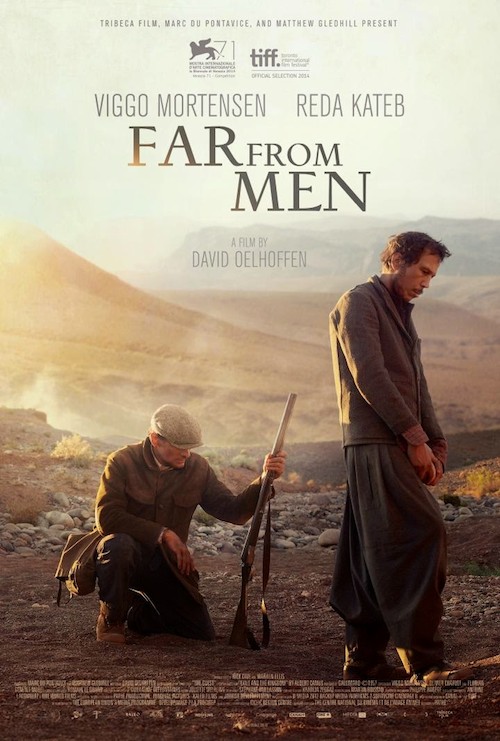
By Joe Bendel. Nobel Prize Laureate Albert Camus is associated with existentialism, but he was really a determined foe of all totalitarian “isms.” He is also closely linked to his Algerian birthplace, with good reason. In addition to his celebrated novels The Plague, The Stranger, and the posthumously published but still quite good The First Man, Camus’s most anthologized short story, “The Guest,” is also set in Algeria. Screen-writer-director David Oelhoffen thoughtfully but not entirely faithfully adapts Camus’s story as Far from Men, which opens this Friday in New York, following its U.S. premiere at the 2015 Tribeca Film Festival.

Daru is a former military officer trying to make amends for his mysterious past by serving as a school teacher in a remote village. The meditative life seems to suit him, but it will be rudely interrupted by Balducci, the gendarme. Whether he wants to or not, Daru has been tasked with escorting Balducci’s Algerian prisoner to the nearest French outpost in Tinguit, where he will likely be executed. That night, Daru makes it clear to the man named Mohamed, he is welcome to escape at any time. However, the admitted murder seems perversely intent on facing French justice. He does indeed have his reasons, which constitute some unusually smart writing on Oelhoffen’s part.

Unfortunately, Mohamed’s family did not have the blood money to buy peace after he justifiably killed his cousin. As a result, Daru will find himself in the middle of an intra-family feud, as well as increasingly violent uprising led by many of his former Algerian army colleagues. Fortunately, Daru is a crack shot with a rifle, because he will have to shoot his way out of a lot of trouble.

Essentially, Oelhoffen trades the icy cold irony of the Camus story for the tragic sweep of a revisionist Algerian western. Cinematographer Guillaume Deffontaines fully exploits the craggy terrain’s epic big sky country possibilities. After playing the Gloomy Gus in self-consciously arty films like Jauja and Everybody has a Plan, Viggo Mortensen finally finds the right vehicle for his simmering tough guy intensity. It also further burnishes his polyglot chops, this time showcasing him in French. Reda Ketab’s performance as Mohamed is almost too impassive as Mohamed, but it still sort of works for a pseudo western, in the moody Anthony Mann tradition.

Frankly, Far from Men is exactly the kind of film the pretentious Jauja should have been, but so wasn’t. It critically engages with a lot of hot button issues, including colonialism and tribalism, but never at the expense of its lean and mean narrative. Visually striking and tightly disciplined, Far from Men is recommended for fans of Mortensen and historical drama when it opens this Friday (5/1) in New York at the Cinema Village, following hard on the heels of its well-received screenings at this year’s Tribeca Film Festival.

LFM GRADE: A-

Posted on April 27th, 2015 at 1:22pm.

LFM Reviews Lost Child: Sayon’s Journey on PBS

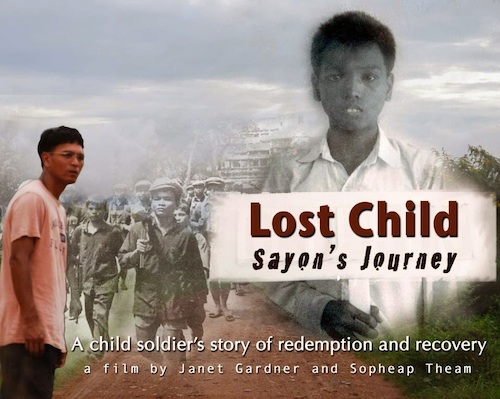
By Joe Bendel. By now, everyone should fully understand the Khmer Rouge killed approximately two million Cambodians (maybe more) in their attempt to create an agrarian socialist utopia. However, there are thousands of forgotten victims of Pol Pot’s reign of terror. They are the child soldiers who were abducted by the Khmer Rouge and forced to commit atrocities (sometimes against their own families). One former child soldier finally returns to Cambodia in search of his long lost family ties. Filmmaker Janet Gardner documents Sayon Soeun’s homecoming in Lost Child: Sayon’s Journey, which airs this Thursday on New York’s Thirteen.

Abducted at the age of six, Soeun arguably got off easier than many child soldiers, both in terms of what he was required to do and the punishments he suffered. Nevertheless, it was all more than sufficiently brutal to cause long term psychological scarring. Again, Soeun was comparatively fortunate to be adopted by an American family. Effectively denied the basic coming of age process in Cambodia, the teenaged Soeun would emotionally mature in tandem with his new two year-old sister.

While Soeun had a spot of trouble in his early adult years, he soon settled down into a stable and productive life as a social worker and family man. Just as the limited genocide trials began to make international news, Soeun gets word he might just have surviving family after all. In fact, it would be quite a large, extended family. Although skeptical, Soeun hastens to investigate, bringing along his sister-in-law, co-producer Sopheap Theam, while his wife remained to care for their newborn.

In many ways, the tone of Lost Child is not unlike various survivor homecoming documentaries, such as Blinky & Me and Here I Learned to Love. Unlike Thet Sambath in Enemies of the People, he is not searching for cathartic confrontation or higher truths. He would simply like to feel a familial connection again.

Despite references to terrible crimes against humanity, Gardner and Theam only focus on good, decent people. Granted, there are a lot of inconsistencies in the memories of Soeun’s prospective family, but that is not so unusual given the extreme circumstances they endured. Viewers can be assured there will be some closure at the end of Lost Son.

Marking the fortieth anniversary of the fall of Phnom Penh and the start of the Killing Fields era of mass murder, Lost Child is a timely reminder of the dangers of utopian collectivist movements. While it is intimate in scope, Soeun still speaks frankly about the horrors he witnessed. Indeed, viewers can directly see how macro events devastatingly impact discrete macro lives. Recommended for mainstream documentary watchers, Lost Child: Sayon’s Journey airs on WNET 13 this Thursday night (4/30) and on Boston’s WGBX44 this Saturday (5/2). Check local listings for further dates nationwide.

LFM GRADE: B

Posted on April 27th, 2015 at 1:22pm.

The Ghosts of Gallipoli: LFM Reviews The Water Diviner

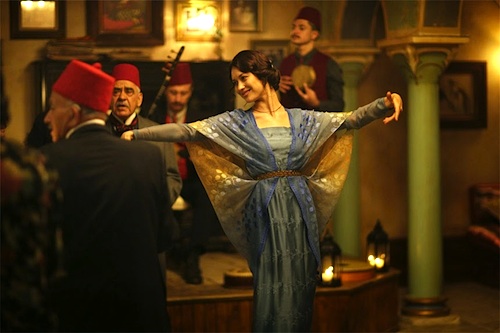
By Joe Bendel. Joshua Connor has the Australian version of The Shine. The grizzled farmer senses certain things, like where to drill for water. If he can only get to the blood-soaked beaches of Gallipoli, he is sure he can find the remains of his three sons who died in combat there. That is something the British authorities are not so eager to facilitate in Russell Crowe’s The Water Diviner, which opens today in New York.

All three of Connor’s sons enlisted in the ANZACs and all three presumably perished at Gallipoli. When the bitter news drives their mother to her grave, the salt-of-the-earth Connor promises his late wife he will find their sons and bring them home to her. However, Gallipoli is not exactly a tourist attraction in 1919. The British military consul flatly refuses him access to the prohibited beaches. Of course, he is not about to be dissuaded after such a long and arduous journey.

Bribing a fisherman, Connor makes his way to the fateful beaches, where a combined team of British and Turkish military personnel are working to identify and properly bury as many fallen combatants as possible. Although Lt. Col. Cyril Hughes is a little put off by Connor’s sudden appearance, his Turkish counterpart, Maj. Hasan, convinces him to assist Connor’s search. Sure enough, the farmer quickly finds his sons, but only two of them. Through a little bureaucratic digging, Hasan discovers the eldest Connor brother might have been taken captive as a POW.

Suddenly, Connor has a glimmer of hope and a knotty mystery to entangle. The British are even more determined to send him packing, but Connor finds unlikely allies in Hasan and his veteran aide-de-camp, Sgt. Jemal. As Turkish nationalists loyal to Ataturk, they are more concerned with the Greek occupation of Smyrna. The fact that Hasan commanded Turkish troops at Gallipoli also makes their relationship somewhat awkward, but the slowly develop a degree of mutual respect. Much to his surprise, Connor also finds himself acting as a surrogate father for Orhan the urchin-like son of Ayshe, the widowed proprietor of the hotel he is staying at.

From "The Water Diviner."

In Australia, Gallipoli is still the source of strong national emotion, so this was a somewhat bold choice for Crowe’s feature directorial debut. Presumably, his countrymen are okay with it, since Diviner tied with The Babadook for best picture at the Australian Academy Awards. Frankly, Crowe’s film should have had the award all to itself or shared it with the Spierig Brothers’ Predestination. Crowe uses an epic story to tell an acutely personal story—and quite effectively so.

Screenwriters Andrew Anastasios and Andrew Knight accurately reference all the macro forces roiling the Ottoman Empire’s final days, but they keep a lot of details hazy, such as Ataturk’s commitment to secularism. These days, Turkey could use a reminder on that score. Nevertheless, it is reasonable for the film to reflect Connor’s naïve confusion with Turkish mores and politics.

As his own lead, Crowe is perfectly on-key as Connor, the quietly grieving father. It is the sort of understated performance that pays far greater dividends than overindulgence, over-the-top Meryl Streepian wailing and garment-rending. The French-Ukrainian Olga Kurylenko also puts the “hot” in hotelier as Ayshe, developing some better-than-you-expect chemistry with Crowe. However, it is Yilmaz Erdoğan who really puts a stamp on the film, oozing integrity while avoiding cliché as the hard but compassionate Maj. Hasan.

There are a lot of potential potholes in Diviner, including Connor’s prophetic dreams and his chaste non-courtship of Ayshe. However, Crowe consistently brings a light touch to bear in scenes other directors would drive into the ground. More often than not, his filmmaking instincts are correct. Recommended for those who enjoy sweeping historicals, The Water Diviner opens today (4/24) in New York, at the AMC Empire.

LFM GRADE: B+

Posted on April 24th, 2015 at 2:36pm.