LFM Reviews Misery Loves Comedy @ Tribeca 2015

By Joe Bendel. Stand-up comedy is a tough racket. When you’re on, you’re killing and when you’re off, you’re dying—and you’re rarely anywhere in between. What kind of person is drawn to this business? Depressive neurotics. At least that is the casual thesis of Kevin Pollak’s riff-heavy interview documentary Misery Loves Comedy, which had a special Tribeca Talks screening at the 2015 Tribeca Film Festival, ahead of its official opening today at the IFC Center.
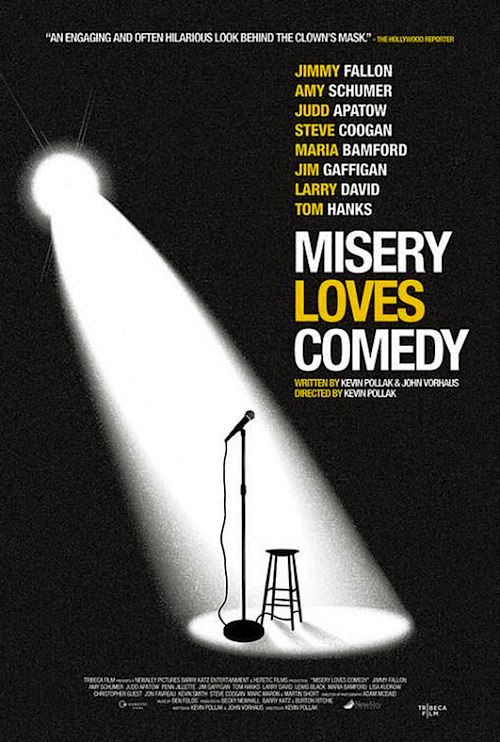
To explore the notion that comedy is either some kind of cathartic therapy or sick compulsion, Pollak interviewed over sixty comics and performers, as well as Jimmy Fallon. Of course, everyone was “on.” That is the whole point. Nevertheless, they said some revealing things. After all, they just can’t help themselves.

Pollak and editor Robert Legato went for and nailed the rat-a-tat pacing. They never linger long enough after a punchline for the audience to supply their own rim-shots. As a result, there are a lot of laughs in Misery. A good deal of attention will be focused on big names like Penn Jillette, Steve Coogan, Tom Hanks, Jim Gaffigan, Mike Birbiglia, Christopher Guest, Martin Short, and Richard Lewis, as well as filmmakers like Jason Reitman and James L. Brooks. Fittingly, Lewis Black and Jim Norton are also prominent in the film, considering they joined Pollak for the Tribeca Talk and will also represent at the IFC Center. However, some of the best material come from unlikely sources, like journeyman comic Dana Gould getting in a killer bit about his struggle with depression and Freddie Prinze, Jr’s reflections on his father.

Listening to Black and Norton after the screening really helps underscore Pollak’s general point. Clearly, they are both gallopingly neurotic, but in vastly different ways. It also provided Pollak with an opportunity to respond to criticism regarding the alleged lack of diversity in the film, but such charges are completely unfair. For instance, he features Whoopi Goldberg and she isn’t even funny.

Sure, you could ask about dozens of absent well-known comics, but a film like Misery is largely captive to people’s schedules. You get who you can get and then you go. Pollak’s film never delves too deeply into serious pain (arguably, Adam Carolla’s Road Hard offers a more revealing look into the trials of life as a comedian), but so what? It’s breezy and consistently amusing, which is what most people want from a comedy doc. Recommended for stand-up fans, Misery Loves Comedy opens today (4/24) at the IFC Center.

LFM GRADE: B

Posted on April 24th, 2015 at 2:35pm.
LFM Reviews All Eyes and Ears @ Tribeca 2015

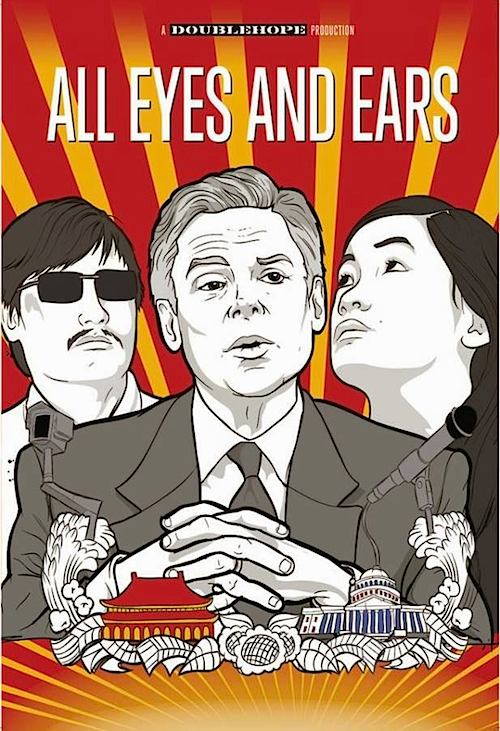
By Joe Bendel. During his confirmation hearing, our current ambassador to China, former Sen. Max Baucus, admitted: “I’m no real expert on China.” At least he was being honest. In contrast, his predecessor’s predecessor certainly was. A former Ambassador to Singapore, Gov. Jon Huntsman was familiar with the region and fluent in Mandarin. However, his greatest asset was probably his adopted daughter Gracie Mei Huntsman. Vanessa Hope chronicles their posting to Beijing in All Eyes and Ears, which screens during the 2015 Tribeca Film Festival.

Huntsman’s nomination was a bit of a surprise in 2009, especially considering Huntsman was still widely seen as a conservative at the time. He would leave the Utah Governor’s Mansion with high marks from the Cato Institute, after having signed an ambitious school voucher program into law. However, it was fortunate America had an experienced adult serving as ambassador during Huntsman’s eventful tenure, which would include the aborted Jasmine Revolution and the diplomatic crisis arising from blind dissident attorney Chen Guangcheng’s request for asylum.

Essentially, All Eyes follows Huntsman’s term of service from three perspectives: that of the diplomat, his adopted daughter, and the so-called “Barefoot Lawyer.” While braiding the three threads can get a little unwieldy, it is crucial to have Chen’s viewpoint, because it often acts as a corrective to the Communist Party’s narrative. As a diplomat, Huntsman acts scrupulously diplomatic, whereas young Gracie Huntsman has a very personal reaction to the events unfolding.

Of the three vantage points, Hope arguably favors hers—and it is easy to see why. She is clearly a “good kid” with remarkable poise. Commentators in the film make the point that probably no other Chinese adoptee will ever return to their birthplace under similar circumstances. Most likely this is true, but Hope never really delves into what Gracie Huntsman truly represents to the Chinese people. She documents the Huntsman family’s return to the orphanage she was adopted from, which all parties clearly find quite moving. However, China’s One Child policies were very likely a major reason why her name is now Huntsman, yet they are only mentioned in passing. Likewise, the widening gap between the oligarchical urban haves and the provincial have-nots is a direct cause of other children getting put up for adoption. Only Chen talks about these issues in the film, which is why it is so important to have him there.

Frankly, so many significant events transpired during Huntsman’s stint and Hope’s three primary POV figures are so compelling, All Eyes could easily be expanded to a longer form series, which reportedly might be in the works. Yet, somewhat ironically, Hope’s short doc China in Three Words (also featuring the Huntsmans) is even more incisive and grabby. Still, Chen Guangcheng and Gracie Huntsman definitely deserve your full attention (but some of the old China hands, not so much). Recommended as a reflection of a good deal of contemporary Chinese reality and the often awkward messiness of diplomacy, All Eyes and Ears screens again tonight (4/24), at the reasonably located Chelsea Bowtie, as part of this year’s Tribeca Film Festival.

LFM GRADE: B

Posted on April 24th, 2015 at 2:35pm.
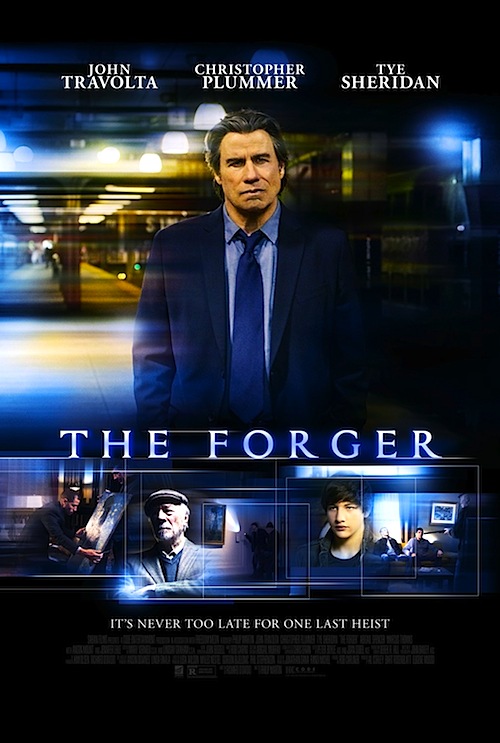
LFM Reviews The Forger @ Tribeca 2015

By Joe Bendel. Raymond J. Cutter is not exactly Raffles or the Pink Panther. This working class art thief and forger is a decidedly Gloomy Gus. His son Will’s terminal illness gives him a very valid reason. To get out of prison while there is still time to reconnect with the young lad, Cutter makes a deal with the devil involving a Monet. Eventually, things will get caperish in Philip Martin’s The Forger, which screens during the 2015 Tribeca Film Festival.

With a little less than a year left on his sentence, Cutter would ordinarily sit tight and do the time. Unfortunately, time is one thing Will Cutter does not have, so Cutter reaches out to Keegan, a Boston mobster, to “fix” things with the judge. Of course, there will be a quid pro quo. In this case, Cutter must steal Monet’s Woman with a Parasol on loan from the National Gallery, replacing it with a fake. It seems Keegan desperately needs to clear a debt to his art-loving cartel connection—hence the caper.

It takes a while to get to the actual art thievery, though. Instead, Martin and screenwriter Richard D’Ovidio force viewers to cool their heels in a lot of hospital waiting rooms and sit through many father-and-son heart-to-hearts. Patience and character development are both good things, but at some point the film starts to feel like it is stalling for time.

It has been a while since Travolta rekindled that old magic on-screen, but in a way that works to his advantage here. Believe it or not, he is quite good as Cutter, forcefully conveying all his guilt and regret, without wallowing in melodramatic excess. Unfortunately, Tye Sheridan is pretty dull and wooden as his son, whereas it is hard to know what to make of Christopher Plummer as Travolta’s extremely Irish father.

There are random flashes of chemistry between Travolta and Abigail Spencer’s Special Agent Paisley, but the film goes out of its way to keep them apart. The actual heist is well executed, but the film’s casts its lead characters as Red Sox fans, thereby making it extremely difficult to establish any degree of viewer sympathy.

Much to the frustration of his fans, The Forger probably ranks as one of Travolta’s better vehicles in recent years (anyone care to make a case for Old Dogs or Wild Hogs? Anyone?). It is not without merit, but it is maddeningly uneven and undeniably slow out of the blocks. Watchable but hardly worthy of Manhattan movie ticket prices, The Forger opens tomorrow (4/24) in New York, at the AMC Empire.

LFM GRADE: C+

Posted on April 23rd, 2015 at 3:59pm.

LFM Reviews Paolo & Vittorio Taviani’s Wondrous Boccaccio @ Tribeca 2015

By Joe Bendel. When you are waiting to possibly die, telling stories is a fine way to pass the time—especially if you have sworn off hanky-panky. Such is the position ten high-born friends find themselves in when they seek refuge in the countryside from the Black Death ravaging Renaissance Florence. They will learn how to cook for themselves and will take turns telling stories in Paolo & Vittorio Taviani’s Wondrous Boccaccio, which screens during the 2015 Tribeca Film Festival.

The plague has reduced Florence to anarchy, so a group of friends retreats to a country villa. There they will either wait out the horrors racking the city or die in relative comfort. Like the pilgrims in Chaucer’s Canterbury Tales (generally thought to be inspired by Boccaccio’s Decameron), they will tell stories to entertain each other. The Taviani Brothers chose five out of the one hundred assorted tales and anecdotes, three of which live up to their implied greatest hits status and two that seem rather slight.

The telling of tales begins with perhaps the best, the almost Shakespearean saga of Catalina, a young wife who apparently dies of the plague and is callously cast away by her mother-in-law, only to be reclaimed first in death and then in life by her secret admirer. It is followed by the Medieval O. Henry tale of a lonely falconer who serves up his beloved bird to Giovanna the woman who spurned him, yet now has her own reasons for needing his now broiled companion. The Brothers Taviani also evoke the spirit of Pasolini with a wild and bawdy tale of cloistered sex and intrigue, mercifully sparing us the auteur’s excesses.

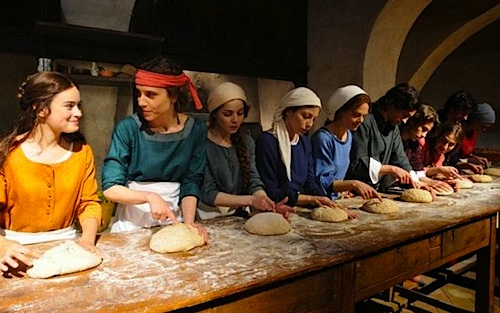
From "Wondrous Boccaccio."

Unlike other Decameron adaptations and anthology films in general, the Tavianis are most interested in the framing narrative rather than the constituent tales. The opening scenes in Florence are strikingly stark and stylish, again inviting comparison to Pasolini and Terry Gilliam.

At times the cast is a bit difficult to distinguish from one another, like good Italian proletariats, but Josafat Vagni and Jasmine Trinca definitely stand out in the Falconer’s Tale. However, cinematographer Simone Zampagni, costumer Lina Nerli Taviani, and production designer Emita Frigato’s team are the real stars of the film. Wondrous just looks like a work of art worth framing.

Wondrous is actually often quite ribald, but it is such a classy package it always feels like proper prestige cinema (except maybe during the convent tale). Recommended for those who enjoy mature literary adaptations, Wondrous Boccaccio screens again tonight (4/22) and Sunday (4/26), as part of this year’s Tribeca Film Festival.

LFM GRADE: B

Posted on April 22nd, 2015 at 1:07pm.

LFM Reviews Kung Fu Killer

By Joe Bendel. Hahou Mo is no Hannibal Lecter, but this will still be a case where a killer is recruited to catch a killer. In his thirst to become the number one martial artist, Hahou Mo won a fateful match, but lost his honor and his liberty. Although he dearly regrets losing control, another martial artist is deliberately following his fatal example. The mystery man is seeking out all the masters Hahou Mo beat, but his challenges necessarily end in death. Teddy Chan marries together the martial arts and serial killer genres in Kung Fu Killer, which opens this Friday in New York.

Even though he was once a police instructor, nobody in Stanley Prison messes with Hahou Mo, for obvious reasons. However, when he hears of the first victim and the circumstances surrounding his murder, Hahou Mo has to do something dramatic to attract the attention of Detective Inspector Luk Yuen-sum, unfortunately for seventeen of his fellow inmates. At first, she wants nothing to do with him, but he is soon remanded into her custody when one of the names he gives her turns out to be the next victim.

The newly freed Hahou Mo quickly deduces the pathological Fung Yu-sau is working his way through the masters of each respective discipline: boxing, kicking, grappling, qi, weapons, and inner energy. As the former head of the Mergence school of Kung Fu, his name is all over the latter. To raise the stakes even further, his former school is now overseen by Sinn Ying, the love of his life.

From "Kung Fu Killer."

You don’t need to read a book on screenwriting to guess Hahou Mo and Fung Yu-sau will go toe-to-toe in the third act. Even though the highway setting is somewhat reminiscent of scenes in Iceman, the climatic duel lives up to expectations and then some. Donnie Yen’s fight choreography is bruising yet quite cinematic. Fans only complaint might be some of the earlier duels end too soon, but at least Louis Fan gets his money’s worth as Weapons Champ Hung Yip.

As Hahou Mo, Yen once again demonstrates why he is one of the biggest stars in the world. His skills are as sharp as ever and he remains a likable, charismatic screen presence. He has okay chemistry with Michelle Bai’s Sinn Yang, who also displays some strong martial arts chops. Indeed, she acquits herself quite well in her action feature spot, but again, it is too bad this did not become an extended centerpiece scene, like Jing Tian’s spectacular face-off with Andy On in Special ID. Typically known for comedic roles and psychopaths, Wang Baoqiang finds unexpected pathos in Fung Yu-sau, playing him as both a sinister and tragic figure, almost like a Phantom of the Opera.

Due to Chinese censorship, Chan’s film was known as Kung Fu Jungle in Mainland theaters, which seems pretty ridiculous, but at least some apparatchik was able to exercise his power. Needless to say, Kung Fu Killer is more accurately descriptive. Yen delivers the goods and scores of figures associated with old school HK action films get to feel the love in smaller supporting roles. Darker than many of Yen’s films, but still all kinds of fun, Kung Fu Killer is highly recommended for martial arts fans when it opens this Friday (4/24) in New York, at the AMC Empire.

LFM GRADE: B+

Posted on April 22nd, 2015 at 1:06pm.

LFM Reviews Sunrise @ Tribeca 2015

By Joe Bendel. If Andrew Vachss made a Giallo in Mumbai, you would have to give it your full attention. Arguably, India could use a child protection advocate and cautionary story teller like Vachss, judging by the reported 60,000 children that go missing in the country every year. It is a grim statistic that opens Partho Sen-Gupta’s hallucinatory but hard-hitting Sunrise, which screens during the 2015 Tribeca Film Festival.

Lakshman Joshi is a social services inspector with the Mumbai police force (think SVU). His own daughter Aruna was kidnapped and the copper still isn’t over it. Neither is his wife Leela. In fact, they might both be losing their grip on reality, but in very different ways. When Joshi starts investigating the suspected abduction of another young girl named Naina, her case and that of his daughter become intertwined with the presumed visions Joshi has had of a seedy nightclub ironically called Paradise.

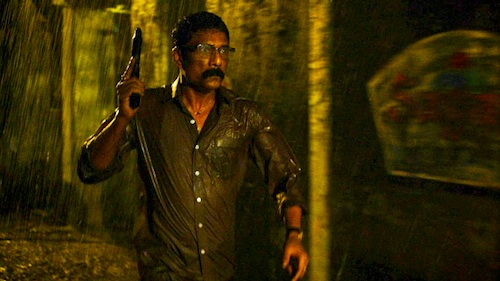
As Joshi chases a shadowy figure through the city’s rain-drenched streets, he experiences increasing difficulty distinguishing reality from his visions. It might even be bigger than Joshi’s problematic perception, as the film’s border between reality and fantasy becomes increasingly porous.

Sunrise is the sort of massively stylish Lynchian-film-on-acid that can overwhelm even the sturdiest screen presence. However, Adil Hussain’s absolutely riveting work as Joshi stands out and stands tall. It is a haunting, soul-searing performance that is all the more impressive given the gallons upon gallons of water that are dumped on him over the course of the film.

From "Sunrise."

The ultra-noir and uber-surreal tone of Sunrise makes it unlikely to go mainstream, which is too bad, because it has an important message. Coming in the wake of the India’s Daughter censorship controversy, it viscerally addresses another social pathology many Indians are inclined to sweep under the rug. With recent studies suggesting 53% of the nation’s children have suffered some form of sexual abuse, you can quibble with numbers here and there, but the trends and the magnitudes are undeniably alarming.

Be that as it sadly is, Sunrise is a bravura work of auteurist cinema. Sen-Gupta and cinematographer Jean-Marc Ferriere give the film a striking look, using the lurid Giallo color palate and the traditional nocturnal neons of film noir. Highly recommended for fans of high-end mind-benders with a social purpose, Sunrise screens again tonight (4/22) and tomorrow (4/23), as part of this year’s Tribeca Film Festival.

LFM GRADE: A-

Posted on April 22nd, 2015 at 1:06pm.