LFM Reviews A Faster Horse @ Tribeca 2015

By Joe Bendel. It is a scrappy underdog story, whose hero is the world’s oldest automotive company. Granted, old Henry Ford was a hard cuss to love, but at a time when we lucky taxpayers were underwriting all of its competitors’ bad decisions – and Detroit, the seat of the nation’s auto industry, was declaring bankruptcy – it was hard to root against the Ford Motor Company. Not only did they refuse government bailout money, they announced an ambitious redesign of their signature vehicle, the Mustang, to be released in time for its fiftieth anniversary. It will be Chief Program Engineer Dave Pericak’s task to ensure the new Mustang is both innovative but also true to the beloved car’s tradition. David Gelb follows the process from drawing board to dealer lot in A Faster Horse, which screens during the 2015 Tribeca Film Festival.

Yes, Steve McQueen drove a Mustang in the eternally cool Bullitt chase scene. Yet, the Mustang was conceived as a high performance car that was affordable for middle class consumers—a classically American concept if ever there was one. However, it was not so easy convincing Henry Ford II, who was still smarting from the Edsel. Horse gives full credit to then Ford exec Lee Iacocca for his role in championing the Mustang. Gelb also nicely captures the love and esteem many Mustang enthusiasts and motor clubs have for their car of choice.

Nonetheless, most of film follows the design, testing, and manufacturing process. Frankly, it is refreshing to see a film that values commerce and industry. Gelb is also fortunate that most of the Ford team are enthusiastic and rather eloquent. After all, they are all delighted to be working on the pride of the company’s fleet. Whether you are in engineering or marketing, everyone at Ford wants to work on the Mustang—and if you work at General Motors, you want to be at Ford.

From "A Faster Horse."

Clearly, there are real stakes at play in Horse. However, Gelb does not merely bury his lede, he covers it in cement and drops it in the East River. The GM and Fiat Chrysler bailouts and Detroit’s economic woes are briefly mentioned at the start of the doc, only to be neatly swept under the rug. Given the situation, the guts and vision of the Mustang redevelopment project were rather remarkable.

Not to be spoilery, but Horse ends on a wholly satisfying note. Let’s be honest, there is a reason Gelb’s film is about the Mustang instead of the Camaro. It is more-or-less the same reason Ford has outperformed its subsidized rivals. Fifty years from now, you will probably still be able to get your Mustangs serviced. Had it been less timid in exploring the full economic and political context of the fiftieth anniversary redesign, Horse could have been a truly great documentary. As it stands, it is highly watchable and a nice change of from the typical demonization of the auto industry. Recommended for car fans and viewers fascinated by processes, A Faster Horse screens again tonight (4/20), Thursday (4/23), and Saturday (4/25), as part of this year’s Tribeca Film Festival.

LFM GRADE: B

Posted on April 20th, 2015 at 4:40pm.

LFM Reviews Listen @ Tribeca 2015

By Joe Bendel. If you think the burqa is empowering, try wearing one for a week in August. Then try reporting your violent and sexually abusive husband to the local police, despite not speaking the local language. A translator ought to help, especially a woman, but reality will be tragically different for the battered wife in Hamy Ramezan & Rungano Nyoni’s short film Listen, which screens as part of the Interferences programming block during the 2015 Tribeca Film Festival.

She cannot speak Danish and she cannot remove her burqa. She has fled her home, taking only her young son with her, hoping and expecting the Danish police will provide shelter. However, she never anticipated the interpreter would deliberately mistranslate her pleas. The translator is also a woman, but clearly she considers herself an Islamist first and foremost. She duplicitously tells the police the woman is seeking divorce advice, whereas she tries to convince the increasingly desperate woman to trust her imam to resolve her marital troubles.

It takes about five seconds to understand just how isolating and alienating the burqa truly is. Had her face been visible, her expressions and her bruises would have told the cops what the interpreter deliberately mistranslated. Listen is a relatively short thirteen minutes, but Ramezan & Nyoni still patiently take their time, showing the initial police interview from each party’s perspective, to fully establish the tragic significance of the situation.

From "Listen."

Although we never see her, Zeinab Rahal’s body language still constitutes a harrowing performance. Just think how good she could be unshackled from the burqa. Likewise, Amira Helene Larsen discomfortingly projects the assurance of a blind believer. Nanna Bottcher also nicely hints at the police woman’s nagging suspicions, but Alexandre Willaume’s knuckle-dragging police man is film’s only real caricature.

As a strong follow-up to Ramezan’s previous solo short film, Keys of Heaven, Listen forcefully announces it is time for the Finnish-Iranian filmmaker to graduate to full features. Its treatment of issues facing Muslim women is both stinging and sensitive. Highly recommended as an eye-opener with serious dramatic chops, Listen screens again as part of Tribeca’s Interferences short film program today (4/20), Friday (4/24), and Saturday (4/25).

LFM GRADE: A

Posted on April 20th, 2015 at 4:39pm.

LFM Reviews Human Highway

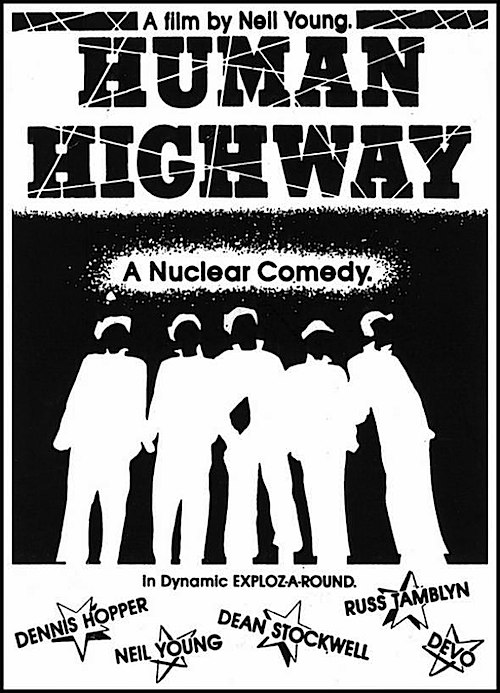
By Joe Bendel. It is the end of the world, but everyone feels fine. Linear Valley is pretty much devastated from the radiation spewing from the nearby nuclear power plant and outright nuclear war is imminent. However, burning down the local diner for the insurance money is still a viable scheme for the new owner. Too stoned-out to even be considered satire, Neil Young’s pseudonymously directed apocalyptic musical Human Highway finally gets a proper New York release, starting today, as part of the IFC Center’s new film series, Bernard Shakey Retrospective: Neil Young on Screen.

Co-directed under Young’s Shakey alter-ego with co-star Dean Stockwell, Highway also features Dennis Hopper (in dual roles), Russ Tamblyn, and Mark Mothersbaugh with Devo, so that should give you a general idea what’s on-tap. Young plays earnest loser mechanic Lionel Switch, who harbors dreams of rock & roll stardom, but every year the nuclear power plant’s garbage men win the radio station’s talent show. This morning he has brought along his pal Fred Kelly, whom his boss, Old Otto has promised a job.

Unfortunately, he wasn’t known as “Old Otto” for nothing. Sadly, the town benefactor has passed away and his money grubbing son, Otto Quartz has inherited the diner and garage. He has some new policies that will not go over well with the staff. Yet, it may not matter very much, judging from the ominous radio reports.

It is hard to apply any rational critical standard to such a manic exercise in DIY spit-ball shooting and general tom-foolery. Frankly, the reason most people will want to see it would be Young’s hard-edged rendition of “Hey Hey, My My (Into the Black)” with Devo. Arguably, Highway is even more a curio for Devo fans than admirers of Young (who has been quite well documented on film, by Jonathan Demme).

As Switch, Young is pretty shameless mugging for the camera. Likewise, Stockwell is not exactly shy about chewing the scenery while playing the villainous Quartz. What would you expect from a film conceived as a lark and fueled by peyote and transcendental meditation, or who knows what?

This is the sort of film you watch just to confirm it exists. Some see seeds of The Simpsons in its wacky nuclear waste handlers, but you could probably find crude analogs for just about every subsequent surreal vision quest within Linear Valley. For fans of Young, Devo, and anarchic micro-budget slapstick allegories, the director’s cut of Human Highway opens today (4/17) at the IFC Center.

Posted on April 20th, 2015 at 3:26pm.

LFM Reviews Live from New York @ Tribeca 2015

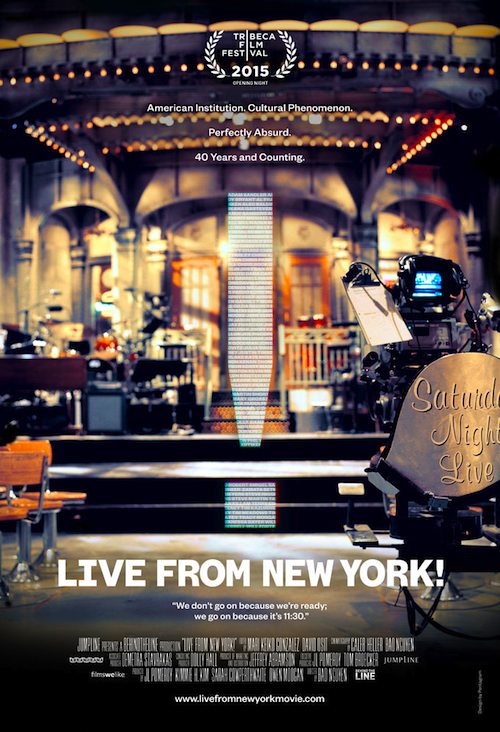
By Joe Bendel. Having featured Ornette Coleman as a musical guest, Saturday Night Live has a claim to coolness nobody can ever take away from it. Unfortunately, the show is a pale shadow of what it once was. Where did it go wrong? Do not look for an answer from Bao Nguyen’s documentary, since it refuses to acknowledge any slippage in the show’s cultural currency. Instead, expect several rounds of back-patting when Live from New York! screens at the 2015 Tribeca Film Festival.

Live duly chronicles the show’s creation story, largely from Lorne Michaels’ perspective and spends a fair amount of time with the surviving original cast-members. However, the only skits they really analyze are Chevy Chase’s bumbling Gerald Ford impressions. Julia Louis-Dreyfus then apologizes for how bad the show was during Michaels’ five year absence—before the film hastens to celebrate Dana Carvey and Will Farrell’s impressions of the respective Presidents Bush. Eventually, it stutter-steps to the one high-point: the first show broadcast after September 11th, as remembered by Michaels and Giuliani. It shows how SNL can capture the sentiments of the City when it tries.

Frankly, Live is not merely shallow. It is a nauseating combination of self-congratulatory narcissism periodically interrupted by bouts of self-flagellation for not being more racially and ethnically inclusive over the years. Of course, they take great self-serving efforts to call out their new and improved line-up, but the obvious lack of a Hmong cast-member suggests they still plagued by extensive institutional racism.

To give you an idea of the film’s editorial focus, its de facto centerpiece sequence revolves around the twitter reaction to Leslie Jones jokes about her hypothetical sex life if she were a slave. Right now, you’re probably wondering who is Leslie Jones? To put this in perspective, the doc has nothing to say about the Coneheads, the Killer Bees, the Wild and Crazy Guys, Mr. Bill, Father Guido Sarducci, Deep Thoughts, Buckwheat, Ed Grimley, the Liar, “You Look Marvelous” Fernando, Charles Rocket dropping the F-bomb, or Elvis Costello pulling a set-list switcheroo, whereas Jones’ twitter feed represents the show’s defining moment. That’s just sad.

Live would be a disappointment as a DVD extra, but it was inexplicably chosen to open this year’s festival. The fact that it presents Brian Williams as an authority on the show’s wider significance without a trace of irony is tragically embarrassing. Yet in a way, it is so politically incorrect and deeply in denial, it is exactly the sort of docu-treatment the current incarnation of the show deserves. Not recommended, Live from New York! screens again next Friday (4/24) and the following Saturday (4/25) as part of this year’s Tribeca. Watch the 1979 show surreally featuring Coleman as musical guest and Milton Berle as host, instead.

LFM GRADE: D-

Posted on April 20th, 2015 at 3:25pm.

The Smell of Burning Kaiju in the Morning: LFM Reviews Monsters: Dark Continent

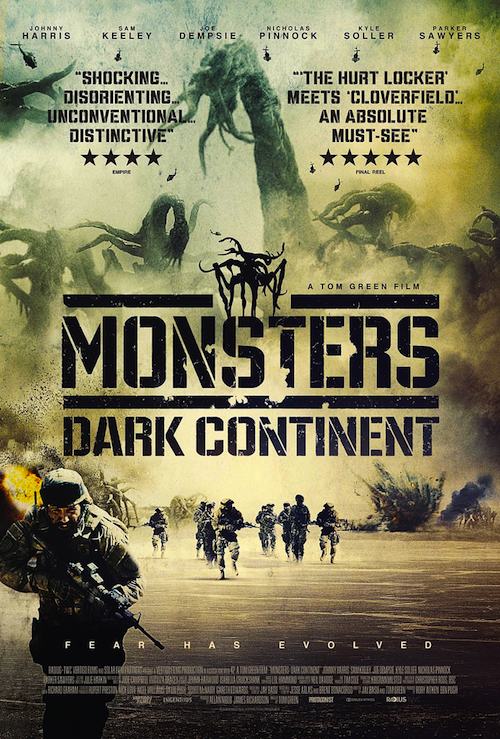
By Joe Bendel. There is an old saying about no atheists in fox holes. By the same token, a herd of rampaging kaijus ought to make even the most irrational jihadist grateful to see the U.S. Marines. Sadly, that is not the case in this chaotic near future monster bash. The Middle East has become the world’s hottest infection zone, so the American military has come to fight the monsters where they are. Yet, every accidental case of collateral damage becomes grist for Islamist grievance propaganda in Tom Green’s Monsters: Dark Continent, which opens this Friday in New York.

For those keeping score at home, Dark Continent is technically a sequel to Gareth Edwards’ Monsters, but it is probably just as well if prospective viewers are not aware of its lineage, or else they might expect a significantly better film. Ten years after the events of straight Monsters, the Middle East has become the new center of battle. A group of thuggish friends from Detroit (looking even scarier than the terrorist and tentacle ridden desert) have shipped off to Sgt. Noah Frater’s unit, so he will make sure the maggots are in proper fighting condition. They are a stereotypical pack, who hardly deserve names, including the sullen orphan protagonist, his unstable protector, and the buddy whose girlfriend just had a baby. Right, odds are he won’t even make it into the second act.

Edwards’ Monster was a clever DIY calling card that led directly to his Godzilla gig. Unfortunately, even though Green retained the general creature designs, he emphasizes the worst aspects of the previous film. Where Monsters offered a lot of not so subtle immigration commentary, Dark Continent sees itself as an extended critique of American military intervention in the Mid-East. However, the message-making was hardly the reason the prior film was successful. The first time around, Edwards understood his responsibility for providing certain kaiju deliverables. In fact, aspects of the politicized near future worked in tandem with the film’s genre movie conventions. Being stuck on the monster-plagued side of an ultra-fortified border follows right in line with the basic rock-and-a-hard-place tradition.

Bizarrely, Green frequently loses sight of the titular monsters and invites the audience to openly side with the terrorist insurgency against the American military. They are just uneducated thrill seekers who shoot first and ask questions later, whereas the victimized local population understands how to live with the monsters in inter-species harmony. Of course, if any of the monsters were women, they would have to wear a burqa – and if any were homosexual, they would logically be stoned to death.

There is precious little characterization in Dark Continent, except for Frater, whom British thesp Johnny Miller plays as a bulging eyed, anti-social, PTSD head case. Happily, nobody in the film says: “it became necessary to destroy the village in order to save it,” but that probably represents a supreme act of restraint on Green’s part. Shallow as a puddle and clumsily didactic, Monster: Dark Continent is not recommended when it opens this Friday (4/17) in New York, at the Village East.

LFM GRADE: D-

Posted on April 16th, 2015 at 10:03am.

Wrist Breaks and Other Golf Dangers: LFM Reviews The Squeeze

By Joe Bendel. Augie Baccus has a heck of a swing and a solid short game, but he makes Happy Gilmore look like a genius. Unfortunately, he also lacks the popular Adam Sandler character’s toughness. That will become a serious problem when he gets entangled with some dodgy professional gamblers in Terry Jastrow’s The Squeeze, which opens this Friday in select cities.

Baccus is a dirt poor but amiable young kid, going nowhere in rural Texas. However, he can shoot the lights out on a golf course. When the slicker-than-slick gambler known as Riverboat happens to hear his impossibly low scoring amateur tourney victory on the radio while passing through town, he recognizes an opportunity worth taking a detour for. With the backing of his lover-accomplice, “The Bank,” Riverboat convinces Baccus to play for him in a series of high-stakes money games, sort of like Cruise and Newman in The Color of Money, but without the grit.

Of course, Baccus’s girlfriend Natalie is against the arrangement from the start, for moral reasons as well as the waves of bad vibes cascading off Riverboat. Baccus jumps in anyway, hoping to score some money for his battered mother and his beloved little sister. Inconveniently, Natalie’s concerns are soon justified in Las Vegas, where both Riverboat and mobbed-up gambler Jimmy Diamonds put the titular squeeze on Baccus before his million dollar match with the top-ranked youth-amateur.

Tin Cup was such a great golf film because it captured the inviting feeling of a lush green course on a sunny day that is not too hot and has a pleasant breeze blowing. The Squeeze does not do that, but at least it honestly seems to enjoy the game, beyond using it as a plot device.

Reportedly, Jeremy Sumpter was cast as Baccus because of his golf skills, which makes sense, because his bland white-bread screen presence doesn’t do much to move the needle. While the film is ostensibly about Baccus (modeled on the real life Texas Phenom Keith Flatt), it is much more interested in Riverboat’s Cheshire cat grin and Natalie’s legs. As the latter, Jillian Murray (from Cabin Fever: Patient Zero) certainly looks the part and expresses Natalie’s ethical and religious reservations without sounding hopelessly moralistic, which is something.

From "The Squeeze."

Nevertheless, Christopher McDonald is the real show. Essentially, he revisits his Shooter McGavin persona from Happy Gilmore, but takes delight in upping the villainous ante. He is consistently fun to watch, but Michael Nouri looks kind of weird as the bleach blond Diamonds. What was that all about?

Jastrow and his wife, co-producer Anne Archer have been dubbed “Super Scientologists” in the media, but it is hard to pick up on any overt references to Overlord Xenu or “Suppressive People” in The Squeeze. Frankly, it is largely rather by-the-numbers stuff, but McDonald makes it worth watching on cable or Netflix streaming. He can slyly turn a witty line and then pull off a goofy bit of physical comedy. Honorary Oscars ought to go to character actor mainstays like him, but instead they are determined by Hollywood popularity contests. Mostly just a harmless time-kill, golf movie fans can safely wait when The Squeeze opens Friday (4/17) in Denver at the AMC Highlands Ranch and Los Angeles at the Laemmle Playhouse.

LFM GRADE: C+

Posted on April 16th, 2015 at 10:03pm.