Time to Grow Up, Amigos: LFM Reviews Twenty

By Joe Bendel. It is an uncertain age for guys in South Korea, typically coming after high school, but before their expected military service. It is particularly awkward for these three chums, because everything is. Somehow they will mature a little over the course of Lee Byeong-hun’s Twenty, which opens this Friday in New York.

They never had much in common beyond a general horniness, but that was enough for a fast friendship when Chi-ho, Dong-woo, and Gyeong-jae met John Hughes-style. After graduation, Chi-ho becomes a lay-about, only aspiring to seduce an older sugar-mommy. Dong-woo retakes senior year in hopes of scoring better university test scores the second time around. Although not an uncommon practice in the ROK, it is a luxury he can no longer afford when his family’s fortunes precipitously decline. A born plugger, Gyeong-jae enters university hoping it will be a stepping stone to a prestigious corporate gig.

These plans, such as they are, will be complicated by romantic entanglements. Chi-ho will taste some of his own medicine when he develops an ambiguously romantic relationship with Eun-hye, a starlet with more ambition than talent. At least it is a more reciprocal arrangement than Gyeong-jae’s torch-carrying for Jin-ju, an out-of-his-league senior in his campus investment club. Working several part-time jobs to support his family, Dong-woo is initially annoyed by the advances of Gyeong-jae’s sister So-hee, but the high school senior is persistent.

Frankly, it is all even more complicated than that, but screenwriter-director Lee rather dexterously juggles the many subplots and extensive cast of characters. He also nimbly walks a fine line, giving the lads serious enough issues so that there are real stakes involved, but never letting the film get so heavy it craters into melodramatic or after-school special terrain. Kang Hyeong-chul’s monster hit Sunny, which Lee co-wrote, is a somewhat apt comparative film in terms of tone, but he displays a much lighter touch for his directorial debut.

From "Twenty."

In contrast, the sizable ensemble is less consistent. Arguably, Kim Woo-bin shows the greatest range and charisma as the entitled Chi-ho, whereas both Lee Joon-ho and Kang Ha-neul are a bit too passive and sometimes even a little flat as Dong-woo and Gyeong-jae, respectively. Lee Yoo-bi and Jung So-min add some nice energy as little sister So-hee and Chi-ho’s neglected pseudo-girlfriend So-min, but some of the assorted love interests are cold and detached to a problematic extent. However, Oh Hyun-kyung completely subverts sentimental stereotypes and steals most of her scenes as Dong-woo’s brutally honest and direct mother.

You do not often see American studio films that so freely combine comedy and young anxiety. Again, maybe think of some of the films we assume John Hughes directed, but he really only wrote and produced, like Pretty in Pink and Some Kind of Wonderful. Twenty skews a little older and little sillier, but American teens would probably love it if they were bold enough to give it a try. It is surprisingly endearing, but not overly desperate to be loved. Recommended for fans of Korean rom-coms and coming-of-age films, Twenty opens tomorrow in New York, at the AMC Empire.

LFM GRADE: B

Posted on April 16th, 2015 at 10:02am.

Truth in Titling: LFM Reviews Vengeance of an Assassin; Now on DVD/Blu-ray

By Joe Bendel. Bone-crunching badassery runs in Nathee and Than’s family, but it apparently skipped their drunken uncle. He has his reasons for retreating into a beer bottle. He promised to keep them on the straight and narrow after their undercover cop parents were murdered, but the brothers remain dead set on revenge. Inconveniently, the old family nemesis gets proactive in Vengeance of an Assassin, the final film helmed by late Thai action maestro Panna Rittikrai, which releases today on DVD and Blu-ray from Well Go USA.

To discover the identity of his parents’ killers, Nathee leaves his uncle’s home to become a professional assassin. Than stays with their guilt-ridden guardian, but he secretly develops his skills using training tapes made by their parents. One day, “Thee” gets a suspicious assignment: he is supposed to protect Ploy, the daughter of a well-connected politician and minor celebrity in her own right. Nathee quickly figures out he is being set up by his mysterious employer to take the rap for Ploy’s murder. Although there is not a lot of trust between him and Ploy, he protects her anyway, because that is his assignment, dodgy as it is. Needless to say, it was personal to begin with and becomes even more so after Nathee kills Nui, the lethal girlfriend of his archenemy’s entitled son.

From "Vengeance of an Assassin."

Okay, what part of Vengeance of an Assassin don’t you get? You have an assassin and he’s out for revenge. The plot is simple, yet strangely incomprehensible at times. Realism is not exactly a top priority here, either. Frankly, Nathee probably should have died a dozen times over before he ever reaches the third act. At one point, he is repeatedly impaled on a metal spike, but Ploy is able to get him to her family doctor just in time. He practices Chinese medicine, you see. At least it provides an opportunity for the good doctor to lay a massive beatdown on the henchmen who follow Ploy and Nathee.

Without question, the main attraction is Rittikrai’s super-charged OSHA-free fights scenes. They are wildly cinematic and relentless over-the-top. As Nathee, Dan Chupong has the right old school 1980s down-and-dirty chops. Ooi Teik Huat nicely channels Gordon Liu as the venerable but surprisingly spry doctor, but it is tough to top the star power and action cred of Kessarin Ektawatkul, who really has Tony Jaa-level international breakout potential, even when she plays a villain like Nui. Nisachon Tuamsoongnern doesn’t get to have nearly as much fun as Ploy, but she is not nearly as annoying as most genre damsels in distress.

The CGI in Vengeance is not so hot and there are narrative holes big enough to hurtle a derailed train through, which in fact Rittikrai does. However, when the characters are bashing each other black and blue with license plates and windshield wipers, it is pretty darned entertaining. Recommended for martial arts fans hoping for a big serving of red meat, Vengeance of an Assassin is now available for home viewing from Well Go USA.

LFM GRADE: B

Posted on April 14th, 2015 at 1:23pm.

LFM Reviews 1915

By Joe Bendel. Through his studies of the Ottoman Turks’ systematic massacre of Armenians, Raphael Lemkin coined the term genocide. Yet, Turkey refuses to acknowledge the genocide as such, insisting instead it was merely a bit of clumsy rough-housing. This might sound like a purely academic question at this point, but it surely has very real world significance to Turkey’s Kurdish population, especially as the government becomes increasingly Islamist and more closely aligned with Iran. Clearly, the lack of historical closure deeply troubles the Armenian protagonist of Garin Hovannisian & Alec Mouhibian’s 1915, which opens this Friday in greater Los Angeles and next Wednesday in New York.

Simon Mamoulian once directed a series of popular ethnic European comedies at the iconic Los Angeles Theatre, but this will be his first production in seven years. It has a limited run of one night only, yet it has inflamed the community. Turks are outraged by the play for forthrightly depicting the genocide perpetrated by the Ottoman Empire, whereas many Armenians are troubled by its Sophie’s Choice-like climax. It seems like just about everyone is protesting outside, but the stakes are even higher inside the theater.

Mamoulain’s wife Angela is playing the character unambiguously inspired by his grandmother and it is taking a lot out of her. The director seems to be able to transport her back in time to 1915 through a form of Svengali-like mesmerism. The rash of suspicious accidents do not help much either. However, we slowly start to realize Mamoulain’s play has two levels. Obviously, he wishes to speak for the estimated 1.5 million victims of the Genocide, but the play also has hidden personal meanings for him and Angela.

It is hard to imagine an independent film that is more ambitious structurally and thematically than 1915. As a result, it is impossible to judge Hovannisian & Mouhibian harshly when they lose control of their narrative. This is arguably a case where a little less would have been a little more. In particular, there is potential nemesis character introduced midway through, but his role is never cogently explained and he is so quickly dispensed, he really only serves as a baffling distraction from the serious issues at hand.

From "1915."

On the other hand, the filmmakers made truly inspired castings choices, starting first and foremost with French Armenian actor Simon Abkarian (Gett, Army of Crime, Wedding Song, etc.) as Mamoulain. He has a commanding presence, yet he vividly conveys how tormented his character is by personal and historical tragedies from the past. Likewise, Twilight franchise alumnus Angela Sarafyan truly looks like she was transported from 1915 into the Los Angeles Theatre. Sam Page also shows some range when the audience least expects it as James, the celebrity outsider.

It is kind of impressive how much Hovannisian & Mouhibian try to say in 1915. It does not completely work, but they swing for the fences—and arguably do not come up so embarrassingly short. In fact, it is rather fascinating to watch where the film goes. They also convincingly make their central motivating point. When incidents of great historical enormity are covered-up they fester and metastasize in the national psyche. Sort of worth seeing as a noble failure with no obvious prior analog, 1915 opens this Friday (4/17) at the Laemmle Music Hall 3, Town Center 5, and Playhouse 7, as well as next Wednesday (4/22) at the Quad Cinema in New York.

LFM GRADE: B-/C+

Posted on April 14th, 2015 at 1:23pm.

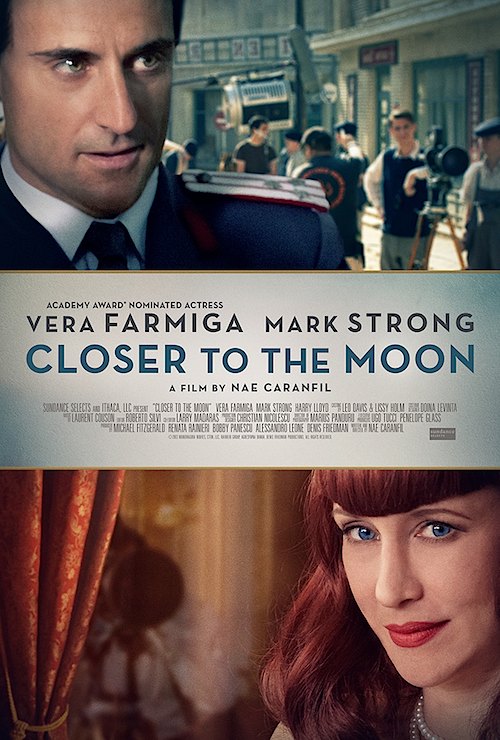
Romania’s Crime of the Century: LFM Reviews Closer to the Moon

By Joe Bendel. Irony was usually lost on Communist apparatchiks. It was especially so in this case. The socialist authorities were completely baffled why a small band of former Party members would stage a daring armored car robbery for a few million worthless Romanian leu, at a time when everyone was desperately seeking hard foreign currency. Yet, the absurdity is the whole point for the disillusioned resistance heroes in Nae Caranfil’s Closer to the Moon, which opens this Friday in New York.

All the major facts of Moon are historically accurate, but the why’s remain a bit murky. However, Caranfil’s speculations are more than persuasive. They clearly carry the spirit of the truth, even if they cannot be verified by the participants, for reasons one could easily guess. At, one time, police inspector Max Rosenthal and his comrades were ardent Communists and heroes of the resistance. They also happened to be Jewish. The post-war years would have been disheartening enough as the Communist Party proceeded to betray their ideals, but to make matters worse, the group of friends have all largely lost their positions thanks to the Stalin-mandated anti-Semitic purges. Only Rosenthal still maintains his post, entirely due to the fact he is married to the shrewish daughter of his superior. However, he is dead set on a divorce, regardless of the repercussions.

Sadly, Yorgu Ristea, the academic, Razvan Ordel, the journalist, and Dumitru Dorneanu, the research scientists have even worse seats in the same boat. The outlook is nearly as bad for Rosenthal’s old flame, Alice Bercovich, who had been sent abroad to study, but was recalled under ominous circumstances. Unlike the others, she has a son to protect. Yet, against her better judgement, she gets caught up in Rosenthal’s armored car scheme. Conceived as an existential protest, they hope to spur their countrymen to start questioning the claims of the Communist government. Of course, one of the central pillars of its propaganda is the supposed abolition of crime in Romania.

Both the scheme and the punishment are so crazy they have to be true. Rosenthal and his comrades really did perpetrate the heist under the guise of an action movie shoot (it would have been the first in Romania, had it been real). Likewise, the government really did force the condemned prisoners to re-stage the crime for a massively ill-conceived propaganda film. With nothing to lose, the prisoners largely take over the production (aided and abetted by Virgil, the fictionalized apprentice cameraman). Desperate to learn why they did it and who else might be involved, Holban the frazzled bureaucrat, indulges their demands for champagne and caviar, hoping the truth will come out during an unguarded moment. Yet, the truth is all around him, if he could only see it.

Obviously, this story holds tremendous cinematic potential, which Caranfil fully exploits, but he also gives it all a darkly wry comedic twist. At times, it feels like The Lives of Others rewritten by a less manic Alan Ayckbourne, but viewers are constantly reminded of the impending finality. Indeed, Caranfil nicely balances the absurdist humor with the tragic fatalism.

The mostly British cast is particularly well suited to the film’s matter-of-factly sardonic tone, especially Mark Strong, who personifies world-weary dignity as Rosenthal. Vera Farmiga gets to exercise both her drama queen and sultry femme fatale chops as Bercovich, making the most of each. Eventually, Christian McKay will break out for his witty, sophisticated performances, including his work here as the disenchanted Ristea. Game of Thrones’ Harry Lloyd is blandly forgettable as Virgil, but his job is mostly to observe. However, David de Keyser adds real heart and gravitas to the film as Moritz, the camera man’s VOA-listening landlord. British television regular Anton Lesser might also do his career best as the politically vulnerable insomniac, Holban.

Moon bears witness to the crimes of Communism in an unusually droll and humanistic way. It is a finely crafted period production, recreating the space exploration-obsessed late 1950s (hence the title) in detail, but Marius Panduru’s cinematography often looks a little too sunny given the events in question. Regardless, it is a fascinating story (already the subject of at least one worthy Romanian documentary) brought to life by a distinctive cast. It also represents a rare opportunity to see excerpts from the re-enactment film, which the Party immediately locked away in a vault, upon its completion. Highly recommended for fans of heist and con films as well as prestige historicals, Closer to the Moon opens this Friday (4/17) in New York, at the IFC Center.

LFM GRADE: A-

Posted on April 13th, 2015 at 3:57pm.

LFM Reviews Mary Lou Williams: The Lady Who Swings the Band on PBS

By Joe Bendel. You can pretty much count on one finger the jazz musicians who have received Papal commissions. Mary Lou Williams will always be remembered for excelling as a musician-arranger-composer at a time when the music industry was ridiculously male-dominated. Yet, by reconciling and combining jazz with her Catholic faith, Williams shattered just as many musical preconceptions. Williams’ life and music are surveyed in Carol Bash’s Mary Lou Williams: The Lady Who Swings the Band, which premieres on many PBS stations this week.

Williams was a child prodigy born to play the piano, but she first started to make a name for herself in Kansas City, at the height of the town’s hipness. Most musicians were loath to play with women, but her husband, alto and baritone player John O. Williams, knew she could swing. When his boss, territory bandleader Andy Kirk, found himself caught without a piano player, he reluctantly called her in to sub. Needless to say, she basically made Andy Kirk and the Clouds of Joy. Naturally, he resented her for it, but the producers were adamant—no Williams, no contract.

From "Mary Lou Williams: The Lady Who Swings the Band."

Eventually, Williams would separate from both Kirk and her husband, striking out on her own. Despite her talent and reputation, she would experience all the ups and downs of the jazz musician’s life, except it was always even more challenging for Williams—until she heard what can be rightly described as her calling. Finding spiritual renewal in the Catholic Church, Williams was encouraged to use her musical gifts, but in a way that expressed her deepening faith.

It is great to see Bash fully explore the significance and influence of Williams’ sacred music. She also gives the jazz legend her due as an entrepreneur – self-producing her releases on her own Mary label, long before that became the industry norm. However, the film leaves some unanswered questions regarding her relationship with John O. According to his obit, he also played with the Cootie Williams band and co-wrote “Froggy Bottom,” which suggests he might be one of those unfairly overlooked kind of guys.

Of course, the music is the most important thing in Lady Who Swings. Bash incorporates some all-star performances, appropriately including Geri Allen, who played the Mary Lou Williams figure in Robert Altman’s unfairly panned Kansas City. Wycliffe Gordon also leads a big band and Carmen Lundy lends her vocal chops and elegant presence, but Bash cuts off them off before they really get started. That is a shame, because just about all of us interested in Williams will want to hear their take on her music. Maybe the concert interludes are allowed to go on longer in a more extensive festival cut.

Indeed, fifty-four minutes on Mary Lou Williams is certainly economical, but it only scratches the surface and whets the appetite. Nevertheless, Bash makes sure viewers leave with the right take-aways. If you still don’t understand Williams was Catholic who could still swing hard after watching her film, you have serious retention issues. Brisk, informative, and respectful of Williams’ Catholicism, Mary Lou Williams: the Lady Who Swings the Band will leave audiences wanting more, but what we have is still definitely worth seeing. Highly recommended, it airs Monday night (4/13) in LA and Wednesday night (4/15) in San Francisco, with more airdates to come across the country, so check those local listings.

LFM GRADE: B+

Posted on April 13th, 2015 at 3:56pm.

LFM Reviews Éric Rohmer’s Newly Remastered Full Moon in Paris

By Joe Bendel. It is the early 1980s in Paris. The hair is feathered and the phones are all rotary. It looks glaringly dated, but the relationship issues of the characters inhabiting this world are as fresh today as they were when the film wrapped. Such is often the case with the work of Éric Rohmer. Technically, it is the fourth of his narratively discrete Comedies and Proverbs pseudo-series, but Full Moon in Paris is completely its own Rohmeresque animal, which launches Film Movement’s Classic line when it re-releases this Friday in New York.

Louise loves Remi, more or less, but she is not nearly as enamored with him as he is with her. By now, the lovely social butterfly is accustomed to being in that position. Still, she is committed enough to move into his modern suburban condo in Marne. The daily commute from her Paris interior design internship is a bit of a drag, especially when she wants to go out with friends. Everything would be much simpler if Remi would agree to let her keep a pied-a-terre. Of course, that means they will have to mutually trust each other.

Despite her aggressively flirtatious nature, Louise is, by-and-large, faithful to Remi. Ironically, it is Octave, the married platonic friend whose advances she frequently refuses, who plants the seeds of suspicions in her. He is absolutely convinced he saw Remi with one of Louise’s fashionista friends, under rather intimate circumstances.

Like most of Rohmer’s films, Moon completely stands alone. Yet, the more Rohmer films viewers watch, the more they get out of them as a collective body. Again, Rohmer displays a characteristic fascination with schedules and time tables, while duly marking the passage of successive months. He also gives us a time capsule snap shot of the suburban Paris circa 1984.

However, Moon is arguably one of the easiest Rohmer films for viewers to identify with. Let’s be honest, just about everyone has been in an unequal relationship, liking the other person more than they reciprocated, or liking them in a completely different way. Louise is in several such relationships, but karma will ultimately catch up with her.

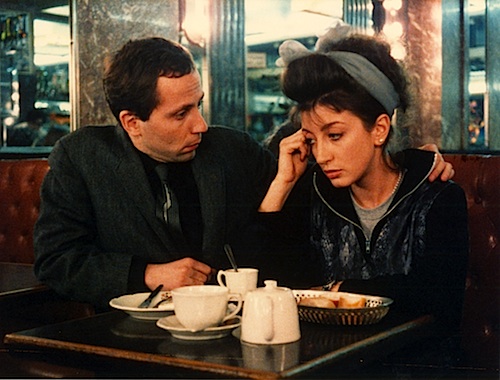
Perhaps the saddest aspect of Moon is the tragic fate of Pascale Ogier, who would become only the second actress to be posthumously nominated for César Award for her performance as Louise. She might very well have become a Rohmer mainstay, but it was not to be.  Even though the character causes all her angst and heartache, Ogier still makes Louise a figure of great sympathy. Yes, she is self-serving and insensitive, but in a strangely naïve way. Indeed, she is the picture of waif-like vulnerability.

From "Full Moon in Paris."

It is also rather mind-blowing to see the future Luc Besson tough guy Tchéky Karyo playing the socially awkward Remi. He is in fact, quite good, especially in the big pay-off scene. In contrast, Octave is not so very different from the supercilious characters Fabrice Luchini has made a career out of playing, but he gives Louise’s married suitor a notable edge. Whereas, in the Rohmer tradition of small parts with large impact, László Szabó nearly steals the entire picture outright in his eleventh hour appearance as an illustrator working in the wee hours at a local café, slyly putting an exclamation point on Rohmer’s chosen proverb: “he who has two women loses his soul, he who has two houses loses his mind.”

Moon returns just in time to act as a corrective to Victor Levin’s middling 5 to 7, which seems to think it has a lot to say about relationships, but is completely undercut by Louise’s eye-opening experiences. Rohmer’s film has a forgiving nature, but there is still a lot of sting to it. It is also rather encouraging to see the quiet Rohmer renaissance continue, following the long deferred proper New York opening of A Summer’s Tale and the subsequent revival of A Tale of Winter. Both are fine works, but Full Moon in Paris is an even better film. Highly recommended for those who appreciate honest and sophisticated filmmaking, Full Moon in Paris opens this Friday (4/17) at the Elinor Bunin Munroe Film Center, in conjunction with a full retrospective of Rohmer’s Comedies and Proverbs.

LFM GRADE: A

Posted on April 13th, 2015 at 3:56pm.