LFM Reviews The Dead Lands

By Joe Bendel. You may not be familiar with the Maori martial arts discipline of Mau Rakau, but there is a reason it translates as “to bear a weapon.” Viewers will see just how lethal paddle-shaped Patus and assorted traditional spears can be when a teenage Maori follows his father’s killer through a shunned stretch forest in Toa Fraser’s The Dead Lands, which opens this Friday in New York.

This is New Zealand before contact with Europeans, but it is not necessarily unspoiled. Something so horrific happened in the so-called Dead Lands, the various Maori tribes avoid it at all costs. The exact details remain hazy, but everyone believes the old, ferocious figure known simply as “the Warrior” was intimately involved in the atrocity. Just about everyone will travel days out of their way to avoid his territory – but not Wirepa, who just barges through.
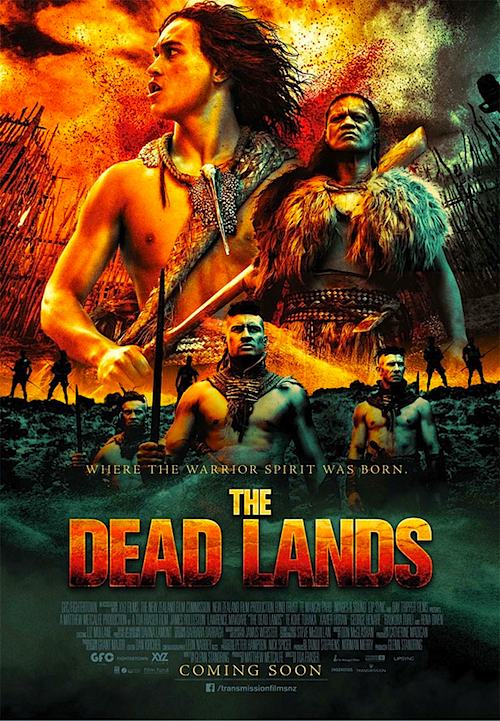
The arrogant young son of the tribal chief has just manufactured a grievance against their rival tribe. His subsequent sneak attack nearly wiped out all of Hongi’s people and killed his father, the peace-loving chief. Nobody ever thought the clumsy Hongi would ever amount to much of a warrior, but he will have to develop his skills quickly to avenge his people. With the encouragement of his grandmother’s aggrieved spirit, Hongi forges an alliance with the fearsome Warrior (with a capital “W”), who does not appreciate the entitled Wirepa traipsing through his territory. Despite his profoundly antisocial nature, The Warrior will take Hongi under his wing, teaching him the deadly art of Mau Rakau.

Dead Lands is bound to offend some viewers because its vision of pre-contact Maori is all about fighting. Yet that is not such a bad strategy, since it allows the film to sidestep the awkward melodrama of a Rapa Nui. It certainly makes viewers reluctant to hassle anyone carrying a patu with authority, which is something the film can hang its hat on.

Indeed, the Mau Rakau fight scenes choreographed by cast trainer and co-star Jamus Webster are spectacularly cinematic. The imposing Lawrence Makoare (a veteran of The Lord of the Rings franchise and Marco Polo) is an especially effective action figure, who seems ripe for a cult following after all the glowering and hacking-and-slashing he does as “The Warrior.” James Rolleston and Te Kohe Tuhaka also go at it with admirable vigor as Hongi and Wirepa, respectively. Frustratingly, Raukura Turei displays impressive Mau Rakau chops and real screen presence as Mehe, a lady warrior and potential love interest, but she is forced to make a rough entrance all too quickly after the film introduces her.

There is probably plenty of ethnographic hand-wringing to do over Dead Lands, but the action scenes are cool and it provided a lot of work for Maori actors and craftsmen. In its way, it should inspire widespread fanboy appreciation for the time honored practice of Mau Rakau. Fraser gives it all a strong sense of place and nicely instills a mood of mystery and foreboding. Recommended for fans of Seediq Bale, The Dead Lands opens this Friday (4/17) in New York, at the Village East.

LFM GRADE: B

Posted on April 13th, 2015 at 3:56pm.

LFM Reviews Li Wen at East Lake @ Art of the Real 2015

By Joe Bendel. A cop who collects Cultural Revolution-era pre-execution photos must sound like one scary cat, but Li Wen does it with a sense of irony. To keep the peace, he will hunt a supposedly mentally disturbed troublemaker, who might just be an eccentric gadfly the powers-that-be find inconvenient. Everything about the copper and his latest case are both fake and real, making Luo Li’s meta-meta-hybrid documentary Li Wen at East Lake a perfect selection for the Film Society of Lincoln Center’s annual Art of the Real series of aesthetically challenging docs.

Following in the recent tradition of independent Chinese cinema, Li Luo does not exactly rush into his narrative. Instead, he establishes a sense of East Lake, one of the few remaining inland lakes in the hyper-developed Wuhan metropolitan district. Legend has it, a dragon once rose from the lake to wreak fiery, purifying vengeance. A sort of Holy Fool seems to be peddling that story again, which is bad for state socialist-crony capitalist business, so Li Wen and his deputy must track down the rabble-rouser. Yet, either their quarry is surprisingly elusive or Li Wen is not feeling especially motivated, because it will take quite some time.

If ever there was a film whose sum of its parts is greater than its whole, it would be LW@EL. There are a number of boldly pointed scenes, some of which even get quite intense. Unfortunately, there is an awful lot of sketchy and sluggish connective material, ostensibly holding it together, but really just watering down the overall cinematic experience.

From "Li Wen at East Lake."

Nevertheless, when it is on, it scores impressive points. This is especially true when Li Wen argues with a gender and sexuality identity-studies grad student—a sequence that is as funny as anything you will see in a major studio release this year. Yet, there is also a very serious subtext critiquing the Communist government and state media’s hostility towards LGBT citizens. Likewise, Li Wen’s rather frank discussions regarding the Party and the Cultural Revolution (which officially never happened) are far from flattering. In fact, we eventually learn he was once a modernist artist, but now Li Wen paints motel-worthy landscapes as brown-nosing offerings for his uncultured superiors.

Piling on the meta-ness, Li Wen the copper-painter is played by Li Wen the real life painter and occasional actor, previously seen as the title character in Luo Li’s Emperor Visits the Hell. As his namesake, he shows considerable range, in the unlikeliest of ways. He shows off some razor sharp comedic timing, while also conveying profoundly sad awareness of current injustices and the weight of historical tragedies.

There are flashes of brilliance from Li Luo and his mostly unprofessional (or perhaps semi-professional) cast throughout LW@EL, but he forces viewers to really work for them. Committed China watchers will find it worth the effort, but the less cerebral and adventurous the viewer, the slimmer the returns. Recommended for a narrow, confidently self-selected audience, Li Wen at East Lake screens this Wednesday (4/15) at the Francesca Beale Theater, as part of this year’s Art of the Real.

LFM GRADE: B-

Posted on April 13th, 2015 at 3:55pm.

LFM Reviews Flowers of Taipei

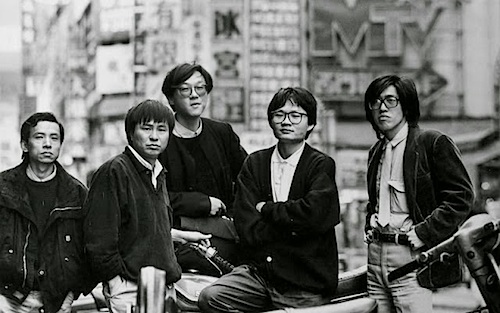
By Joe Bendel. Even according to its most ardent admirers, it was a movement that only lasted a few years in the 1980s. Yet, it has had a lasting influence on art cinema throughout Asia and beyond. If there is one filmmaker who best embodies the New Taiwanese Cinema (or New Wave) it would be Hou Hsiao-hsien. Fittingly, Hou factors prominently in Hsieh Chin-lin’s documentary, Flowers of Taipei: Taiwan New Cinema, which screens as part of the Hou retrospective Also Like Life, now underway at UCLA’s Billy Wilder Theater.

They were the product of a very specific place, at a very specific time. Taiwan was beginning its transition to a legitimate democracy, while its economy was emerging as one of Asia’s vaunted “Tigers.” Hou and Edward Yang were addressing the Taiwanese character in intimate terms, while also exploring the messier aspects of the nation’s history, including the Japanese occupation and the purges of the 1950s. Perhaps most importantly, they received unprecedented recognition on the international festival circuit.

It is particularly telling to hear Chinese filmmakers like Jia Zhangke and dissident artist Ai Weiwei express their esteem for New Taiwanese Cinema and considerable regret an equivalent movement was not possible in Mainland cinema. Hsieh does not belabor the point, but one gets a real sense that Hou, Yang, and their colleagues helped exorcise many of Taiwan’s ghosts and thereby helped the nation progress into a modern democracy.

We hear from many other appreciative filmmakers, including Apichatpong Weerasethakul, who credits the New Taiwanese Cinema for shaping his style. It is not hard to see the seeds of his inspiration, but it does not seem fair to lump the 1980s Taiwanese auteurs into the slow cinema rubric. Yang’s A Brighter Summer Day is a particular touchstone for Weerasethakul, but that film has no shortage of plot in its two hundred thirty-seven minutes.

From "Flowers of Taipei."

Unlike typical talking head documentaries, Hsieh is unusually sensitive to the power of place. It just adds something unquantifiable when Japanese actor Asano Tadanobu discusses making Hou’s Café Lumière in the Japanese bookstore where many of their scenes were shot. It is also a nice touch interviewing Hirokazu Kore-eda in the hotel room where Ozu and his co-writer Kogo Noda worked out so many of their great collaborations. Of course, Hsieh liberally illustrates Flowers with clips from the films under discussion. Many might be obvious choices, like the stunning opening shot of Shu Qi in Millennium Mambo (which some might consider a post-New film), but they still look great.

There is a fair degree of debate amongst Flowers’ expert commentators, but there is general agreement on the merits of Taiwanese New Cinema films, regardless of categorizations. It is rather fascinating to see how these acutely personal films fit within a larger social and cultural context. This is also an appropriate time to take stock of Taiwanese cinema, with the Hou retrospective now playing in Los Angeles and the Tsai Ming-liang career survey launching at MoMI this weekend, both of whom appear in Flowers. One of the best documentaries on non-genre-related cinema in recent years, Flowers of Taipei is very highly recommended when it screens this Sunday (4/12) in Los Angeles, as part of Also Like Life: the Films of Hou Hsiao-Hsien.

LFM GRADE: A-

Posted on April 10th, 2015 at 2:59pm.

LFM Reviews Who Am I—No System in Safe @ Kino! 2015

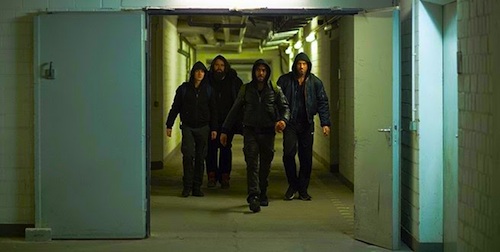
By Joe Bendel. Considering the shadowy cyber-activist outfit known as FR13NDS decks out their avatars with masks clearly inspired by the terrorist protagonist of V for Vendetta, it is probably safe to assume the sanctity of life is not a big priority for them. However, a hero-worshipping hacker will be rather disappointed to learn they are in league with the Russian mob. Unfortunately, this revelation comes after he ever so ill-advisedly passes along some highly secretive intel. Cyber monkey-wrenching inevitably turns into cyber-terror in Baran bo Odar’s Who Am I—No System is Safe, which screens as part of Kino! 2015, the festival of German Films in New York City.

Life has not worked out so well for Benjamin, at least so far. Yet, it always makes more sense when he is in front of a computer screen. Since he bought into the propaganda disseminated by FR13NDS, Benjamin has become one of the sycophants hanging on the pronouncements of the group’s shadowy leader, Mr. X, in super-secret online forums. He is not the only one. A chance meeting during court mandated community service with the mercurial Max will bring the two kindred spirits together. Together with Max’s old co-conspirators, they form CLAY (“Clowns Laughing At You”) in hopes of impressing Mr. X with their socially conscious prankersterism.

Much to the temperamental Max’s frustration, Mr. X remains dismissive of CLAY. Yearning for online approval, they swing for the fences, launching a major online and physical breach of the Federal intelligence service. Regrettably, when Benjamin gives Mr. X a batch of unvetted classified files as proof-of-hack, it leads to the gangland-style execution of government informants. Wanted for murder, CLAY will have to take down Mr. X to clear their names.

It might be awkwardly titled (“No system is safe” being one of Mr. X’s maxims), but WAI—NSIS is a massively slick thriller that offers a pointed critique of Vendetta and Hacktivist culture in general, while also slyly riffing on Fight Club. Odar’s inventive representations of cyberspace (in a dodgy looking subway car) are quite stylish and cinematic. He also stages some impressive breaking-and-entering scenes and seamlessly executes the third act mind-twister. Based on WAI—NSIS and his previous film, The Silence, it should not be long before Odar is recruited for a major American studio thriller gig.

From "Who Am I—No System in Safe."

The cast might have to wait longer for a call from Hollywood, but they are all reasonably solid. Tom Schilling (Generation War and A Coffee in Berlin) is suitably earnest and nebbish as Benjamin. Elyas M’Barek also vents some convincing spleen as the petulant Max, while Wotan Wilke Möhring and Antoine Monot Jr. add seasoning as their unlikely looking accomplices. On the other hand, it is difficult to fathom Hannah Herzsprung’s appeal as Marie, the charmless object of Benjamin’s affections.

Frankly, it is almost a miracle the production company behind WAI—NSIS has not been hacked back to the Stone Age by hacker-activists taking umbrage with the film’s relatively favorable depiction of law enforcement and decidedly critical portrayal of their online skulduggery. Arguably, it is one of the bravest films you will see all year. Highly recommended, Who Am I—No System is Safe screens this coming Monday (4/13) and Wednesday (4/15) at the Cinema Village, as part of this year’s Kino! in New York.

LFM GRADE: A-

Posted on April 10th, 2015 at 2:59pm.

LFM Reviews Broken Horses

By Joe Bendel. It is not exactly a western, but Of Mice and Men is certainly a novel of the American west. It clearly wasn’t conceived as a bordertown noir—and with good reason. Vidhu Vinod Chopra will demonstrate just how ill-conceived such a story would be. For his American directorial debut, Chopra transfers his Bollywood mega-hit Parinda to the Southwest, but something is definitely lost in the Spanglish translation that is Broken Horses, which opens today in New York.

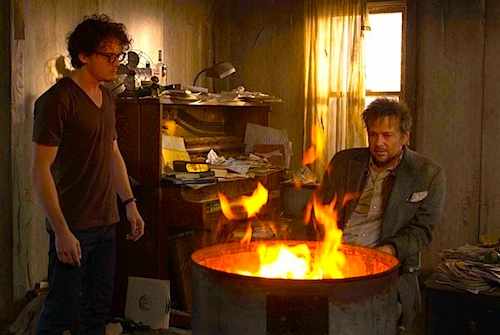
Buddy Heckum is the older brother, but Jakey is supposed to be the responsible one. Buddy is a bit slow, but he sure can shoot a gun. When their Pa, the sheriff is murdered, local crime lord Julius Hench tricks Buddy into thinking he is avenging his father by killing Hench’s enemies. Soon, the elder Heckum Brother is a full-fledged member of the gang. That must make him a Henchman. Meanwhile, Jakey Heckum maintains his blissful ignorance pursuing his violin studies in New York. However, with his marriage to Vittoria, a fellow struggling musician, soon approaching, Jakey returns home to brief Buddy on his best man duties.

Much to his shock, he finds his brother is totally mobbed up. Afraid the younger Heckum will challenge his hold on Buddy, Hench tries to have Jakey killed. He somehow survives, but it is quite the wake-up call. Determined to save Buddy, Jakey decides to take down Hench’s outfit from the inside by joining the organization. Fortunately, Hench was looking to recruit a violinist. Actually, he wanted a second viola player, but he will have to make do.

From "Broken Horses."

The very notion of Anton Yelchin’s nebbish Jakey Heckum talking his way into a ruthless border gang is seriously credibility challenged. While Yelchin can be a hit-or-miss actor, he completely throws in the towel halfway through Horses. The whole point of the film is to watch him belatedly accept responsibility for Buddy and save him from his soul-sucking life of crime. Yet, he spends the entire third act setting up house with Vittoria on Buddy’s ranch, letting the brother is supposed to protect handle all the thriller business.

Clearly, Yelchin is trying to vanish into the background. As Buddy Heckum (seriously, why not just call him Friendly Helzapoppin?), Chris Marquette induces cringe after cringe with a performance suggesting Lennie Small with anger management issues. Likewise, Vincent D’Onofrio over-indulges all his annoying tics and scenery chewing shtickery, but since he is the villain, it is somewhat forgivable. Probably only María Valverde (seen at Sundance a few years ago in the infinitely superior Madrid, 1987) merits any notice for bringing some warmth to the film as Vittoria.

This movie is just an absolute mess. Somehow it manages to be exploitative and boring at the same time. The title is a reference to putting down horses that pull up lame, which might be the only fitting aspect of the entire shooting match. Not recommended, Broken Horses opens today (4/10) in New York, at the AMC Empire.

LFM GRADE: D-

Posted on April 10th, 2015 at 2:58pm.

Cloning in Suburbia: LFM Reviews The Reconstruction of William Zero

By Joe Bendel. Even though the technology is not there yet, most countries have laws on the books limiting the extent of human cloning. A geneticist with issues will demonstrate why such precautions are probably prudent. Uncertified copies will be made in Dan Bush’s The Reconstruction of William Zero, which opens tomorrow in select cities.

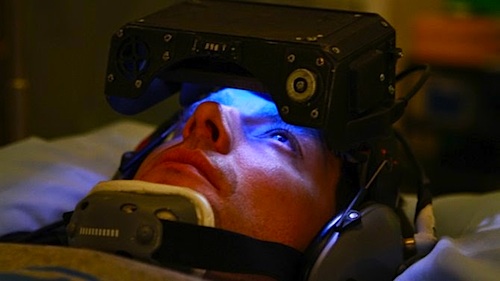
When he wakes up in a suburban split-level suspiciously well-appointed with medical equipment, a man finds himself being cared for by someone claiming to be his fraternal twin. Since they are dead-ringers for each other, this should be believable. However, he would have to have been born yesterday not to be leery of the squirrely-acting fellow. Of course in his case, that is not so very far from the truth.

William Blakely was a geneticist at Next Corp, whose cloning team reached an impasse with their canine test subjects. Every proxy, as they call them, developed rapidly progressing brain tumors. Clearly, it is way too early to apply this technology to human beings. Yet, Blakely has apparently done just that. He had his motives, specifically the debilitating guilt stemming from the accidental death of his young son several years ago. As the new proxy’s artificially impressed memories kick in, he sets out to make amends for abandoning his grieving wife Jules, while his “brother” ominously shadowing him.

It is always cool when a filmmaker finds an inventive way to realize a science fiction film without a lot of effects. However, this requires a really grabby story and a mind-twisting concept. Films like Coherence, Frequencies, and the soon to be released Time Lapse have both, but Reconstruction is a little short in both departments. Granted, Bush’s first act is rather effectively disorienting, but once we all have our bearings, the film proceeds in a quite orderly manner to a disappointingly standard conclusion.

From "The Reconstruction of William Zero."

Bush opts to focus on the personal drama of a clone coming to terms with his clone-hood, which is an interesting strategy, but it does not provide much grist to turn your head inside out. As a result, it is a fine showcase for co-writer Conal Byrne, who essentially gets to play extreme versions of the same William character, all of whom/which he differentiates quite distinctly. Amy Seimetz also looks convincingly exhausted as the still hurting Jules, but her frequent co-star A.J. Bowen must bid too hasty an exit as a private investigator prowling around Blakely’s house.

A clone’s journey to self-awareness is a potentially fascinating subject, but Bush never manages to lower the dramatic boom with authority. It is the sort of film that will leave viewers wondering: “so, that’s really it then?” Its DIY scrappiness is commendable, but it needed more narrative development. Not the definitive cloning film, The Reconstruction of William Zero opens tomorrow (4/10) in Los Angeles, at the Arena Cinema.

LFM GRADE: C+

Posted on April 10th, 2015 at 2:58pm.