LFM Reviews Kidnapping Mr. Heineken

By Joe Bendel. Alfred Henry “Freddy” Heineken was sort of like the Netherlands’ Lindbergh Baby, except he was nobody’s victim. A desperate group of disenfranchised construction workers pulled off the truly daring abduction, but getting away clean turned out to be a trickier proposition. Nevertheless, their crime-of-the-century had considerable long term consequences that are duly revealed in Daniel Alfredson’s Kidnapping Mr. Heineken, which opens this Friday.

Frankly, if Holland in the early 1980s had better respected property rights, Cor van Hout and his business partners might have never resorted to crime. They desperately needed a loan to keep their small construction enterprise afloat, but their only collateral was a building infested with legally protected squatters—not exactly a property the bank would be happy to assume should they default. Ironically, old man Heineken, a supporter of the Dutch People’s Party for Freedom and Democracy, probably would have empathized. Regardless, when Van Hout and his hot-tempered mate Willem Holleeder resolve to follow Willie Sutton’s advice and go where the money is, it necessarily means Mr. Heineken.

Showing considerable patience, Van Hout, Holleeder, and their accomplices spend two years in planning, rather than rushing into the operation. They want the authorities to assume Heineken was grabbed by a well-funded international terrorist organization or the mob. Initially, it all goes according to plan, but old man Heineken is cool customer. His chauffeur Ab Doderer is a different story. Heineken tries to reassure his panicking employee through the walls of their makeshift cells, but the working class immigrant is not holding up well.

You can expect to see a lot of negative reviews of Mr. Heineken from those hung up on class warfare rhetoric because of its largely positive portrayal of Freddy Heineken. He is consistently calm, collected, and caring with respects to poor Doderer. It is also rich to learn how he responded to his kidnapping as a capitalist once he was released (no thanks to his captors).

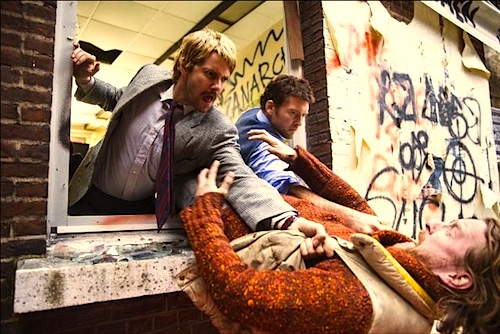
In large measure, Mr. Heineken is the sort of caper film where the whole point is to watch it go spectacularly wrong. Getting the ransom is the easy part, as it usually is. The getaway is way more difficult. However, in this case, the endgame is especially long and twisty.
From "Kidnapping Mr. Heineken."

Screenwriter William Brookfield incorporates a number of fascinating historical details into the narrative and the mostly British Commonwealth cast looks appropriately continental and suitably beaten down where applicable. Of course, Sir Anthony Hopkins is totally credible as Freddy Heineken, instantly establishing his intelligence and charisma. Jim Sturgess does his best work in years as the angsty Van Hout, while Sam Worthington is reliably tightly wound as Holleeder (but not nearly as awesome-nuts as he was in the under-rated Texas Killing Fields).

Alfredson, who helmed the second two Swedish Lisbeth Salander films, keeps the action moving along and the tension cranked up, despite the fatalistic direction it must take. Cinematographer Fredrik Bäckar also gives it a gritty look that nicely suits the times. It is quite a well-produced period-thriller that does justice to fascinating real life events. Recommended quite highly, Kidnapping Mr. Heineken launches on iTunes and opens in select theaters this Friday (3/6), including George R.R. Martin’s Jean Cocteau Cinema in Albuquerque.

LFM GRADE: A-

Posted on March 6th, 2015 at 1:25pm.
LFM Reviews October Gale

By Joe Bendel. Imagine a Hallmark Hall of Fame production that breaks out into a thriller—eventually. Viewers should be advised: they will have to wait a rather long time. Dr. Helen Matthews has come to her family’s cabin to mourn her recently deceased husband and clear out the clutter. It is decidedly off-season in Northern Ontario’s Georgian Bay. That will be perfect for either cathartic meditation of criminal skullduggery in Ruba Nadda’s October Gale, which opens this Friday in New York at the IFC Center.

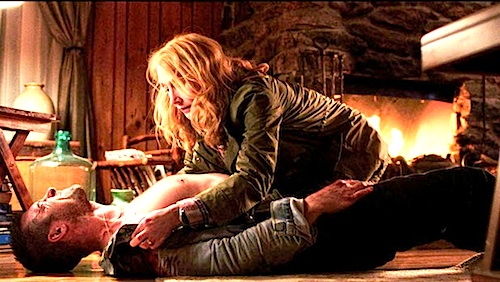
Matthews’ son tries to dissuade her from moping about the cabin during the stormy season, but she is drawn to the place. Perhaps it is the solitude she really needs. Alas, her seclusion will be interrupted when a man with a conspicuous bullet-wound collapses in her cabin. Vague on the details, he is eager to be on his way once she has stitched him up, but that simply is not realistic. Even if he were strong enough, his dinghy could never navigate the mounting storm.

Of course, someone shot the man calling himself William. Turns out, one of them was an old neighbor of Matthews’ who comes calling. Belatedly, Matthews’ realizes the extent of their trouble and starts to prepare for his return. Fortunately, he will be bringing the man responsible for the violence with him. That would be the mysterious Tom, played by the ever-reliable Tim Roth, who delivers a much needed energy boost to the film.

It is nice to see Nadda working again with Patricia Clarkson, the star of her art-house hit, Cairo Time. Their first collaboration is a beautiful ships-passing-in-the-night romance. Nadda’s Syrian-set follow-up Inescapable had its heart in the right place and made some worthy points, but it just did not click as a thriller. Unfortunately, such is also the case with Gale.

From "October Gale."

Nevertheless, Gale is not a complete dead loss. In general, it is always refreshing to see a character like the intelligent and mature Matthews on screen. Medically trained and handy with firearms, she is the antithesis of a helpless victim, which is cool. The compulsively watchable Clarkson is instantly credible in the role. However, aside from Roth’s late arrival, she does not have much support. Scott Speedman, who must be the primary beneficiary of some sort of Canadian protectionism for thespians is so lifeless and wooden as William, you could almost confuse him with the dead parrot in the Monty Python sketch.

The thrills never really coalesce in Gale, but it has a strong sense of place (as was also true of Cairo). Cinematographer Jeremy Benning capitalizes on the striking scenery of the isles dotting the bay, conveying both the beauty and the ominous power of nature. Thrillers just aren’t Nadda’s thing. Best saved for cable or Netflix streaming, the uneven October Gale opens this Friday (3/6) at the IFC Center.

LFM GRADE: C

Posted on March 6th, 2015 at 1:25pm.
Australia Dies Last: LFM Reviews These Final Hours

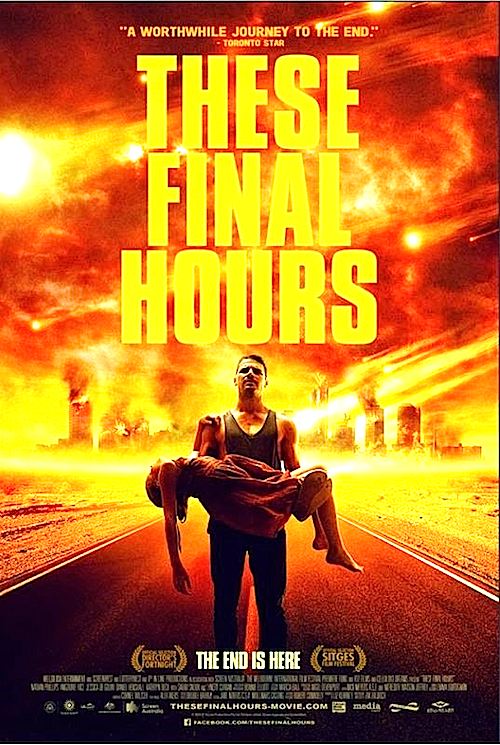
By Joe Bendel. James has mainly gone through life as a surly, self-absorbed slacker, but he is turning over a new leaf. Frankly, his efforts to reform his worthless life come in just under the wire. However, they still count for a lot in Zak Hilditch’s doomsday drama, These Final Hours, which opens today in New York.

The comet or whatever it was originally impacted in the North Atlantic. Western Europe was wiped out first and New York soon followed. We were probably fortunate in that respect. The apocalyptic shockwaves rippling across the globe will reach Western Australia last, giving the citizens of Perth enough time to anticipate the wrath about to hit them. They will deal with it in very different ways.

The immature James is determined to meet his end in a state of debauched delirium, so he leaves the lover he is with to join his even shallower girlfriend at a hedonistic end of the world party. In doing so, he fully realizes he is leaving the woman he always should have been with, in favor of the profoundly wrong one. Yet, fate intervenes when he observes two pedophiles abducting a young girl. Even after saving Rose, he is uncomfortable playing the role of her protector, but he eventually agrees to escort her to the aunt’s home where she hopes to meet up with her father. Of course, this trip becomes increasingly perilous, considering the end is nigh.

There is no doubt this particular apocalypse is a complete downer in every respect. Hilditch’s screenplay is nothing like cult favorite Night of the Comet, in which the end of the world was a total blast. Despite being a somewhat genre-ish film, TFH is emotionally heavy and deeply resonant. Yet, in a strange way it makes a hopeful statement, arguing redemption is still possible up until the very point we are engulfed in continent-buckling fireballs.

Nathan Phillips has kicked around for a while doing Australia TV and movies (such as the original Wolf Creek) and the odd Hollywood gig, but his work in TFH is next-level worthy. He convincingly establishes all of James’ considerable personality flaws, but he soon takes us to some genuinely raw and cathartic places. For the most part, Angourie Rice is respectable child thespian, but the character of Rose is problematically passive at times, like a garden variety horror movie child-in-jeopardy. On the other hand, Lynette Curran’s scenes with Phillips as James’ semi-estranged mother pack a real punch.

This is sort of film that does the little things right, such as the unseen David Field, who sets the perfect tone with some of the best voiceovers of the year as the intrepid radio broadcaster. Hilditch and his SFX team also pull off a fitting finale that feels appropriately all-encompassing without looking excessively 1990s Roland Emmerichian. This is a very well-crafted film that should generate positive attention for all involved, but you might want to follow it up with something more upbeat, like Comet. Recommended for fans of apocalyptic cinema, These Final Days opens this Friday (3/6) in New York, at the Village East.

LFM GRADE: A-

Posted on March 6th, 2015 at 1:24pm.

LFM Reviews Big Muddy

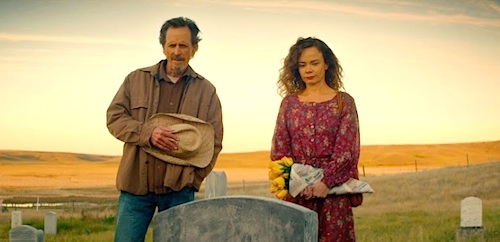
By Joe Bendel. It is like a film noir in the middle of an Andrew Wyeth painting, except these are the plains of Saskatchewan rather than the hardscrabble fields of Maine. It is even as quiet as a canvas at times. That can be both good and bad, but at least it suggests some integrity of vision on the part of screenwriter-director Jefferson Moneo when giving his prior short film the feature treatment. Rural Canada gets dark and dangerous in Moneo’s Big Muddy, which screens this weekend at the Catskills’ Mountain Cinema.

Martha Barlow and her current man, Tommy Valente, are no Bonnie and Clyde. Frankly, they are pretty crummy people, who specialize in liquoring up poor slobs to set them up for subsequent home invasion robberies. At least Barlow loves her moody son Andy. She just cannot help surrounding him with chaos. She ain’t seen nothing yet.

Unbeknownst to Barlow, her former lover Donovan Fournier is out to find her, having escaped from his prison farm. Even more ominously, Buford Carver, the horse race fixing gangster who came somewhere between Fournier and Valente, is back in town with a new horse and all kinds of bad intentions. Worried about the influence he exerts over her son, Barlow agrees to meet him at the track, but when Valente crashes the party with a gun and a poorly thought through plan things get very bad, especially for Carver’s prized horse. Suddenly, Barlow and her son are on the run, with a satchel full of Carver’s cash and a couple of highly irritated gangsters on their tail.

The two twains of Muddy will meet in Barlow’s rustic hometown, where she and Andy crash with her less than thrilled old man, Stan. In fact, Moneo handles the intersection of the two major plot lines quite deftly. However, he sure loves character-establishing scenes of Andy and Grandpa stringing up barbed wire fences. The truth is an editor with a free hand could easily trim fifteen or twenty minutes of Muddy without any ill consequences, but that is hardly unusual these days.

From "Big Muddy."

Happily, Muddy features the craggy gravitas of Stephen McHattie as Grandpa Stan. As usual, he commands the screen with his forceful badassery. On the other hand, Nadia Litz and David La Haye are not bad per se, but they make the strangest looking couple as Barlow and Fournier. James Le Gros is also reliably villainous, but his Carver seems a bit restrained when it comes to chewing the scenery and talking the trash.

Regardless, Moneo’s strong feel for the lonely, howling plains and Craig Trudeau’s stylish cinematography give Muddy a distinctive pastoral-noir vibe. It can be a bit slow, but it delivers when it needs to. Those who enjoy small town thrillers should find it worth seeing. Recommended accordingly, it has its premiere New York theatrical run this weekend (3/6-3/8) at Mountain Cinema and also just released this week on DVD.

LFM GRADE: B

Posted on March 6th, 2015 at 1:24pm.

LFM Reviews Detective K: Secret of the Lost Island

By Joe Bendel. Considering what debased currency did to the Roman Empire, the Joseon king is right to be concerned about an upsurge in counterfeit silver in circulation. However, it is highly debatable whether Kim Min, a.k.a. Detective K, and his shticky sidekick are the right people to investigate. They dive head-first into the case nonetheless in Kim Sok-yun’s Detective K: Secret of the Lost Island, which opens today in Queens.

Even in the Joseon era, no good deed goes unpunished. As a reward for his brilliant service, Detective K has been banished to the provincial coast. He understands it is just a temporary political thing, but it provides a handy excuse to rebuff young Da-hae. Desperate to find her missing sister Do-hae, she swims the channel every morning to cook and clean for the so-called detective, hoping he will take on the case. Eventually, she sets out to find Do-hae herself. Unfortunately, by the time Det. K grows alarmed by her prolonged absence, he is so deeply embedded on our hate-list, he will probably never redeem himself.

From "Detective K: Secret of the Lost Island."

Of course, it is the counterfeit silver that really motivates Kim Min to sneak away from his exile. Naturally, this leads to trouble with the authorities, but at least one high-ranking official will cover for him. His investigation soon brings him to the wild and woolly Japanese port colony that processes most of Joseon’s silver imports. There Detective K encounters Hisako, the femme fatale courtesan, who is either a lethal villain or an alluring ally. Only time will tell. However, the pressure and guilt will quickly mount for Detective K when he realizes the disappearances of Da-hae, Do-hae, and hundreds of other young nobi slave girls are somehow related to the silver counterfeiting ring.

There is something a little off about Lee Nam-gyu and Kim Soo-jin’s screenplay when it makes us despise the franchise character. It is really not Kim Myung-min’s fault, but he never conveys any spark of life as Detective K. For his part, the rubber faced character actor Oh Dal-su continues to be Michael Caine-level busy. Despite a little mugging, he is likable enough as the put-upon sidekick, Seo Pil. On the other hand, Lee Chae-eun and Hwang Chae-won are unusually charismatic and painfully heartrending as Da-hae and Do-hae, respectively. At least for pure entertainment, Lee Yeon-hee scorches up the screen as Hisako.

Nobody respects Korean cinema more than we do here, but the not infrequent habit of putting tiny little girls in positions of horrifying peril has become a too familiar custom better honored in the breach than the observance. It makes it difficult to enjoy the action and mayhem. Nevertheless, Detective K has some impressively mounted set piece sequences and several highly effective supporting turns. Recommended for those who enjoy broad comedy mixed with intrigue, Detective K: Secret of the Lost Island opens today (3/6) at the AMC Bay Terrace in Bayside, Queens.

LFM GRADE: C+

Posted on March 6th, 2015 at 1:23pm.

Get a Load of that Pastrami: LFM Reviews Deli Man

By Joe Bendel. By now, many people do not realize that at the time of the Civil War, Jews were largely more accepted by the South than the North. However, there was one Unionist who stood tall against anti-Semitism (Lincoln, of course). Maybe it should therefore not be so surprising one of the one hundred fifty-some surviving real deal kosher delis happens to be in Houston, Texas. Proprietor Ziggy Gruber (formerly of New York) will be our primary guide through the savory traditions of delicatessen cuisine in Erik Greenberg Anjou’s Deli Man, which opens this Friday in New York.

Gruber was born into the delicatessen establishment, as the grandson of the owner of Broadway’s famed Rialto deli. He started working part-time for his beloved grandfather at an early age and absorbed all his traditional recipes and practices like a sponge. He now co-owns and operates Kenny & Ziggy’s New York Delicatessen in Houston, one of an estimated 150 legit kosher delis in America. To put things in perspective, there were over 1,500 certified kosher delis in New York City during the 1930s.

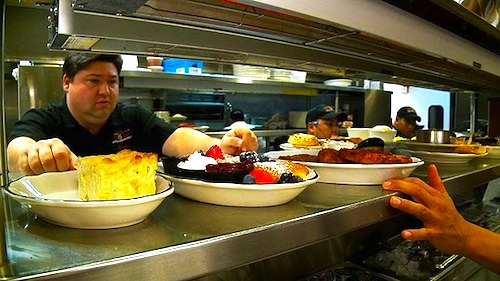
Anjou supplies some historical context (pastrami originally came from Romania) and offers some analysis of deli fare as a poignant cultural remnant of a shtetl world that no longer exists, but when you really get down to it, Deli Man is all about the food. The mountainous pastrami sandwiches are as mouth-watering as you would expect, but everything coming out of Gruber’s kitchen looks appetizing. In fact, he whips up some sort of roast shank that could probably justify a trip to Houston by itself.

From "Deli Man."

Anjou could not have cast a more fitting central figure than the effusive Gruber. The man knows deli traditions through and through, yet he treats his staff and customers like family, regardless of their backgrounds. We also meet a representative sampling of other deli men and women, including Jay Parker of Ben’s Best in Rego Park, Queens, which is about as authentic as it gets. However, Anjou only peaks into the personal life of Gruber, who may have finally found someone willing share so much of his time with the corned beef. It is nice to see things working out for him, considering what he has done to keep his family and culinary traditions alive.

Anjou duly observe the irony that it was Jewish Americans’ successful acceptance and assimilation into suburbia that largely drove scores of neighborhood kosher delis like Ben’s Best out of business, without belaboring the point. Indeed, there is some serious substance to the film, but there is no getting around its food porn indulgence—and who would want to? Recommended for those who appreciate culinary cultural history on rye, Deli Man opens this Friday (3/6) in New York at the Lincoln Plaza uptown and the Landmark Sunshine, not so far from Katz’s on Houston Street.

LFM GRADE: B

Posted on March 4th, 2015 at 10:13pm.