LFM Reviews When Marnie Was There @ The 2015 New York International Children’s Film Festival

By Joe Bendel. For young Anna Sasaki, coming of age is a particularly dramatic process, in a dark psychological kind of way. She is like a character out of Daphne du Maurier or Mary Roberts Rinehart novels, who has been sent to spend the summer in a bucolic marshland that could have been painted by the Impressionists. Nobody would be better suited to realize her new environment than the Studio Ghibli team, but alas, this will be their final release for the foreseeable future. While it lacks the tragic sweep of its immediate predecessors (Princess Kaguya and The Wind Rises), Hiromasa Yonebayashi’s When Marnie Was There is an appropriately intimate goodbye that packed the house for the opening night of the 2015 New York International Children’s Film Festival.

Sasaki is far too sensitive to make friends easily with her classmates. Her stress-aggravated asthma does not help, either. After a particularly severe attack, Sasaki’s mother Yoriko sends her to stay with her extended relatives, kindly old Kiyomasa and Setsu Oiwa. However, as a foster child, Sasaki has difficulty accepting any of them as family, including Yoriko, despite their genuine concern.

To humor Setsu, she makes a few half-hearted efforts to befriend some of the village girls her age, but Sasaki prefers to make sketches on her own. One of her favorite subjects is Marsh House, an abandoned mansion only intermittently accessible during low tides. Strangely though, a young girl named Marnie seems to live there with her ominously gothic servants. Sasaki and Marnie are drawn to each other like lonely kindred spirits. At last, each feels they have finally found a true friend. Yet, Marnie’s penchant for vanishing without a trace confuses and sometimes hurts Sasaki.
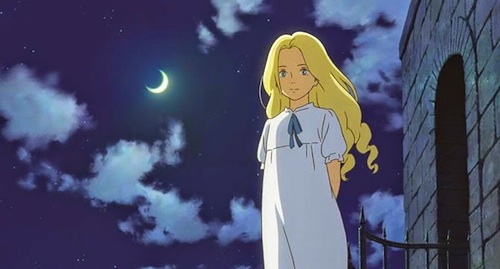
From "When Marnie Was There."

It does not take much deduction or intuition to figure WMWT is some sort of supernatural story, but it still holds some profoundly resonant secrets. It certainly looks like a Studio Ghibli film, which means it is lushly gorgeous. As with The Secret World of Arrietty, his previous film as a director (also based on a British YA novel), Yonebayashi fully captures the beauty and malevolent power of the natural world. Frankly, it is rather impressive how quickly and yet how smoothly he can change the vibe from sunny pastoral to psychological suspense. There is even a scene in a supposedly haunted grain silo that evokes the mission tower staircase in Vertigo, fittingly enough in a film featuring a titular character named Marnie.

WMWT is a deeply humanist film, brimming with forgiveness and empathy. Through her POV, we will acutely understand how coming to terms with the past will allow Sasaki to carry on and embrace life. As a potential sign-off from Studio Ghibli, that’s not bad. Amongst their storied output, it probably ranks somewhere in the middle, but had it come from just about any other animation house, it would represent their crowning achievement. Granted, the opening act is a little slow getting it in gear, but overall, it is remarkably astute emotionally and refreshingly life-affirming. Highly recommended, When Marnie Was There screens again next Saturday (3/7) at the SVA Theatre, as part of this year’s NYICFF.

LFM GRADE: A-

Posted on March 4th, 2015 at 10:12pm.
LFM Reviews The World of Kanako @ The 2015 Film Comment Selects

By Joe Bendel. Showa Fujishima has made just about every parenting mistake a father can make and invented some that are uniquely his own. Not surprisingly, he really hasn’t been around much to see the results. At least that allows him to cling to a few willful misconceptions regarding Kanako. However, when his estranged ex-wife begrudgingly requests the ex-cop’s help finding their missing daughter, he learns far more than he bargained for in Tetsuya Nakashima’s The World of Kanako, which screens during the 2015 edition of Film Comment Selects.

Prepare to have your head messed with. Nakashima will fracture his timeline nearly beyond recognition and do his best to represent Fujishima’s warped perspective. The former copper now working as a rent-a-cop always had anger management issues, which directly led to his personal and professional disgrace. He is supposed to take drugs for his temper and mood swings, but they do not seem to be working, even though they might somewhat skew his perception of reality.

Kanako has already been missing for five days before Fujishima’s ex finally asks for his help. Intuitively, he assumes her disappearance is linked to the punky gang kids she has been hanging with, which is largely correct, but his presupposition that Kanako is an innocent victim will be rudely disabused. He soon learns she is up to her neck in drugs and pimping out classmates to well-heeled pedophiles. She was also apparently somehow mixed up in the suicide of her classmate Ogata. We will learn just exactly how so in flashbacks seen through the eyes of Boku, a secondary POV character, whose experiences with Kanako will parallel those of poor Ogata.

Meanwhile, Fujishima’s hostile former colleagues are more than happy to treat him as a suspect in a gangland-style killing perpetrated at the minimart he was ostensibly guarding. It turns out Kanako’s world is a small world when links turn up suggesting a connection between the convenience store massacre and her disappearance. Fujishima is in for a lot of pain and humiliation, but he will deal out plenty more to anyone he considers a potential suspect or accomplice.

Man, Kanako is dark, even by the standard Nakashima set in his previous films, Confessions and Memories of Matsuko. However, unlike the seamlessly constructed escalation of Confessions, WoK is a bit of a rat’s nest, compulsively flashing forward and backwards and liberally tossing unreliable perceptions or downright hallucinations to the point where many viewers will just drop the narrative thread and stop caring altogether, despite the occasional tongue-in-cheek hat-tips to 1970s exploitation cinema. The form of the film is enough to give you a headache, separate and apart from the rampant cruelty it depicts. Based on Akio Fukamachi’s novel, WoK is a nihilistic indictment of just about everything—that’s nihilism spelled with a capital “F” and a capital “U.”

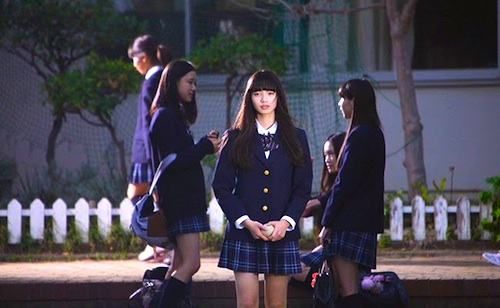
To his credit, Kôji Yakusho doubles down over and over again as the violently erratic Fujishima. It is a messy, let-it-all-hang-out performance, but Yakusho takes it to such dark places, it is ultimately rather soul-scarring. Nana Komatsu is ethereally evil as the deceptively innocent looking Kanako, while Satoshi Tsumabuki chews the scenery with swaggering glee as Det. Asai, the sucker-sucking cop who apparently thinks he’s Kojack. Ai Hashimoto manages to add a thimble full of humanity to the film as Kanako’s estranged and disgusted middle school friend Morishita, but such figures of decency are few and far between in Kanako’s world. Frankly, it is hard to fully judge Kanako’s former homeroom teacher, Rie Higashi, but (Matsuko star) Miki Nakatani’s performance is truly riveting and maybe even redemptive.

From "The World of Kanako."

If this is what life is really like for Japanese middle and high school students, I would immigrate if I were a parent. It is hard to imagine a more exhausting film than WoK, for reasons of both style and content. It is clearly the work of a genuine auteur, who does not get his just international due, but Nakashima really demands a great deal of indulgence this time around. Lacking the tightness of Confessions and the pure gut-wrenching emotional payoff of Matsuko, it just starts to feel like it is piling it on after a while. For those who enjoyed cult hits like Confessions, Lady Snowblood, Audition, and the real Oldboy, but found them too artificially optimistic, WoK will give you the straight shot of bile you crave. Recommended accordingly for ardent Nakashima admirers, The World of Kanako screens this Thursday (3/5), at the Walter Reade Theater, concluding this year’s Film Comment Selects.

LFM GRADE: C+

Posted on March 4th, 2015 at 10:11pm.

LFM’s Jason Apuzzo at The Huffington Post: The Time a UFO Invaded Los Angeles: UFO Diary Recreates the Great LA Air Raid of 1942

[Editor’s Note: the post below appeared today at The Huffington Post.]

By Jason Apuzzo. Today marks the 73rd anniversary of The Battle of Los Angeles, also known as The Great LA Air Raid, one of the most mysterious incidents of World War II — and one of the most colorful tales in all of UFO lore.

It’s also a tale we couldn’t resist turning into a movie.

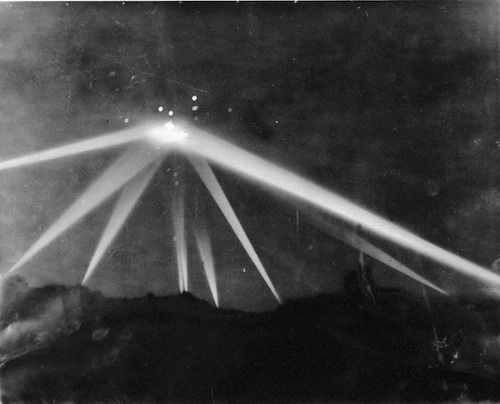
Between the late evening of February 24th, 1942 and the early morning hours of February 25th, the City of Angels flew into a panic as what were initially believed to be Japanese enemy aircraft were spotted over the city. This suspected Japanese raid — coming soon after the Pearl Harbor bombing, and just one day after a confirmed Japanese submarine attack off the Santa Barbara coast — touched off a massive barrage of anti-aircraft fire, with some 1400 shells shot into the skies over Los Angeles during the frantic evening.

Strangely, however, the anti-aircraft shells hit nothing. Despite the intense barrage, no aircraft wreckage was ever recovered.

Indeed, once the smoke had cleared and Angelenos calmed down (the public panic over the raid was mercilessly satirized by Steven Spielberg in 1941), no one really knew what had been seen in the sky or on radar. Were they weather balloons? German Zeppelins? Trick kites designed by Orson Welles?

Many people believed the aircraft they’d seen was extraterrestrial – one eyewitness even described an object he’d seen as looking like an enormous flying “lozenge” – and some accused the government of a cover-up. Conflicting accounts of the incident from the Navy and War Departments didn’t help clarify matters.

An image from the Great Los Angeles Air Raid.

As if to confirm public fears of extraterrestrial attack, one famous L.A. Times photograph (see left) emerged from the incident showing an ominous, saucer-like object hovering over the city. This much-debated photograph inspired America’s first major UFO controversy — a full five years before Roswell.

To this day, no one knows for sure what flew over Los Angeles that night and evaded the city’s air defenses. But since it’s more fun to assume that it was aliens than weather balloons, we decided to honor The Battle of Los Angeles by dramatizing it in our film UFO Diary as an encounter with the unknown. And as a special treat for UFO enthusiasts and history buffs, we’re releasing the trailer for UFO Diary today. Continue reading LFM’s Jason Apuzzo at The Huffington Post: The Time a UFO Invaded Los Angeles: UFO Diary Recreates the Great LA Air Raid of 1942

Salma Hayek vs. the Yakuza: LFM Reviews Everly

By Joe Bendel. Even if you believe “violence is never the answer and what the world really needs is more love and understanding,” just keep it to yourself. Everly does not have time for warm and fuzzy liberal new age platitudes and we do not want to hear them. She is simply too busy worrying about escape and payback. For several years, she was enslaved as a prostitute by the Yakuza, but now she will try to shoot her way out of their fortified brothel. It is not a well thought out  plan, but at least she will be able to take a lot of bad guys with her in Joe Lynch’s Everly, which opens this Friday in targeted markets.

Everly used to be the favorite of the kingpin, Taiko, but not anymore. An honest cop also lost his head over her. Taiko had it boxed up and presented to her. She had agreed to testify for the late detective, but obviously that will not be happening. Taiko’s men were supposed to do their worst to her, but she was able to stash a gun in the toilet bowl. Bullets will fly—and they will keep flying, but Everly is not immune to them. In fact, she starts the film pretty dinged up, but she is able to patch herself up and keep going.

Unfortunately for him, one of Taiko’s bean-counters gets gut-shot in the first volley. There is clearly no way he will make it. Much to her surprise, the dying paper-pushing gangster offers her some helpful strategic consultation as he slowly expires. Acting on his advice, she makes a risky play, arranging a pretext for her mother and the daughter she never knew to pick up a bag of traveling money from Taiko’s high-rise of hedonism-turned war zone.

To their credit, Lynch and screenwriter Yale Hannon understand the point of a film like this and therefore never cheapen it with a disingenuous take-away about the supposed dangers of firearm possession or the folly of vengeance taking. Taiko and his associates need to die—period. Frankly, some bits are rather disturbingly explicit, particularly those involving the “Sadist” played by the classy Togo Igawa (the first Japanese member of the Royal Shakespeare Company), but that makes it extra satisfying when they get theirs.

It should also be noted that the forty-eight year old Salma Hayek looks all kinds of dangerous as Everly. She is in tremendous shape and shows real action chops, but in a grittier, less cartoony way. She conveys the well-armed rage of a desperate mother, which makes each showdown deeply primal. There are real stakes in Everly—and plenty of blood, but her relatively quiet scenes with Akie Kotabe as the dying suit are some of the film’s best.

We have often lamented the dearth of legitimate female action stars in Hollywood and mainstream indie movies. It is so bad, Meryl Streep has laughably been suggested for the female Expendables film in development. With Everly, Hayek blasts herself into contention to lead the whole darned shooting match. Despite its obvious debt of inspiration to Gareth Huw Evans’ The Raid, it is an old school, deliciously sleazy revenge thriller that always delivers the goods right to your doorstep and never expects a tip. Highly recommended for fans of exploitation action, Everly is now available on VOD via iTunes and opens this Friday (2/27) in selected cities.

LFM GRADE: A-

Posted on February 25th, 2015 at 9:59pm.

LFM Reviews My Life Directed by Nicolas Winding Refn

By Joe Bendel. It was not a total loss when Only God Forgives, Nicolas Winding Refn’s much anticipated follow-up to Drive, bombed with the Cannes press corps. At least it should have shown Ryan Gosling how to deal with the Lido drubbing dealt to his directorial debut, Lost River. Maybe Winding Refn’s film is not looking as bad to them, by comparison. Maybe. Nevertheless, his family did not return from six months in Thailand without bringing home one highly watchable film. Alas for Refn, that would be his wife Liv Corfixen’s up-close-and-personal behind-the-scenes documentary, My Life Directed by Nicolas Winding Refn, which opens this Friday in New York.

When watching Corfixen’s film, you immediately realize there was no way OGF was going to work. Winding Refn essentially admits his script makes no sense, which is never a good sign. Yet, his own contradictory impulses imply an even deeper identity crisis for the film. On one hand, he is clearly preoccupied with the pressure to repeat the success of Drive, yet he is perversely determined to produce a something utterly dissimilar. Mission accomplished on that score.

Much to her frustration, Winding Refn strictly limited Corfixen’s access to the set. It is evident from their often testy exchanges that she missed a lot of “making of” drama as a result. Still, it is blindingly obvious from the get-go this is a “troubled” production. In some shockingly revealing scenes, she captures all of her husband’s unvarnished self-doubt and self-pity, as OGF irreparably runs off the rails. Winding Refn’s references to compatriot Danish filmmaker Lars von Trier sounds especially telling. They seem like they should be two neurotic peas in a pod, but Winding Refn clearly nurses an inferiority complex.

Life should really not be dismissed as a DVD-extra, because it is hard to see anyone packaging it with OGF. After all, the shorter film basically explains why the longer feature attraction is such a chaotic mess. Short is also the right term. The actual movie substance of Life clocks in just under sixty minutes. However, Life has one thing few films can boast: their legendary family friend, director Alejandro Jodorowsky reading tarot and providing marriage counseling.

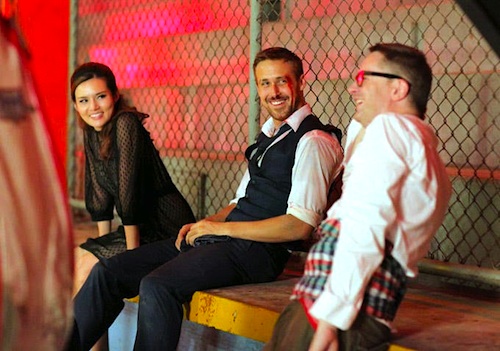
From "My Life Directed by Nicolas Winding Refn."

In all honesty, OGF has its moments, but they all come courtesy of the wonderfully fierce Kristin Scott Thomas and stone cold Thai movie star Vithaya Pansringarm, both of whom are seen in Life, planning their climatic scene together. In contrast, Gosling is utterly underwhelming, but to be fair, he comes across like a good sport in Corfixen’s doc, often seen playing with the couple’s young daughters. Perhaps he and Refn should just leave the making of David Lynchian films to David Lynch.

Regardless, Life is a brutally honest look at the personal and emotional repercussions of a film that never worked, in any step of its production. It is also frequently very funny, in decidedly uncomfortable ways. Frankly, it is a shame we do not have similarly intimate records of the notorious production processes for films like Heaven’s Gate, but Life will be there as a cautionary example for all future filmmakers battling their expectations and egos. Highly recommended for fans of cult cinema, My Life Directed by Nicolas Winding Refn opens this Friday (2/27) in New York, at the Elinor Bunin Monroe Film Center.

LFM GRADE: B+

Posted on February 25th, 2015 at 9:58pm.

LFM Reviews Serangoon Road, Now Available on DVD

By Joe Bendel. If the boy from Empire of the Sun, grew up to be a hardboiled private detective, he would be a lot like Sam Callaghan. The Aussie expat is still haunted by his childhood experiences in a Japanese internment camp, but he toughened up considerably through his Malaya military service. He used to lend a hand to the late Winston Cheng on a freelance basis, but he reluctantly agrees to a more regular arrangement when his widow Patricia decides to keep the agency open. Thanks to the Secret Societies, terrorist bombings, and all sorts of garden variety smuggling, they will find no shortage of business in Serangoon Road, HBO Asia’s first original series production, which releases today on DVD from Acorn.

Callaghan sort of blames himself for Cheng’s death, but the elegant Mrs. Cheng plays the guilt card with restraint. Although she is from a “mainline” establishment Peranakan Chinese family, the childless widow still needs the agency as a means of support. With the help of Sam and her progressive niece Su Ling, she also hopes to catch her husband’s murderer.

Their first case seems to be a one-off with little long term implications, but it will introduce the large cast of characters. Fresh-faced CIA recruit Conrad Harrison and his shadowy boss “Wild Bill” need the Cheng Agency to track down an African American sailor accused of murdering his best mate. It is probably the series’ least flattering depiction of American spooks and servicemen, but at least Harrison, one of those “best and brightest,” seems to care about right and wrong. He is also very interested in Su Ling, but she initially wants nothing to do with a Yankee government employee.

The past will directly haunt the present in subsequent episodes, as when the Cheng Agency takes on an illegal refugee’s case in the second episode. Forced to take flight during the Japanese invasion, Ms. Feng has returned (undocumented) in search of the husband she left behind. The case looks pretty cold until Ms. Feng is mysteriously poisoned. As she clings to life, Callaghan scrambles to trace her beloved husband, empathizing with her deep sense of loss. He will become even more personally involved with a case later in the season, when the Aboriginal soldier who watched over him during the darkest hour of the war is accused of murdering an aspiring journalist.

Many of the Cheng Agency cases lead back to Kay Song, the heir apparent of Singapore’s most feared secret society (a gang primarily involved in crimes of sin). For some reason, the sinister gangster has it in for Kang, Callaghan’s compulsive gambling partner in a barely legal shipping operation. It is hard to see why he bothers, given Kang’s multitude of self-destructive flaws. Frankly, Kang subplots will become a tiresome distraction as the series progresses.

As befits a good period noir, everyone in Serangoon is compromised to some extent, particularly Callaghan, who is rather openly carrying on an affair with Claire Simpson, the wife of a junior executive assigned to a powerful western trading company’s Singapore office. Conveniently, Frank Simpson is often required to travel throughout Southeast Asia. Rather awkwardly, Callaghan is even hired to investigate his rival when Simpson is anonymously sullied with rumors of corruption.

During the course of the first season, the Cheng Agency will also deal with a mysterious foundling, a suspicious business leader with political aspirations, his nearly as suspicious trade unionist brother, two kidnapped Australian tourists, and a massive race riot that the bad guys will opportunistically exploit to the fullest. Structurally, each episode is reasonably self-contained, but they fit together to form a wider overall narrative arc.

Although many of the mid-sixties Singaporean details are quite intriguing, it is the strong ensemble cast that really distinguishes Serangoon. Even though he sometimes overdoes the heartsick brooding, Don Hany’s Callaghan still has an appropriately manly yet world weary screen presence. Of course Joan Chen adds plenty of class and sophistication as Patricia Cheng. It is easy to see why western bureaucrats would have confidence hiring her.

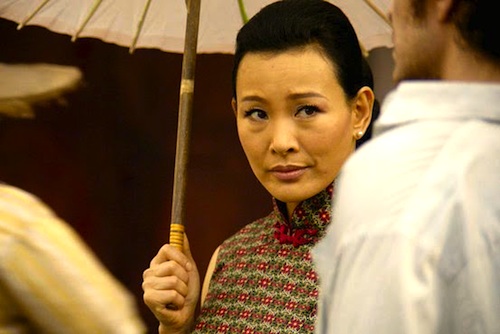
From "Serangoon Road."

Frankly, the real discovery is Pamelyn Chee (who maybe a handful of people saw in Wayne Wang’s Princess of Nebraska), stealing scene after scene with Su Ling’s wry sarcasm and slightly deceptive elegance. Chin Han chews the scenery like he enjoys the taste as the villainous Kay Song (just as he did in Marco Polo). Somewhat frustratingly, Indonesian superstar Ario Bayu does not get a lot of fun things to do this time around, but there is room for his character, Inspector Amran, to grow. However, Maeve Dermody’s hopelessly vanilla Simpson falls somewhat short in the scandalous femme fatale department. It is hard to get why Callaghan is so hung up on her. Maybe you just have to be there—in Singapore—circa 1964.

Regardless, there is more than enough mystery, betrayal, and colorful supporting characters to keep viewers engaged and increasingly invested. Frankly, it seems strange the American HBO did not pick it up to fill a slow spot in their calendar. In terms of production quality, it holds its own with most limited-event cable series and should equally satisfy Joan Chen fans who know her either from Twin Peaks or Xiao Hua (The Little Flower). Recommended for anyone who enjoys humid noir in serial form, Serangoon Road is now available on DVD from Acorn.

LFM GRADE: B+

Posted on February 25th, 2015 at 9:58pm.