LFM Reviews The Interview; Now on DVD/Blu-ray

By Joe Bendel. It has generated more irony than a hipster gathering at Cracker Barrel. Perhaps the biggest head-scratcher was the AWOL administration’s belated decision to respond to the Sony hack by cutting North Korea’s internet access, right when the studio was negotiating its availability on every digital VOD platform they could find. Perfect—for Lil’ Kim. Finally, you can take home a physical copy of Evan Goldberg & Seth Rogen’s unlikely free speech cause célèbre, The Interview, which releases today on DVD and Blu-ray.

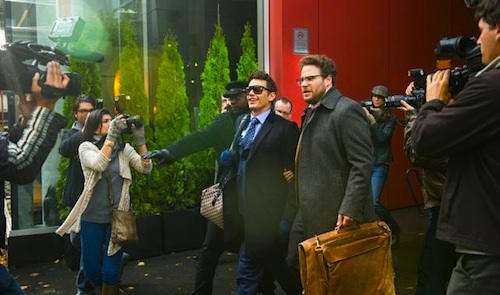
If you haven’t heard about a jillion times already, James Franco (or Flacco as our super in-touch president knows him) plays a shallow celebrity chat show host who scores an interview with Kim Jong-un, but the CIA convinces him and his responsible producer to use the opportunity to assassinate the dynastic Communist dictator. Hilarity then ensues, but The Interview’s humor has taken it in the shins from cultural commentators who are uncomfortable defending the free expression of scatological jokes.

Yes, Rogen’s Aaron Rapaport, the loyal producer of the Dave Skylark show, sticks a metal tube up his butt. It is kind of an uncomfortable scene. However, the good news is The Interview is funnier than it has been cracked up to be, but it is easy to see why a lot of media people were not laughing. Most of the jokes come at their expense. Sure, Skylark is an over the top caricature of the most superficial red carpet stalker, but his differences with the coach sitters on the morning “news” shows and The View are only of degrees and not of kind. Dave Skylark more or less is the media, except he is not a bad person. We know that because he loves puppies.

Through Rapaport, The Interview establishes the general reality of North Korean prison camps and famines, but it stops short of a categorical indictment. It fully admits (and the Dennis Rodmanesque Skylark eventually accepts) the fact that an appalling number of North Koreans have been sentenced to concentration camps, but it never delves into the standard practice of condemning entire families, two generations in each direction, for dubious crimes against the state. Admittedly, that would be a real buzz kill for a comedy.

In a weird way, Skylark is the dark flipside of the media-obsessed sociopath Flacco plays in True Story. It is a fitting role for the compulsively publicized actor-student-film director. Rogen largely assumes the straight man duties, but he shares decent buddy chemistry with Flacco. Randall Park probably earns a more villainous feature spot in the next Awesome Asian Bad Guys with his highly Freudian portrayal of Kim Jong-un. He certainly undermines the lofty stature of Kim, but the film never invites outright sympathy for his insecurities. However, the real breakthrough has to be Diana Bang, who exhibits nimble comic timing and solid action chops as Sook, the lads’ minder and unlikely ally.
From "The Interview."

The Interview’s reportedly draggy midsection really is a fair rap, but the last half hour just might be worth balloon-dropping over Pyongyang. The tone is pretty much what you expect, but it is not as dumb as you’ve been told. Arguably, it should have been even more explicit explaining the crimes of the Kim Marxist Monarchy. Honestly, it would have been a shame if they self-censored themselves, because what more could have possibly gone wrong?

Regardless, it is still worth seeing as a way of making a personal statement. Of course, watching documentaries like Red Chapel, Kimjongilia, Yodok Stories, and The Secret State of North Korea with it or in its place makes an even stronger statement. Reasonably amusing as a dumb comedy, The Interview still carries wider significance, so it is duly recommended as a way to annoy Kim the Third when it releases today (2/17) on DVD and Blu-ray.

LFM GRADE: B-

Posted on February 16th, 2015 at 10:05pm.

LFM Reviews Haze and Fog @ MoMA’s 2015 Documentary Fortnight

By Joe Bendel. A community is not just an assemblage of condos. Frankly, the complex in question is more of a concentration of angst than a communal body. Notions of community and the lack thereof feature prominently in Cao Fei’s hybrid documentaries, with the emphasis placed squarely on the “hybrid.” Contemporary Chinese life gets a strange but true-in-spirit genre spin in Cao’s Haze and Fog and iMirror, which screen together during MoMA’s 2015 Documentary Fortnight.

Initially, Haze feels very much like a standard aesthetically severe observational documentary, except Cao seems to have an eccentric knack for focusing on dark, uncomfortable moments. We see a prostitute going about her 50 Shades business with clients in the building, security guards peeping on tenants, and a pregnant housewife engaging in self-destructive behavior. Perhaps Cao’s cast really is part of the building’s universe, but hopefully they are playing fictionalized roles.

Clearly, everyone is alienated to some extent, despite their close proximity. Gao uses their daily frustrations to critique an increasingly fractured Chinese society and the continuing conflict between empty consumerism and traditional values. Then Haze turns into a zombie film. For real. It is all part of the allegory, but the zombies do what zombies do.

This is a strange film—and a bold pick for Doc Fortnight. It clocks in just over an hour, but it is unlikely Cao could have sustained the weird, anesthetizing vibe and frequency of understated, untelegraphed WTF moments much longer. It is a masterful piece of filmmaking that keeps the audience off-balance from start to finish, but Cao also gets some notably sensitive performances from Wang Chenxu as the young single woman and Liu Lu as the expecting housewife.

iMirror also falls a good deal outside the traditional bounds of Fortnight selections, but it is more deliberately doc-ish. Cao, billed as “China Tracy,” her virtual handle, chronicles a relationship she had with the avatar of an older man from San Francisco, within the virtual reality world of Second Life (SL). It is not really a catfish story, because he was more-or-less who he claimed to be and it is understood that everyone constructs idealized versions of themselves. Yet, it got pretty real, even though it wasn’t.

From "Haze and Fog."

The second part of iMirror focusing on China Tracy’s virtual something with the younger and then older looking Hug Yue is considerably stronger than parts one and three, which mostly just establish the issues and environment of SL. Naturally, the animation looks very computer generated, as it must, because that is SL. Nevertheless, the film raises a number of questions for offline viewers, especially given the apparent freedom Cao found there. Is this a place where connected Chinese citizens can go to escape government censorship and surveillance? If so, why the hammer-and-sickle decorative motifs? Is a utopian ideologue inherently attracted to the presumptive perfectiveness of SL’s virtual world?

Given their genre elements, Haze and iMirror fit together rather easily, but the former is the far more challenging and inventive film. If you are a MoMA member you should drop in and see it when it screens, because love it or hate it, you will not see anything like it anytime soon. Highly recommended, Haze and Fog screens with iMirror next Thursday (2/26) and Friday (2/27) as part of this year’s Documentary Fortnight at MoMA.

LFM GRADE: A

Posted on February 16th, 2015 at 10:05pm.
Don’t Call It Found Footage: LFM Reviews Digging Up the Marrow

By Joe Bendel. Thanks to the found footage sub-genre, the horror movie community hardly knows what to do when the real thing comes along. At least that is sort of the premise of the new meta-meta mock-and-shock doc from the team behind the Holliston television series. Director Adam Green, playing himself and riffing off his Holliston persona, starts to suspect monsters are real, so naturally he sets out to film them in Digging Up the Marrow, which launches on VOD and opens in select theaters this Friday.

Green really does get a great deal of intricately constructed fan fiction sent to him, in some cases much like the incredibly detailed but presumably barking mad missive that starts his on-camera excursion down the rabbit hole. A retired Boston cop named William Decker claims a secret band of the freakishly deformed live in a subterranean world he calls the Marrow. The entrances are closely guarded, but he has discovered one, logically located in an out of the way cemetery. Thus begins a series of futile stakeouts, with his reluctant cinematographer Will Barratt (played by cinematographer Will Barratt) in tow.

Of course, just when Green decides Decker is a complete nut leading them on a wild goose chase, they finally see something that changes everything. However, they still have to convince their colleagues to take their footage seriously. Green’s real life editor Josh Ethier (who also played the killer lumberjack-alien in Joe Begos’ Almost Human) is particularly skeptical, but he is perfectly willing to cut Green’s stolen shots. “It’s not found footage, it’s . . . footage” he insists.

Frankly, this is one of the best postmodern self-referential genre films since Wes Craven turned his signature franchise on its head with New Nightmare. It is light-years better than the Vicious Brothers’ knowing but disappointingly flat Grave Encounters 2. While there are plenty of creepy moments, the film is more about exploring how the horror industry and sub-culture would respond when confronted with possible evidence that maybe some of this stuff might just be real.

In a pleasant turn of events, Ethier and Hatchet star Kane Hodder (best known for his stint as Jason in the old school Friday the 13th films) are totally hilarious playing off each other and Green. They give the film a major energy boost during their scenes. Green himself is a good sport as the straight man for their quips and all of Decker’s macabre madness, whereas Ray Wise, the only cast member assuming a fictional persona, is reliably looney as the unreliable Decker.

From "Digging Up the Marrow."

Inspired by the Alex Pardee’s monster art, Marrow is a strong creature feature that might even be more interesting when it operates in the ostensibly real world. Sadly, the film also marks the last screen appearance of Green’s late series co-star Dave Brockie. Green also was disciplined enough as a director to keep the scenes of actress Rileah Vanderbilt playing his actress-wife Rileah, even though she would now have to play his ex-wife should there ever be a sequel.

Given all that seems to transpire, fans will not be expecting a third season of Holliston anytime soon after watching it, but they should enjoy appearances from leading genre filmmakers like Don Coscarelli, Mick Garris, and Tom Holland. Highly recommended as a clever, fully developed, ironically meta genre film, Digging Up the Marrow hits iTunes this Friday (2/20).

LFM GRADE: B+

Posted on February 16th, 2015 at 10:04pm.

LFM Reviews Electric Boogaloo: the Wild, Untold Story of Cannon Films

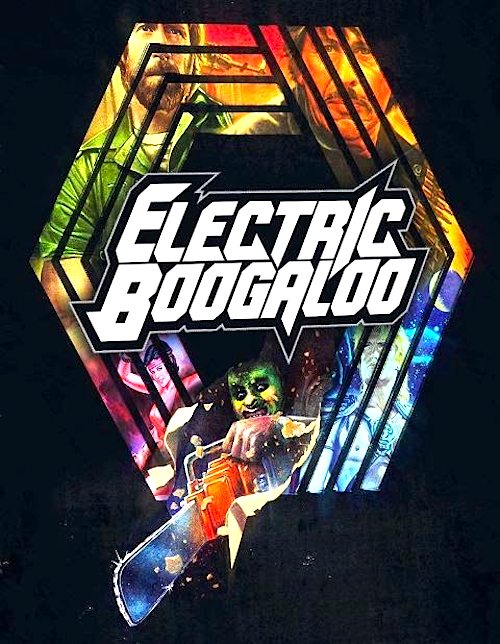
By Joe Bendel. They were decades ahead of the curve, making profitable films about terrorism long before it became an overriding concern for Americans. Of course, Menahem Golan and Yoram Globus happened to be Israeli, so they understood how dangerous the world could be. Unfortunately, they were not as canny judging the American marketplace with the releases that followed Invasion U.S.A. and The Delta Force. Mark Astley compiles a breezy oral history of their rise and fall in Electric Boogaloo: the Wild, Untold Story of Cannon Films, which opens this year’s 2015 Film Comment Selects.

Yes, Hilla Medalia’s Cannon doc The Go-Go Boys just played the New York Jewish Film Festival, but there is always room for more Cannon. Reportedly, Go-Go is considered the B-movie moguls pre-emptive attempt to tell their side of the story. Hartley’s film even acknowledges the competition, comparing it to the dueling lambada films the former partners rushed to the marketplace after their contentious split. While Medalia spends more time on their early days in Israel, Hartley delves further into the early history of Cannon before Golan and Globus acquired it to serve as their Hollywood beachhead.

Plenty of the executives, writers, and directors associated with Cannon fondly remember the duo’s eccentricities, but there is not a lot of nostalgia coming from Frank Yablans, the former MGM studio head, who was contractually obligated to distribute their mid-1980s output. Hartley, who previously documented the Australian exploitation cinema of the 1970s and 1980s in Not Quite Hollywood and surveyed the low budget foreign and domestic action movies filmed in the Philippines with Machete Maidens Unleashed, not surprisingly shows an affinity for the nuttier movies in their filmography, like the notoriously spaced out futuristic rock opera The Apple and Tobe Hooper’s sci-fi grand guignol, Lifeforce.

Of course, it was their ill-conceived bids for Hollywood blockbuster respectability with the peacenik Superman IV and the Sylvester Stallone arm-wrestling epic Over the Top that would be their undoing. Frankly, it seems they never really understood their true comparative advantage: action cinema. Cannon really did take Chuck Norris to the next level and they substantially prolonged Charles Bronson’s career. They also discovered a Belgian waiter named Jean-Claude Van Damme. Unfortunately, they never really figured out what to do with their potential breakout star Michael Dudikoff, beyond the completely awesome American Ninja franchise and never recognized the untapped star-power of frequent supporting player Steve James (who frustratingly goes unmentioned again, after being overlooked by The Go-Go Boys).

Hartley marries up generous helpings of off-the-wall clips with some hilarious commentary (it is especially nice to see Catherine Mary Stewart remembering The Apple with self-deprecating humor). However, some of his talky head witnesses suggest some of the Hollywood resentment of Golan and Globus was a dark product of anti-Israeli, anti-immigrant sentiments, which is a place Medalia’s film never treads. Boogaloo (taking its title from their ill-advised break-dancing sequel) also gives the almost-moguls credit for successfully backing a number legit art films, but it is less interested in this side of their business than Go-Go Boys.

Go watch The Delta Force (with Chuck Norris, Lee Marvin, and the late Steve James) and try to pretend it doesn’t hold up today. The best of Cannon really defined the 1980s. Even after two documentaries, the full importance of those action movies still has not been fully explored. For instance, James may well be the first African American cult actor whose fan-base at the height of his productivity was nearly entirely white (and probably right-of-center). That seems culturally significant, but nobody wants to pick up on it. Regardless, Electric Boogaloo delivers plenty of entertaining nostalgia and attitude. Recommended for genre fans, it kicks off the 2015 edition of Film Comment Selects this Friday (2/20), at the Walter Reade Theater.

LFM GRADE: B+

Posted on February 16th, 2015 at 11:02am.

LFM Reviews Black Mountain Side @ The 2015 SF Indie Fest

By Joe Bendel. What was an ancient civilization doing in the northern most regions of the Yukon’s Taiga Cordillera? Not much, at least not anymore. However, their stag-headed demigod might be up to some bad supernatural business in writer-director Nick Szostakiwskyj’s Black Mountain Side, which screens during the 2015 SF Indie Fest.

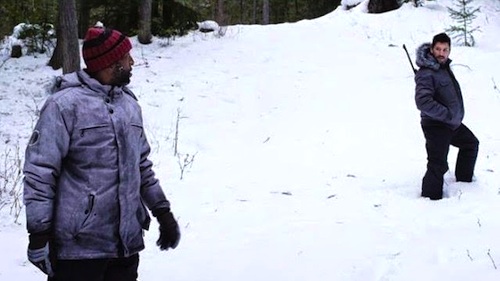
Although there are indigenous peoples in the Taiga Ecozone, by the time you reach the research station commanded by Myles Jensen, civilization thins out to pretty much to nothing. That is why the discovery of a Mesoamerican monument (or rather the visible tip of it) is such a significant surprise. The more academically respectable Peter Olsen is flown out to inspect it, unfortunately for him. He agrees, it is the darnedest thing, but it is not Mesoamerican.

Soon thereafter, the camp cat is found murdered at the excavation site, like a sacrifice at an altar. The next day, the outpost’s indigenous workers have all taken to the wind. With the weather getting even worse, the men are cut off from the world, struggling with each other’s increasingly violent, delusional behavior, diagnosed by the camp doctor as the result of exposure to an ancient but still potent virus.

Frankly, Szostakiwskyj’s surprisingly subtle script allows for the possible the bedlam might just as easily be the product of an all-too human psychosis brought on by stress and isolation as it is the result of a killer virus or the work of a malevolent entity. We can probably safely assume all three are a factor in the ensuing chaos.

From "Black Mountain Side."

Despite the severed body parts, Mountain is remarkably restrained for a horror film. Much like the original Howard Hawks produced The Thing, it features some unusually smart dialogue, particularly the speculation regarding the vanished civilization that left behind the ominous artifact (someone should have thrown a bone up in the air in front of it to see if it would turn into a space station). This film was not exactly a bumper crop of opportunities for actresses, but Szostakiwskyj deals pretty forthrightly with both sides of masculinity—the cerebral reserve and the arm-chopping violence.

Arguably, Mountain is a little too quiet, soaking up atmosphere when it should be getting somewhere quicker. The primary characters are also a bit tricky to differentiate from one another. Mostly, they are smart, intense, and liberally appointed with facial hair. Still, Michael Dickson makes all of Olsen’s anthropological speculation sound cool.

While its horror movie mechanics are a tad off, the creepy vibe and distinct sense of place elevate Mountain above most indie genre outings. It the sort of film that makes viewers feel chilly in the moment and inspires gratitude as they live in major metropolitan centers after their screenings. Recommended for fans of naturalistic horror films, Black Mountain Side screens this Sunday (2/15), and the following Wednesday (2/18), as part of this year’s SF Indie Fest.

LFM GRADE: B

Posted on February 9th, 2015 at 8:59pm.

Off-Broadway Goes Big Screen: LFM Reviews The Last Five Years

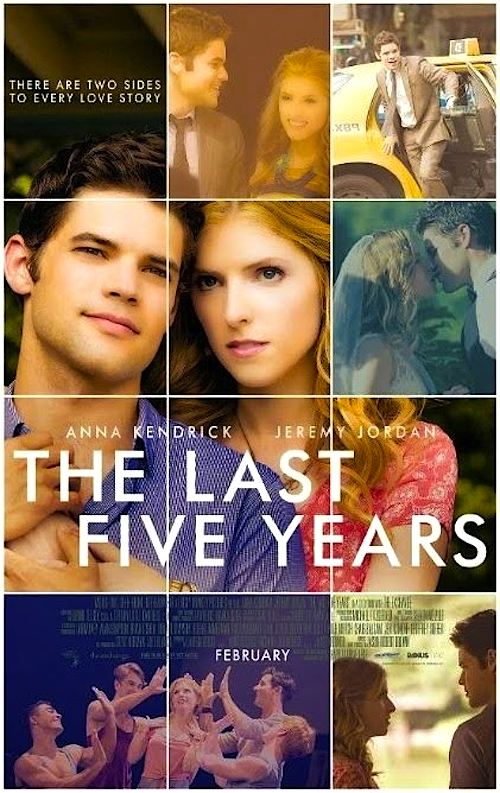
By Joe Bendel. The title of Jamie Wellerstein’s bestselling debut novel sounds nauseatingly pretentious, but Light Out of Darkness happens to be a hat tip to Sondheim’s Merrily We Roll Along, so all is forgiven. Regardless, his remarkable early success will put a strain on his marriage to a would-be Broadway actress. We know it will not last, because he walks out in the first scene. We will subsequently see how it all unraveled in Richard LaGravenese’s adaptation of Jason Robert Brown’s Off-Broadway musical, The Last Five Years, which opens this Friday in New York.

Wellerstein is leaving and it looks like he is never coming back. Cathy Hiatt is obviously devastated, but it gives her the first opportunity to show her range with the nakedly revealing feature spot, “Still Hurting.” There is more to this story than first appears. Wellerstein was once reasonably in love with Hiatt. It was he who first suggested they live together, before he eventually proposed. Yet, Wellerstein’s immediate success caused friction. Yes, it brought him into close proximity of literary groupies and trampy editorial assistants, but it is really caused more of a psychological disconnect between the brashly confident Wellerstein and the increasingly despondent Wellerstein née Hiatt.

Although the original stage production somewhat resembled Love Letters in its stripped down, dueling song-and-monologue structure, LaGravenese opens it up quite nicely. He brings it out onto the streets of New York and transforms the musical numbers into dramatic exchanges.

Frankly, the real issue with LFY is common to many new book musicals today. You might consider it the Rent effect. There simply is not enough emotional diversity to the score. Each number requires the cast to start at practically a crescendo level, maintaining the notes and the soul-baring wails. Even the show’s “novelty song,” “Shiksa Goddess” requires Wellerstein to belt out at the top of his lungs. It is more effective when a show goes up and down the scale. Give us some slow groovers and easy loopers, but with catchy melodies. Then hit us with the show-stopper.

Be that as it may, Anna Kendrick and Jeremy Jordan do everything that is asked of them and then some. As a veteran of Broadway (the way better than you’ve heard Bonnie & Clyde) and Smash, Jordan exhibits the chops you would expect, but the strength and clarity of Kendrick exceeds the expectations established by Pitch Perfect and her Tony nomination for High Society at the precocious age of twelve. They also have appealing chemistry together in the early days and convincingly push each away during the later bad times. Together, they make the arc of the relationship feel true.

Much of LFY’s narrative context and on-screen communication is delivered through song, often giving it a rock opera-ish vibe. Necessarily, one song often leads into another, reinforcing the samey-ness of the score. Nevertheless, Wellerstein’s climatic “If I Didn’t Believe in You” stands out as a dramatic equalizer, largely regaining the audience sympathy he lost in the opening scenes. Cinematographer Steven Meizler makes it all sparkle in a way that subtly evokes the big colorful Golden Age musicals, but in a way the still feels contemporary. If you like the sound of most post-Rent Broadway musicals that are not period productions, LaGravenese’s adaptation should be like catnip. For the rest of us, the two leads manage to carry the day through sheer gumption. Recommended for fans of movie musicals, The Last Five Years opens this Friday (2/13) in New York, at the Village East.

LFM GRADE: B-

Posted on February 9th, 2015 at 8:58pm.