LFM Reviews Knock Knock @ The 2015 Sundance Film Festival

By Joe Bendel. Eli Roth digs Chile and they dig him back. He’s like Hasselhoff over there, so its not surprising he shoehorned in some Chilean references, shot in Chile (Santiago doubling for the Hollywood Hills) and featured two Chilean actresses (one being his wife, Lorenza Izzo) in his latest film. However, the love affair might end once they get a load of his new psycho-sexual home invasion thriller, Knock Knock, which premiered at the 2015 Sundance Film Festival.

Evan Webber is an architect and a committed family man, but he still remembers his glory days as a DJ. He is home alone working on a commission while his artist wife and kids spend the weekend at the beach. Unfortunately, Webber’s dope smoking is soon interrupted by a fateful knock at the door. That will be Genesis and Bel Who, two party girl flight attendants who got lost in the rain looking for a friend’s bash. At least that is their initial story.

As Webber lets them in to dry off, they start flirting hard. Honestly, flirting is not a strong enough term. They practically wrestle him to the ground and have their way with him. Yet, the opening act is surprisingly effective pitting his awkward attempts at evasion against their sexed-up seduction techniques. There is a sly give-and-take or ebb-and-flow to this first half hour or so, but unfortunately it is completely jettisoned once Webber inevitably succumbs to temptation.

From here on out, Genesis and Bel become moralizing fatal attractions, who declare Webber must pay for his transgressions. Suddenly, Webber is fighting for his life and the well-being of his family, but he never stands a chance. The ladies just keeping beating him down at every turn. Perhaps this constitutes some sort of subversive feminist statement, but as dramatic arcs go, it is pretty darn flat.
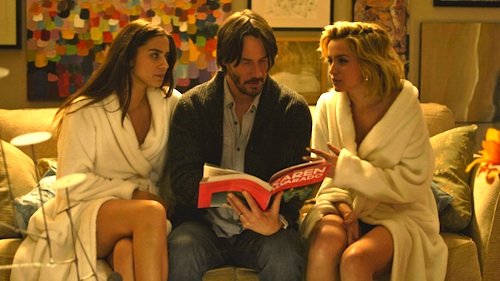
From "Knock Knock."

One of the biggest disappointments of Knock Knock is the speed bump it drops in front of the Keanu Reeves comeback express. Everyone primed for more badassery after John Wick and Man of Tai Chi, will be let down by this Nic Cage-ish turn. Let’s face it, we don’t want to watch Reeves losing his cool. We want him to be silent, but violent. Still, Izzo and Ana de Armas are sufficiently ferocious and they look good soaking wet, so at least they keep their end up, in exploitation terms.

Knock Knock is largely based on/inspired by the 1977 cult exploiter Death Game, which featured producer Colleen Camp and executive producer Sondra Locke tormenting Seymour Cassel, so there is precedent for everything that feels like a misfire. It is a bit of a departure for Roth, but despite the lack of gore, it still really doesn’t work. It is all cat-toying-with-the-mouse with no promise of table-turning to keep things interesting. Regardless of its shortcomings, Knock Knock was picked up by Lionsgate, so expect to hear more from it following its midnight screenings at this year’s Sundance Film Festival.

LFM GRADE: D+

Posted on February 2nd, 2015 at 9:13pm.

LFM Reviews 20 Years of Madness @ The 2015 Slamdance Film Festival

20 Years of Madness – Trailer from 20 Years of Madness on Vimeo.

By Joe Bendel. In 1988, Mystery Science Theater 3000 debuted on Minnesota’s struggling independent KTMA with little fanfare, but it was just too funny not to go national. High school student Jerry White, Jr. assumed the same was true of his raucous suburban Detroit cable access show, 30 Minutes of Madness (30MOM). You could legitimately debate whether this was true or not, but the fact remains he never received the big league call-up he was hoping for. Twenty years later, White tries to get the gang together to take another shot at it. Jeremy Royce documents the unruly reunion in 20 Years of Madness, which won the Jury Honorable Mention for Documentary Feature at the 2015 Slamdance Film Festival.

Based on the generous samplings of weird and wacky clips, the original 30MOM looks like a cross between the slapstick stunts of Jackass and The Kids in the Hall at their most conceptual. Although it was an analogue VHS deal, through and through, White had a facility for pulling off strange visual effects. Perhaps they could have caught on, but like every cult band that didn’t make it big, they imploded from within before they ever got that big break.

Having recently graduated from film school (where he met Royce), White is now at loose ends. Since 30MOM is still his best known calling card, he tries to revive it with his old colleagues. White will more or less admit his runaway ego was most to blame for poisoning the chemistry the first time around. Everyone seems to be willing to make another go of it, but some seem more willing to patch up old resentments than others.

One of the strange things about 20YOM is the way the various players shrink and grow in stature over time. Sometimes White seems to be reverting to his old high-handed ways, but as we listen difficult cast-members whine and play the diva card, it is hard to blame him for telling them where to get off. Happily, he seems be able to permanently repair his friendship with Joe Hornacek, who was probably the second most important 30MOM contributor after White.

From "20 Years of Madness."

It is rather fascinating to see what the motley crew does with their possible second chance. After all, no 30MOM alumnus has exactly set the world on fire. One lost about a decade to heroin addiction, while another struggled with bi-polar disorder. At least White and Hornacek could reconnect for real, which is a rather hopeful development.

At times, White is rather contemptuous of YouTube, explaining that 30MOM had viewers who made a real time commitment to find and watch their show, rather than net surfers hitting the “like” button. Those who share his affection for the VHS tapes and cable broadcasting of the 1980s and 1990s will get his point. Even if you never saw 30MOM, 20YOM will make you nostalgic for the era that produced it. Who knows, now that Royce’s doc has at least one festival award under its belt, maybe the 30MOM show could see some kind of release on the increasingly obsolete format known as DVDs? Recommended for anyone who still feels more comfortable with old school media (and the grungier the better), 20 Years of Madness screened at this year’s Slamdance Film Festival.

LFM GRADE: B+

Posted on February 2nd, 2015 at 9:12pm.

LFM Reviews Hellions @ The 2015 Sundance Film Festival

By Joe Bendel. One of the nice things about Manhattan walk-ups is trick-or-treaters never knock on your door. Instead, it is the local businesses that have to deal with them. Sure, you might think you would miss the little dears until you see Bruce McDonald’s Hellions, which screened during the 2015 Sundance Film Festival.

Dora Vogel just got the super exciting news that she is pregnant—on Halloween. Seriously bummed out, she mopes around the house waiting for her boyfriend to pick her up, so she can spring the good news on him. However, he is running suspiciously late. With her mother and obnoxious younger brother out trick-or-treating, Vogel is stuck dealing with the persistent little buggers who keep coming to the door. They just aren’t satisfied with the dregs of her candy. When they show Vogel the head of her baby-daddy in their trick-or-treat bag, she realizes these little monster are as evil as they seem.

Of course, any horror fan knows the demonic trick-or-treaters really want the baby growing at a supernatural rate within Vogel. It turns out carrying a Halloween baby is a dangerous proposition in this paganistic neck of the woods. The creatures seem to be able to summon all kinds of elemental and inter-dimensional forces to help terrify Vogel. Somehow, the previously calm and rational Dr. Henry and Corman the local copper manage to reach Vogel, but they are essentially ineffectual dead meat. At least Corman brings guns, but they won’t be enough to stop the maniacal moppets. Only salt seems to do the trick.

McDonald certainly sets the creepy scene in Hellions, but compared to his cult classic Pontypool (arguably the best zombie film since the original Night of the Living Dead), it feels rather conventional. Granted, he opens it up rather well, turning the Vogel house into a surreal nightmarescape. Still, the film always fundamentally boils down to Vogel getting chased by kids wearing burlap sacks.

Robert Patrick (T2, The X-Files) is still pretty awesome, delivering instant genre credibility as Corman. Rossif Sutherland also helps flesh out the good doctor, beyond being mere meat for the grinder. Unfortunately, Chloe Rose is a bit of a dull scream queen.

McDonald and cinematographer Norayr Kasper give the film an eerie, otherworldly look. Arguably, the implications of the film also support gun-ownership rights, because you never know when your home will be overrun by hellions. It gets the job done, but Pontypool admirers will be disappointed it isn’t more ambitious. Recommended for mostly fans of Patrick and evil children horror movies, Hellions is sure to make the genre festival rounds after premiering as a Park City at Midnight selection of this year’s Sundance Film Festival.

LFM GRADE: C+

Posted on February 2nd, 2015 at 11:53am.

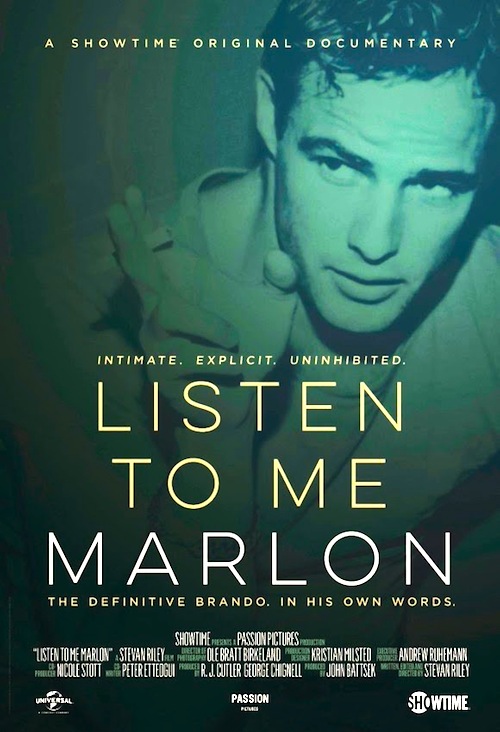
LFM Reviews Listen to Me Marlon @ The 2015 Sundance Film Festival

By Joe Bendel. Let’s be honest, the notion of Marlon Brando talking to himself probably isn’t that shocking. You might not have guessed it was through self-hypnosis tapes, but that probably still feels like it fits. They happened to be part of a large collection of private Brando recordings preserved by his estate. With its blessing, director-editor Stevan Riley has shaped this archive into a ghostly first-person confessional narrative, “written by” and “starring” the famous actor. The Brando that emerges is exactly what we expect, yet deeper and surprisingly revealing throughout Riley’s Listen to Me Marlon, which screened during the 2015 Sundance Film Festival, in advance of its future Showtime debut.

Through audio diaries and rarely seen interviews, Brando pretty much covers all his big career milestones (like Streetcar, Waterfront, Last Tango, and Godfather) as well as his more notorious misfires (Guys and Dolls, Mutiny on the Bounty, and Countess from Hong Kong). He also opens up regarding his troubled childhood and the profound influence of his acting teacher Stella Adler. Yet, as is often the case, some of the best sequences are relatively small moments, like his shameless flirting with a series of female interviewers during an early 1960s press junket.

Yes, Brando loved Tahiti, which he speaks of with deep affection. In fact, Brando is quite eloquent on his private tapes. Clearly, he is not speaking with an audience in mind, because he definitely lets his public mask slip. He is often painfully honest in his assessment of his own character and rather dismissive of much of his own work. His curt appraisal of his Oscar winning turn in On the Waterfront will be especially vexing to some fans, but it contains a real nugget of wisdom when recommending giving the audience the space to create a performance themselves. (Don’t you wish Meryl Streep had given us more of that kind of space in Osage County?).

Riley’s only real misstep is the overuse of a disembodied head, generated from a laser scanning session Brando consented to. It sort of breaks the intimate mood, evoking a Max Headroom vibe instead. However, the archival news reports of tragic Brando family scandals feel shockingly honest and raw. We get a sense the Brando on television and the private Brando were essentially one and the same.

For those of us who grew up when Letterman was still funny, it is strange to realize how spot-on Chris Elliott’s impersonations on the Late Show really were. All those Brandoisms are true, but we can understand better where they came from. Listen is the rare bio-doc that might make more fans for its subject, because it allows Brando to humanize himself. Recommended for fans of 1960s and 1970s Hollywood, Listen to Me Marlon was a hot ticket at this year’s Sundance Film Festival that should soon find a wide audience on Showtime.

LFM GRADE: B+

Posted on February 1st, 2015 at 10:50am.

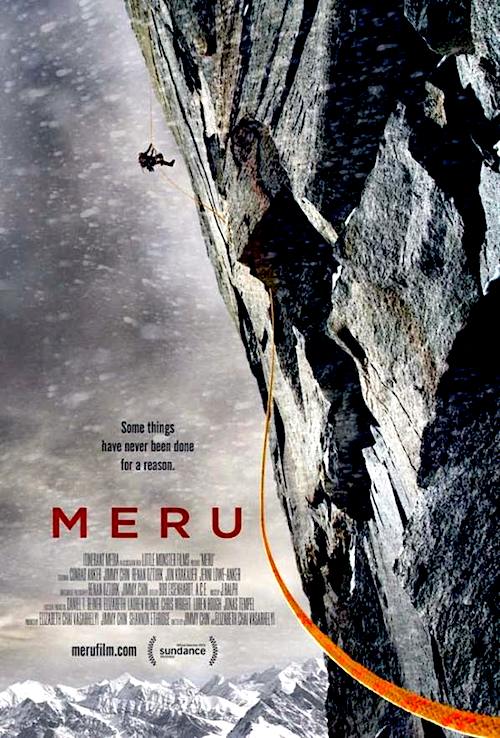
LFM Reviews Meru @ The 2015 Sundance Film Festival

Meru Official Trailer from Chai Vasarhelyi on Vimeo.

By Joe Bendel. You could call it the extremely scenic route. In the alpinist world, the forbidding Shark’s Fin route up Mount Meru was one of the last great conquests. Three climbers came maddeningly close in 2008, but fell short. Filmmaker-alpinist Jimmy Chin and his producer-co-director wife E. Chai Vasarhelyi document the 2008 expedition, their 2011 return, and the dramatic intervening events in Meru, which screens during the 2015 Sundance Film Festival.

Located in the Northern Indian Himalayas, Meru had been summited before, but never via the Shark’s Fin. It is an arduous field of ice obstacles, frozen sheer, offering precious few footholds or crevices. So why climb it? Presumably, because it is there. As one of the most respected alpinists climbing today, Conrad Anker was an obvious candidate to finally lick the Shark’s Fin. Chin also had extensive experience as a climber and photographer. Renan Ozturk was the junior man on the team, but the trio meshed well together. They just didn’t quite make it on their first attempt.

Frankly, Chin and Vasarhelyi do not spend must time establishing the significance of Mount Meru or the Shark’s Fin, pretty much launching into the climbing right away. Similarly, we do not get much sense of the three climbers’ personalities, until about halfway through. However, when two of the three are sidelined by misfortune, we start to get a better sense of who they are and what Meru means to them.

Anker had previously lost one regular team-member (ultimately marrying his widow), so he already knew tragedy first hand. Nevertheless, the time between Meru expeditions was comparatively less eventful for him. In contrast, after Ozturk barely survives a spectacular accident, it is unclear how much basic mobile function he will regain. Initially, the notion of mountain climbing in general seems awfully ambitious, let alone attacking the Shark’s Fin. Somehow, Chin also survived a freak avalanche. He is relatively unscathed physically, but clearly quite shaken, emotionally and spiritually.

By the time the three men launch their second campaign against the Shark’s Fin, the audience is thoroughly primed for a feast of redemption. Frankly, everything about the 2011 attempt just sort of boggles the mind, especially some of the jury-rigging we see them do with faulty equipment. Co-cinematographers Chin and Ozturk capture some absolutely awesome shots, particularly given the circumstances they were working under. Indeed, the film looks incredible and it eventually delivers the comeback satisfaction it promises.

The stakes have increased for subsequent mountaineering documentaries following the release of the very good to great The Summit, Beyond the Edge, and K2: Siren of the Himalayas, but Meru finds something new to say (and ends on a considerably different note than the first and third films). It seems like a particularly fitting Sundance film, incorporating elements of previous selections, like The Summit and The Crash Reel, but ending with considerably more uplift. Highly recommended for fans of outdoorsy cinema, Meru screens in Park City, as part of this year’s Sundance Film Festival.

LFM GRADE: B

Posted on February 1st, 2015 at 10:49am.

LFM Reviews Cartel Land @ The 2015 Sundance Film Festival

By Joe Bendel. Dr. Jose Mireles is like a kindly Mexican Marcus Welby, except he also happens to be the leader of a group of paramilitary vigilantes. Tim “Nailer” Foley more looks the part of a border militiaman, but he shares a common enemy with Mireles. It is not the illegal immigrant per se that concerns him, but the drug cartels running the human trafficking business. Matthew Heineman documents the full scale breakdown of law and order south of the border and some of the resulting implications for American border towns in Cartel Land (teaser here), which screens today as an award winner at the 2015 Sundance Film Festival.

Perhaps the most disturbing thing about “El Doctor” Mireles’ Autodefensas organization is that they operate in the central state of Michoacán, far away from the border. Although Mireles originally attended Autodefensas organizing meetings wearing a mask, he was so recognizable, he simply chose to embrace his role as the group’s public face and spiritual leading. Under his guidance, Autodefensas has been on a roll, liberating town after town from their cartel occupiers. If that sounds like a military campaign, it darn well should.

Meanwhile, Nailer and his Arizona Border Recon group patrol what is known as “Cocaine Alley,” scouring the hills for the cartels’ spotters and traffic directors. Yes, they are also heavily armed. You do not challenge the drug cartels with good intentions and optimism.

Although Cartel Land started out as a project solely about American border patrol groups, Mireles and Autodefensas completely took over the film once Heineman widened the scope. Frankly, it seems like the film is not sure what to make of the Arizona scenes in light of the chaotic drama it documents in Mexico. You can practically feel the film shrug, as if to admit they might have a point.

In contrast, the sequences in Mexico are absolutely harrowing and massively telling. Early on, there is a mind-blowing scene in which an exasperated village rises up against a military unit trying to disarm the Autodefensas. They make it clear, in no uncertain terms, they consider the government to be in league with the cartels. They therefore put their trust in Autodefensas rather than the military. It is stunning stuff, but it should be noted not every village shares this sentiment.

No matter how you feel about the film, you have to give Heineman credit for making it under genuine battle conditions. He was there filming during live firefights, when nobody really knew who was shooting at whom or from where. This is legit war-reporting, just like Sebastian Junger’s Restrepo films.

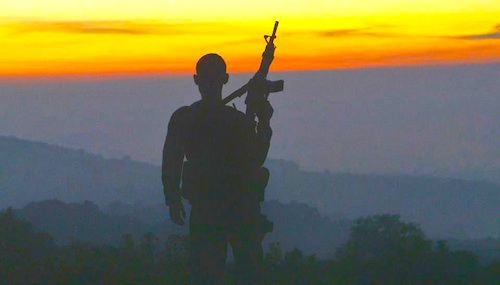
From "Cartel Land."

Cartel Land does not necessarily endorse taking the law into one’s own hands. In fact, many of the scenes in Mexico illustrate the ethical perils of doing so. However, it leaves viewers with no illusions about the complete absence of the rule of law in Mexico today. You can question their on-the-ground tactics, but why it is painfully obvious why Dr. Mireles and his comrades joined together in Autodefensas. Arguably, the film might have been tightened up by editing out more of the Arizona material, but who would want to tell them they ended up on the cutting room floor?

Regardless, Cartel Land is quite an eye-opener as it is. (Since the current president refuses to visit the border, perhaps a private screening can be arranged for him). Recommended for anyone concerned affairs in our hemisphere, Cartel Land screens again today (2/1) as part of this year’s Sundance Film Festival.

LFM GRADE: B+

Posted on February 1st, 2015 at 10:49am.