LFM Reviews Ripley: Believe It or Not on PBS

By Joe Bendel. Leroy Robert Ripley was a cartoonist who really put his stamp on Times Square. In 1939 the syndicated globe-trotter opened his first Odditorium on Broadway and the organization that bears his name and catch phrase successfully re-launched a tourist trap on 42nd Street in 2007. Ripley’s various media properties might seem kitschy to contemporary ironic hipsters, but writer-director-producer Cathleen O’Connell and her cast of expert commentators establish how popular and respected he was during his Depression-era heyday in Ripley: Believe It or Not, which premieres this coming Tuesday as part of the current season of American Experience.

Ripley was a rather nebbish fellow with tragically buck teeth that Steve Carrell might consider playing next time he trolls for Oscar love. After getting sacked by newspapers in San Francisco, Ripley was able to re-start his career in New York penning sports cartoons. For slow sports days, he started cataloging unusual athletic feats for what became early forerunners of the Believe It or Not template. Obviously, readers approved. Much to his surprise, it led to a dream assignment sending comic strip dispatches from an around-the-world journey. Soon the Ripley’s comic as we know it was humming along, but it was a book deal with Simon & Schuster that really turned him into a sensation.
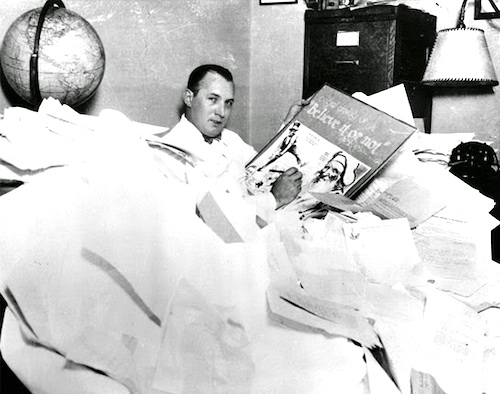
From "Ripley: Believe It or Not."

There are probably a lot of people who remember buying Ripley’s books at school book fares, so it will be somewhat mind-blowing to learn his was a Da Vinci Code level bestseller in his day. Many of the 1980s generation will also remember the packaged television series with Jack Palance, but radio was really the medium that cemented Ripley’s fame.

O’Connell, who previously helmed American Experience’s War of the Worlds special, has a good feel for slightly genre-ish non-fiction filmmaking. She largely casts Ripley as a pseudo-Horatio Alger figure, but also gives due credit to Norbert Pearlroth, his unsung research director, without getting bogged down in the three-headed dogs and ten foot cigars Ripley breathlessly covered. Ultimately, she paints an appealing portrait of a self-reinvented adventurer, despite his considerable human weaknesses.

O’Connell’s Ripley is a breezy hour that never overstays its welcome. Those who watch it will be far less likely to roll their eyes while dashing past the new Times Square Odditorium on their way to a screening at the AMC Empire. Recommended for those who enjoy slightly strange Americana, Ripley: Believe It or Not airs this coming Tuesday (1/6) on most PBS outlets nationwide.

Posted on January 5th, 2014 at 12:10pm.
LFM Reviews Today @ The Palm Springs International Film Festival

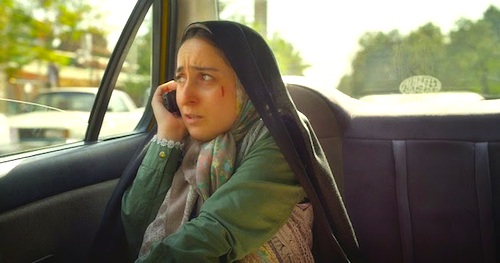
By Joe Bendel. Youness is the wrong man, in the wrong place, at the wrong time, but since Iran is still a man’s world, he could get away clean, nonetheless. However, the grouchy old cab-driver is too compassionate for that. A fateful fare could have serious long-term implications in Reza Mirkarimi’s Today, which screened during this year’s Palm Springs International Film Festival.

Youness is the type a cabbie who will just toss out customers if they rub him the wrong way. Yet, he takes pity on the extremely pregnant and considerably panicked Sedigheh. He will even schlep her into the hospital, despite suspecting she has no money for the fare. At this point, he could safely bolt according to Iranian law (as we are later told), but he stays nonetheless.

It is quickly apparent Sedigheh has been physically abused and has neglected her pre-natal care as a result. Naturally, the hospital staff silently accuses Youness. Despite the awkwardness and potential legal ramifications, he accepts their contempt, for Sedigheh’s sake, because as an unaccompanied pregnant woman, she would be even further marginalized by the Iranian medical system.

On its face, Today is a deceptively simple issue-oriented drama, but it makes a deeply eloquent statement on contemporary Iranian society. It is a lot like A Separation with a more fully developed social conscience. It is a bit surprising Iran selected it as their foreign language Oscar submission and utterly baffling how it could miss the shortlist cut. You would had to have seen a heck of a lot of films this year to find nine better than Today.

Perhaps it is too subtle. You really have to pay attention to what is said and what is left unsaid to fully appreciate the positions Youness and Sedigheh are in. It is also fascinating how ghosts from the past loom over the film in strange and unlikely ways. For instance, the hospital in question lacks the latest medical equipment, because it was once part of a larger triage center during the Iran-Iraq War, but has yet to be retrofitted after the adjoining building was closed.

From "Today."

Eschewing cheap theatrics, Parviz Parastui puts on a clinic in how to say more with less as the taciturn Youness. It is a quiet performance, but he has the audience hanging on his every word and gesture. In contrast, Soheila Golestani’s guileless directness and vulnerability are quite arresting. Watching them feels like being there in that slightly shabby hospital in Tehran. That might not sound like a lot of fun, but the net effect is hard to shake off.

While Today is about as character-driven as films get, it is still quite an impressive feat of direction. Mirkarimi has quite a lot of traffic to manage, sort of like a stage farce, except it is deadly serious. It is too bad he will not be getting any Academy love this time around, especially since his previous film A Cube of Sugar had been selected as Iran’s Oscar submission two years ago, until the Islamist government decided to boycott in protest of a low rated YouTube video. This is a potent film that directly advocates breaking the pernicious cycle of abuse, but it is probably too complicated for daytime talk show hosts to understand. Highly recommended for everyone else, Today screens this Tuesday (1/6) as part of this year’s PSIFF.

LFM GRADE: A

Posted on January 5th, 2015 at 11:53am.

Conquering Takeout: LFM Reviews The Search for General Tso

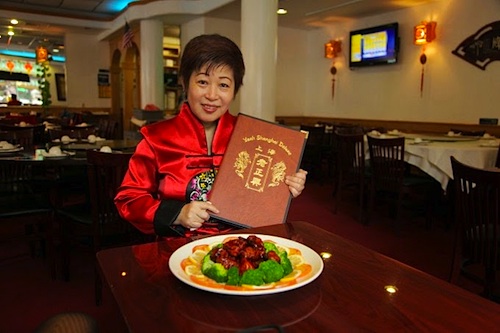
By Joe Bendel. He never lost a battle, but he has been immortalized with a dish that would probably not appeal to his palate. Reportedly, Zuo Zongtang, a.k.a. General Tso, really did like chicken, but the Americanized sauce of the recipe bearing his name would be far too sweet for the ardent Chinese nationalist. While nobody recognizes the American Chinese take-out staple in his home province of Hunan, it is a different story in Taipei. Ian Cheney chronicles the recipe’s journey and the Chinese-American restaurants that serve it in The Search for General Tso, which opens this Friday in New York.

Frankly, the real General Tso was a counter-revolutionary, who successfully put down the crypto-Christian millennial Taiping Rebellion that would later be invoked by both Dr. Sun Yat-sen and Mao. He was also dead-set against western influence in China. So how did his namesake chicken conquer the American takeout market? It is a complicated story, but Cheney conclusively follows a trail running directly through New York back to Taiwan. As a bonus, he also reveals the origins of cashew chicken in the unlikely city of Springfield, Missouri.

Ostensibly, Search is about the Qing Dynasty General and the crispy chicken he never knew, but it is really more about the Chinese-American immigrant experience and the entrepreneurial drive that has produced thousands of restaurants throughout America. It was never easy, especially when Nativist laws were still in force during the late Nineteenth and early Twentieth Centuries. Yet, with the support of their families and cooperative neighborhood associations, new arrivals were able to scratch out a living in the restaurant sector, often relocating to towns with nearly no Chinese-American communities to speak of (and therefore no competition). Indeed, Americanized dishes like Chop Suey and General Tso’s Chicken reflect an impulse to assimilate and cater to their regional customers.

From "The Search for General Tso."

The big picture is rather inspiring, despite plenty of ugly episodes in places like Springfield, before the locals were won over by cashew chicken. In fact, much of the film could be considered a celebration of hard work and family, especially when it interviews people like Philip Chiang, founder of P.F. Chang’s, who started in the business working in his mother’s ambitiously upscale restaurant.

Visually, Search is also unusually stylish for a documentary, incorporating Sharon Shattuck’s lively animated transitions and plenty of glorious food shots. If you are looking for foodie indulgence, Cheney delivers. The Szechuan Alligator at Trey Yuen’s in Louisiana looks and sounds particularly tempting. There is just no way viewers will not have Chinese for dinner after watching the film.

You sort of expect the search for General Tso to be Quixotic, but Cheney answers all his questions, establishing a definitive history of the crispy chicken menu item. Yet, the film covers much more cultural history, without getting hopelessly bogged down in identity politics. Smart, well balanced, and briskly paced, The Search for General Tso is highly recommended for culinary minded audiences when it opens this Friday (1/2) in New York at the IFC Center.

LFM GRADE: B+

Posted on December 30th, 2014 at 5:19pm.

There’s an App for That: LFM Reviews App

By Joe Bendel. If you work for Sony, you probably don’t need a Dutch genre filmmaker to tell you how scary the internet can be just now. However, if you are a selfie-taking, social network junkie who can hardly put down your smart phone, perhaps you could use another cautionary tale. Arriving at a zeitgeisty moment, while Sony and JLaw are still reeling from their respective hackings, a college student will indeed struggle with digital technology at it most pernicious in Bobby Boermans’ App, which launches today on DVD from RAM Releasing.

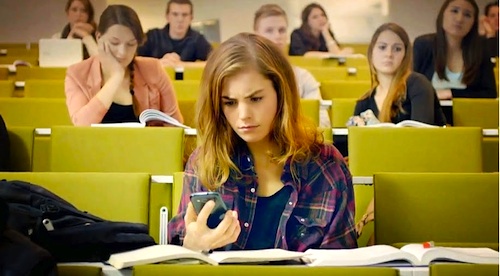
Initially, technology is not all bad for Anna Rijnders. After all, an experimental implant is keeping her extreme sports dunderhead of a brother alive (hello, foreshadowing). Then the morning after a party at her ex-boyfriend’s Rijnders she wakes up with a hangover and a nasty piece of scumware installed on her phone. It is called IRIS and it has an attitude. While it feeds her a few answers during philosophy class, it also has a wicked sense of initiative. For instance, recording and posting naked videos is one of its favorite tricks. It also makes calls at inopportune moments. As we can tell from the prelude, it has already driven victims to suicide.

Just buy a new phone, right? Rijnders tries that. It only makes IRIS angry. Frankly, much of the app’s reign of terror defies logical explanations, but at least it convincingly shores up Rijnders’ actions and motivations. It is sort of like the old cult favorite Electric Dreams, depicting the technology of the day running impossibly amok – but if you buy into it, the film chugs along pretty smoothly.

In the case of App, Boermans and screenwriter Robert Arthur Jansen tap into a real and growing paranoia over handheld gadgets and accidental over-shares. Much has been made of its “second screen” component, allowing viewers to simultaneously see supplemental scenes and stills via the real life IRIS app.  Fortunately, the film holds up just fine on one screen, because voluntarily downloading IRIS just seems like bad karma.

From "App."

Without question, App benefits from its lead performance. Hannah Hoekstra (recently seen in the pretty good Irish horror film The Canal) is no stupid teenager or mindless scream queen. She has a smart, dynamic presence that never taxes the audience’s patience. Obviously, she is not making movies because she is plain, but she feels relatively real and down-to-earth as Rijnders. While she interacts with dozens of supporting cast members, Hoekstra is the only one getting appreciable character development time, but she carries the film rather well.

When was the last time digital and wireless technology were a force for good in a film? Maybe You’ve Got Mail? While there seems to be something problematic about that, this is probably not the right time to argue the point, given the recent cyber-terror attacks. As a result, this should be App’s time to shine. In fact, it is a good film to catch up with on DVD. It is occasionally preposterous, but always solidly entertaining. Recommended for international thriller fans, App is now available for one and two screen home viewing, from Film Movement’s RAM Releasing.

LFM GRADE: B

December 30th, 2014 at 5:19pm.

LFM Reviews The Taking of Tiger Mountain

By Joe Bendel. Qu Bo’s war novel Tracks in the Snowy Forest was adapted as the revolutionary opera Taking of Tiger Mountain by Strategy, one of the so-called “Eight Model Plays” allowed to be staged during the Cultural Revolution. After years of frustration, Tsui Hark has finally realized his big shiny capitalistic adaptation of Qu Bo’s source novel, but the good guys are still PLA soldiers and the bad guys are not. The powerful outlaw Lord Hawk is about to learn he is on the wrong side of history in Tsui’s The Taking of Tiger Mountain, which opens this Friday in New York.

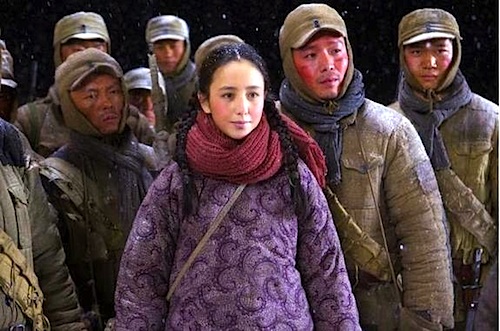
It is the bitter cold winter of 1946 and warlordism plagues northern China. PLA Captain 203 and his troops have been dispatched to restore order, but they are outmanned and outgunned. For reinforcements, the Party sends him Little Dove, a cute medical officer, and Yang Zirong, a political and intelligence officer, whose exact brief is rather vague. After helping the Captain shore up the most vulnerable village lying in the foothills of Hawk’s mountain stronghold, Yang announces his plan to infiltrate the band of brigands posing as a notorious but seldom seen member of a rival gang. Capt. 203 is not exactly crazy about the plan, but he signs on anyway, since there is no stopping Yang. Of course, he will need Yang’s intelligence when Hawk finally decides to attack the village.

Wisely, Tsui never lets any of his characters jabber on about historical dialectics. Aside from a few snarky comments about the Nationalists, there are not a lot of ideological identifiers in Tiger Mountain beyond the obvious uniforms. However, a contemporary descendant of one of the survivors often watches Xie Tieli’s 1970 film treatment of the Revolutionary opera, giving us several quick tastes of its didacticism.

Frankly, if you are going to tackle any of the Eight Model Plays, it might as well be Tiger Mountain, because nobody is in favor of banditry. Tsui stages some suitably big action spectacles, including the big mountain plane crash that factors so prominently in the trailer and one-sheet, but he puts it in the darnedest place, thereby sacrificing much of its suspense. It really feels like it was tacked on at the last minute to justify the expense of 3D.

From "The Taking of Tiger Mountain."

Given its propaganda roots, it is not so very surprising that most of the Tiger Mountain characters or more like symbolic types than fully developed individuals. Still, Zhang Hanyu (terrific in both the under-appreciated Equation of Love and Death and the otherwise problematic Back to 1942) plays Yang with grit and roguish panache. Tong Liya’s turn as Little Dove is also both sensitive and energetic. “Big’ Tony Leung Ka Fai chews on plenty of scenery as Lord Hawk, but unfortunately, Yu Nan never seems to quite unlock Qinglian, his involuntary mistress. However, her presumably orphaned son Knotti is like a human emergency brake, bringing the narrative to a screeching halt whenever he is on screen.

It is not often you can see a film with apostolic links to Madam Mao and the Gang of Four that features an animatronic tiger developed by the Jim Henson Creature Shop, but here it is. One could perhaps debate who has done the coopting in Tiger Mountain, but the real point is the action, which is decent but never approaches the level of Tsui’s spectacular Flying Swords of Dragon Gate. If action fans can tune out the political implications, it is an okay as a quick snack, but it will not be a crossover breakout, like The Raid franchise, by any means. For loyal Tsui fans, The Taking of Tiger Mountain opens this Friday (1/2) in New York, at the AMC Empire.

LFM GRADE: C+

Posted on December 30th, 2014 at 5:18pm.

LFM Reviews Love on the Cloud

By Joe Bendel. Screenwriter Sha Guo will write treatments for just about every sort of contemporary Chinese film a doofus character such as himself might appear in. There will be romantic comedy, tragedy, compulsive social networking, and a surprisingly credible haunting. Still, the big question will be whether he gets the girl or the dog, or both, or neither in director-screenwriter Gu Chang-wei’s Love on the Cloud, which is now playing in New York.

Sha Guo and his buddies, aspiring cinematographer Ma Dai and would be matinee idol-producer Huang Xaigang, the so-called “Three Dreamers,” have just reeled in an investor for their first film, Living with the Werewolf. Ms. Ma the beef magnate just wants a couple script revisions: product placement for her Little Bull company. No problem, they can do that. In this case, “they” means Sha Guo. After a hard session of rewriting, he hits the social media apps looking for a hook-up. Instead, up-and-coming auto-show model Chen Xi exploits his “Sad Shar Pei” handle, suckering him into dog-sitting her furrowed browed Mo Chou. Of course, he agrees, hoping it will lead to bigger and hotter things. However, both Chen Xi’s dog-sitting and Ms. Ma’s rewrites will become a constant in his increasingly frustrated life.

Given its title and genre, HK film fans might assume Love on the Cloud is the next installment in Pang Ho-cheung’s Love in a Puff-Love in the Buff series, but Cherie Yu and Jimmy Cheung will not be breaking up and getting back together again, at least not right now. Cloud is actually Beijing-set and Mainland produced, featuring a star turn from Angelababy. About a billion people already knew the model-turned-actress was a star, but with Cloud she successfully transitions from perky teen roles (Love in Space, All’s Well Ends Well 2010 and 2011) to a legit romantic lead. She smokes up the screen and leaves poor Michael Chen and his hapless Sha Guo looking small and deflated on-screen.

From "Love on the Cloud."

Still, when he is satirizing the Chinese film business with the other two Dreamers, Chen is a good sport, keeping the material remarkably grounded, all things considered, by minimizing the shtick and the mugging. In fact, the entire cast earns props because Gu throws the kitchen sink at them, but never wastes much time on dry, boring transitions. Frankly, it is hard to believe how much of the film works. Even the horror movie segments, necessitated by another batch of rewrites for Ms. Ma, are actually sort of creepy and very true to genre conventions.

Angelababy is radiant throughout Cloud and Chen keeps plugging away, but good old Mo Chou just sort of steals the picture rather effortlessly. The camera loves the Shar Pei, but he never resorts to cheap tricks to look cute. So yes, give the dog credit for subtlety of his performance (would it be going too far to compare him favorably with Meryl Streep’s excessive theatrics in Ossage County? It’d be true.) Regardless, there are enough laughs mixed with Angelababy’s glamour and Mo Chou’s furry charm to keep Cloud chugging along at a good clip. Recommended for those who like a good doggie rom-com with a little bit of an edge, Love on the Cloud is now playing in New York at the AMC Empire.

LFM GRADE: B

Posted on December 30th, 2014 at 5:17pm.