LFM Reviews Stonehearst Asylum; Now Available on DVD/Blu-ray

By Joe Bendel. Dr. Silas Lamb certainly understands the pluses and minuses of corporal punishment and anesthetizing drugs as treatment for lunacy. He is, after all, based on the superintendent of Poe’s short story “The System of Dr. Tarr and Prof. Fether.” He will indeed reveal a revolutionary and irreversible new treatment to his naïve young colleague. Yes, there has been the proverbial reversal of positions in the remote mental hospital, but the standard of care has arguably increased in Brad Anderson’s Stonehearst Asylum, which releases on DVD and Blu-ray today from Millennium Entertainment.

Idealistic Dr. Edward Newgate has arrived at Stonehearst determined to talk his way into a job. He has a passion for psychiatric medicine that duly impresses Dr. Lamb, even though he was not expecting a prospective assistant. Although he talks a progressive game, Newgate is rather shocked by Lamb’s indulgent methods. Several of the patients even perform nursing duties and dine with the staff at night. However, he is even more preoccupied with Eliza Graves, the abused wife of a rich and powerful society scion. For her own protection, Lamb promises to keep her safely committed. Of course, Newgate has his own ideas regarding Ms. Graves that become ever more confused when he discovers the real staff chained up in the dungeon.
It goes without saying, but Stonehearst would have been so much more awesome if it had been made by Roger Corman. Anderson and the design team get the trappings right, but they never properly convey an atmosphere of gothic dread nor a flair for cheeky camp. It is sort of like a middling BBC historical drama set in a nut house.

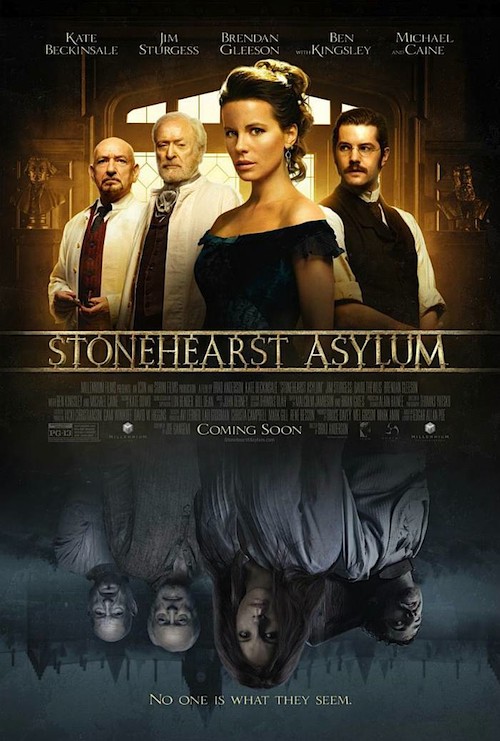
Still, Sir Ben Kingsley gets in the spirit of things rather admirably. He certainly is not bashful when it comes to chewing scenery and freaks out quite convincingly when he has to. Unfortunately, Jim Sturgess and Kate Beckinsale make pretty vanilla Victorians as Newgate and Graves, respectively. Michael Caine and Brendan Gleeson have their moments as more conventionally problematic alienists, but there is only so much they can do. Even David Thewliss seems to be forcing matters as the malevolent groundskeeper known as “Mickey Finn.”

Screenwriter Ben Gangemi is about as faithful to Poe as the classic Corman adaptations, adding a further ironic twist that works well in context. Nevertheless, a costume genre film really ought to be more fun. Instead, Stonehearst is strangely determined to make a serious statement about the shortcomings of the Victorian mental health system, which seems beyond unnecessary at this point. Kingsley is a gamer, but only Poe completists should feel the need to catch up with Stonehearst Asylum, now available on DVD from Millennium Entertainment.

LFM GRADE: C+

Posted on December 15th, 2014 at 9:39pm.

How Not to Tour the Philippines: LFM Reviews Faraway

By Joe Bendel. Don’t want to take responsibility for your crummy life? Blame the Diwata, the creatures of Philippine legend that literally write the fates of every human being. An American tourist is convinced she knows where to find the seat of their mystical domain. There might be considerable treasure there as well. To be honest, she is not too sure about that point, but it doesn’t stop a gang of bandits from following her rag-tag party in Randal Kamradt’s Faraway, which releases on VOD today, from Devolver Digital.

Audrey Felidor does not have much of a plan, but she seems to generally know where she is going. She acts All-American and does not speak Tagalog or other local lingo, despite claiming to be half-Filipino. Needing an English speaking guide, she somehow convinces Nick, the expatriate screenwriter staying in her boarding house to help her traverse three hundred miles to her destination island. He is a far cry from Indiana Jones, but at least their landlady’s rebellious daughter Hazel and her forbidden boyfriend Rey have a set of wheels. Unfortunately, their drunken chatter attracts the attention of a band of cutthroats that will be hard to shake.

To his credit, Kamradt staked out a mythical race that has not been spoiled by Twilight or another paranormal YA franchise. In fact, the opening introduction to the Diwata and their Diwataism is quite intriguing and grabby. The subsequent ride will have its bumpy patches, but there is something appealingly scrappy about the film, nonetheless.

To be honest, Faraway is a dashed difficult sort of film to review. If you only see one film in a week or a month, you are likely to be disappointed by its rough edges, but if you see ten or fifteen a week, you will give it credit for its eccentricities and stylishly turned scenes (particularly the expository puppet show and the rave in the jungle). Kamradt’s screenplay takes a surreal twist down the stretch that might not work so well, but it certainly is not the third act audiences will be expecting. For what it’s worth, the one-sheet is also totally cool.

From "Faraway."

In a case of aesthetic consistency, Dana Jamison brings the strangest screen presence to the film as Felidor. It is not that she is bad. In fact, her performance is rather effective given the full dramatic context, but it still feels a little odd. Over time, Nick Medina somewhat grows on the audience as his namesake screenwriter. First time screen-thesp Genelyka Castin is a total natural right from the start as Hazel, but Leonard Olaer’s Rey sort of wilts amongst the bedlam.

Those who are always looking for the next big thing in indie genre cinema will not begrudge time spent with Faraway and will be receptive to Kamradt’s next film, but it is not exactly a magnum opus. For now, give cast and crew credit for finishing what must have been a difficult shoot. Recommended for the adventurous who appreciate an unpolished bauble, Faraway is now available on VOD platforms from Devolver Digital.

LFM GRADE: C+

Posted on December 15th, 2014 at 9:38pm.

LFM Reviews Uncle Tony, Three Fools, and the Secret Service @ The AFI’s 2014 EU Film Showcase

“Uncle Tony, Three Fools and the Secret Service” – Trailer from activist 38 on Vimeo.

By Joe Bendel. High ranking secret policemen do not often get to present their own work at MoMA, but Donio Donev did. His involvement in the Bulgarian domestic intelligence service is an established fact now that his dossier has been released. However, Donev’s films really aren’t his films. It was always an open secret Anton Trayanov was the uncredited animator of beloved Bulgarian classics like The Three Fools, but Donev took all the bows on the international festival circuit. Mina Mileva & Vesela Kazakova set the record straight with Uncle Tony, Three Fools, and the Secret Service, which screens during the AFI’s 2014 EU Film Showcase.

By all accounts, Donev really was a clever and skillful caricaturist, but he probably could not have animated a mouse if he shot 50,000 volts through it. Most Bulgarian filmmakers, especially those working in animation, knew Trayanov was the real artist responsible for some of the country’s best loved films. They also understood why his name was not on any of them. Under Communism, all of the film authority’s division heads and nearly all of the film directors were secret service agents.

Eventually, the understandably frustrated Trayanov was fired when he started complaining. For three years he survived as a construction worker for a Japanese firm building a luxury hotel in Sofia (lord knows why). He was lucky to get that gig, considering he was blackballed at every other Bulgarian state industry. Eventually, he started teaching animation at the National Academy Theater and Film Arts, where Mileva took his courses, before he was sacked again under murky circumstances.

Sadly, little has changed since the fall of Communism. The apparatchiks still jealously guard their power, but Trayanov might just get the last posthumous laugh. Although he died shortly after filming wrapped, his documentary had a record breaking theatrical run in Bulgaria. Not surprisingly, Donev’s family has threatened legal action. More troubling (if not necessarily shocking), Mileva and Kazakova have had their copyright protection revoked, award nominations rescinded, and endured a campaign of physical and emotional harassment.

It is easy to see why Uncle Tony et al touched a nerve. It addresses head on the privileges and abuses of position that have carried over from the Communist era. The case it makes on Trayanov’s behalf (and against Donev) is not just convincing. It is pretty much conclusive. In fact, there are a handful of scenes that are jaw-droppingly damning, as when Dimitar Tomov, animation chair of the National Academy, tries to convince Mileva Trayanov never taught the classes she enrolled in, through a combination of double-talk and Orwellian Newspeak. It is nearly as surreal watching an interviewer catch Donev in a telling contradiction during an archival television report. You have to wonder what happened to that poor guy.

Yet, UTTFTSS is as much a tribute to Trayanov and his films (and they really are his films) as it is an expose of institutionalized Party corruption. Despite all the wrongs done to him, Trayanov is an unflaggingly upbeat and winning presence on camera. Spending time with him is a pleasure. This is a genuinely bold documentary that will resonate with animation fans and anyone who values artistic freedom. If its cogently presented revelations do not forever change how you think of Bulgarian animation, nothing will. Highly recommended, Uncle Tony, Three Fools, and the Secret Service screens this coming Wednesday (12/17) and next Saturday (12/18), as part of the AFI’s EU Film Showcase, outside of Washington, DC.

LFM GRADE: A

December 14th, 2014 at 10:32pm.

LFM Reviews Radhe, Radhe: the Rites of Holi

By Joe Bendel. In 1913, the premiere of Stravinsky’s The Rites of Spring caused riots. One hundred years later it has been codified and canonized to such an extent, considerable programming was commissioned to celebrate its centennial. The music does not directly correlate to Stravinsky’s score, but it served as something of a road map for Prashant Bhargava when he filmed the Holi springtime festival in the Northern Indian city of Mathura. Conceived and commissioned as a collaboration with musician Vijay Iyer, Bhargava’s Radhe, Radhe: the Rites of Holi screens with the composer’s live score accompaniment as part of Iyer’s Music of Transformation concert program at BAM.

Now available on DVD from ECM Records, Radhe, Radhe is sort of an experimental melding of music and images in the spirit of Shirley Clarke’s Bridges-Go-Round, but with dramatic and ethnographic components. Bhargava duly captures the eight day Holi festivities in Lord Krishna’s traditional birthplace, but he intersperses the revelry with impressionistic scenes of the goddess Radha, whose ardor for Krishna encompassed and transcended all forms of love.

Although it mirrors the twelve movement structure of Stravinsky’s Rites, viewers will be forgiven if they do not pick up on that point while immersed in the work, especially since the film only identifies two primary sections, “Adoration” and “Transcendence.” Iyer’s solo piano prelude is rather dissonant and free-ish, but it soon gives way to a brightly hued, driving theme with a somewhat Metheny-esque vibe nicely suited to the exuberant crowd scenes. Eventually the flutes evoke the sounds of traditional Indian musical forms, but the trumpets build to a series of rather brassy and jazzy crescendos.

From "Radhe, Radhe: the Rites of Holi."

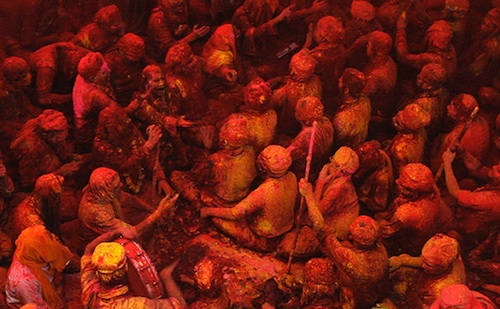
During the “Transcendence” section, Iyer’s skittering piano often announces abrupt mood swings on screen. While Holi is a celebration, nobody is excluded from the customary dousing of colorful dies and powders, regardless of age or general willingness. Indeed, some targets of the merriment clearly do not enjoy the attention, which rather darkens the film’s tone, but it is true to life.

Perhaps the most intimidating challenge fell to actress Anna George, who must convey the passion and devotion of Radha without the benefit of dialogue. Yet, she does so with great power and sensitivity, without ever allowing becoming overwhelmed by Iyer’s roiling score.

The combined artistry of Iyer, Bhargava, and George really transports viewers to an entirely different sphere. Even with the recorded score, it is the darnedest Stravinsky tribute. Hearing it performed live (by Iyer with the International Contemporary Ensemble) should give it a further kick. Recommended for those who appreciate multi-media collaborations, Radhe, Radhe: the Rites of Holi screens during Iyer’s Music of Transformation concerts this Thursday, Friday, and Saturday (12/18-12/20) at BAM.

LFM GRADE: A-

Posted on December 14th, 2014 at 10:32pm.

LFM Reviews Sagrada: the Mystery of Creation

By Joe Bendel. It could very well have been St. Joseph himself who miraculously constructed the Loretto Chapel’s circular staircase in Santa Fe, but strictly speaking, he was a carpenter. That leaves Antoni Gaudí in pretty exclusive company as a beautified architect. One hundred thirty years after it first broke ground, his life defining project continues to be erected in Barcelona. Stefan Haupt follows the progress and meditates on the significance of the already imposing cathedral in Sagrada: the Mystery of Creation, which opens this Friday in New York.

Originally commissioned in 1882, the Order of St. Joseph hired Gaudí to take control of the unwieldy project a year later. Known for his devout Catholicism and wholly distinctive style, Gaudí was an inspired but slightly risky choice. Throughout his final years, he lived and breathed the Sagrada Familia, even though he knew he would never live to see its completion. He hoped to see the Nativity façade finished, but tragically succumbed to injuries sustained from a tram accident. For a while, his assistant Domènech Sugranyes carried on in his stead, until the macro events of the Twentieth Century temporarily halted the project.

Haupt does a nice job chronicling the various phases of construction, but his cast of talking head experts are suspiciously concise when discussing the effects of the Spanish Civil War. Evidently, when the Loyalists were burning churches, they also destroyed all of Gaudí’s plans and scale models that they could find, leaving the Sugranyes and his fellow architects in absolute disarray, but they were good leftists, so let’s not discuss it.

Still, Haupt and the current architectural team clearly understand the Ken Follett-like sweep of the project. For many, it represents not just faith in God and his church, but a faith that succeeding generations would finish the work they started. Obviously, the final Sagrada Familia will be necessarily different from what Gaudí originally conceived, which is a burden and an opportunity for several contemporary artists working on its decorative elements. Easily the most eloquent is Japanese sculptor Etsuro Sotoo, who converted to Catholicism while working on the Sagrada Familia. In fact, there are a number of Japanese connections to the cathedral, such as Hiroshi Teshigahara, who previously documented an earlier period of construction in his film Antonio Gaudí (also opening this Friday).

From "Sagrada: the Mystery of Creation."

At times, Haupt asks (or implies) some spot on questions, like what do contemporary Christians build if we no longer erect cathedrals? Of course, his trump card is the Sagrada Familia itself. It is a stunning sight, perhaps even more so when juxtaposed against the modern secular cranes supporting its raise into the heavens. It would be hard to make it look prosaic, but Haupt and cinematographer Patrick Lindenmaier find particularly cinematic angles for some truly dramatic visual compositions.

On the other hand, Haupt forces an artificially surreal note into the film when he stages brief scenes of dancer Anna Huber posing amid the half-constructed interiors. Regardless, it still serves as a thoughtful overview, primer, and guided tour of what has already become Barcelona’s most popular tourist attraction. Sometimes religion and architecture can actually draw a crowd. Recommended for Gaudí admirers, Sagrada: the Mystery of Creation opens this Friday (12/19) in New York, at the Elinor Bunin Munroe Film Center.

LFM GRADE: B

December 14th, 2014 at 10:31pm.

LFM Reviews The Captive

By Joe Bendel. Its population is less than ninety thousand, but evidently organized pedophilia is a growing danger in Niagara Falls, Ontario. They now have a sizable police task force working full time on such crimes. The leader even becomes an Oprah style celebrity. However, they have not produced sterling results. After eight years, Matthew Lane’s daughter Cass is still missing. Past his breaking point, the desperate father is more than willing to take the law into his own hands, if he can finally find a target in Atom Egoyan’s The Captive, which opens tomorrow in New York.

It has been a hard eight years for Lane and his wife, Tina. She still blames him for their daughter’s abduction and so does he. He only briefly popped out to pick up a pie while she rested in the back seat of his truck after ice skating practice. Tragically, it was long enough for the pederast ringleader stalking them. As the years advanced and their marriage imploded, Tina started seeing Det. Nicole Dunlop for counseling, but her partner (and lover) Det. Jeff Cornwall still suspects Lane sold his daughter to a pedophile ring, because he reminds him of a guy he used to know. Seriously, that’s the best he can do after eight years?

Of course, Lane’s investigative techniques basically amount to him driving around looking for something suspicious, but he is still more effective than the cops, who will make a series of spectacular blunders. Eventually, Det. Dunlop will wind up in peril herself, following a head-scratchingly unlikely chain of events.

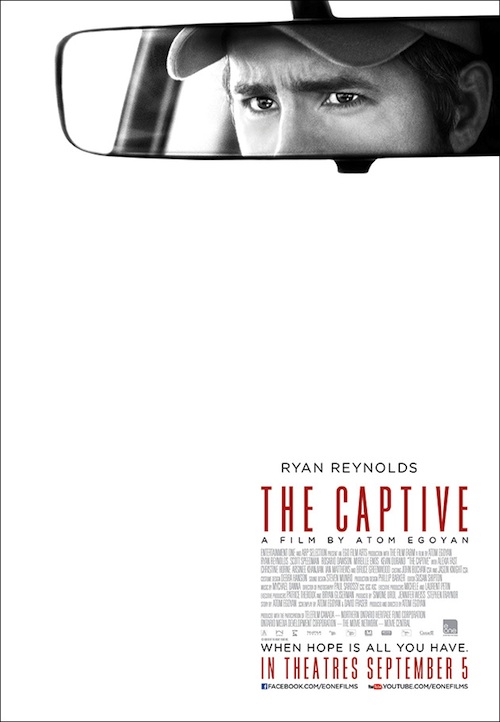
Frankly, it is a real shame Captive morphs into such a klutzy thriller, because Ryan Reynolds’ lead performance could have been a career game-changer in a tighter, more grounded film. He really digs in and digs deep as Lane. You feel his pain and his rage, without any cheap theatrics. He also makes the thriller mechanics work better than they deserve to, particularly an oblique confrontation with his daughter’s abductor late in the game.

Conversely, Kevin Durand is an excellent actor, but his performance as Mika, the pervert ringleader is beyond caricature. Everything about him, from his affected voice to his sinister sliver of a moustache screams “Chester Molester.” Yet, he still hob nobs with Niagara Falls’ elite without anyone getting suspicious. Rosario Dawson is reasonably competent as Det. Dunlop. She may not look like she is from Niagara Falls, Ont., but diversity in Canadian cinema is a good thing. As if on cue, Scott Speedman also turns up, underwhelming us as Cornwall, arguably the worst cop ever who wasn’t on the take, just to remind everyone this is a Canadian film.

There was a time during the mid-1990s and early 2000s people who did not normally patronize festivals and art cinemas still went to Egoyan’s films because they were so widely acclaimed and zeitgeisty. What a difference three or four films make. Many of his regular themes are still present and accounted for, but the narrative twists are rather clunky and therefore dashed difficult to buy into. Reynolds’ work is legitimately award caliber, but it really needs Ice-T and Richard Belzer. If you have DirecTV, it is almost worth watching just to see how Paul Sarossy’s uncompromisingly icy cinematography conflicts with the otherwise lurid vibe, but it is hard to recommended The Captive when it opens today (12/12) in New York, at the Village East.

LFM GRADE: C-

Posted on December 12, 2014 at 8:34pm.