LFM Reviews Waste Land @ The AFI’s 2014 EU Film Showcase

By Joe Bendel. Géant is the Col. Kurtz of Belgian art dealers. He has definitely embraced the heart of darkness in the Congo. He even has his personal “witch doctor.” It is not clear that he really believes, if the cop pursuing him believes he believes, or even whether the cop starts to believe himself. Regardless, Det. Leo Woeste is in for a rough final investigation in Pieter Van Hees’s Waste Land, which screens during the AFI’s 2014 EU Film Showcase.

Woeste is your basic cop on the edge. He tries to be a good husband and a responsible father to the step-son he has helped raise since infancy, but he has seen some terrible things. The fact that his new partner, Johnny Rimbaud, is a coke-fueled hedonist hardly stabilizes his erratic mood swings. When his wife Kathleen announces her pregnancy, but doubts the wisdom of keeping the baby, Woeste promises to retire from the force and start acting normal. Unfortunately, he has one last case to solve.

When an African immigrant is murdered and dumped in a garbage bag, the initial clues point towards Géant. Woeste tries to be extra-supportive to the slain man’s grieving sister, Aysha Tshimanga, perhaps because his fatherly instincts have been stimulated. However, their relationship soon takes on weird sexual overtones. She will accompany him to various underground boxing matches and hipster night clubs, where the throbbing hot house atmosphere will keep his head spinning.
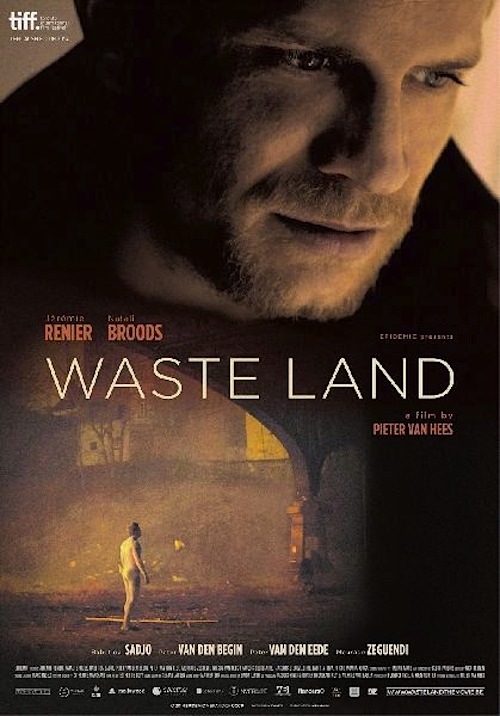
Waste Land flirts with a lot of genres, but it never fully commits to any. It also injects some clumsy commentary on imperialism, particularly a running non-joke supposedly claiming Woeste is descended from Leopold II. Nevertheless, much of the second act investigation is rather compelling procedural stuff. Unfortunately, the climax is so self-consciously feverish, it undermines the gritty mystery and ambiguous genre elements that proceeded it.

Still, there is no denying Dardenne Brothers regular Jérémie Renier puts on a clinic as Woeste. This is fierce, no-holds-barred, rub-your-nose-in-the-self-destruction work, but it is never self-indulgent. In fact, he balances the inward burn with the outward rage quite adroitly. Babetida Sadjo also finds a spark in Tshimanga that elevates her beyond a mere victim, while Peter Van den Begin gorges on scenery as the roguish Rimbaud.

Despite its narrative frustrations, Waste Land is a massively stylish film. Cinematographer Menno Mans makes Brussels look like a real life Sin City, where most of the buildings are either abandoned warehouses or underground dance clubs. The opening sequence is especially evocative, in a disconcerting way. Nicely played and skillfully put together, Waste Land just lurches out of control down the stretch. Recommended for those who will admire its ambition, Waste Land screens this coming Tuesday (12/16) and Wednesday (12/17), as part of the AFI’s EU Film Showcase, outside of Washington, DC.

LFM GRADE: B-

Posted on December 12th, 2014 at 8:59pm.
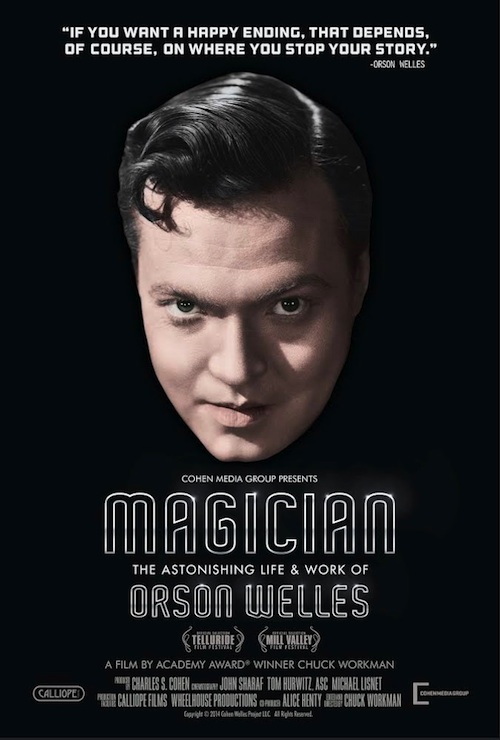
LFM Reviews Magician: the Astonishing Life & Work of Orson Welles

By Joe Bendel. Just imagine what might have been if Orson Welles had worked in the digital era. Probably no other filmmakers left behind so many unfinished yet potentially great films. As his latest video-biographer Chuck Workman documents, Welles had no shortage of work ethic. It was simply a lack of everything else, particularly money. You may have heard this story before, but Workman illustrates the great auteur’s rise and fall with a wealth of striking visuals and many rarely seen archival interviews. Welles gets the full Workman treatment in Magician: the Astonishing Life & Work of Orson Welles, which opens this Wednesday in New York.

Welles was a precocious but never small child. Evidently, in the Welles family, children had to be interesting performers, or they were banished to the nursery to be boring in private. Obviously, Master Orson was not about to be shunted away. In a departure from many DVD-behind-the-scenes-extras, Workman patiently invests a bit of time up-front on Welles’ formative years in Woodstock, Illinois, where he honed his craft at the Todd School and the local Woodstock Theatre, whose main stage has since been renamed in Welles’ honor. Workman takes the audience there and it does indeed look like fitting launching pad for Comet Welles—an intimate yet classy space that could fire a young genius’s imagination.

By the time Welles hit the New York theater world, he was practically a fully formed master. Workman breezes through his early Broadway triumphs and radio superstardom, essentially using the feature films to island-hop his way through Welles career. At this point, the film starts to feel very familiar to anyone with a casual knowledge of Welles’ life and career. Yes, Citizen Kane is a masterpiece and The Magnificent Ambersons sort of is too, but according to Welles RKO cut out the most important parts. However, Workman includes some fascinating interview excerpts with the late Oscar winning Robert Wise, justifying the cuts he made at the studio’s behest.

Magician also incorporates tantalizing glimpses of films Welles started but never completed, such as The Deep, Don Quixote, and the technically finished but now mostly lost Merchant of Venice. Frankly, this is some of the best material Workman collects, hinting at what might have been. It nicely compliments Workman’s full visual portrait of the artist, which also directly addresses his larger than life celebrity status, as seen through clips of Welles guest appearances on I Love Lucy, The Muppet Show, and various chat shows and commercials.

There are not a lot of surprises in Magician. Frankly, you really have to stretch to find any new material at all in the film. Still, Workman and company make a convincing defense of Welles’ unfinished oeuvre, arguing he was committed enough to start production, whereas most would-be filmmakers accept defeat in the development or pre-production stages.

Magician certainly makes you want to watch all of Welles’ films again, including the ones that we can’t, which means it probably accomplishes its goals, but it never feels as fresh as Visionaries, Workman’s relatively recent (stylistically traditional) survey of avant-garde filmmaking. Recommended for Welles diehards looking for something to tide them over until the long rumored release of The Other Side of the Wind (promised for the auteur’s centennial this coming May), Magician opens Wednesday (12/10) in New York, at the Lincoln Plaza Cinema.

LFM GRADE: B-

Posted on December 9th, 2014 at 8:24pm.

LFM Reviews Marco Polo on Netflix

By Joe Bendel. He wrote the equivalent of a bestselling memoir, before the invention of Gutenberg’s printing press. Dozens of hand-written manuscripts of The Travels of Marco Polo have widely circulated, making it rather difficult to determine the canonical truth of the celebrated merchant’s life. That might be frustrating for scholarly biographers and historians, but it rather takes the pressure off filmmakers dramatizing his life. Before securing his fame and fortune, the young Venetian (or “The Latin” as he will often be called) finds an unusual place in the Court of Kublai Khan, becoming enmeshed within a geo-political struggle between two ancient dynastic powers in Marco Polo, an original ten episode historical series premiering on Netflix this Friday.

Polo never knew his father Niccolò Polo, until the Venetian trader made a brief homecoming, before setting off for Asia once again. Desiring a paternal relationship, the younger Polo invited himself along, but it is soon apparent he is quite well-attuned to the rhythms and mysteries of the Eastern world, perhaps even more than his father and uncle. In fact, the great Kublai Khan accepts Marco Polo into his service, when Niccolò Polo offers to barter him in exchange for trading rights along the Silk Road. Of course, the son is quite put out by this, but his father promises to return, which he will, but maybe not in the manner he imagined.

Valuing Polo’s shrewd observations unclouded by courtly biases, Kublai Khan often dispatches the Latin to report on flashpoints within his empire. Not surprisingly, Polo’s favor rather displeases the Khan’s Chinese-educated son, Prince Jingim. Frankly, Polo is not exactly close to anyone in court, least of all the Khan’s trusted ministers. However, he will develop something approaching friendship with Byamba, the Khan’s illegitimate son with one of his many concubines. Polo also becomes ambiguously involved with Kokachin, the Blue Princess, the last surviving noble of a conquered people, and Khutulun, the Khan’s independent-minded warrior niece.

Regardless of historical accuracy, writer-creator John Fusco spends enough time in the Khan’s harem to make the broadcast networks curse the FCC. As Mel Brooks would say, it’s good to be the Khan. Yet, despite the nudity and hedonism, some of MP’s strongest action figures are women. As Khutulun, Korean actress Claudia Soo-hyun Kim credibly wrestles men twice her size and projects a smart, slightly subversive sensibility. Olivia Cheng also displays first class martial arts chops (sometimes naked) as Mei Lin, a Song concubine who infiltrates the Khan harem on the orders of her war-mongering brother, the villainous Imperial Regent Jia Sidao. Zhu Zhu’s Kokachin might be more demur, but she is still quite compelling, balancing her vulnerability with resoluteness. Of course, international superstar Joan Chen frequently upstages everyone as the iron-willed Empress Chabi.

From "Marco Polo."

Italian actor Lorenzo Richelmy holds his own as best he can amid the exotic locales and pitched battles, maintaining the necessary fish-out-of-water earnestness. However, he is no match for the British Benedict Wong (son of naturalized Hong Kong parents), who absolutely dominates the series as Kublai Khan. Although he put on considerable weight for the role, it is his commanding presence that really seems huge. Likewise, Tom Wu is terrific delivering the goods for genre fans as Hundred Eyes, Polo’s blind tutor in the martial arts.

In the initial episodes, MP offers more intrigue and Game of Thrones style decadence than actual fist-and-sword action, but the martial arts melees increase as the series progresses, with the threat (or promise) of an epic war hanging over everyone’s heads. There is a lot of setting-the-scene in episode one, but it quickly sets the addictive hook in the second installment and reels in viewers from there. Kon-Tiki directors Espen Sandberg & Joachim Rønning give the pilot an appropriate sense of mystery and sweep, which carries forth throughout the show. Based on the six episodes provided to the media, MP definitely seems to maintain its passion-fueled energy and richly detailed period production values. Highly recommended (so far), Marco Polo launches for binge-streaming this Friday (12/12) on Netflix.

LFM GRADE: A-

Posted on December 9th, 2014 at 8:23pm.

LFM Reviews Maidan

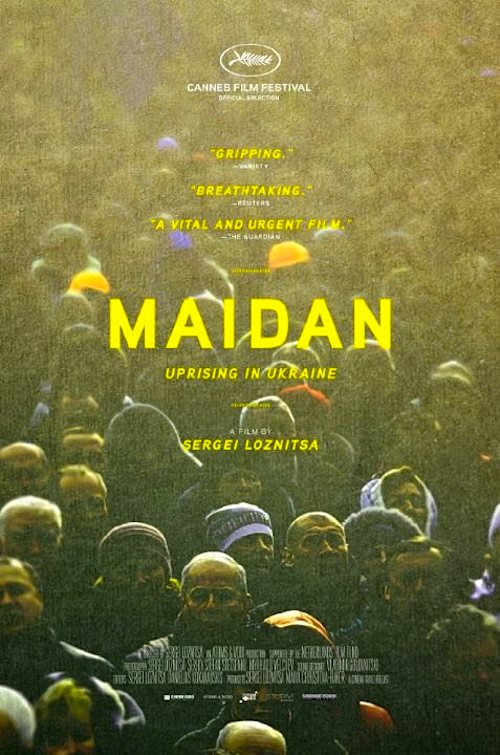
By Joe Bendel. The opening lyrics of the Ukrainian National Anthem make a fitting commencement for any film on the Euromaidan demonstrations and the subsequent Russian aggression: “Ukraine’s glory has not yet perished, nor has her freedom. Upon us fellow patriots, fate shall smile once more.” Let’s be frank, most of the media now considers Ukraine’s freedom a lost cause and the lame duck administration no longer has anything to say on the issue. Yet, when the Ukrainians unite in common purpose, they are a resilient force. Sergei Loznitsa captures his countrymen’s collective spirit in the direct cinema documentary Maidan, which opens this Friday in New York.

Kiev’s central city square is currently known as Maidan Nezalezhnosti, or Independence Square. It was previously known as Soviet Square, Kalinin Square (in honor of Stalin loyalist Mikhail Kalinin), and the Square of the October Revolution—and it might be so renamed again if deposed President Viktor Yanukovych and his Russian masters have their way. In late 2013, outraged Ukrainians took to the square, protesting Yanukovych’s decision to reject an association agreement with the EU, in accordance with Moscow’s wishes. Protests did indeed erupt in Maidan, the scene of many Orange Revolution demonstrations following Yanukovych’s suspect election in 2004, but it was far from the “pogrom” Putin suggested. Loznitsa has the footage to prove it.

In a way, it is too bad the Euromaidan movement advocates freedom and closer ties with the west, because Loznitsa’s documentary could have been the greatest socialist film ever made. Arguably, no other film so powerfully conveys the spirit of collective action and a sense of individuals dedicating themselves to a larger cause. There are many long takes and wide angle crowd shots, but Loznitsa and his fellow cameraman Serhiy Stefan Stetsenko capture the tenor of the time quite viscerally.

Loznitsa never focuses on representative POV figures, maintaining a macro perspective throughout. Nevertheless, we can easily observe the trends and magnitude of the situation from his vantage points. At first, there is very much a sense that things will change, much as it did in 2004. We see the volunteers making sandwiches and distributing tea to regular Sunday night demonstrators. A gullible media largely accepted Putin’s smears at face value, but it is hard to imagine a neo-fascist movement would dispatch four volunteers to make sure nobody slipped on a spot of spilled water in the lobby.

Tragically, Yanukovych would unleash the Interior Ministry’s Berkut forces in January. At this point the audience can clearly see how unscripted Loznitsa’s film truly was, as either the director or his co-cinematographer is caught in a tear gas attack. They maintain the same long fixed approach, but the pleas for medical personnel to come to the stage area to treat the collected wounded speaks volumes about the old regime. Not to be spoilery (unless you work at a major network, you should already know this ends rather badly), but Loznitsa concludes the film with a funeral for two fallen activists, which is absolutely emotionally devastating, even without a personal entry-point character to concentrate on.

Still, the individual stories of Maidan supporters desperately need to be heard, which is why Dmitriy Khavin’s Quiet in Odessa is such a timely and valuable film. Since there is almost no supplemental context in Loznitsa’s Maidan it is best seen in conjunction with a film like Khavin’s. However, it has the virtue of presenting events as they happened and allowing the audience to draw their own conclusions. Highly recommended for anyone seeking an immersive understanding of Ukraine’s Euromaidan movement, Loznitsa’s Maidan opens this Friday (12/12) in New York, at the Elinor Bunin Munroe Film Center.

(The international film community should also note that Ukrainian filmmaker Oleg Sentsov is still being held incommunicado in Russia, on trumped-up terrorism charges, awaiting his day in kangaroo court. Along with Loznitsa’s Maidan and Khavin’s Odessa, film programmers ought to consider scheduling Sentsov’s politically neutral Gaamer to raise awareness for his plight.)

LFM GRADE: A-

Posted on December 9th, 2014 at 8:23pm.

LFM Reviews I’m an Old Communist Hag @ New Romanian Cinema 2014

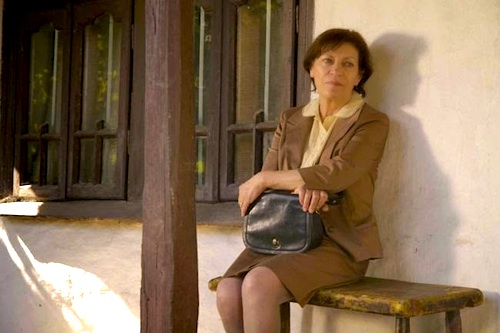
By Joe Bendel. Emilia was allowed to shake Ceauşescu’s hand because she was a Party member who didn’t have sweaty palms. For a while, that encounter gave her great prestige in her state-run factory, but she tried to avoid discussing it after the revolution. Nonetheless, her nostalgia for the past is rather well known in Stere Gulea’s I’m an Old Communist Hag, which screens during Making Waves: New Romanian Cinema 2014.

She was once an industrial foreman, but now Emilia and her husband Ţucu make do on their pensions and a bit of bartering-up. If you ask her, she will tell you the old dictator did a better job managing the economy. At least, that is how she remembers it. However, her memory is selective and she may have only noticed what she wanted to back in the day. She will slowly and only partially come to realize this when she visits Madame Stroescu to have a dress made for her expat daughter Alice’s sudden visit.

Madame Stroescu was always a favorite of Alice’s, but Emilia never realized how much the gentle woman suffered under Communism. She should have been an accomplished artist, but she was forced to work as a seamstress instead. With her eyesight now failing, even such work is beyond her, but she still hopes to have her late father’s confiscated tailor shop restituted to her. It is an inconvenient episode for Emilia to process, especially with the 2010 financial crisis swirling around her. In fact, that is why Alice and her American husband Alan have suddenly arrived. Both have been let go by their multinational employer and now find themselves at loose ends.

Despite its hot-button title, Hag is a restrained film that eschews all ideologies in favor of human relationships. Emilia is not a bad person. She just happened to do somewhat better than her neighbors during the old regime and is now experiencing a bit of a rough patch due to the new more cyclical system. Nevertheless, Valeria Seciu’s haunted Stroescu unambiguously serves as the film’s conscience and moral corrective. It is a quiet but powerful performance that undercuts Emilia’s romanticized memories.

From "I’m an Old Communist Hag."

While it is a more restrained and forgiving role than her celebrated turn in Child’s Pose, Luminita Gheorghiu still commands the screen as Emilia, embracing her complications. Ana Ularu counterbalances her well as Alice, the daughter who sees the past era in its full historical context, but struggles with her own personal and professional failings. Texan Collin Blair’s Alan resembles a young Michael Rapaport, which works rather well in context. There are probably a dozen additional supporting players playing former colleagues and family members, who are quite colorful, but feeling unfailingly real. Still, it is Gheorghiu and Seciu who really define the film with their contrasting presences.

Gulea was a rather bold critic of the Communist regime in past films, so Hag should not be dismissed as revisionism, but more of a meditation on how folks get by, regardless of the times. It is a nice film, elevated by several thoughtful performances and a lively yet elegiac score composed by Vasilé Sirli. Recommended for those interested in seeing a different side of Romanian cinema, I’m an Old Communist Hag screens this afternoon (12/7) at the Walter Reade Theater and tomorrow (12/8) in Long Island at the Jacob Burns Film Center, as part of Making Wave: New Romanian Cinema.

LFM GRADE: B

Posted on December 9th, 2014 at 8:22pm.

Innocence Martyred: LFM Reviews Keys of Heaven

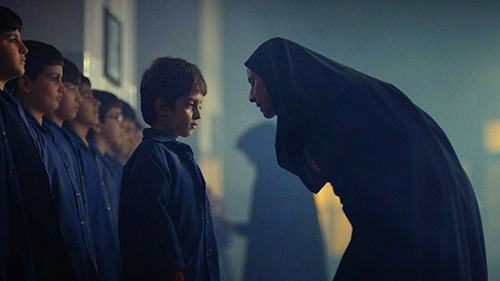
By Joe Bendel. You could say Majid and Adel have student deferments. They are fifteen and twelve, respectively. Of course, that is hardly too young to die for Revolutionary Iran, especially when it was locked in mortal combat with Iraq. They might live in an Orwellian state prosecuting an apparently endless war, but the brothers lead desperate Dickensian lives in Finnish-Iranian director Hamy Ramezan’s short film, Keys of Heaven, which starts a special three-day engagement today in Los Angeles.

It is in fact 1984. Majid and Adel are homeless in the great Islamist republic, but the elder brother insists they keep attending school. Should they drop out, they would be prime candidates to join the 500,000 other Iranian children who served in the Iran-Iraq War. They work late into the night as street hawkers to earn money for a more permanent relocation, because for some reason, Majid has cut all ties to their widower father. Unfortunately, the dissolute old Kiamarz still has the brothers’ identification papers, which they will need to sit for their final exams.

Keys is a dark film with a bracingly bitter twist that Ramezan skillfully implies rather than bashing the audience’s heads with it. The film very definitely protests the use of child soldiers, but it acknowledges (obliquely) even worse crimes. It also depicts the ruthlessness of the Ayatollah’s thought police in no uncertain terms. Yet, the brothers’ relationship is the engine driving the film.

From "Keys of Heaven."

Salar Ashtiyani gives an extraordinarily honest performance as the gaunt Majid. The young actor maintains a brittle intensity while subtly turning his big revelations. Yazdan Akhoondi’s Adel reliably serves as a wide-eyed picture of innocence and Shaghayeh Djodat brings considerable nuance and sensitivity to bear as the teacher who tries to help the brothers, but lacks a full understanding of their situation.

Filmed in Turkey with Farsi dialogue, Keys feels absolutely genuine. The period details look right and the atmosphere of paranoia is quite tangible. It could be called a powerful coming-of-age tale in a country where vulnerable children, like the brothers, frequently do not live long enough to come of age. Another fine example of diasporic Iranian filmmaking, Keys of Heaven is highly recommended when it screens afternoons, today, tomorrow, and Thursday (12/9-12/11) at the Laemmle Royal in Los Angeles.

LFM GRADE: A-

Posted on December 9th, 2014 at 3:23pm.