LFM Reviews 100 Days

By Joe Bendel. The natural beauty and quaint charm of the Matsu Islands make them a perfect tourist destination. The spotty cell-phone reception and lack of wi-fi could also be attractive to visitors, but it is highly inconvenient for full-time residents. A hot shot telecom exec has returned to his home island to scuttle a fiber optic development plan. While he is there, he will pencil in his mother’s funeral. However, he never bargained on the local tradition requiring his marriage a little more than three months after the ceremony. Romance and ritual threaten to stall his career in Henry Chan’s 100 Days, which opens this Friday in Los Angeles.

Wu Bo Dan felt rejected by his mother when she re-married and packed the teen off to be educated in America. Frankly, he was fine with leaving, because he would only miss his ambiguous girlfriend Xiao Wei. Now a high-flying dealmaker, Wu is not sure how to react when his stepfather comes bearing the bad news. He also brought Wu one of his mother’s favorite chickens, confusing the corporate shark even more.

Once Wu finally arrives on fictional North Island, chicken in tow, he begrudgingly attends her funeral. Of course, he is having none of the get-married-in-100-days mandate. Fortunately, his step-brother Zhen Fong is willing to fulfill Wu’s ceremonial duties in his stead. Unfortunately, he has a five-year arranged engagement with Xiao Wei. That does not sit right with Wu, but she does not want to hear it.

100 Days is pretty much headed exactly where you think it is, but it has the good sense to lose the chicken before the second act starts in earnest. It is also a ridiculously good looking film. The island is spectacularly cinematic, sort of like the Village in The Prisoner, but with shrines dedicated to the ocean deity Mazu. The cast is also obscenely attractive, even including Xiao Wei’s shy, unlucky-in-love bridesmaid Yu Jen, played by the drop-dead gorgeous Julianne Chu. So yes, 100 Days will definitely make viewers want to visit Peikan Island’s Chinpi village, where the film was shot.

From "100 Days."

Model-turned-actress Tracy Chou plays Xiao Wei with demur intelligence, somehow managing to sell her martyr complex. Likewise, Chu’s turn as Yu Jen is touchingly sweet and wholly likable. Aboriginal actor Soda Voyu (seen in Seediq Bale) largely minimizes the shtick as the unflaggingly earnest and only slightly goofy Zhen Fong. On the other hand, poor Johnny Lu’s Wu gets quite a bit of slapstick comeuppance and never really feels like he connects with the other characters, except maybe briefly with Tsai Ming-hsui, who invests his step-father with a quiet dignity that classes up the joint.

100 Days never really tries to transcend the rom-com genre, but it observes the category conventions in moderation. Chan (whose American television credits include episodes of Scrubs and the better-than-its-reputation Kitchen Confidential) keeps things moving along at an easy mid-tempo and cinematographer makes everything sparkle in the warm sunlight. If you are looking for niceness in a film, it has a bounteous spread. Recommended as a safe date film, 100 Days opens this Friday (12/12) in the Los Angeles area, at the Laemmle Playhouse 7.

LFM GRADE: C+

Posted on December 9th, 2014 at 3:22pm.
LFM’s Jason Apuzzo & Govindini Murty at The Huffington Post: For Love of the Game: Talking with Kurt Russell About The Battered Bastards of Baseball

[Editor’s note: the post below appears today at The Huffington Post.]

It’s the kind of thing you probably missed over Thanksgiving dinner, while gnawing on a turkey leg, bickering with your uncle, or falling asleep during a Detroit Lions game: the Miami Marlins just signed an outfielder to a $325 million deal, the largest contract in sports history.

You read that correctly: $325 million. That’s Hunger Games money, Transformers money. It’s the kind of figure you associate with World Bank loans or Rolling Stone comeback tours. Apple needs at least a day to make that kind of cash.

The young outfielder, named Giancarlo Stanton – no, I hadn’t heard of him, either – apparently hit .288 with 37 home runs last season. (Note to Marlins: those were roughly my numbers playing T-ball in 5th grade.) Stanton later celebrated his deal in a Miami nightclub with a $20,000 bottle of champagne coated in 22-carat gold leaf. I don’t know whether he kept the bottle.

It says something about baseball today that a guy you’ve never heard of – again, he plays for the Marlins – can be signed for $25 million per year over 13 years. Frankly, it’s probably a bad deal for the Marlins – especially if the names Albert Pujols, Alex Rodriguez or Josh Hamilton ring a bell. Players paid more than they’re worth – more than some national economies are worth – rarely stay motivated purely by love of the game.

Love of the game. That’s what sports are supposed to be about, isn’t it?

When you think about love of the game, you think of Lou Gehrig – the Iron Horse – playing in 2,130 straight games until his body gave out from ALS. Or Pete Rose, aka Charlie Hustle, barreling over Ray Fosse in the 1970 All Star game to secure a seemingly meaningless win. Or Kirk Gibson, gamely limping around the bases after hitting his clutch home run in the 1988 World Series.

And you should also think of the Portland Mavericks, the subject of a wonderful new documentary called The Battered Bastards of Baseball that premiered this past year at Sundance and is currently showing on Netflix.

My writing partner Govindini Murty and I caught Battered Bastards at Sundance and also at this year’s Los Angeles Film Festival. At the Sundance screening we had the chance to speak to Kurt Russell, who’s interviewed in the film, along with his nephews Chapman Way and Maclain Way, Battered Bastards‘ co-directors.

2014-12-08-JasonApuzzoKurtRussellSundance2014.jpg
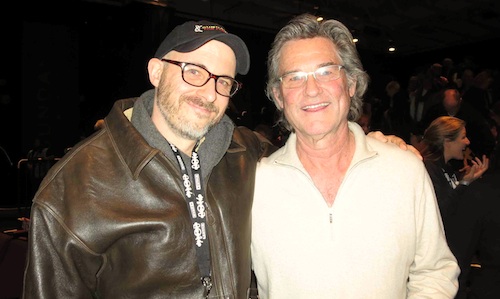
LFM's Jason Apuzzo & Kurt Russell at Sundance 2014.

The Mavericks – an independent, Class A minor league baseball team between 1973-77 – were the brainchild of Bing Russell, the actor best known for playing deputy sheriff Clem on TV’s Bonanza. A hugely colorful showman with a fast wit (“I played Clem for 13 years on Bonanza and never solved a case”), Russell appeared in countless film and TV westerns, and made a career of getting killed on camera – most notably in Howard Hawks’ Rio Bravo and John Ford’s The Horse Soldiers.

Of course, Russell is best known today as the father of Kurt Russell, who himself played for the Mavericks in 1973.

As Battered Bastards relates, Bing served as a bat boy for the mighty New York Yankees between 1936-41, when he got to know legends of the game like Joe DiMaggio, Lefty Gomez and Lou Gehrig (who gave young Bing his bat after hitting the final home run of his storied career). Although Bing later tried his hand at pro baseball, an injury cut short his career – leading him to try an acting career in Hollywood.

His love of baseball never left him, however – so when his acting career stalled in the early 1970s, Russell jumped at the opportunity to bring pro baseball to Portland in 1973 after the prior team left town.

“Baseball was a big part of our family,” Maclain Way told us. “Kurt, our uncle, played professional baseball. Bing, himself, played professional baseball. We had cousins who played major league baseball, so baseball was a huge part of our life growing up. I played baseball in high school because of Bing – he taught me how to play.”

The upstart Mavericks would become a team like no one had seen before – totally unaffiliated with any big league franchise, and filled to the brim with misfits and rejects – a scrappy, real life Bad News Bears squad.

“He had a great eye for ball players,” Kurt Russell told us, speaking warmly of his father. “We knew we could put a competitive team together.”

2014-12-08-GovindiniMurtyKurtRussellSundance2014.jpg
Kurt Russell & LFM's Govindini Murty at Sundance 2014.

Managed by restaurant owner Frank “The Flake” Peters, the Mavericks’ roster of wild characters would include: a shaggy, 33 year-old high school English teacher named Larry Colton (who’d later be nominated for a Pulitzer Prize); 38 year-old ex-Yankee Jim “Bulldog” Bouton (who’d been blackballed from baseball after writing a wild tell-all memoir); Joe Garza (aka “JoGarza”), a madman utility player who waved flaming brooms when the Mavericks swept opposing teams; Rob Nelson, who invented Big League Chew bubble gum in the Mavericks’ bullpen; star outfielder Reggie Thomas, who took a limo to games even though he lived only a block from the stadium; and fiery batboy Todd Field, who once got tossed from a game, and later became an Academy Award-nominated writer-director.

And, of course, there was Kurt Russell. “I got injured [playing minor league baseball in Texas], so I had the opportunity to go to Portland and help them get the ball club started,” Russell told us.

“It was just a time in my Dad’s life where I was really happy he was involving himself in something completely new,” says Russell. “It was a big part of our lives.” Continue reading LFM’s Jason Apuzzo & Govindini Murty at The Huffington Post: For Love of the Game: Talking with Kurt Russell About The Battered Bastards of Baseball

LFM’s Govindini Murty at The Huffington Post: Music Made by People, not Algorithms: a DVD Review of Frank

[Editor’s note: the post below appears today at The Huffington Post.]

By Govindini Murty. We’re told that in our digital future music will be created by computer algorithms. But could an algorithm make music anywhere near as weird and wonderful as Frank? Frank is the titular character of Lenny Abrahamson’s touching and funny new black-comedy Frank, an ode to the irreplaceable nature of quirky, individual human creativity.

Coming out on DVD/Blu-ray December 9th, Frank premiered at the Sundance Film Festival earlier this year to rave reviews. The movie is inspired by the true story of Chris Sievey, a British musician and comedian who performed wearing a large paper-mâché head under the pseudonym Frank Sidebottom.

If you’re seeking a cinematic antidote to our flattened-out, Big Data, crowd-sourced, mass conformist digital age, then take the time to see Frank. Frank is a paean to true creativity – the kind of creativity that can only come from an individual.

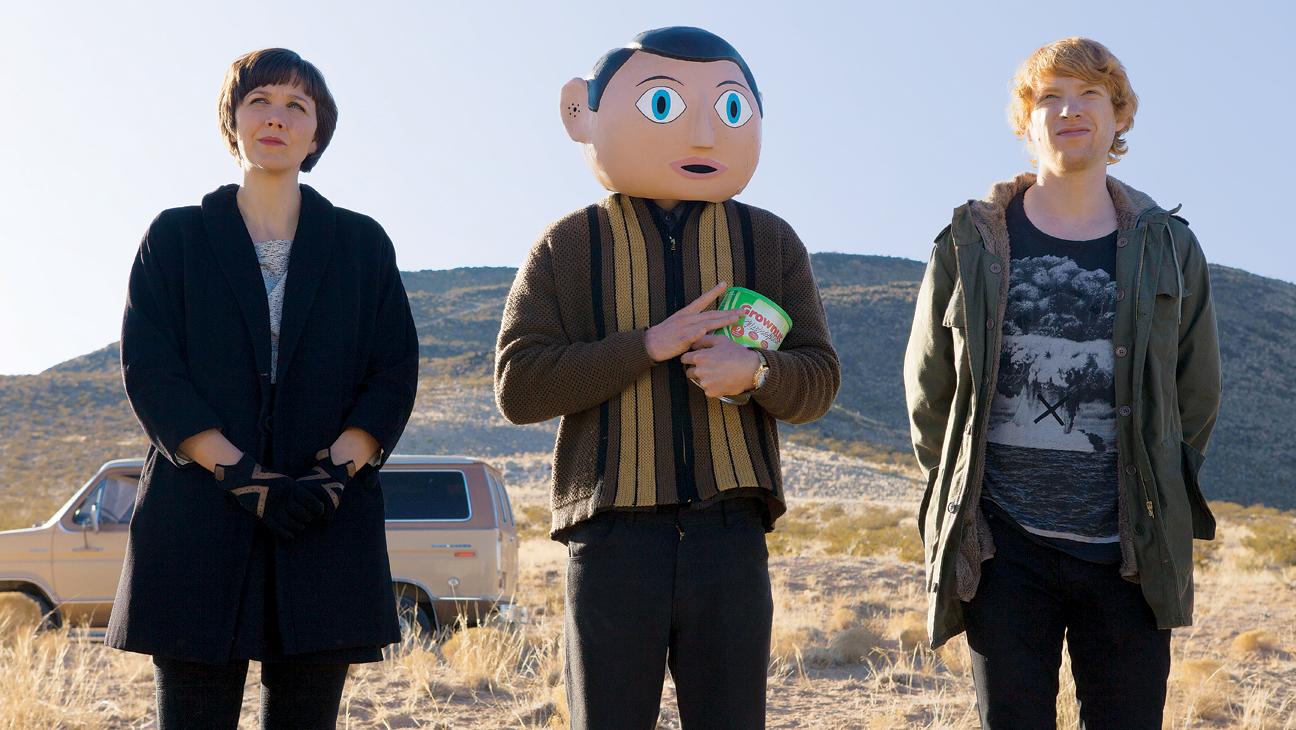
Frank stars Michael Fassbender as the eponymous musician – a mysterious, wildly talented singer-songwriter who wears a large paper-mâché head over his face at all times. Frank is supported in his musical efforts by a medley of eccentric band mates; these include nerdy keyboardist Jon (Domhnall Gleeson), surly theremin player Clara (Maggie Gyllenhaal), and troubled band manager Don (Scoot McNairy).

2014-12-08-fassbenderfrank1.jpeg
From "Frank."

The story is told from the point of view of Jon (Domhnall Gleeson), a would-be keyboardist and song-writer who spends his days searching for poetic inspiration in his quiet seaside town, while posting random updates on social media about what sandwiches he’s eaten, his humdrum home life, and so forth.

One day while staring blankly out at the ocean, Jon witnesses a man being rescued from an attempted drowning. It turns out the man is the keyboardist for an avant-garde band with the unpronounceable name of “The Soronprfbs.” Jon meets the band’s manager Don (Scoot McNairy) and is invited to play with the band that night.

Jon is enthralled by the chaotic creativity of the band – so different from his own dull existence- and in particular by the manic, oddly compelling performance of Frank, a figure wearing a large, round head with blank, staring eyes and a goofy, painted-on smile. Jon seems to make the right impression on Frank, and so Frank invites Jon to join the band at a remote country house in Ireland to record their next album.

Jon is over the moon with joy, convinced that being in close proximity to musical genius will finally unleash his own creativity. However he soon learns that the other band members are suspicious of him – especially Clara – because they think that he’s a mediocrity only out to exploit Frank’s talent.

Unbeknownst to them, Jon is also secretly videotaping the band’s offbeat practice sessions (in which they find inspiration in things as diverse as bird calls, pouring water, and slamming doors) and uploading them to social media, gaining them an online following. Continue reading LFM’s Govindini Murty at The Huffington Post: Music Made by People, not Algorithms: a DVD Review of Frank

LFM’s Govindini Murty & Jason Apuzzo at The Huffington Post: The Double and the Christmas Holidays

[Editor’s note: the post below appeared this weekend at The Huffington Post.]

By Govindini Murty & Jason Apuzzo. Do you feel like you’re turning into a different person over the holidays? How about your fellow citizens – do they appear to be morphing into unrecognizable automata? The holidays can do that to you – especially in Los Angeles. It’s a time when people get consumed with travel schedules, holiday parties, frenzied “gifting,” and trying to keep up with the Kardashians – and forget to act like real human beings.

Just this past week we saw a grown man bark at a Starbucks barista because his eggnog latte wasn’t hot enough, soccer moms body-check each other grabbing at Target discount wreaths, and senior citizens hydroplane in a Mercedes while trying to grab a parking spot at a rainy mall.

Fellow citizens, enough is enough. Get some perspective – before you become ersatz human beings even your nearest and dearest wouldn’t recognize.

This is where indie cinema can offer some timely lessons on the perils of modern dehumanization. One of our favorite films at the Sundance Film Festival earlier this year was The Double, starring Jesse Eisenberg and written and directed by Richard Ayoade. Currently out on DVD and VOD, the film is one of the smartest adaptations yet of Fyodor Dostoevsky’s The Double, the seminal novella of modern alienation.

Jesse Eisenberg plays Simon James, a meek office drone toiling away in a retro-futuristic dystopia of grimy office buildings and gray apartment flats. The bleak settings owe much to Terry Gilliam’s Brazil and George Orwell’s 1984, while Simon’s character recalls Anthony Perkins’ persecuted office worker in Orson Welles’ adaptation of Kafka’s The Trial.

2014-12-07-thedouble2014diner1.jpg
From "The Double."

The hapless, ineffectual Simon loves a fellow office worker, Hannah (Mia Wasikowska), but he is completely unable to assert himself with her or with his co-workers – indeed, at times he is barely able to make it out of the office elevator. For this he is treated as if he is of little more consequence than the paint on the dingy office walls.

A wrench is thrown in the works one day when Simon is introduced to a new co-worker: a fellow named James Simon (also played by Eisenberg) who strangely enough, looks exactly like him. In personality, however, James is the opposite of Simon – smooth, assertive, full of charm and slick maneuvering. In short order, James takes credit for Simon’s work, double-crosses him with his boss, and starts putting moves on the lovely Hannah before Simon’s horrified eyes.

Making matters worse, no one seems to notice the striking similarity between Simon and James – something that infuriates poor Simon. James taunts Simon by stealing more and more of his life, eventually driving Simon to take desperate measures before a final, surreal denouement. Continue reading LFM’s Govindini Murty & Jason Apuzzo at The Huffington Post: The Double and the Christmas Holidays

LFM Reviews TNT’s The Librarians; Premieres Sunday, 12/7

By Joe Bendel. Flynn Carsen is a librarian Kramer would approve of. He does not spend a lot of time putting newspapers on big wooden sticks for cheapskates trying to save a quarter and probably doesn’t even know the Dewey Decimal System. Instead, he spends his time tracking down magical items to keep them out of the hands of potential evil-doers. The protagonist of TNT’s hit television movie franchise The Librarian is now a recurring character in their new regular series, The Librarians, note the plural form, which debuts with back-to-back episodes (The Librarians and the Crown of King Arthur and The Librarians and the Sword and the Stone) this Sunday.

Carsen has two last names and twenty-two college degrees. The perennial student was chosen by “the Library,” the mystical apostolic successor to the great Library in Alexandria, now hidden beneath the Metropolitan Public Library in New York. Having held his own in a series of adventures, Carsen is rather put out when the Library recruits Col. Eve Baird, a no-nonsense counter-terrorism operative to be his Protector. However, he will reluctantly accept her help when the shadowy Serpent Brotherhood starts assassinating all the weird genius rivals he beat out for his current globe-trotting gig. In fact, the only former candidates still surviving are the three oddballs who never made it in for their interviews.

Jacob Stone is an unassuming laborer in the Oklahoma oil fields, who writes scholarly articles on medieval art and history under an assumed name. Ezekiel Jones is a thrill-seeker, who likes to steal the things Stone writes about. Cassandra Cillian has savant-like powers of memory and superhuman computation, but it might be linked to the tumor that will eventually kill her. Together with Carsen and Baird, they will track down several Arthurian relics the Brotherhood needs to control the magic they intend to let loose upon the world.

The Librarian one-offs might have been popular, but they must have skewed toward a decidedly younger demographic. While the premiere episodes, directed in a straight forward manner by Independence Day producer Dean Devlin, never descend into outright slapstick, the dominant acting style practiced is decidedly broad. This is especially so for Noah Wyle’s Carsen and hammy John Larroquette, joining the Librarian world as Jenkins, the curmudgeonly manager of the Library’s branch office (evidently in Portland of all places), who is clearly being set up to serve as the Giles-Watcher to the three new recruits. However, Rebecca Romijn demonstrates decent action chops and an appealingly down-to-business screen presence as Baird.

From "The Librarians."

The villains are not bad either. Matt Frewer returns to chew a bit of scenery as the Brotherhood’s immortal overlord, Dulaque and Lesley-Ann Brandt’s unfortunately named Lamia is a promising femme fatale. It is hard to judge from just two episodes, but John Kim and Christian Kane at least seem comfortable in the parts of Jones and Stone. In contrast, Lindy Booth may need some time to figure out how to breathe life into Cillian, a passive naïf character written somewhere between a door mouse and door mat.

Guys of my generation probably would have loved this show when we were twelve years old. There is magic and adventure, but it feels old fashioned in a 1980s network television kind of way. To an extent, it is like the Friday the 13th series, with fantasy trappings instead of the supernatural horror (it also lacks the evil antiquing show’s distinctive vibe). It is harmless and might serve as a productive stepping stone for Romijn, but it will underwhelm most adult genre audiences. For franchise fans, the first two episodes of The Librarians debut on TNT this Sunday (12/7).

Posted on December 5th, 2014 at 2:51pm.

Know When to Walk Away, Know When to Run: LFM Reviews Poker Night

By Joe Bendel. In this case, poker is not a metaphor for thermonuclear war or anything else. It is a social convention. As a rookie detective in Warsaw, Indiana, the newbie is expected to lose money and listen to the stories of the crafty veterans to gain from their hard-earned experiences. Unfortunately, he will only have one night of lessons to apply before he is abducted by a serial killer in Greg Francis’s Poker Night, which releases on VOD and in select theaters today.

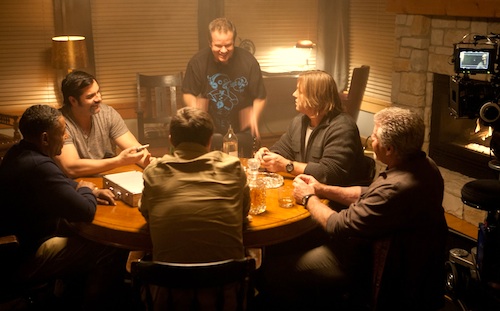
Jeter made a name for himself breaking a big case, but at least one of the grizzled detectives is not convinced the whippersnapper deserves his seat at the table. However, the legendary Det. Calabrese (played by Ron Perlman) is in his corner, so end of discussion. Each of the four greybeards relates an anecdote with practical applications that Jeter will realize over time, as he languishes chained up in the hooded maniac’s customized basement.

Much to Jeter’s distress, his captor is also holding Amy Maxwell, the daughter of his least welcoming colleague, with whom he has been carrying on a dangerously flirtatious but not yet criminal relationship. He quickly draws his first conclusion: his predicament is not random. It is personal.

Poker Night is about as uneven as a film can get. When it features great character actors like Perlman, Giancarlo Esposito, and Titus Welliver trash talking and telling sea stories, it is a lot of fun. Unfortunately, the vanilla Beau Mirchoff is no match for any of them, yet he carries the film’s dramatic load. He even takes their places on camera as he starts to envision their stories through his eyes.

From "Poker Night."

Still, there is a distinctive streak of pitch black humor running through the film. Francis also turns a few good twists, but he does not know when to stop. The ultimate ending (following several false stops) makes absolutely no sense within the film’s narrative context. Sensitive viewers should be further warned, Poker Night can get a little rough. Strictly speaking, it is more of a thriller than a horror film, but you can definitely see the Saw franchise from here.

Arguably, Poker Night’s concept would work better as an ongoing television show than a one-shot feature. Each week, a different reminiscence could illuminate dumb plodding Jeter’s latest case. It would also force the showrunner to keep things more focused and grounded, which would be all to the good. Nevertheless, it is hard to get really down on any film that lets Perlman and Esposito do their thing. Strictly for the cult stars’ fans, Poker Night launches on VOD and opens simultaneously in limited release today (12/5).

LFM GRADE: C+

Posted on December 5th, 2014 at 2:51pm.