Rendle Sham: LFM Reviews Hangar 10

By Joe Bendel. The Rendlesham Forest “Incident” is often dubbed “Britain’s Roswell,” so you know it must be pure hokum. Nevertheless, ostensibly grown adults really believe there was some sort of UFO cover-up going on at the old RAF Woodbridge while the USAF was in residence. To feed conspiracy theorists’ persecution complexes, Rendlesham gets the found footage horror treatment in Daniel Simpson’s Hangar 10, which opens late night tonight in New York at the IFC Center.

Sometimes there is a good reason found footage was lost in the first place. In this case, Gus heads into the woods with his girlfriend Sally and her ex, would be filmmaker Jake, who will document their efforts prospecting Saxon gold for YouTube posterity. This has to be the first extreme metal-detecting film—and hopefully the last.
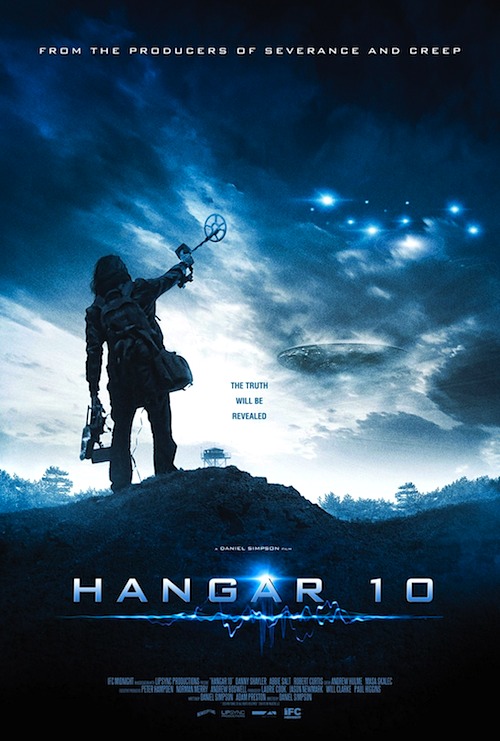
Of course, things are highly awkward from the start and get even edgier when strange lights start appearing. No abductions yet, just lights. Basically, for the first forty-five minutes, Gus and Jake stagger around saying things like: “Hey, did you just see that? But what’s with you and Sally anyway?” At this point, the audience would find alien abduction to be a relief.

That said, Simpson deserves credit for stepping up his game in the third act. The sequences shot in the not-so-abandoned Air Force base have a really stark look that pops off the screen. His special effects are surprisingly well rendered, but he does not show too much here, thereby maintaining the tension derived from uncertainty. It is a shame we can’t simply lop off the last twenty minutes or so and append it to a better movie.

Frankly, Simpson is already late to the found footage party, following up his middling Saw knock-off Spiderhole with a Roswellish abduct-and-probe horror show. Devin McGinn’s not-half-bad Skinwalker Ranch got there earlier and delivered more genre goods (it also co-stars the eternally cool Michael Horse). Throughout Hangar, Simpson does not get much help from his white-bread-and-mayonnaise cast, but the design team makes the base look huge and ominous, in a crummy government-issue kind of way.

An hour after Hangar ends, you will completely forget what Gus, Sally, and Jake look like, but some of Simpson’s Woodbridge visuals will stick for a while. There are much better found footage alternatives out there, such as The Taking of Deborah Logan and the VHS franchise. If you are in the West Village with friends hoping for a horror movie fix, it will suffice, but it is not worth seeking out when it starts its ‘round midnight screenings tonight (11/7) at the IFC Center.

LFM GRADE: C-

Posted on November 6th, 2014 at 10:28pm.
It’s Worse Than You Think: LFM Reviews Lance Armstrong: Stop at Nothing

By Joe Bendel. In 1998, Greg LeMond was the last American to win the Tour de France. In 2012, LeMond once again became the last American to win the Tour. He had not staged a comeback. The US Anti-Doping Agency had stripped Lance Armstrong of his Yellow Jerseys. Everyone (including Armstrong, to some extent) now concedes the cyclist lied and cheated. However, his former fans will be shocked by the systematic deceit and vindictiveness exposed in Alex Holmes’ Lance Armstrong: Stop at Nothing, which airs on Showtime this Friday.

In a matter of seconds, Holmes conclusively proves Armstrong perjured himself. In a videotaped deposition, he flatly denies taking the illegal performance enhancing drugs (PEDs) he later copped to during his Oprah confessional, while readily acknowledging he was under oath. Holmes then rewinds to chronicle the unvarnished story of Armstrong’s rise and fall. Once, he was a clean and promising talent, but he was already cutting shady deals with competing cyclists—or so they allege with accounts of Panettone tins full of cash.

Ironically, Stop at Nothing implies the first Tour might have been legit, but soon thereafter, Armstrong commenced a professional relationship with Michele Ferrari, a notorious sports physician with a reputation for crossing over the line. We know from Armstrong’s own lips he consumed a whole battery of enhancers. According to teammate Frankie Andreu and his wife Betsy, Armstrong also admitted it to his cancer doctors, in their presence, during the early stages of his treatment. That conversation would become the focus of a pitched legal battle.

Arguably, the heroic protagonist of Stop at Nothing is Betsy Andreu. Alarmed by the obvious risks of PED abuse, Andreu forced her husband to stay largely clear of them, which ultimately cost him his place on the US Postal Service Team. Knowing what they knew, Armstrong and his surrogates did their best to pressure the Andreus into silence, but they stuck to their guns when subpoenaed.

The other heroes of Stop at Nothing are Greg and Kathy LeMond, who were vilified in the media when the former Tour champion diplomatically cautioned colleagues not to lash U.S. Cycling’s wagon so tightly to Armstrong’s star. Former Armstrong Foundation executive director Steve Whisnant explicitly regrets not heeding LeMond’s advice. For his common sense, LeMond was rewarded with canceled endorsements and wild rumors of alcohol and heroin addiction.

From "Lance Armstrong: Stop at Nothing."

At times, Stop at Nothing resembles a gangster movie, where whistleblowers are routinely intimidated and ostracized. Yet, other times, it plays like a spy film, documenting the elaborate means by which Ferrari’s treatments were smuggled to Armstrong’s team. It is all completely gripping and absolutely scandalizing in the tradition of the best true crime books.

There is a general sense that Armstrong started lying to himself as well as the cycling world at large, essentially losing sight of the truth. As problematic as that is, the reality is far worse. The portrait Holmes paints is of a clinical sociopath, who fully understood the implications of his actions and would do anything necessary to maintain his righteous public image. It is not pretty, but it is fascinating. Stop at Nothing is a damning indictment and a grab-you-by-the-lapels watching experience. Recommended for fans of cycling and legal thrillers, Lance Armstrong: Stop at Nothing premieres this Friday (11/7) on Showtime, with multiple airdates to follow.

LFM GRADE: B+

Posted on November 6th, 2014 at 10:27pm.

Politicians and Madmen: LFM Reviews Viva la Libertà

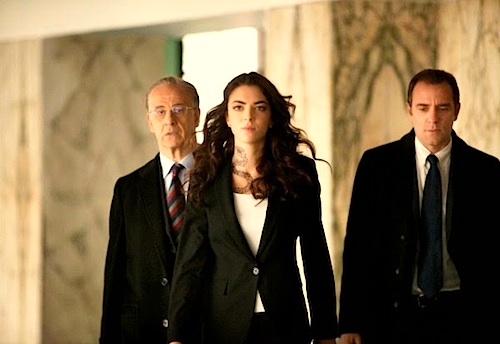
By Joe Bendel. Enrico Oliveri is as tired as his platform. The current leader of Italy’s leftwing opposition was considered the safe choice, pretty much guaranteeing their continued electoral futility. It hardly matters when Oliveri precipitously disappears. In fact, the party just might find itself in better hands when he is secretly replaced with his legitimately certifiable twin in Roberto Andò’s Viva la Libertà, which opens this Friday in New York.

The reserved and increasingly depressed Oliveri has become a convenient punching bag for frustrated party members. His business-like relationship with his wife Anna does not provide much joy either, so finally walks away from everything, turning up unannounced on his former lover Danielle’s doorstep in France.

With elections fast-approaching, Oliveri’s chief of staff Andrea Bottini stalls for time as best he can. As a temporary stop-gap, he recruits Oliveri’s lunatic identical twin to impersonate him until Oliveri returns. However, the recently de-institutionalized brother, who writes under the pseudonym Giovanni Ernani, demonstrates a far greater flair for politicking. Suddenly, Bottini is not so sure he wants his old boss back.

Ironically, it is unclear whether Andò realizes Ernani’s red meat demagoguery is just as substance-less as Oliveri’s mealy-mouthed prevarications. Aside from some class conscious blaming “the man,” there is really nothing to Ernani’s supposedly inspiring rhetoric, especially his third act recitation of Bertolt Brecht’s “To the Wavering,” which is a great way to say precisely nothing. It would all be rather clever if it were deliberate, but one gets the impression Andò accidentally satirized himself.

From "Viva la Libertà."

Regardless, Toni Servillo clearly has fun mugging and goofing as Ernani, but he is far more compelling as the world weary Oliveri, coming to grips with his personal and political failings. However, it is Valerio Mastandrea who supplies the film’s real heart and soul as Bottini, a tragic true believer not yet completely disillusioned. Unfortunately, most of the women are rather bland supporting characters, even the Machiavellians (although Giulia Andò’s snake tattoo certainly makes an impression, especially for a junior aide). Eric Trung Nguyen is similarly underutilized as Danielle’s filmmaker husband, but at least he adds some diversity.

Given Servillo’s remarkably accomplished work in films like Il Divo, Dormant Beauty and the Oscar winning Great Beauty, expectations will be high for Viva, but it is a surprisingly lukewarm affair. Nonetheless, its lack of ideological brass knuckles makes it relatively accessible to a wide spectrum of viewers, much like Ivan Reitman’s Dave, except even less pointed. Harmless and sometimes pleasant in a non-taxing way, Viva la Libertà is mostly just recommended for fans of Italian cinema (and Servillo in particular) pining for a fix, when it opens this Friday (11/7) in New York at the Quad Cinema.

LFM GRADE: C

Posted on November 6th, 2014 at 10:27pm.

Lithuania’s Heritage of Resistance: LFM Reviews The Invisible Front

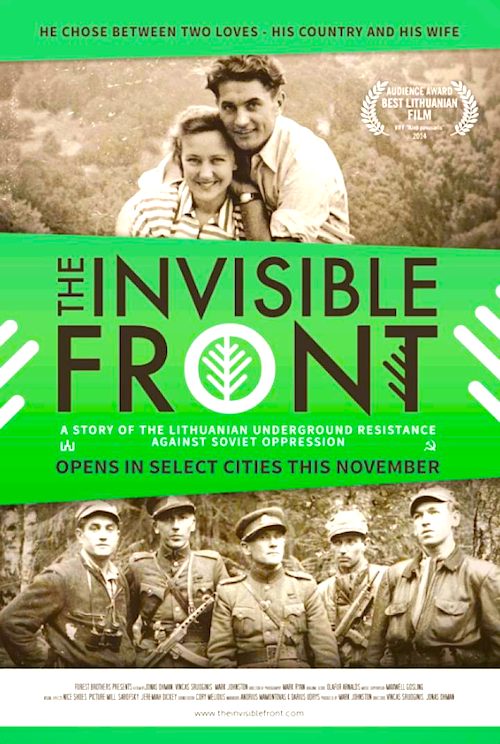
By Joe Bendel. As Putinist forces wage a dirty war against Ukraine, it is hard to avoid the sinking feeling of history repeating itself. However, there is some history he and his separatist lackeys would be advised to remember. The Soviets did their best to banish any mention of the armed resistance to their Baltic occupation from the media and the history books, but the truth will out. The heroic struggles of Lithuania’s partisans are chronicled in Jonas Ohman & Vincas Sruoginis’s The Invisible Front, produced by Mark Johnston, which opens this Friday in New York.

The Baltic Republics were caught in a tight spot during WWII, trapped between two ruthless totalitarian systems. When the Soviets reconquered the Baltics at the end of the war, they commenced a brutal crackdown, hoping to beat the occupied nations into submission. It had the opposite effect.

At its height, one out of every twenty Lithuanians was directly involved with the armed partisan resistance, known as the Forest Brothers—a staggeringly high percentage given the risks. Juozas Lukša emerged from the ranks as the movement’s inspirational leader. He was a warrior when necessary, but first and foremost, he was a journalist documenting Soviet atrocities.

Lukša’s memoir of resistance, The Forest Brothers, provides much of the film’s descriptive commentary, augmented by the testimony of surviving partisan supporters, as well as some of the occupying Soviet oppressors, at least one of whom has since had a change of heart. Unfortunately, America plays the role of the absent cavalry in this story, never interceding on behalf of the Baltics as the Forest Brothers hoped and prayed. It was certainly not for a lack of trying on Lukša’s part.

Several times he clandestinely traveled to the west, hoping to spread awareness of Soviet human rights abuses and thereby spur western action. His efforts were not completely wasted. He met his future wife, Nijolė Bražėnaitė while on assignment in Paris. Needless to say, their romance would be sadly cut short.

Told through the prism of Lukša’s life, Invisible begins as a war story, evolves into a surprisingly tense tale of espionage, with a heartbreaking romance embedded right in its center. All are stirring stuff, but it is the love story of Lukša and Bražėnaitė that really cries out for a dramatic feature treatment.

Ohman & Sruoginis scored some impressive on-camera interviews, including Bražėnaitė, former Lithuanian President Valdus Adamkus, and at least one former Russian officer who does not realize how ominous it sounds when he explains that they referred to duty in the Baltics as the titular “Invisible Front” because of the complete news blackout throughout the rest of the USSR. (Yet, nobody can say they did not give the other side a chance to speak for themselves). Lithuanian pop vocalist-actor Andrius Mamontovas (excellent in Hong Kong Confidential) adds further domestic star power, sensitively narrating passages from Lukša’s memoir.

Invisible Front is a tightly constructed documentary, arriving at a precarious moment in history, with Putinist Russia is openly aggressing against a free and unified Ukraine. Keenly aware of the film’s timeliness, the production team has started raising funds to supply body armor and medical kits to Ukraine’s volunteer Self-Defense Brigades. It is a worthy cause and a worthy documentary. Ultimately, it is an inspiring film, but it is eerie just how directly it speaks to events unfolding in Ukraine. Highly recommended, particularly for younger viewers who did not live through the Captive Nations era, The Invisible Front opens this Friday (11/7) in New York, at the Cinema Village.

LFM GRADE: A-

Posted on November 4th, 2014 at 8:00pm.

LFM Reviews Brothers in Exile on ESPN’s 30 for 30

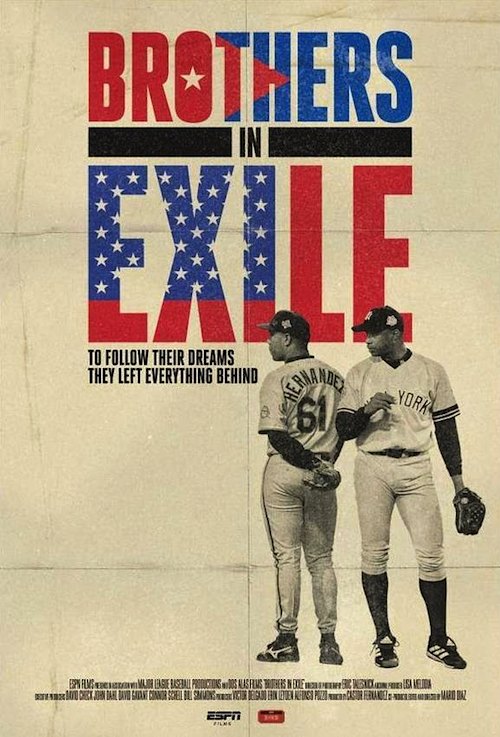
By Joe Bendel. New Yorkers would recognize Orlando “El Duque” Hernandez’s high leg kick anywhere. His half-brother Livan did not do so badly for the Florida Marlins, either. For the Cuban pitchers, winning World Series championships was the easy part. Escaping Castro’s police state was much more difficult. Their journeys to freedom and a better life are chronicled in Mario Diaz’s Brothers in Exile, which airs this coming Tuesday as part of ESPN’s 30 for 30 film series.

As half-brothers, Orlando and Livan Hernandez did not grow up together, but baseball clearly ran in their mutual father’s side of the family. Orlando quickly made a name for himself, first as the ace of the Havana Industriales and then with the Cuban national team. That name would be “El Duque.” From time to time, he would visit his younger half-brother, giving him tips. That clearly panned out. Unfortunately, when the state athletic commissars and minders finally pushed Livan past his breaking point with their controls and humiliations, his defection caused profound problems for El Duque. The Party security apparatus and their plain clothes thugs just automatically assumed El Duque was in on his plans.

Banned from baseball, shunned by society, and frequently harassed on the streets, El Duque feared for his safety and his family’s future. Unfortunately, thanks to the Clinton Administration’s changes in immigration policy (never addressed in Exile), it had become much harder for Cuban refugees to be granted asylum status, while it was still just as treacherous navigating the Straits of Florida.

The truly perilous circumstances of El Duque’s flight for freedom are perhaps not a scoop per se, but they are certainly not well understood by the general baseball public. Frankly, he is lucky to be alive. Likewise, the role John Cardinal O’Connor and the New York Catholic diocese played facilitating El Duque’s eventual reunion with his family will be eye-opening stuff for many viewers.

To his credit, Garcia is pretty forthright documenting the persecution directed at El Duque and his family by the Party and its enforcers. However, he essentially lets Castro and his fanatical devotion to a command-and-control ideology off the hook for the mass suffering experienced during the so-called “special period.” Regardless, some of the best sequences explore the significance of the Hernandezes’ successes for the Cuban-American community.

Exile has a strong emotional kick, but it also brings back many fond memories for Yankees and Marlins fans. In fact, some of the best stories come from their respective glory year catchers, Jorge Posada and Charles Johnson. Ultimately, it expresses the value of baseball and freedom, two things that have a prized place within the Cuban-American experience. Recommended as a solid installment in the first-rate 30 for 30 series, Brothers in Exile premieres this Tuesday (11/4) on ESPN.

LFM GRADE: B

Posted on October 31st, 2014 at 5:18pm.

The Cool Part of the 1970s You Probably Missed: LFM Reviews Eurocrime!

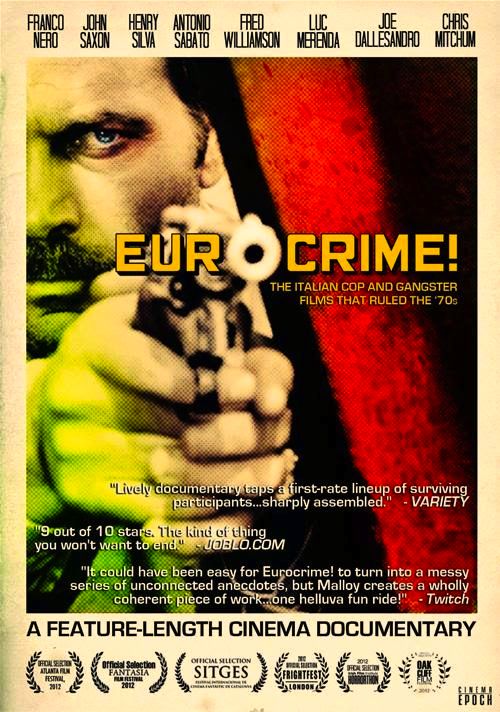
By Joe Bendel. Do you want a congressman who can wage a one-man war against the mob? If so, Chris Mitchum is definitely your candidate in California’s 24th district. While not as famous as his father, Mitchum still had quite a career overseas that included the Italian cops-and-mobsters genre known as “poliziotteschi.” Originally inspired by American films like The Godfather, they were popular domestically, throughout Europe, and even in Asia, but never found a fraction of the spaghetti westerns’ success in the American market. Yet, the genre has developed a cult following among hip cineastes in recent years, which gratifies and/or amuses the poliziotteschi veterans in Mike Malloy’s documentary Eurocrime! The Italian Cop and Gangster Films that Ruled the ‘70s, now available on DVD from Cinema Epoch.

The poliziotteschi were actually meant to be dubbed. It was faster and cheaper to drop the sound in later than to record it live. As a result, the average poliziotteschi shoot was considerably louder and more chaotic than American actors were accustomed to. The dubbing was obviously not a hindrance for Italian audiences, who ate up poliziotteschi on a weekly basis, but it never worked over here. Of course, the spaghettis had been dubbed as well, but they used dialogue rather sparingly. Not so the poliziotteschi.

Nonetheless, they sure cranked out a lot of them. It all started with Franco Nero in Enzo Castellari’s High Crime, but when he passed on the follow-up, the similar looking Maurizio Merli was hired—and a star was born. Quite a few Americans found  regularly work in poliziotteschi, including Mitchum, John Saxon, Henry Silva, Fred Williamson, and Joe Dallesandro, all of whom remember the chaos quite fondly for Malloy. Except for Mitchum, whose heart belongs to the 24th District, they all say they would love to go back and start doing them again.

Their stories are about as crazy as you would expect, involving real life mafia encounters, dodgy safety precautions, and general run-and-gun filmmaking madness, sans permits. However, Malloy also explores the ironic cultural and political context of these films, largely focused on cops and vigilantes, but often produced by avowed Communists, during a period of violent leftwing terrorism conducted by the Red Brigades.

Throughout the film, Malloy hits the right notes, celebrating the good things about poliziotteschi (cars driving on stairs), while admitting their faults (frequent scenes of violence against women). Although Eurocrime! is considerably longer than you would expect, clocking in just over two hours, it moves along at breakneck speed. Malloy channels the poliziotteschi spirit quite cleverly, reusing an exploding car to introduce each segment, much like the waste-not-want-not films with their well-earned reputation for recycling action scenes.

Who knew Henry Silva was this funny? It’s true, Malloy has the proof in his interview segments. The DVD also features two deleted scenes that have great material, but maybe do not exactly match the tone of the rest of the film. The whole package is thoroughly entertaining, especially for cult film fans who will see the poliziotteschi as the forefathers of the 1980s Cannon action B-movies. Highly recommended, Eurocrime! is now available on DVD from Cinema Epoch, right in time for holiday shopping.

LFM GRADE: A-

Posted on October 31st, 2014 at 5:17pm.