LFM Reviews Mississippi Grind @ The 2015 Sundance Film Festival

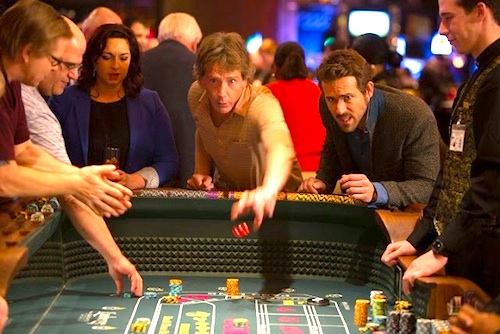
From "Mississippi Grind."

By Joe Bendel. Apparently, Gerry never heard the old Kenny Rogers song. He is the sort of gambler you bet against and feel fine about doing so. He might win for a while, because he spends every spare moment studying various games of chance, but he reeks of losing. However, he believes his fortunes have turned when he teams up with a younger, luckier gambler in Anna Boden & Ryan Fleck’s Mississippi Grind, which screened during the 2015 Sundance Film Festival.

Curtis is just passing through. That’s what he does. Gerry really ought to be leaving soon. He owes a lot of people a lot of money, but just keeps digging a bigger hole for himself. Strangely enough, he wins when playing at Curtis’s table, but he promptly blows all his takings on an ill-advised bet shortly thereafter. When fate subsequently brings them together again, Gerry recognizes a good thing. Determined to keep it going, Gerry convinces Curtis to join forces to play regional games and hole-in-the-wall casinos as they work their way down the Mississippi towards a high stakes poker game in New Orleans.

It sounds like a winning proposition, but the “sign”-obsessed Gerry cannot change his spots. He is still a crummy person and when Curtis is not around, he keeps finding ways to lose. In contrast, Curtis might be slightly commitment-phobic, but he is dramatically healthier than Gerry, often preferring to visit the local blues club over a tacky gambling den. It is really quite considerate of him, since it justifies Grind’s savory blues soundtrack (and some original themes scored by Scott Bomar).
From "Mississippi Grind."

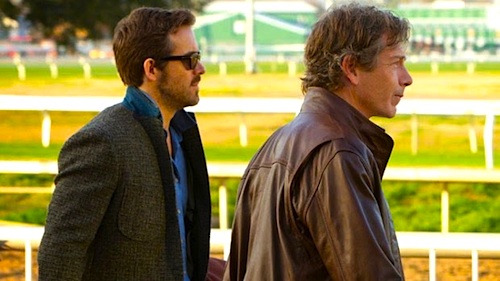
Although Gerry, the aggressive screw-up, is the flashier role, Grind still might prove to be a career pivot for Ryan Reynolds. As Curtis, he plays with and against his pretty-boy type-casting, showing surprising grit down the stretch. Although Ben Mendelsohn is relatively restrained compared to some of his scenery-chomping villainous turns, he fully embraces Gerry’s pathetic, self-deluding, self-centered nature. Frankly, sometimes it is painful to watch his debasement.

Granted, anyone who has seen a gambling road movie will have a general idea where Grind is headed, but Fleck & Boden give the material a few nice twists, including the ironic but wholly fitting third act source of the title. They exhibit a strong sense of place, grounding the film in picturesque Southern-border state locales. It is also certainly safe to say they never glamorize gambling. In fact, the film could almost be a PSA for Gamblers Anonymous and a seedier, more naturalistic corrective to noir-ish The Gambler and Chow Yun-fat’s heroic God of Gamblers franchise. Recommended for fans of gambling films with local flavor, Mississippi Grind screened in Park City as part of this year’s Sundance Film Festival.

LFM GRADE: B

Posted on February 1st, 2015 at 9:57am.
LFM Reviews 2015 Oscar Nominated Animated Shorts

By Joe Bendel. There are ways that parents burden their children, such as decorating their home with hipster Scandinavian furniture. It does not quite work as a unifying theme, but generational debts and inheritances play an important role in at least some of this year’s Oscar nominated animated short films, which opened collectively on Friday in New York.

The first simply will not fit into our artificial framework no matter how hard we try to force it, but it is also the shortest and the slightest of the four nominees provided to the media (again, Disney decided to do their own thing with Patrick Osbourne’s Feast). Marieke Blaauw, Joris Oprins & Job Roggeveen’s A Single Life is sort of a riff on the concept of Adam Sandler’s Click, with a 45 rpm record taking the place of the remote control. It is amusing, but it is hardly a major work.

Daisy Jacobs’ The Bigger Picture certainly deals with serious issues, depicting the struggles of a faithful grown son to care for his ailing mother, even while she persists in favoring his irresponsible brother. Jacobs’ life-size, paper animated figures are undeniably distinctive, but if this were a live action film, we would probably consider the drama manipulative.

Torill Kove’s Me and My Mouton is also a bit sentimental, but in a sweetly nostalgic kind of way. The middle daughter of tragically trendy but well-meaning architect parents must deal with their rather unorthodox aesthetics, which seem strange to her more conventional friends. In fact, Mouton is a rather sly satire of hipster sensibilities as well as an endearing coming of age story. Kevin Dean’s soul jazz trio soundtrack also makes it swing and groove.

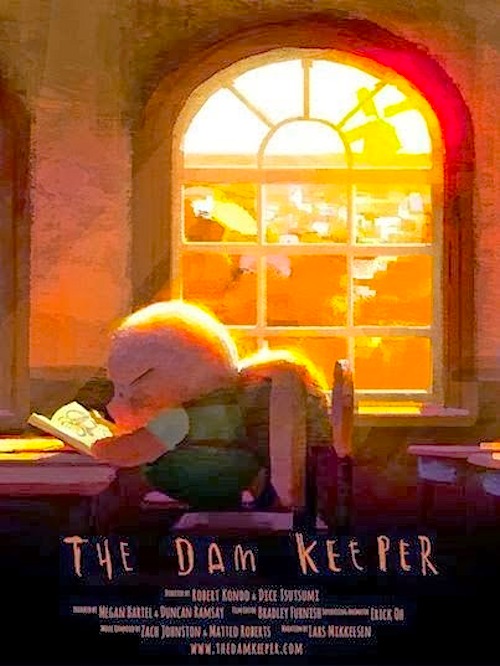
Yet, without question, the class of the field is Robert Kondo & Dice Tsutsumi’s The Dam Keeper. When his father passed away, young Pig assumed his position as the dam keeper, maintaining the windmill that prevents a mass of toxic clouds from overrunning the village. Yet, he is still just a boy, who continues to attend school, where he is often mocked and bullied. One day, a young Fox transfers to his class and the rest of the animal students are quite taken with her (she is a fox, after all). However, she has an artist’s sensitivity, so she soon befriends Pig. Nevertheless, she presumably remains subject to the same peer pressures of other students. When it appears Fox betrays Pig’s trust for the sake of acceptance, the heartbroken dam keeper might just give up entirely, which would have ominous implications for the ungrateful village.

Dam Keeper is a beautiful fable, perfectly served by the stunning painted and hand-drawn animation, but it also resonates on a very personal level. In both visual and narrative terms, it is an extraordinary film. It is worth seeing the entire program just for it, especially since it is the longest of the nominated films. Frankly, if it does not win, the Academy will have some explaining to do.

This year’s nominated short film animated package is augmented with several other films of notable merit, including one selection from the 2015 Slamdance Film Festival. While it is not as graceful and sophisticated as Plympton’s previous Slamdance selection, the feature length Cheatin’, Footprints is a rather clever, postmodern channeling of Peter and the Wolf, rendered in a suitably surreal style.

Without question, The Dam Keeper is the main event here—and hopefully the Oscar favorite. Between it and the addition of the next strongest nominee, Me and My Mouton and the Slamdance alumnus, Footsteps, this year’s presentation of the Academy Award nominated short films is definitely worth seeing. Recommended for animation fans, it opened Friday (1/30) in New York, at the IFC Center.

Posted on February 1st, 2015 at 9:56am.

LFM Reviews Turbo Kid @ The 2015 Sundance Film Festival

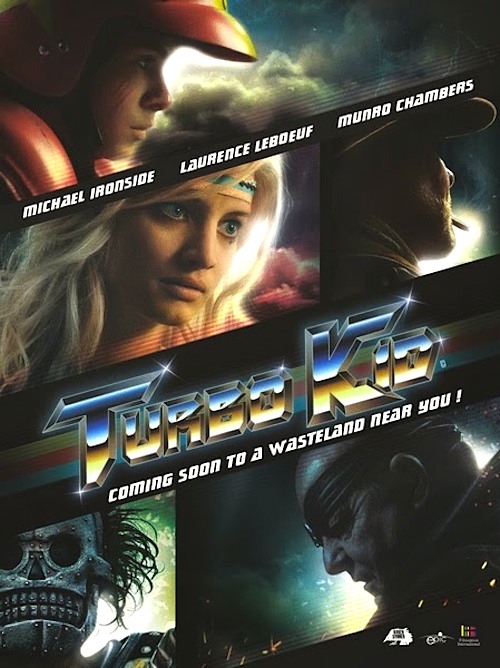
By Joe Bendel. We might as well keep plundering the Earth and maybe the current administration is right, we can just relax and stop worrying about the Iranian nuclear program. After all, the late 1990s apocalypse our 1980s exploitation films warned us about never came to fruition. Take a sentimental journey back to those more innocent, alarmist times in Anouk Whissel, François Simard & Yoann-Karl Whissel’s Turbo Kid, which screens during the 2015 Sundance Film Festival.

In the not too distant future, 1997 A.D. to be precise, a handful of BMX bikers roam the wasteland, clashing with the mutant lackeys of the overlord Zeus. The Kid tries to keep to himself, scavenging comic books and Viewmaster slides. At first, he is a bit annoyed when a girl named Apple starts tagging along with him. However, he soon finds he enjoys her sweetly looney company, even when he learns she is a robot. He duly fashions her a garden gnome club as a weapon, but it cannot compare to the turbo powered gauntlet he salvaged from a crashed government transport. Unfortunately, just as they become an effective dynamic duo, Apple is damaged in a dust-up with Zeus’s goons, forcing them on a perilous detour in search of spare parts.

Basically, there are just a few really big laughs in Turbo, unless you dig on ridiculously gory slapstick violence in the Troma tradition, in which case it is fully loaded. You’ll lose track of how many bodies are cleaved apart in bizarre and unlikely ways. It is so over the top, you have to just buy into it on its own terms. As a result, it is almost impossible to envision Turbo playing in a normal neighborhood theater on a sleepy Wednesday afternoon.

Basically, you know Whissel, Simard & Whissel came to play when cult superstar Michael Ironside shows up as the eye-patch wearing Zeus. MacLeod’s Daughters star Aaron Jeffery is also acceptably grizzled as the Kid’s ally, Frederic the Arm-Wrestler (but don’t get too attached to his paws, so to speak). However, you really have to give credit to Laurence Leboeuf for going all in as the super chipper Apple.

If you have a problem with severed limbs and spurting blood than you are way too sheltered for Turbo Kid. However, if you appreciate retro cheesy nostalgia than you will dig the clever details sprinkled throughout the madness. By now, you should know full well whether it is your cup of tea or not (if you’re still unsure, the answer is probably no). For those who enjoy campy gore, it is a lot of good clean fun. Recommended for serious cult film fans, Turbo Kid screens again tonight (1/31) in Salt Lake, as part of this year’s Sundance Film Festival.

LFM GRADE: B

January 31st, 2015 at 11:52am.

LFM Reviews The Russian Woodpecker @ The 2015 Sundance Film Festival

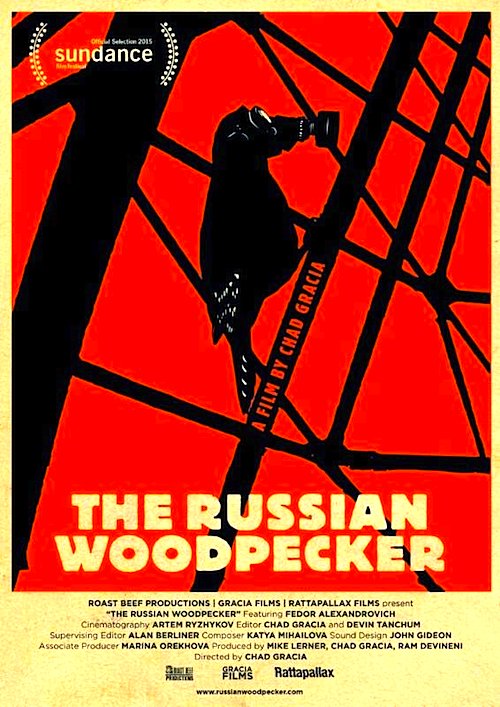
By Joe Bendel. If anyone has a right to be obsessed with Chernobyl, it would be filmmaker-set designer Fedor Alexandrovich. As a four year old child, he was evacuated from what is now the Exclusion Zone—and he has the radioactive material in his bones to prove it. Through his research, Alexandrovich pieced together a theory hypothesizing Chernobyl was not an accident, but a deliberate act of Soviet sabotage. At a time when the Russian military and their proxies are once again committing crimes against the Ukrainian people, Chad Gracia documents Alexandrovich’s deductions as well as the increasingly precarious state of Ukrainian national security in The Russian Woodpecker, which screens during the 2015 Sundance Film Festival.

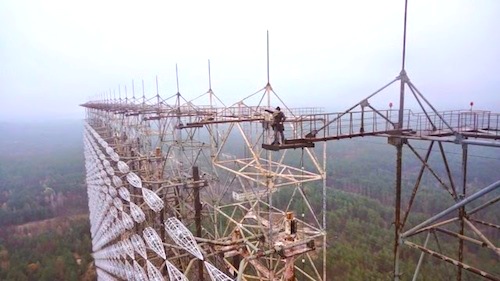
The titular woodpecker was a rhythmically regular radio signal that was thought to emanate from the old Soviet over-the-horizon radar station Duga-3, known to locals simply as the Duga. The Duga was massive and expensive, but it did not work very well. According to Alexandrovich, it would have failed a planned inspection, thereby causing great inconvenience for its high ranking sponsors, had events at Chernobyl not intervened. Can you see where he is going with this?

The Woodpecker ceased with the fall of Communism in 1989, but Ukrainians have recently started picking up an eerily similar signal. Like a prophet in the wilderness, the wild eyed and unruly coifed Alexandrovich had warned anyone willing to listen about the dangers of a resurgent neo-Soviet Russia. Unfortunately, his prophecies have been more vindicated than he would ever wish.

For obvious reasons, it is nearly impossible to untangle the tragic past from the perilous present in Woodpecker. While originally conceived as a short doc on the Duga and its annoying signal, the project expanded in scope due to the magnitude of Alexandrovich’s contentions and the relevance of current events. Those in Park City associated with the film are particularly worried about cinematographer Artem Ryzhkov, a war correspondent by trade, who was embedded with the unit hardest hit by the latest Russian orchestrated attacks.

From "The Russian Woodpecker."

The heavy significance that looms over Woodpecker makes it difficult to really enjoy Alexandrovich’s undeniable eccentricity, even before the multi-hyphenate artist starts to feel the heat as a high profile critic of Putin’s Russia. Essentially, Woodpecker begins as an idiosyncratic character study, evolves into a visually stunning tour of the Duga and the surrounding off-limits environs, and whipsaws into a real life chronicle of paranoia and defiance.

There are precious few documentaries that can compare to Woodpecker’s unclassifiable tone or its sense of urgency. Even if you do not fully buy into Alexandrovich’s theories, he and Gracia provide a great deal of Chernobyl background and context that will be new to most viewers. Highly compelling in an absolutely chilling kind of way, The Russian Woodpecker is definitely recommended for anyone interested in a fresh look at Ukrainian current events and recent history, The Russian Woodpecker screens again tomorrow (1/29) and Friday (1/30) in Park City, as part of this year’s Sundance Film Festival.

LFM GRADE: A-

Posted on January 28th, 2015 at 5:37pm.

LFM Reviews The Chinese Mayor @ The 2015 Sundance Film Festival

From "The Chinese Mayor."

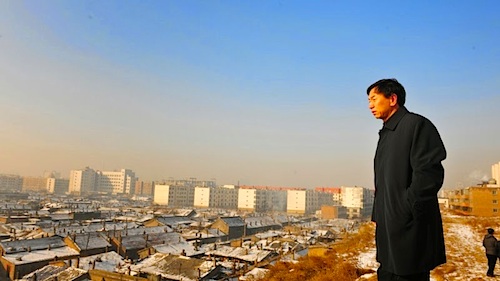
By Joe Bendel. Mayor Geng Yanbo’s re-election is guaranteed, but that does not mean his position is secure. Such is the nature of power in the Chinese Communist Party. His vision for the northern Shanxi city Datong is grandly ambitious, but his intraparty people skills are a little iffy. That is a combination that leads to conflict in Zhou Hao’s The Chinese Mayor, which screens during the 2015 Sundance Film Festival.

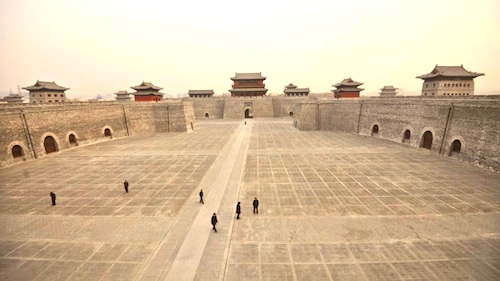
When we first meet “Demolition” Geng, he has already resettled tens of thousands of families to make way for his large-scale construction plans. To restore the city’s centuries old glory, Geng has been razing the old, economically depressed neighborhoods to build a brand spanking new “ancient” quarter, including an imposing city wall. It is a development program that drips with irony. There was a time the CCP tore down cultural landmarks out of ideological zeal, but now they are building up replicas of imperial glory.

Geng’s scheme to convert Datong’s stalling industrial sector into a hub of culture and tourism might be debatable, but his constituents seem to appreciate the fact that he has a plan. Likewise, much can be said for and against his leadership style. He can be high-handed and severe, demonstrating a true Communist’s regard for property rights, but he is also unusually accessible for petitioners with a grievance against the city government. When he dresses down subordinates, they mostly have it coming. In fact, one sequence in which he chastises a contractor for sub-standard cement work brings to mind the shoddy construction techniques revealed in producer Zhao Qi’s Sichuan earthquake documentary, Fallen City.

From "The Chinese Mayor."

Arguably, Zhou’s strictly observational approach leaves viewers somewhat unprepared for the third act surprises, even though Geng clearly comes across as the kind of politician who makes enemies. It is hard to fully take stock of his administration, but it is probably safe to assume he is preferable to the alternatives. Yet, some of the film’s most revealing scenes document his sham re-election at a local Party conference. It was certainly an economical process: one single candidate for each office. Of course, that is exactly the sort of meaningless democracy the Hong Kong Umbrella movement was protesting against, making Zhou’s Chinese Mayor a fitting feature to screen with Flora Lau’s short film, I am Hong Kong.

Geng does not exactly have JFK levels of charisma, but he is probably the only Chinese government official willing to let a documentary film crew follow him for months at a time. In the process of documenting Geng’s tenure, Zhou captures some revealing behind-the-scenes glimpse at CCP political sausage-making. Recommended for those fascinated by the corruption and dysfunction of the secretive Mainland government, The Chinese Mayor screens again this morning (1/28), Friday (1/30), and Saturday (1/31) in Park City and Thursday (1/29) in Salt Lake, as part of this year’s Sundance.

LFM GRADE: B+

Posted on January 28th, 2015 at 5:37pm.

Statham Happens in Vegas: LFM Reviews Wild Card

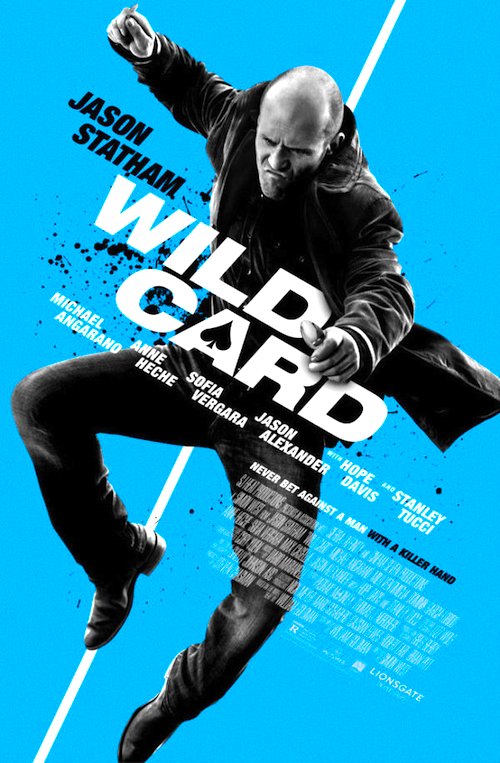
By Joe Bendel. It is not exactly a critic’s dream come true, but it rises to one of our frequent challenges. We often lament studios remaking classic movies, making them considerably worse, rather than redoing and hopefully improving less-than-great films. That sort of happens here when Jason Statham steps into a role originated by Burt Reynolds. It’s already sounding better, isn’t it? In fact, Statham is much more convincing as the lethal bodyguard with a gambling problem in Simon West’s Wild Card, which opens this Friday in New York.

Like the somewhat notorious 1986 film Heat, Wild Card was adapted by screenwriter William Goldman from his own novel. On the screen, it follows much the same structure, but off-screen, hopefully there will be far less litigation. Nick Wild has an uneasy truce with the Mafia. He stays on good terms with the mega-connected Baby, but for the most part, he does not bother them and they do not bother him. Most of his jobs are a little demeaning, like babysitting nickel-and-dime gambler Cyrus Kinnick, but he keeps hoping to hit it big at the tables and run off to Corsica (it was Venice before).

This equilibrium is disrupted when a visiting gangster brutalizes Holly, a prostitute Wild was formerly involved with. She wants him to get the creep’s name, so she can pursue legal action. However, Wild wants no part of anything connected to the Golden Nugget, which must be thrilled to be so explicitly identified as a mobster resort. Of course, as a good guy, Wild can’t help himself. Despite his hesitation, he lays quite a beating on the entitled Danny DeMarco and his henchmen and facilitates their further humiliation at Holly’s hands. From there, one thing leads to another.

Wild Card has a handful of spectacular fights (choreographed by Cory Yuen), sprinkled throughout long stretches of compulsive gambling and macho brooding. The gimmick for Wild (or Nick “Mex” Escalante as he was once known) is his facility for using commonplace items, such as credit cards and poker chips, as deadly weapons. Needless to say, this works so much better with Statham than Reynolds. Dominik García-Lorido (Andy Garcia’s daughter in the excellent Lost City and in real life) and Stanley Tucci also represent considerable upgrades as Holly and Baby, respectively. Indeed, the casting is nearly perfect this time around. Unfortunately, the Kinnick character still gums up the works with his unnecessary subplot.

Unlike the previous film’s revolving door-battery of directors, West keeps Wild Card moving along at a decent clip, even though it is more about gambling and gangster power games than action, per se. He also maintains a relatively upbeat mood, nicely underscored by some classic licensed blues and R&B tunes from artists like Magic Slim, Albert King, and Charles Brown. It still isn’t perfect but it is better, which is something. You could even say it’s not bad—but nowhere near Statham’s best work in The Bank Job and Redemption. For fans of old school Vegas, Wild Card opens this Friday (1/30) in New York.

LFM GRADE: C+

Posted on January 28th, 2015 at 5:36pm.